
Four Precedents That Frame the Comey True Threat Defense
This article analyzes how each of the Supreme Court's four true-threat precedents applies to James Comey's motion to dismiss his '86 47' indictment, providing a doctrinal framework for evaluating similar political-speech prosecutions.
- Jurisdiction
- US Federal (Eastern District of North Carolina)
- Court
- U.S. District Court for the Eastern District of North Carolina
- Judge
- Louise Wood Flanagan
- AI tool named
- None
- Ruling date
- Jul 27, 2026
- Source document
- View primary court order ↗
- Last verified
- Jul 30, 2026
Lex Machina Review is an independent risk-tracking and reference resource. Nothing on this site is legal advice, and using it does not create an attorney-client relationship. Every record is reviewed against primary sources but may not reflect the most current status of a matter — always verify directly against the cited court order, rule text, or a licensed attorney before relying on it.
Companion explanation — secondary to the source document above
As of July 30, 2026, the James Comey true threat defense motion to dismiss is still only a motion. Comey filed it on July 27 in the Eastern District of North Carolina before Judge Louise Wood Flanagan; the government has not yet responded, and the court has not ruled.[1][2] That procedural posture is not a formality. In a criminal-speech case, the difference between a thin public indictment theory and a full evidentiary record can be decisive.
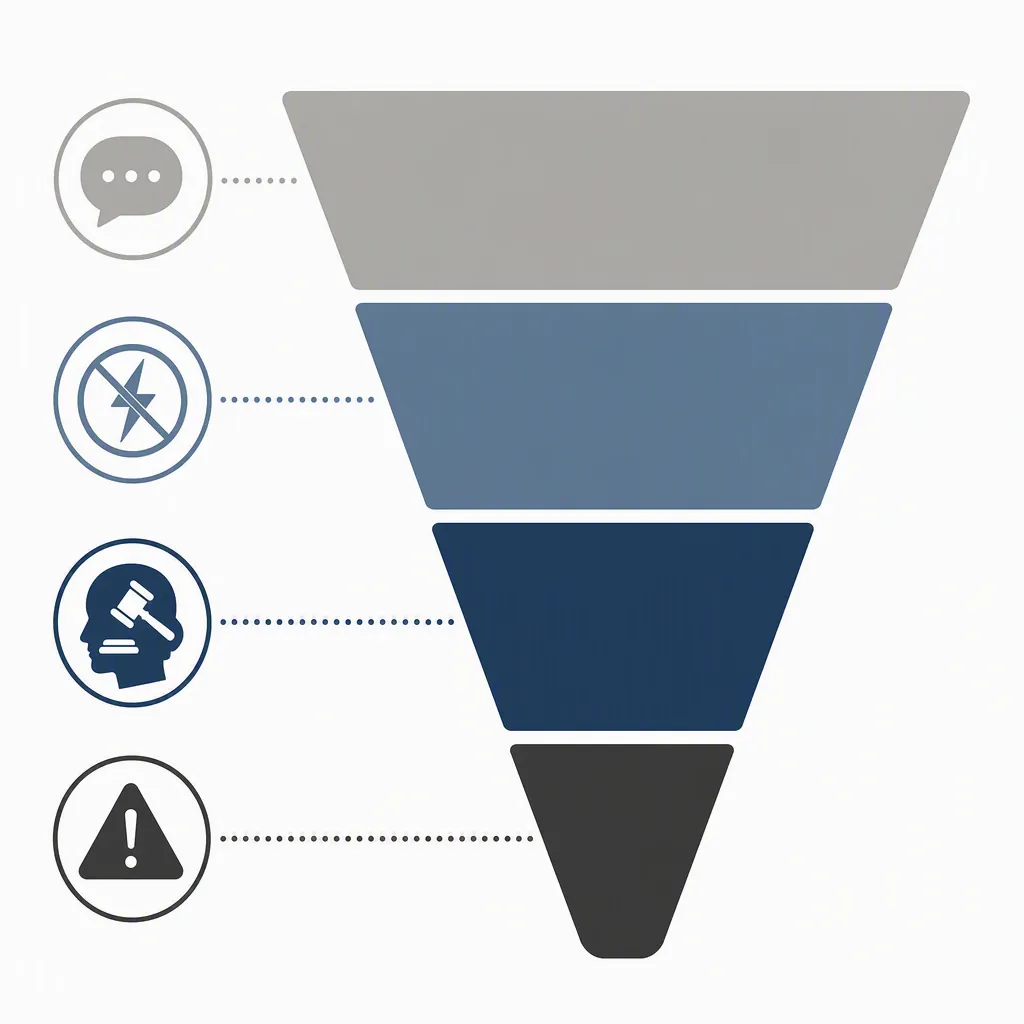
The useful question, then, is not whether the “86 47” Instagram post was crude, foolish, anti-Trump, or politically radioactive. The useful question is what the government must prove at each First Amendment gate. Four Supreme Court precedents frame that inquiry: Watts v. United States, Virginia v. Black, Elonis v. United States, and Counterman v. Colorado. Read in order, they move from context, to seriousness, to subjective mens rea, to the minimum constitutional floor.
There is one important caveat at the outset. Acting Attorney General Todd Blanche has said publicly that the indictment is based on “more than just the shell photo,” but the additional evidence has not been disclosed in the public materials available for this analysis.[2] If the government’s response produces contemporaneous messages, planning evidence, audience targeting, prior warnings, or other facts that change the communicative context, the analysis changes with it. On the public record now available, however, the motion attacks the government’s true-threat theory at every doctrinal layer.

The four-case ladder
| Precedent | Doctrinal function | Comey motion’s application |
|---|---|---|
| Watts v. United States | Separates protected political hyperbole from punishable threat language. | The motion treats “86 47” as a political slogan in an anti-Trump context, closer to protest rhetoric than a serious threat. |
| Virginia v. Black | Requires a serious expression of intent to commit unlawful violence. | The seashell photo, especially if Comey photographed preexisting beach art rather than arranging it, is argued not to express his own serious intent to kill or injure anyone. |
| Elonis v. United States | Requires proof of purpose or knowledge for the federal threat statute at issue there. | Comey’s prompt deletion and statement that he took the post down because it could be seen as a threat undercut a claim that he meant it that way or knew it would be received that way. |
| Counterman v. Colorado | Sets recklessness as the constitutional minimum for true-threat prosecutions. | The motion uses Comey’s contemporaneous explanation that violence “never occurred to me” to contest conscious disregard of a known threat risk. |
That ladder matters because the government does not get to skip from public outrage to criminal liability. It has to pass through each layer with evidence tied to this defendant, this communication, and this mental state.
Watts: political hyperbole is the first gate
Watts remains the starting point because it involved ugly political speech directed at a president. During a public rally, the speaker said, “If they ever make me carry a rifle, the first man I want to get in my sights is L.B.J.” The Supreme Court reversed the conviction, treating the statement as political hyperbole rather than a true threat.[3]
That does not mean every presidential death reference is protected. Watts did not create a presidential-threat exception to criminal law. It did something narrower and more important: it required courts to read threat language in context, including the political setting, conditional phrasing, audience reaction, and the rough conventions of protest speech.[3]
Comey’s motion leans heavily on that contextual move. The charged expression was not a direct message to President Trump, not an instruction to an identified actor, and not accompanied in the public record by a weapon display, operational details, or a plan. The motion characterizes “86 47” as a political slogan appearing in protest and online contexts, not as a bespoke communication of intended violence.[1]
The dictionary argument belongs here, but it should not be made to carry more than it can. Comey’s motion says most dictionaries do not list the “to kill” meaning that the government attributes to “86.”[1] That is useful against a prosecution theory that treats the phrase as self-evidently murderous. But courts also know that slang often travels faster than dictionaries. The stronger Watts point is not that “86” can never mean kill. It is that, in political speech, slang, slogan, and insult do not become a true threat unless the surrounding facts make the expression seriously threatening.
This is also where the “47” matters. The phrase is intelligible only through political identification: Trump as the 47th president. That political target does not immunize the speech, but it does place the communication inside the very zone where Watts requires caution before a court allows a criminal case to treat hostile rhetoric as punishable threat language.
Black: the government still needs a serious expression of intent
Virginia v. Black adds the next narrowing principle. A true threat is not merely a statement that someone could interpret darkly. The Court described true threats as statements where the speaker means to communicate a “serious expression of an intent to commit an act of unlawful violence.”[4]
That formulation does real work in the Comey motion. A photograph of seashells arranged as “86 47” is not, by itself, the same thing as a statement saying “I will kill President Trump.” The motion also argues that Comey did not arrange the shells but photographed preexisting beach art.[1] If that fact holds, the government has a harder time treating the image as Comey’s own serious expression of intent to commit violence.
The distinction is not technical hair-splitting. Criminal threat doctrine turns on communication, and communication turns on what the defendant adopted and conveyed. A person who photographs a slogan may endorse it, mock it, amplify it, misunderstand it, or simply document it. Some of those possibilities may be irresponsible. They are not all serious expressions of intent to commit unlawful violence.
The government can answer that reposting or publishing an image is itself communicative adoption. That is a real argument. If a defendant knowingly posts an image whose ordinary meaning is a call for assassination, the fact that someone else arranged the shells would not automatically end the case. But Black requires more than the prosecution’s preferred translation of a slogan. It requires evidence that the communication conveyed a serious intent to commit unlawful violence.[4]
On the public record, the motion’s best Black argument is cumulative: the message was ambiguous, politically coded, apparently drawn from public protest culture, and allegedly photographed rather than created by Comey. Those facts do not prove innocence. They do make it more difficult to characterize the post as the kind of serious threat the First Amendment leaves unprotected.
Elonis: deletion and disavowal are mens rea evidence, not just cleanup
Elonis shifts attention from what an observer might fear to what the defendant knew or intended. In Elonis, the Supreme Court rejected a negligence-style approach under 18 U.S.C. § 875(c), holding that the government had to prove more than that a reasonable person would view the communication as threatening. The Court required proof of a culpable mental state, identifying purpose or knowledge as sufficient.[5]
That is why Comey’s post-deletion conduct is legally significant. According to the motion and public reporting, Comey removed the post and said he took it down because it “could be seen as a threat.”[1] That statement is awkward for both sides, which is usually a sign that it matters.
The government will likely emphasize the phrase “could be seen as a threat.” A prosecutor can argue that Comey recognized the threatening meaning quickly enough to show awareness of the risk, and perhaps awareness of the meaning at the time of posting. That is not frivolous.
But under Elonis, the timing and content of the statement also cut sharply the other way. Comey did not double down, address the supposed target, urge anyone to act, or leave the post up after recognizing the risk. He removed it and gave an explanation that framed the threat interpretation as unintended. If the government must prove that he posted with the purpose of threatening, or with knowledge that the communication would be viewed as a threat, that contemporaneous correction is powerful defense evidence.[5]
This is the point in the analysis where after-the-fact advocacy should be separated from contemporaneous conduct. A motion brief can always redescribe a post in litigation-friendly terms. A near-immediate deletion and public explanation are different. They occurred before the doctrine was being briefed and before lawyers had organized the case into Supreme Court categories. That does not make them conclusive, but it makes them the kind of evidence a court should hesitate to flatten into mere public relations.
Counterman: recklessness is a floor, not a substitute for proof
Counterman is the government’s fallback if it cannot show purpose or knowledge. In 2023, the Supreme Court held that the First Amendment requires at least recklessness in true-threat prosecutions. The defendant must have consciously disregarded a substantial risk that the communication would be understood as threatening violence.[6]
That standard is lower than purpose or knowledge, but it is not negligence. It is not enough that Comey should have known better, or that a public official with his background should have anticipated the worst reading, or that the internet predictably turns ambiguous political speech into a threat controversy. Counterman asks for subjective awareness of a substantial risk and conscious disregard of that risk.[6]
The motion’s strongest Counterman fact is Comey’s statement that violence “never occurred to me.”[1] A defendant’s self-exculpatory statement is not a magic wand; courts and juries do not have to believe it. But it is directly responsive to the constitutional mens rea floor. If violence genuinely never occurred to him, he did not consciously disregard a known substantial risk that his communication would be understood as a threat.
Again, the government has possible replies. It can argue that Comey’s background in law enforcement, the public meaning of “86,” the identity of the target, and the volatility of threats against public officials made the risk so obvious that his claimed lack of awareness is not credible. It can also argue that deletion after posting shows he recognized the threat risk, and that the recognition came too quickly to have been newly formed.
Those arguments may matter more after the government files its response. On the present record, however, they still have to overcome the sequence: ambiguous political slogan, no public evidence of operational follow-through, prompt deletion, explanation that the post could be misread, and a contemporaneous denial that violence entered his mind. Counterman does not allow the government to replace that sequence with a reasonable-person theory under a different label.
For readers tracking the recklessness issue as its own litigation-risk category, the related analysis in Comey Indictment Tests First Amendment Defense After Counterman is the more focused path. The point here is narrower: Counterman is the final mens rea screen after Watts, Black, and Elonis have already done substantial narrowing work.
The protest-slogan evidence helps context, not everything
Comey’s motion also argues that the phrase was not uniquely his. It says the slogan appeared on internet merchandise and at protests around the country, and public coverage has described the motion’s claim that “thousands of items” featuring the slogan had been sold online.[1][7]
That material is relevant, but it should stay in its lane. It supports the Watts context argument because repeated public use can make a phrase look more like political shorthand than a private threat. It can also bear on Black because a widely circulating slogan is less readily characterized, without more, as one person’s serious expression of intent to commit violence.
It does not automatically prove selective prosecution, and it does not itself defeat mens rea. Many people may repeat a phrase innocently while one defendant uses it threateningly in a particular factual setting. Conversely, the government cannot make a slogan criminal as to Comey merely by selecting the most violent possible gloss and ignoring ordinary political usage. The facts matter on both sides.
Marty Lederman’s public criticism marks how mainstream the concern has become. Forbes reported that the Georgetown Law professor called the indictment “an embarrassment” and predicted the motion “should be one of the most easily and swiftly granted motions ever.”[8] That is a sharp assessment, but the doctrinal work does not depend on adjectives. It depends on whether the government can plead and prove the elements that Watts, Black, Elonis, and Counterman require.
What undisclosed evidence could change
The Blanche caveat remains important because true-threat cases can turn on facts outside the four corners of a post. If the government has evidence that Comey discussed a violent meaning before posting, targeted the communication to people likely to act, coordinated with others, ignored warnings, or used the same phrase in a more explicit threatening exchange, the motion-to-dismiss analysis becomes harder for him. None of that evidence is part of the public record described in the motion materials available as of July 30, 2026.
There is also a separate evidentiary track in the case. Readers following the challenge to the government’s factual showing can compare this analysis with Can a Franks Hearing Expose Government Misconduct in the Comey Case? The true-threat question, however, should not be allowed to dissolve into generalized distrust of the prosecution or generalized dislike of the defendant. The elements remain the discipline.
That discipline is also why institutional context can inform risk assessment without deciding the motion. For readers tracking the prosecuting office and Todd Blanche’s public role, How Acting AG Todd Blanche Reshaped DOJ Reliability provides the broader backdrop. But a First Amendment motion to dismiss rises or falls on speech, context, seriousness, and mens rea.
The practical read
Comey’s motion is strong on the present public record because it does not rest on a single slogan-defense theory. It stacks the doctrine in the order the Supreme Court built it. Watts asks whether the post is better understood as political hyperbole. Black asks whether the seashell image communicated a serious intent to commit unlawful violence. Elonis asks whether Comey acted with purpose or knowledge. Counterman asks, at minimum, whether he consciously disregarded a substantial risk that the post would be understood as a threat.
The public facts give the defense something material at each layer: political context, ambiguity, alleged preexisting beach art, widespread slogan usage, prompt deletion, and a contemporaneous explanation that violence “never occurred to me.”[1] The government may have more. It has said it does. Until its response is filed, that assertion is a placeholder, not proof.
For litigators and risk managers evaluating political-speech prosecutions, the reusable lesson is not that provocative slogans are safe. It is that true-threat analysis has to be layered, sourced, and tied to contemporaneous evidence. Public disgust may explain why a post becomes a controversy. It does not supply context under Watts, seriousness under Black, intent under Elonis, or recklessness under Counterman.
References
- Motion to Dismiss, United States v. Comey, CourtListener, July 27, 2026, link
- CNN coverage of Comey motion and government response schedule, CNN, July 27, 2026, link
- Watts v. United States, 394 U.S. 705 (1969), Supreme.justia.com, link
- Virginia v. Black, 538 U.S. 343 (2003), Supreme.justia.com, link
- Elonis v. United States, 575 U.S. 723 (2015), Supreme.justia.com, link
- Counterman v. Colorado, 600 U.S. ___ (2023), Supreme.justia.com, link
- The Hill coverage of Comey motion and protest-slogan evidence, The Hill, July 27, 2026, link
- Alison Durkee coverage of Comey motion and Marty Lederman comment, Forbes, July 27, 2026, link
Related records
Tool profile
Browse tool evaluations →Governing regulation
Browse the obligations tracker →Preventive workflow
Browse verification workflows →
Report a correction or tip
Spotted an outdated figure, a misstated fact, or a ruling this case record should reflect? Public comments are disabled for this content given the professional cost of a misreported case outcome, penalty amount, or rule text — use the structured correction channel instead.
Report a correction or tip for this record →