
Costco's $14M Email Settlement Sets a CEMA Risk Benchmark
The $14M Costco CEMA settlement provides the first measurable risk benchmark for email class actions under Washington law, with class definitions, fund mechanics, and deadlines that help legal professionals assess exposure for any company sending promotional emails to Washington residents.
- Jurisdiction
- Washington State
- Court
- King County Superior Court
- Judge
- Janet Helson
- AI tool named
- No AI tool
- Ruling date
- Jul 25, 2026
- Source document
- View primary court order ↗
- Last verified
- Jul 25, 2026
Lex Machina Review is an independent risk-tracking and reference resource. Nothing on this site is legal advice, and using it does not create an attorney-client relationship. Every record is reviewed against primary sources but may not reflect the most current status of a matter — always verify directly against the cited court order, rule text, or a licensed attorney before relying on it.
Companion explanation — secondary to the source document above
Costco's Washington email settlement matters less as a consumer claims story than as a measurable exposure record. In Aaland v. Costco Wholesale Corp., pending in King County Superior Court before Judge Janet Helson, Costco has preliminarily agreed to a $14 million settlement fund for Washington residents who allegedly received promotional emails with false, misleading, or materially fictitious subject lines during a class period running from June 2, 2021 through July 7, 2026.[1]
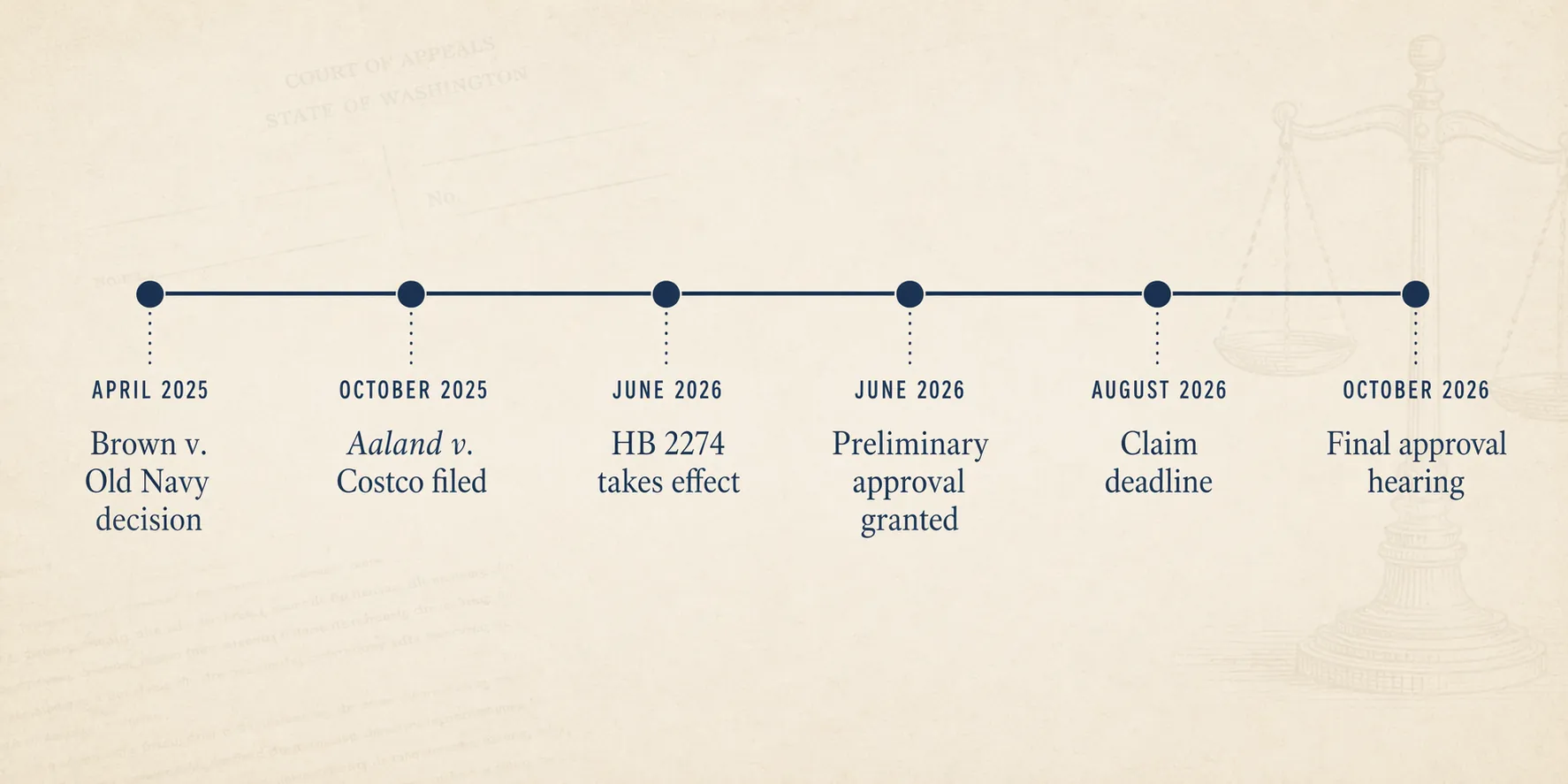
The reported mechanics are unusually useful for risk work: claims are due August 24, 2026; the final approval hearing is scheduled for October 2, 2026; the requested fee award is up to $4.62 million, or 33% of the gross fund plus costs; and the estimated net fund is about $9.36 million for equal pro-rata payments to approved claimants.[1] Payments are not a present entitlement. Distribution depends on final approval and any post-approval proceedings.
That posture matters. The settlement has preliminary approval, not a final judgment or a completed payout. The settlement agreement and preliminary approval order were not directly verified for this article; the class mechanics are synthesized from settlement-tracker and legal-news reporting. That makes the Costco package a strong benchmark for monitoring CEMA risk, but not yet a closed empirical result.
The Settlement Terms Are Doing More Work Than the Brand Name
The reported class definition covers “all natural persons” residing in Washington to whom Costco sent a commercial electronic mail message with a subject line containing false, misleading, or materially fictitious information during the class period.[1] The alleged subject lines included urgency language such as “Today is the last day to access Member-Only Saving” and “Hot Buys available for 5 Days Only,” where the complaint alleged that the offers did not expire as represented.[1]
For counsel assessing comparable exposure, the administrative choices are as important as the allegations. The settlement reportedly does not require proof of purchase. Claimants may file even without a Claim ID. Approved claimants share the net fund equally on a pro-rata basis, rather than receiving a fixed per-email or per-person amount.[1]
| Term | Reported Costco Settlement Measure | Risk Significance |
|---|---|---|
| Class period | June 2, 2021 to July 7, 2026 | Captures a long pre-amendment lookback and extends beyond HB 2274's effective date |
| Gross fund | $14 million | Creates the headline benchmark, but not the final payout signal |
| Requested fees | Up to $4.62 million, or 33% of the fund plus costs | Makes the estimated net fund sensitive to fee treatment at final approval |
| Estimated net fund | About $9.36 million | Available for equal pro-rata shares if the requested fee award is approved |
| Proof requirement | No proof of purchase required; claim may be filed without a Claim ID | Likely reduces friction and makes claim volume central to practical value |
| Timing | August 24, 2026 claim deadline; October 2, 2026 final approval hearing | Leaves the benchmark provisional until participation and approval are known |
That is the first exposure lesson: the $14 million number is not the same thing as a damages formula. The settlement does not tell another defendant what one challenged subject line is worth. It tells counsel that, in at least one post-Brown CEMA case filed before the 2026 amendment, a defendant was willing to fund a no-proof, statewide email class at a level large enough to leave a projected net fund above $9 million if the fee request is approved.[1]
Why the Filing Date and the Email Dates Do Not Point in the Same Direction
Costco sits in the narrow and important window between Brown v. Old Navy and HB 2274. The Washington Supreme Court's April 2025 Brown decision held that Washington's Commercial Electronic Mail Act reaches false or misleading subject-line information generally, not only deception about whether an email is commercial.[2] That interpretation changed the litigation economics for promotional email cases.
The litigation response was fast. One year after Brown, Ballard Spahr reported that CEMA litigation had moved from eight lawsuits in 27 years to more than 105 lawsuits in 12 months.[3] That figure measures filing activity, not merits outcomes and not consumer recovery. Still, it explains why a promotional-email lawsuit filed in late 2025 can become a risk benchmark by mid-2026.
Aaland was filed on October 14, 2025, after Brown but before HB 2274 took effect on June 11, 2026.[1][4] The amendment reduced statutory damages from $500 to $100 per email and added a knowledge or reckless-disregard requirement, but it applies only to suits filed on or after June 11, 2026.[4] Costco therefore remains a pre-amendment case even though the negotiated class period extends through July 7, 2026.[1][4]
That overlap is the pressure point. If the email send date alone controlled the liability regime, post-June 11 messages would carry a different risk profile. The reported legislative analysis instead turns on the filing date: suits filed before the effective date continue to operate under the pre-amendment regime, while suits filed on or after the effective date face the amended knowledge requirement and lower statutory amount.[4]
For risk modeling, that means the Costco class period should not be read as a simple statement that July 2026 emails always carry pre-amendment exposure. It is a settlement term in a case filed before the amendment. The class period tells us what the parties were willing to include in this resolution; the filing date explains why the pre-amendment statutory backdrop still mattered.
No-Proof Claims Shift the Signal From Nominal Exposure to Participation
The settlement's no-proof design changes how the fund should be read. A fixed common fund can look large or modest depending on the denominator. Here, the reported payment structure is not a guaranteed dollar amount per person. It is an equal share of the net settlement fund among approved claimants.[1]
That makes claim volume the live variable. A low claim rate would make the individual payment higher and might make the gross fund look conservative in retrospect. A high claim rate would make the per-claim payment smaller while strengthening the inference that low-friction CEMA settlements can produce meaningful participation without documentary proof. Neither result can be known before the August 24 deadline and final approval process.
The ability to file without a Claim ID is also not a small administrative footnote. It reduces dependence on perfect notice matching, which matters in email cases where the defendant's send records, current email access, forwarding behavior, and household account use may not line up cleanly. For defendants, the question is not only how many addresses received challenged subject lines. It is how many people can pass the settlement administrator's validation process once the claim path is made deliberately simple.
The requested fee award adds another variable. The estimated $9.36 million net fund assumes approval of the full $4.62 million fee request.[1] If the court reduces fees or costs, the net fund changes. If objections or appeals delay the settlement, the timing of any distribution changes. Those are ordinary class-action mechanics, but they are exactly the mechanics that determine whether the settlement becomes a reliable comparable.
What Travels to Other CEMA Cases, and What Does Not
The easiest mistake is to convert Costco into a universal settlement ratio. The record supplied here does not support that. It does not disclose the total number of emails sent, the number of unique Washington recipients, Costco's internal review process, the strength of any defenses, or the parties' private assessment of appeal risk. Without those inputs, the gross fund cannot be translated into a per-email settlement value.
What does travel is the structure. A statewide Washington-resident email class, a multi-year class period, a no-proof claim process, and a common fund with equal pro-rata shares are now observable settlement terms in a live CEMA case. That gives litigators and in-house teams a more concrete starting point than statutory maximums alone.
The statutory maximums still matter because they set negotiation pressure. Under the pre-amendment regime described in the legal commentary, exposure was framed around $500 per email; HB 2274 reduced that amount to $100 per email for suits filed on or after June 11, 2026.[4] Even under the amended number, a hypothetical campaign sent to 500,000 Washington addresses would imply $50 million in statutory exposure before defenses, certification limits, merits issues, settlement discounts, or constitutional arguments are considered. That hypothetical is a scale illustration, not a prediction of recoverable damages.
The knowledge requirement is equally important. Post-amendment cases are not simply smaller versions of Costco. They should turn more heavily on what the sender knew or recklessly disregarded about the subject line at the time of transmission. That places pressure on campaign calendars, promotion extensions, approval workflows, A/B testing records, and the documentation of why urgency language was accurate when sent.
The Remaining Legal Friction Has Not Disappeared
Brown made subject-line liability viable in a way it had not been before, but it did not end every defense. CAN-SPAM preemption arguments have reportedly been rejected at the trial-court level in CEMA litigation, while interlocutory appeals remain pending.[4] That leaves a gap between settlement behavior and final appellate guidance.
Standing is another unresolved pressure point. Global Policy Watch reported in June 2026 on a Washington anti-spam decision addressing Article III standing in CEMA cases, with the issue remaining important for cases that may proceed in or be removed to federal court.[5] State-court settlement mechanics do not answer that federal jurisdictional question.
Nor does preliminary approval establish that Costco's challenged subject lines violated CEMA. The settlement resolves allegations. It does not supply a merits finding that all false-urgency promotional wording is actionable, that all extensions of sale periods are misleading, or that every recipient suffered a cognizable injury. Those distinctions matter when the settlement is used as a comparable in mediation statements or board-level risk summaries.

How to Use Costco as a Q3 2026 Benchmark
For companies that sent promotional emails to Washington residents before June 11, 2026, Costco is now the cleanest available settlement reference because it ties together the features that usually remain abstract: a Brown-era filing date, a long class period, a false-urgency theory, a common fund, a no-proof claim process, and a pending final approval calendar.
The most useful comparison is not “Costco paid $14 million, so a smaller sender should pay proportionally less.” A better comparison starts with the defendant's Washington recipient universe, the number of challenged sends, the subject-line categories, the timing of any suit, the evidence of knowledge after HB 2274, and the likely claim friction in any settlement structure.
- For pre-June 11, 2026 filings, model the case separately from amended-regime matters; the filing date may be outcome-shaping.
- For post-amendment filings, do not stop at the $100 statutory figure; assess what records show about knowledge or reckless disregard.
- For settlement valuation, treat claim design as a monetary term; no-proof and no-Claim-ID processes can change practical participation.
- For mediation comparables, separate gross fund, net fund, fee request, objections, appeal risk, and distribution timing.
As of Q3 2026, Costco provides the clearest CEMA exposure baseline available from a live class-action resolution. The benchmark remains provisional until the claim rate, final approval ruling, fee treatment, objections or appeals, and pending legal challenges reveal how much of the reported settlement structure becomes durable risk evidence.
References
- $14M Costco Settlement Resolves Class Action Lawsuit Over Promo Emails With Allegedly Misleading Subject Lines, ClassAction.org
- Washington Supreme Court Increases Risks of Lawsuits for False or Misleading Email Subject Lines, K&L Gates, August 7, 2025
- CEMA-ingly Endless Litigation: Brown v. Old Navy Turns 1-Year-Old, Ballard Spahr, April 2026
- Washington State's CEMA Amendment: A Speedbump, Not a Roadblock, Arnold & Porter, June 2026
- Washington Anti-Spam Law Decision Addresses Article III Standing in CEMA Cases, Global Policy Watch, June 2026
Related records
Tool profile
How Meta's AI Spending Reshapes Law Firm ProfitabilityGoverning regulation
Browse the obligations tracker →Preventive workflow
Browse verification workflows →
Report a correction or tip
Spotted an outdated figure, a misstated fact, or a ruling this case record should reflect? Public comments are disabled for this content given the professional cost of a misreported case outcome, penalty amount, or rule text — use the structured correction channel instead.
Report a correction or tip for this record →