
Cuba Gooding Jr.'s forcible touching plea didn't stop 2023 ASA lawsuits
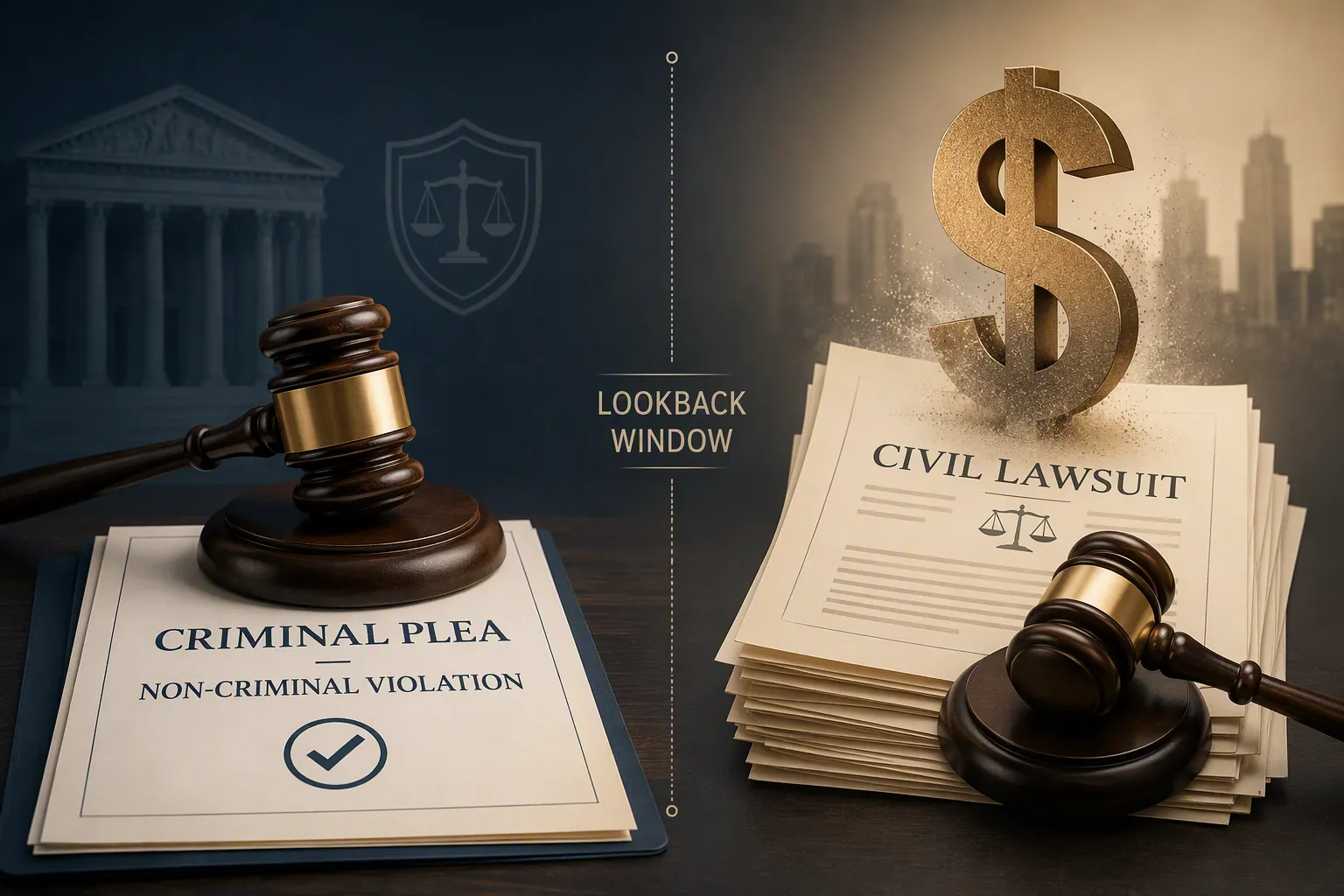
Cuba Gooding Jr.'s 2022 conditional discharge for forcible touching did not shield him from civil liability under New York's Adult Survivors Act. The case illustrates how criminal plea resolutions have no preclusive effect on revived civil claims under lookback-window statutes.
- Jurisdiction
- New York, USA
- Court
- Manhattan Supreme Court
- Judge
- Richard Latin
- AI tool named
- No AI tool
- Ruling date
- Oct 18, 2025
- Source document
- View primary court order ↗
- Last verified
- Jul 30, 2026
Lex Machina Review is an independent risk-tracking and reference resource. Nothing on this site is legal advice, and using it does not create an attorney-client relationship. Every record is reviewed against primary sources but may not reflect the most current status of a matter — always verify directly against the cited court order, rule text, or a licensed attorney before relying on it.
Companion explanation — secondary to the source document above
The phrase “Cuba Gooding Jr. forcible touching guilty plea 2023 legal case” compresses two different procedural tracks into one misleading label. The forcible touching guilty plea was not in 2023. It was entered in April 2022, then converted in October 2022 after Gooding satisfied the conditions of the plea. The 2023 activity was civil: a federal sex-abuse lawsuit settled before trial in June, and two New York Adult Survivors Act lawsuits were filed in November.
That distinction matters because the useful legal lesson is not about celebrity scandal management. It is about parallel proceedings and lookback-window exposure. This is also not an AI-tool, hallucination, or sanctions incident; it belongs in a risk record because it shows how a favorable criminal resolution can coexist with revived civil claims, and how ignoring civil process can turn exposure into a damages award.
| Date | Forum | Event | Procedural significance |
|---|---|---|---|
| April 13, 2022 | Manhattan Criminal Court | Gooding pleaded guilty to one count of forcible touching involving a 2018 incident with a waitress at LAVO New York. | The plea was conditional and tied to compliance requirements, not an end to all potential civil exposure. [1] |
| October 13, 2022 | Manhattan Criminal Court | After compliance, Judge Curtis Farber allowed Gooding to withdraw the misdemeanor plea and plead to a non-criminal harassment violation. | The criminal outcome meant no jail and no criminal record, but it did not adjudicate later civil claims. [2] |
| Nov. 24, 2022–Nov. 24, 2023 | New York civil courts | New York’s Adult Survivors Act opened a one-year revival window for otherwise time-barred civil sexual-abuse claims. | The statute created a separate civil path after the criminal disposition. [3] |
| June 6, 2023 | Manhattan federal court | Gooding settled a 2013 rape lawsuit minutes before jury selection before Judge Paul A. Crotty. | The plaintiff had sought $6 million, but the settlement terms were undisclosed. [4] |
| Nov. 22, 2023 | New York state court | Jasmine Abbay and Kelsey Harbert filed Adult Survivors Act lawsuits against Gooding. | The Abbay claim was tied to the LAVO incident; Harbert alleged a separate 2019 incident at Magic Hour Rooftop Bar. [5] |
| October 18, 2025 | Manhattan Supreme Court | After Gooding was served in May 2024 and did not respond or appear, Justice Richard Latin awarded Harbert $329,750, including $200,000 in punitive damages. | The default sequence, not the 2022 plea, produced the concrete civil money judgment. [6] |
The 2022 plea was a good criminal outcome, not a civil release
The criminal case resolved in a way many defendants would regard as successful. Gooding pleaded guilty to one count of forcible touching under New York Penal Law § 130.52, a class A misdemeanor, for forcibly kissing a waitress at LAVO New York in 2018. The April 2022 disposition required alcohol and behavioral counseling, no further arrests, and an on-record apology. If he failed the conditions, he faced up to one year in jail. [1]
Six months later, the court found compliance. Reports from Gooding’s therapist were positive, and Judge Curtis Farber allowed him to withdraw the misdemeanor plea and plead instead to a non-criminal harassment violation. The result was no jail time and no criminal record. [2]
That sequence is easy to overread. A conditional discharge can be a valuable criminal-law result without becoming a civil-liability firewall. The later harassment violation did not decide damages, did not release all accusers, and did not prevent a claimant from invoking a revival statute in a civil forum. It changed the criminal consequences of the LAVO case; it did not close every courthouse door.
The distinction is especially important because the later civil record involves more than one woman and more than one alleged incident. Abbay was the LAVO waitress connected to the criminal plea. Harbert’s later default judgment arose from an alleged 2019 incident at Magic Hour Rooftop Bar. A separate $80,000 default judgment entered in November 2022 in favor of Natasha Ashworth involved a TAO Downtown bartender and another alleged groping incident, not the forcible kissing conduct that drove the criminal plea. [7]
The Adult Survivors Act created the civil filing window
New York’s Adult Survivors Act was enacted on May 24, 2022, and codified at CPLR § 214-j. It revived, for a one-year period, certain civil claims by adult survivors of sexual offenses that otherwise would have been time-barred. The window ran from November 24, 2022, to November 24, 2023. [3]
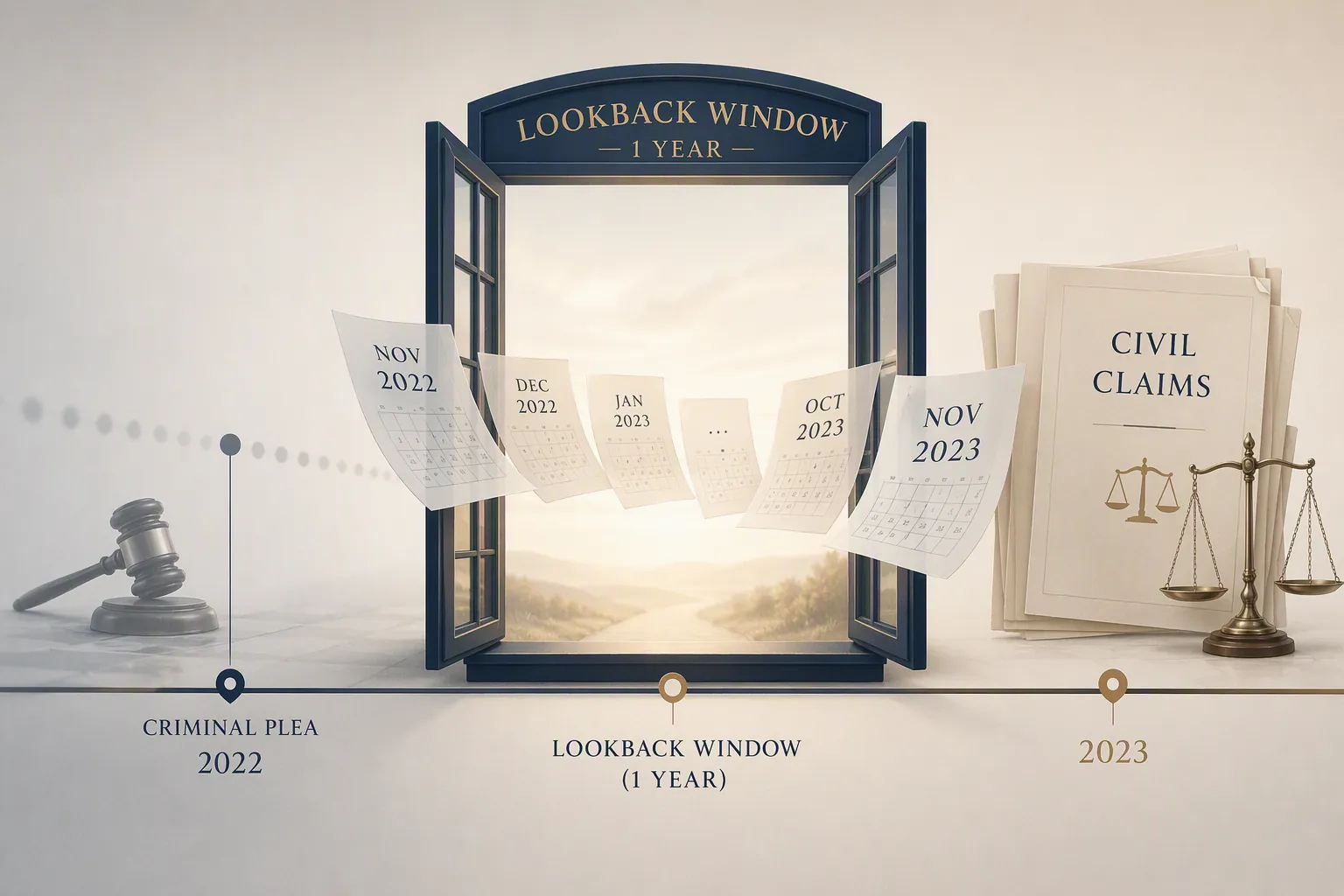
The statute generated more than 3,000 civil suits in New York during the lookback period. Public attention often gravitated to well-known defendants, but for litigation-risk purposes the larger point is simpler: the ASA reopened claims that would otherwise have been unavailable because of limitations periods. [8]
Gooding’s June 2023 federal settlement fits into that ASA-era civil environment, though it should not be made to carry more than the record supports. The plaintiff alleged a 2013 rape and had sought $6 million. The case settled minutes before jury selection in Manhattan federal court before Judge Paul A. Crotty. The settlement terms were not disclosed, so the $6 million demand is not a settlement figure and should not be treated as one. [4]
The November 2023 suits show why forum separation matters
On November 22, 2023, two days before the ASA window closed, Abbay and Harbert filed civil lawsuits against Gooding for assault and battery. Reuters reported that Abbay was the LAVO waitress whose allegation formed the basis for the criminal forcible touching plea. Harbert alleged that Gooding groped her at Magic Hour Rooftop Bar in 2019. [5]
Those filings are where the shorthand “2023 legal case” can do real damage. If the 2022 criminal disposition is treated as the only relevant event, the civil complaints look like an afterthought. They were not. They were filed under a statute that expressly reopened a civil path, and they raised claims in a forum with different parties, remedies, burdens, and consequences.
A criminal plea bargain may be negotiated around jail exposure, a permanent criminal record, allocution language, treatment obligations, and the risk of trial. A civil ASA complaint asks different questions: whether the pleading survives, whether service is effective, whether damages can be proved, whether insurance or indemnity issues exist, and whether the defendant appears at all. Counsel who stop the analysis at “no jail, no criminal record” have not finished the civil-risk analysis.
The Harbert default judgment is the load-bearing event
The strongest practical lesson comes from Harbert’s case. According to the New York Daily News, citing court documents, Gooding was served in May 2024 but never responded or appeared. Manhattan Supreme Court Justice Richard Latin held an evidentiary hearing and, on October 18, 2025, awarded Harbert $329,750. Of that amount, $200,000 was punitive damages; the rest was compensatory. [6]
That judgment should be described carefully. It was a default judgment, not a reported contested trial verdict after adversarial fact-finding. But default is not procedural trivia. Once a defendant fails to answer after service, the plaintiff can move the case forward without the defendant’s participation, build a damages record, and obtain a judgment that may include punitive damages if the court finds the showing sufficient.
The default posture also changes who is left doing the work. Plaintiff’s counsel must establish the basis for relief. The judge must decide whether the evidentiary presentation supports the damages requested. The absent defendant loses the ordinary opportunities to contest liability, test the plaintiff’s proof, narrow the damages record, or preserve arguments that might have mattered had the case been defended from the start.
What counsel should not infer from the record
There are several tempting inferences the available record does not support. The June 2023 settlement cannot be valued from the plaintiff’s $6 million demand because the terms were undisclosed. The Harbert judgment should not be attributed to the LAVO guilty plea because it involved a separate Magic Hour allegation. The Ashworth $80,000 default judgment should not be folded into the forcible-kissing plea because it involved a different woman and a different location. [4][5][6][7]
Nor does the record prove that every ASA claim against a defendant with a prior criminal disposition will produce a substantial civil award. The supported conclusion is narrower and more useful: where a revival statute creates a civil filing window, a favorable criminal resolution does not by itself neutralize civil exposure, and nonresponse after service can permit the plaintiff to obtain damages without a contested defense.
The litigation-risk lesson
The docket sequence is the lesson. April 2022: conditional guilty plea. October 2022: withdrawal of the misdemeanor plea and non-criminal violation. November 2022 through November 2023: statutory lookback window. June 2023: civil settlement on undisclosed terms. November 2023: ASA complaints. May 2024: service in Harbert’s case. October 2025: default judgment with $200,000 in punitive damages. [1][2][3][4][5][6]
For defendants and counsel, the mistake is treating criminal closure as global closure. A conditional discharge may solve the immediate criminal problem. It may avoid jail. It may avoid a criminal record. It does not answer a revived civil complaint, and it does not excuse silence after service. In this record, that silence became a $329,750 judgment.
References
- Actor Cuba Gooding Jr pleads guilty to forcibly touching a woman, NPR, April 13, 2022.
- No jail time for Cuba Gooding Jr. in forcible touching case, NBC News, October 13, 2022.
- CPLR § 214-J, New York State Senate.
- Cuba Gooding Jr. settles civil sex abuse case, averting trial, PBS NewsHour, June 6, 2023.
- Cuba Gooding Jr faces new sexual assault lawsuits, Reuters, November 22, 2023.
- Cuba Gooding Jr. ordered to pay more than $300K to woman he was accused of groping at NYC bar, New York Daily News, October 18, 2025.
- Cuba Gooding Jr. ordered to pay $80K to groping accuser, New York Post, November 17, 2022.
- Adult Survivors Act, Wikipedia.
Related records
Tool profile
How Meta's AI Spending Reshapes Law Firm ProfitabilityGoverning regulation
Browse the obligations tracker →Preventive workflow
Browse verification workflows →
Report a correction or tip
Spotted an outdated figure, a misstated fact, or a ruling this case record should reflect? Public comments are disabled for this content given the professional cost of a misreported case outcome, penalty amount, or rule text — use the structured correction channel instead.
Report a correction or tip for this record →