
What Dale Warner's sentencing shows about digital evidence
Dale Warner was sentenced to 31 to 60 years in the Dee Warner murder case largely on digital evidence: iPad search history, cell records, vehicle telematics, and surveillance footage. This brief assesses what that evidence class supports in court, flags the record as press-confirmed rather than docket-verified, and sets the verification bar — chain of custody, data-source methodology, precision limits — that litigators should apply before trial.
- Jurisdiction
- US-MI
- Court
- 39th Circuit Court, Lenawee County, Michigan
- Judge
- Michael R. Olsaver
- AI tool named
- No AI tool named
- Penalty amount
- 31 to 60 years
- Ruling date
- May 7, 2026
- Source document
- View primary court order ↗
- Last verified
- Aug 1, 2026
Lex Machina Review is an independent risk-tracking and reference resource. Nothing on this site is legal advice, and using it does not create an attorney-client relationship. Every record is reviewed against primary sources but may not reflect the most current status of a matter — always verify directly against the cited court order, rule text, or a licensed attorney before relying on it.
Companion explanation — secondary to the source document above
The Dale Warner sentencing in the Dee Warner case is current because of the prison term reported in May 2026. Its use here is narrower. This is not an AI-sanctions item or a legal-tech failure story. It is a verification-workflows record: a murder prosecution in which ordinary digital residues — search history, phone records, vehicle data, surveillance footage, and related forensic testimony — reportedly did serious work in front of a jury.
The record should be labeled carefully at the outset. The case is reported as State of Michigan v. Dale John Warner in Lenawee County’s 39th Circuit Court before Judge Michael R. Olsaver, following Warner’s conviction in connection with the death of his wife, Dee Warner. The sentencing figures below are press-confirmed and docket-unverified: the Lenawee County judgment was not located for this review, so news accounts should not be treated as a substitute for the sentencing order.
CBS Detroit reported a sentence of 375 months to 60 years for second-degree murder, plus 17 months to 10 years for tampering, to be served consecutively; WILX likewise reported the murder and tampering sentences and said Warner would be eligible for parole in 33 years.[1][2] ClickOnDetroit rounded the principal term as “31 to 60 years.”[3] The “70 years” framing that appears in coverage is best understood as the combined maximum exposure from consecutive 60-year and 10-year maximum terms, not as a single murder sentence.[1][2]
The sentencing matters because the proof pattern held
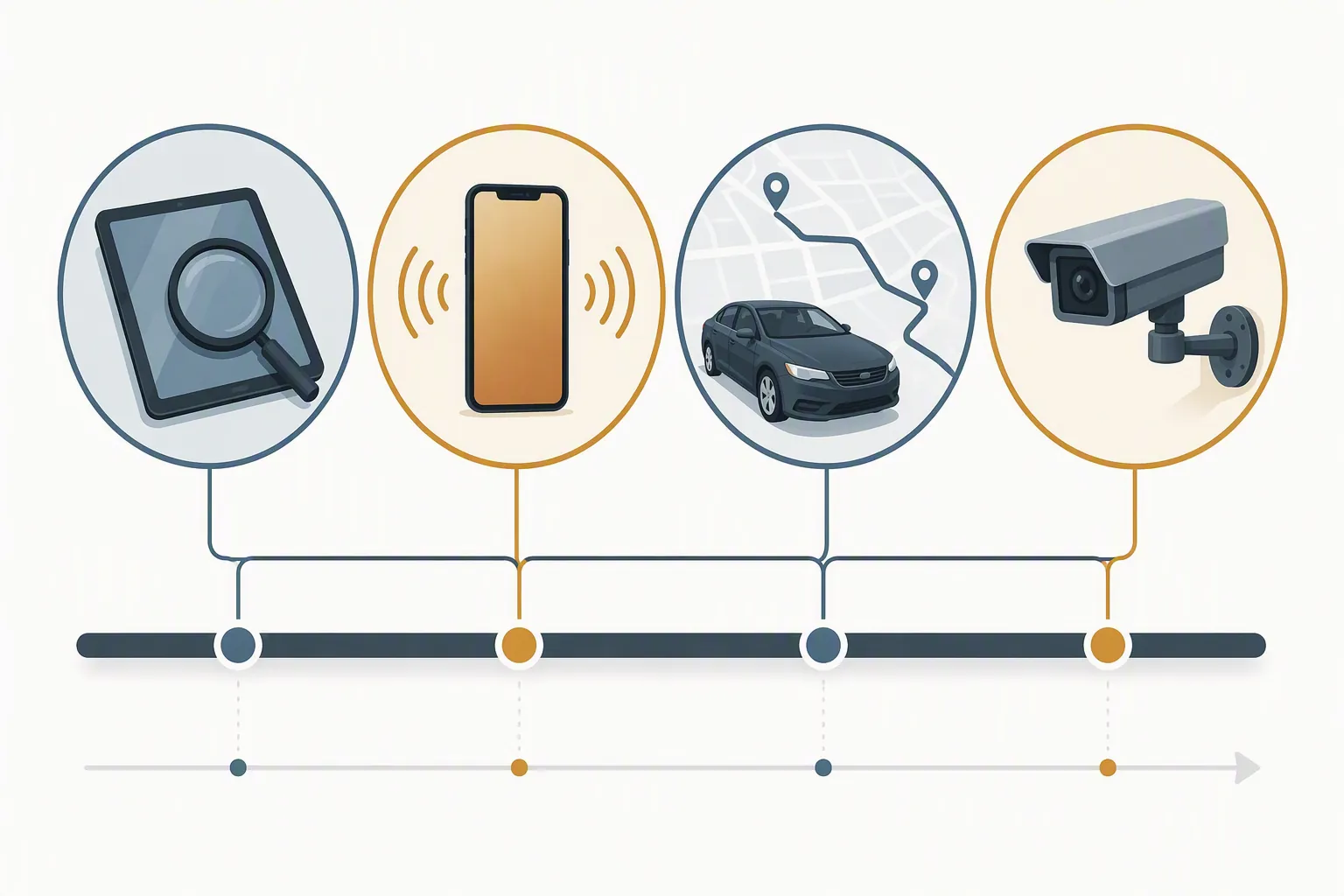
A long sentence can make a trial record look cleaner than it is. The better question is what the jury apparently accepted before that sentence existed. Reporting from the Warner trial describes a case built substantially through a sequence of digital and forensic materials: an iPad search, cell-phone record analysis, GM vehicle-data testimony, FBI digital-forensics testimony, farm surveillance footage, and fingerprint examination.[4][5]
The iPad evidence is the kind of detail that tends to harden quickly in public memory. WTVG/13abc reported that prosecutors pointed to a May 2021 search for “how to dispose of a thousand-gallon propane tank,” in a case where investigators later alleged Dee Warner’s body was hidden in a tank.[4] That does not make the search self-proving. A search-history exhibit still needs attribution, extraction history, device-access context, timestamp interpretation, and an explanation of whether the record came from the device, a browser artifact, a synced account, or another source.
The phone and vehicle evidence carried a different burden. WTVG’s verdict coverage reported testimony from a Michigan State Police cell-phone record analyst, a GM vehicle-data investigator, and an FBI digital forensics examiner, along with surveillance footage and fingerprint examination.[5] Those are not interchangeable proof types. A call-detail record is not a GPS log. A telematics record is not a human eyewitness. A surveillance clip is not necessarily continuous coverage. Each can be persuasive, but each asks the court and jury to trust a different system.
| Reported evidence class | What it may help prove | Verification question counsel should force before trial |
|---|---|---|
| iPad search history | A user-associated query at a reported point in time, including the May 2021 propane-tank search described by prosecutors.[4] | What artifact was extracted, from which device or account, by whom, and how was user attribution established? |
| Verizon / cell-phone records | Communication activity and possible location inferences, depending on the record type and provider data available. | Is the exhibit call-detail data, CSLI, tower-sector analysis, device-derived location, or an analyst’s reconstruction? |
| GM vehicle telematics | Vehicle activity or movement data as interpreted by a manufacturer-side or system-familiar witness.[5] | What does the GM system actually record, at what interval or trigger, and what assumptions turn raw vehicle data into a timeline? |
| Farm surveillance footage | Observed activity within the camera’s field of view, subject to gaps, timing, and system configuration.[5] | Are timestamps synchronized, are files complete, and does the footage show the event itself or only surrounding movements? |
| FBI digital-forensics testimony | Extraction, interpretation, or corroboration of device-originated artifacts.[5] | Can the examiner explain the tool output, preservation steps, and limits without asking the jury to treat software output as an oracle? |
| Fingerprint examination | Physical contact evidence tied to a surface or object, depending on the reported lift and comparison.[5] | Where was the print recovered, how was it preserved, and what does contact establish — presence, timing, or neither? |
The defense reportedly attacked the prosecution’s case as “speculation, assumption, and innuendo.”[5] The verdict shows that this framing did not prevent conviction. But a verdict is not a lab report. It tells counsel that a jury found the overall proof persuasive beyond a reasonable doubt; it does not tell counsel that every digital inference was equally precise, equally necessary, or equally insulated from later review.
Even the deliberation-time detail deserves the same discipline. The available source set describes a relatively short guilty verdict window, with accounts varying between roughly eight and nine hours.[5][6] That range is useful as a trial-practical signal: the jury did not appear immobilized by the defense’s attack on the evidence. It should not be converted into a docket-grade finding about the jury’s reasoning.
The wrongful-death allegations widen the data map, but not the criminal proof
The Detroit News reported that a wrongful-death lawsuit included allegations involving a GPS tracker and copying Dee Warner’s phone.[6] Those allegations matter for a digital-evidence reliability review because they show the broader class of intimate-partner digital tracking and device-access issues surrounding the case. They should not be silently folded into the criminal verdict as if every civil allegation was proved at trial.
That distinction is not pedantry. A GPS tracker allegation raises different questions from provider cell records. Phone copying raises different questions from a forensic extraction performed under warrant or court process. Surveillance footage raises different questions from a manufacturer’s vehicle record. The evidentiary work starts by refusing to call all of it “the digital footprint” and then moving on.
Location evidence is persuasive because it looks like a map
Digital location evidence is often compelling in court because it gives a jury a sequence: a device near here, a vehicle moving there, a camera showing this, a call or message around that time. The risk is that the visual form can outrun the underlying method. A clean timeline may be a litigation product assembled from records with different clocks, different collection rules, and different precision limits.
NACDL’s materials on stingrays and digital location tracking treat these technologies as Fourth Amendment and reliability problems, not merely as investigative conveniences.[7] Berkeley’s cell-phone location tracking primer similarly explains location tracking as a technical and legal subject requiring attention to how cellular systems generate and store location-related information.[8] Those materials do not make every cell-location exhibit unreliable. They explain why “the phone was there” is usually too compressed a sentence for litigation.
A lawyer preparing to use or challenge this evidence should separate at least three questions. First, what is the source: provider records, handset data, app data, vehicle telematics, camera metadata, or a later analyst reconstruction? Second, what is the event being measured: a call, a registration, a location ping, an ignition event, a file creation time, or a video timestamp? Third, what precision is justified: a point on a map, a tower sector, a route segment, a time window, or only a consistency check against other evidence?
The Warner reporting is useful because it appears to involve corroboration across categories rather than a single location source doing all the work. That strengthens a prosecution narrative, but it also increases the pre-trial verification load. The more systems are stitched together, the more counsel must know which clock is being trusted, which custodian produced which record, and which inference belongs to an analyst rather than to the data itself.
Courts are still policing scope and later-reviewability
The contested-reliability layer is not limited to criminal-defense commentary. Courts continue to care about search scope, methodology, and the ability to review digital-forensics work after conviction. Criminal Legal News summarized a Michigan Supreme Court ruling requiring police to limit searches of cellphone data to evidence of the criminal activity alleged in the warrant.[9] The point for trial counsel is immediate: a phone search is not a general permission slip to rummage through a person’s digital life.
Michigan Lawyers Weekly reported in June 2026 on a U.S. Supreme Court ruling concerning geofence warrants and the Fourth Amendment.[10] Because this article relies on downstream legal reporting rather than a full opinion analysis, the safer use is restrained: location-data warrants remain a live constitutional field, and counsel should verify the actual holding and procedural posture before relying on any broad formulation.
Massachusetts Lawyers Weekly also reported in July 2026 on a state high-court ruling involving post-conviction digital evidence.[11] That kind of ruling matters because digital-forensics work is not finished when the verdict is read. If the extraction, tool output, notes, source files, and assumptions cannot be revisited later, the trial record may be persuasive in the moment and fragile on review.
None of those authorities proves that the Warner verdict was wrong. They do something more useful for working litigators: they show why a winning digital timeline still needs a record that can survive a suppression motion, a Daubert-style reliability challenge where applicable, cross-examination, sentencing, appeal, and post-conviction scrutiny.
Make the evidence trial-ready before it carries the case
The practical lesson from the Warner record is not that digital evidence is inherently decisive. It is that ordinary device and vendor records can become decisive if counsel lets the jury receive them as a coherent, corroborated timeline. That makes pre-trial verification the critical stage.
- Chain of custody: identify who collected each record, from what source, under what legal authority, in what format, and with what preservation steps. Do this separately for device extractions, provider records, vehicle telematics, surveillance video, and physical forensic materials.
- Data-source methodology: require a witness or custodian who can explain what the system records and what it does not record. A GM vehicle-data investigator, a cell-record analyst, and an FBI digital examiner are not explaining the same machinery.
- Precision limits: state the level of confidence the data actually supports. If the record supports a time window, do not argue a timestamp as exact. If cell data supports an area or sector, do not display it as a pinpoint unless the method justifies that precision.
- Attribution: separate device activity from human action. A search on an iPad, a phone event, or a vehicle movement still requires a theory tying the record to a person.
- Corroboration map: show which evidence classes independently support the same event and which merely repeat an assumption created elsewhere in the timeline.
- Review file: preserve extraction reports, raw returns, metadata, analyst notes, warrants, affidavits, provider certifications, and demonstrative timelines so the record remains reviewable after verdict.
This is also where the site’s confirmed-versus-reported discipline matters. The Warner sentencing figures are reported by multiple outlets, but this brief does not have the judgment. The evidence chain is reported through trial coverage, but the underlying exhibits and transcripts are not reproduced here. That does not make the case unusable. It defines the level at which it can be used: as a current context record showing the courtroom force of digital evidence, not as a fully docket-verified archive.
For the Fourth Amendment side of location evidence, the natural companion is the site’s Chatrie-based discussion of CSLI and geofence doctrine. The Warner record sits one step closer to trial operations: before counsel asks a jury to trust a search, a phone record, a vehicle log, or a surveillance timeline, counsel should be able to say exactly where the record came from, how it was interpreted, and what it cannot prove.
References
- Sentencing slated for Dale Warner in charges over the death of his wife, CBS Detroit, May 7, 2026
- Dale Warner to be sentenced Thursday for wife’s murder, WILX, May 7, 2026
- Man to spend at least 31 years in prison for murdering wife Dee Warner, ClickOnDetroit, May 7, 2026
- Prosecutors detail how husband allegedly hid Dee Warner’s body in tank, what cracked case, 13abc / WTVG, February 13, 2026
- Jurors reach verdict in Dale Warner murder trial, 13abc / WTVG, March 10, 2026
- Dee Warner murder: Everything you need to know about Dale Warner, The Detroit News, July 31, 2026
- Stingrays and Digital Location Tracking, NACDL
- Cell Phone Location Tracking Primer, UC Berkeley School of Law, June 7, 2016
- Michigan Supreme Court: Police Must Limit Search of Cellphone Data to Uncovering Evidence of Criminal Activity Alleged in Warrant, Criminal Legal News, February 15, 2021
- Supreme Court: Geofence warrants and the Fourth Amendment, Michigan Lawyers Weekly, June 30, 2026
- SJC post-conviction digital evidence ruling, Massachusetts Lawyers Weekly, July 20, 2026
Related records
Tool profile
How Meta's AI Spending Reshapes Law Firm ProfitabilityGoverning regulation
Browse the obligations tracker →Preventive workflow
Browse verification workflows →
Report a correction or tip
Spotted an outdated figure, a misstated fact, or a ruling this case record should reflect? Public comments are disabled for this content given the professional cost of a misreported case outcome, penalty amount, or rule text — use the structured correction channel instead.
Report a correction or tip for this record →