
David Hearn Reflecting Pool Felony Rests on Fragile Evidence
The felony destruction-of-property prosecution against Olympic canoeist David Hearn for the Lincoln Memorial Reflecting Pool incident relies on a single $1,000-threshold count, but key witness testimony and government evidence handling have raised serious doubts. This record details the charges, key actors, procedural history, and the spoliation motion that could determine the case's outcome.
- Jurisdiction
- US-DC
- Court
- D.C. Superior Court
- Judge
- Carmen McLean
- AI tool named
- None
- Ruling date
- Jul 2, 2026
- Source document
- View primary court order ↗
- Last verified
- Jul 29, 2026
Lex Machina Review is an independent risk-tracking and reference resource. Nothing on this site is legal advice, and using it does not create an attorney-client relationship. Every record is reviewed against primary sources but may not reflect the most current status of a matter — always verify directly against the cited court order, rule text, or a licensed attorney before relying on it.
Companion explanation — secondary to the source document above
Current Posture: One Felony Count, One $1,000 Threshold
| Item | Record status |
|---|---|
| Case | United States v. David Hearn, D.C. Superior Court |
| Charge | Felony destruction of property under D.C. Code § 22-303 |
| Felony threshold | Damage exceeding $1,000 |
| Maximum exposure | Up to 10 years, as charged under the felony provision |
| Procedural status | Indicted July 2, 2026; arraigned July 9; not-guilty plea entered |
| Release status | Released on own recognizance; government stay-away request denied |
| Next known date | Status hearing set for August 5, 2026 |
| Last verified | July 29, 2026 |
The Reflecting Pool vandalism case against David Hearn is not, at least on the present record, a complicated charging document. Federal prosecutors obtained a July 2, 2026 indictment charging Hearn with one felony destruction-of-property count tied to the June 19 incident at the Lincoln Memorial Reflecting Pool.[1] He appeared before Judge Carmen McLean on July 9, pleaded not guilty, was released on his own recognizance, and did not receive the stay-away condition the government sought.[2]
The hinge is narrower than much of the public argument around the case. The government must prove damage attributable to Hearn above the $1,000 felony threshold. The statutory maximum matters because it defines exposure, not because it predicts the sentence. Treating the maximum as the expected outcome is a common way to turn a docket entry into theater.
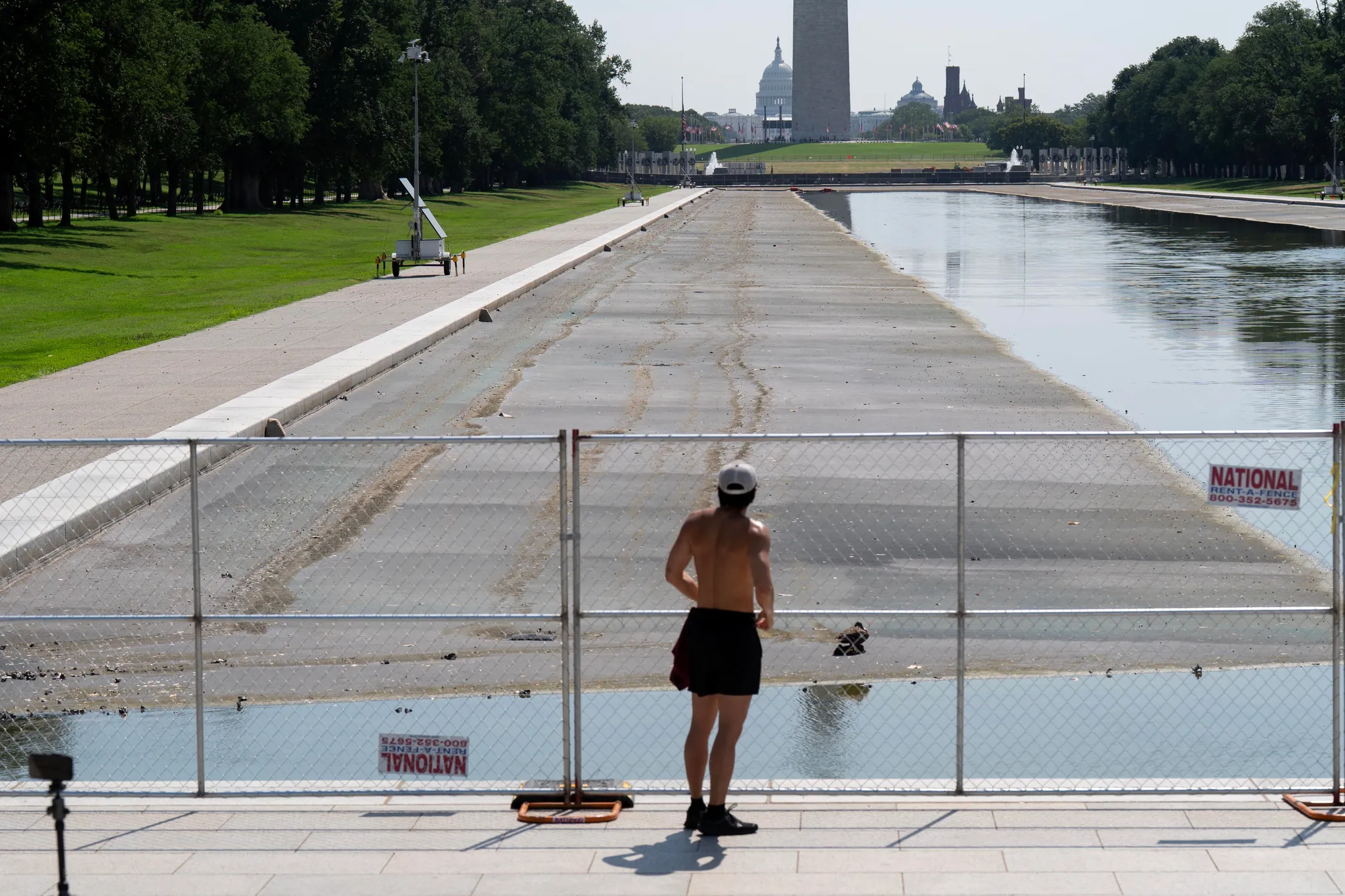
That distinction matters here because the pool’s broader repair condition and the felony element are not the same thing. A large public-works problem can exist at the same time as a much smaller provable criminal-damage figure. The prosecution’s task is not to show that the Reflecting Pool was expensive to fix in general. It is to show that Hearn caused more than $1,000 in legally chargeable damage.
The Damages Witness Created the Problem Prosecutors Now Have to Solve
The most important reported fact in the case is not Hearn’s Olympic background, the setting at the Lincoln Memorial, or the political reaction. It is the government’s own damages evidence. NBC News reported that the only grand-jury witness on damages acknowledged the Reflecting Pool already had preexisting failures requiring between $6,000 and $15,000 in repairs before Hearn’s alleged conduct, and that the witness could not identify any added cost caused by Hearn.[3]
That concession does not automatically defeat the charge. It does, however, change the case from an ordinary vandalism prosecution into an attribution case. If the pool liner or related components already required thousands of dollars of work, the relevant question becomes what incremental damage, if any, the government can tie to Hearn rather than to the preexisting failures.
This is where the $14 million renovation figure, while attention-grabbing, can mislead more than it clarifies. The renovation cost may explain why the site drew official concern, but it does not substitute for proof that Hearn personally caused more than $1,000 in damage. A felony threshold is not met by pointing to the size or symbolic importance of the property. It is met by evidence of chargeable loss.
The witness problem also matters because grand-jury testimony is supposed to help prosecutors establish probable cause for the indictment. A concession at that stage is not trial testimony, and the government may still present additional evidence later. But when the only reported damages witness cannot separate new damage from already-needed repairs, the defense does not need to invent a theory of weakness. The record supplies one.
The Spoliation Motion Is About Testing the Damage Claim
The defense has also moved to dismiss on evidence-spoliation grounds after the government drained the Reflecting Pool without preserving the liner, according to The New Republic.[4] The motion is not a guaranteed dismissal mechanism. It is a procedural challenge to whether the government’s evidence handling has impaired the defense’s ability to inspect, test, and contest the alleged damage.
That distinction is important. Spoliation arguments are often over-described in public commentary as a case-ending trapdoor. Courts usually ask more careful questions: what evidence was lost or not preserved, whether it was materially useful, what the government knew at the time, and what remedy fits the prejudice. As of July 29, 2026, the government has not yet substantively responded to the spoliation motion in the available record.
Still, the motion lands harder because of the damages concession. If the government had clean before-and-after evidence, repair invoices isolating a new tear, or a witness able to assign a specific added cost to Hearn, the missing liner might matter less. In a case already struggling with attribution, the lost or unpreserved physical condition of the pool becomes central to whether the defense can test the felony element.
The practical defense argument is straightforward: the government chose to charge a felony that depends on a dollar amount, then failed to preserve the physical evidence most likely to show whether the alleged act caused that dollar amount. The prosecution’s answer, when filed, may narrow the dispute. It may identify photographs, measurements, inspection records, or other evidence not yet visible in the public reporting. Until then, the evidentiary gap is not a talking point; it is the live procedural risk.
The Procedural Spine So Far
The docket spine is compact:
- June 19, 2026: Hearn arrested after the Lincoln Memorial Reflecting Pool incident.
- July 2, 2026: indictment returned on one felony destruction-of-property count.[1]
- July 9, 2026: arraignment before Judge Carmen McLean; not-guilty plea entered.[2]
- July 9, 2026: Hearn released on his own recognizance; stay-away order denied.[2]
- August 5, 2026: next known status hearing.
That posture leaves the case in a pretrial evidentiary posture, not a merits posture. There is no trial date in the available materials. There is also no public record, as of July 29, showing how prosecutors will answer the spoliation motion or repair the damages-attribution problem.
Why Hearn’s Felony Count Stands Apart From the Co-Defendants’ Cases
Three other defendants tied to the Reflecting Pool episode — identified in reporting as Thiers, Dennison-Gibby, and Carreno — face misdemeanor charges and have pleaded not guilty.[5] Their cases matter here mostly by comparison. They show that the government did not put every alleged participant in the same felony posture.
That does not prove selective treatment or overcharging by itself. Charging differences can reflect alleged conduct, available evidence, criminal history, statutory fit, or facts not yet public. But the comparison sharpens the question readers should keep separate from the noise: what evidence makes Hearn’s alleged conduct felony-level when the others remain in misdemeanor territory?
For a closer look at how charging discretion operates in this same docket, see David Hearn’s not guilty plea and the limits of charging discretion. The point for this record is narrower: once prosecutors elected the felony route, the damages proof became the center of the case.
Political Pressure Is Context, Not Proof
The political setting is part of the record because public officials made it part of the record. Before the indictment, President Donald Trump posted on Truth Social about “10 year prison sentences” in connection with the Reflecting Pool incident.[6] U.S. Attorney Jeanine Pirro also made public statements describing prosecution of the incident as a priority.[7]
Those statements matter as pressure signals. They do not establish the elements of the offense, and they do not answer the evidentiary question. A public official can be angry about damage to a national memorial and still leave prosecutors with the ordinary burden of proving chargeable damage above the felony threshold.
The Atlantic described Hearn in July 2026 as “this year’s emblem of prosecutorial overreach.”[8] That is commentary, not a docket ruling. It captures why the case has become politically legible, but the court will not decide the spoliation motion by measuring the symbolism of the Lincoln Memorial or the heat of public commentary.
For readers tracking politically sensitive DOJ enforcement decisions more broadly, the related discussion of Four Litigation Risks From the Todd Blanche Confirmation Controversy supplies adjacent context. It should not be used as a substitute for this case’s evidentiary record.
What Has to Be Proved From Here
At the next meaningful stage, the government has to do more than point to damage, public outrage, or the seriousness of the location. It has to show a path from Hearn’s alleged conduct to more than $1,000 in damage. If the government relies on total repair cost, the defense will have an obvious answer: those repairs were already needed, according to the reported damages witness.
If the government relies on physical condition evidence, the defense will press the liner-preservation issue. If prosecutors rely on photographs, inspection notes, or expert reconstruction, the court may have to decide whether those substitutes are adequate and whether any prejudice requires dismissal, exclusion, an adverse inference, or some narrower remedy. The available materials do not justify predicting which remedy, if any, Judge McLean will consider.
The legally operative number remains the $1,000 threshold, not the maximum sentence and not the pool’s overall renovation cost. For the threshold issue alone, see What the $1,000 Threshold Means for David Hearn’s 2026 Trial. For the defense-side implications of the witness concession and preservation issue, see David Hearn’s Legal Defense Strategy Against Felony Charges.
As of July 29, 2026, this remains an active D.C. Superior Court felony prosecution. Its vulnerability is not that the case is politically charged, although it is. The vulnerability is that felony-level damage attribution appears contested by the government’s own reported witness evidence, and the physical evidence that could test attribution was not preserved in the form the defense says it needed.
References
- Reflecting Pool indictment: David Hearn charged with destruction, Pirro says, CNBC, July 2, 2026, https://www.cnbc.com/2026/07/02/reflecting-pool-indictment-david-hearn-destruction-pirro.html
- US Olympian David Hearn arraigned on charges in Reflecting Pool vandalism case, NBC News, July 9, 2026, https://www.nbcnews.com/news/us-news/us-olympian-david-hearn-arraigned-charges-reflecting-pool-vandalism-ca-rcna353638
- Reflecting Pool case witness conceded damage before Olympic canoeist Davey Hearn, NBC News, July 27, 2026, https://www.nbcnews.com/politics/justice-department/reflecting-pool-case-witness-conceded-damage-olympic-canoeist-davey-he-rcna589510
- Empty Reflecting Pool Puts DOJ Vandalism Case on Brink of Collapse, The New Republic, July 2026, https://newrepublic.com/post/213251/empty-reflecting-pool-doj-vandalism-case-brink-collapse
- Three people charged with damaging Reflecting Pool, CNN, July 8, 2026, https://www.cnn.com/2026/07/08/politics/three-people-charged-damaging-reflecting-pool
- Trump threatens prison sentences over Reflecting Pool vandalism, CNN, June 22, 2026, https://www.cnn.com/2026/06/22/politics/reflecting-pool-trump-vandalism
- Lincoln Memorial pool vandalism prosecution, The Hill, https://thehill.com/homenews/administration/5933461-lincoln-memorial-pool-vandalism-prosecution/
- David Hearn, Trump, and Reflecting Pool Damage, The Atlantic, July 2026, https://www.theatlantic.com/politics/2026/07/david-hearn-trump-reflecting-pool-damage/687995/
Related records
Tool profile
Browse tool evaluations →Governing regulation
Browse the obligations tracker →Preventive workflow
Browse verification workflows →
Report a correction or tip
Spotted an outdated figure, a misstated fact, or a ruling this case record should reflect? Public comments are disabled for this content given the professional cost of a misreported case outcome, penalty amount, or rule text — use the structured correction channel instead.
Report a correction or tip for this record →