
Lake Winnipesaukee Dive Fire Poses Unique Risks for AI Legal Research
The Dive fire on Lake Winnipesaukee combines recency, multi-domain liability, and thin training data to create a uniquely dangerous scenario for relying on AI legal research. This article explains why any AI-generated analysis of the fire should be treated as presumptively unreliable and what verification steps practitioners should take.
- Jurisdiction
- US-New Hampshire
- Court
- New Hampshire State Fire Marshal's Office
- AI tool named
- Generic legal AI research tool
- Ruling date
- Jul 25, 2026
- Source document
- View primary court order ↗
- Last verified
- Jul 28, 2026
Lex Machina Review is an independent risk-tracking and reference resource. Nothing on this site is legal advice, and using it does not create an attorney-client relationship. Every record is reviewed against primary sources but may not reflect the most current status of a matter — always verify directly against the cited court order, rule text, or a licensed attorney before relying on it.
Companion explanation — secondary to the source document above
Last verified: July 28, 2026. This article is not legal advice and does not treat the Lake Winnipesaukee floating restaurant fire as an AI event. There is no reported factual connection between The Dive fire and artificial intelligence. The AI-reliability issue is the editorial lens: a very recent, still-developing incident is already the kind of matter where a lawyer may ask a legal research tool for a fast liability map, and where a fluent answer can become dangerous before anyone has checked the record.
The factual baseline is still narrow. Reports place the fire at The Dive in Smalls Cove on Lake Winnipesaukee on July 25, 2026, at about 3:39 p.m.; describe a reported kitchen origin; describe the event as non-suspicious; describe the vessel as a total loss; note New Hampshire Department of Environmental Services monitoring for a possible fuel sheen; and report that the number of persons on board remained unconfirmed. The New Hampshire State Fire Marshal’s Office, led by Fire Marshal Sean Toomey, was reported to be continuing its investigation, including video review and witness interviews. As of this verification date, no final official cause report is identified in the supplied research materials. [1]
| Point needing care | Current status |
|---|---|
| Date, time, and place | Reported July 25, 2026, about 3:39 p.m., Smalls Cove, Lake Winnipesaukee. [1] |
| Origin and suspiciousness | Reported kitchen origin and non-suspicious characterization, not a substitute for a final origin-and-cause determination. [1] |
| Loss and environmental follow-up | Reported total loss, with NHDES monitoring for fuel sheen. [1] |
| Persons on board | Reported as still unconfirmed in the supplied materials. [1] |
| Official investigation | Fire Marshal investigation reported as ongoing, including video review and witness interviews; no final official cause report supplied. [1] |
Why this file is unusually bad material for an instant legal answer
The phrase “floating restaurant fire Lake Winnipesaukee investigation legal” sounds like a search query that should produce a tidy memo: incident facts, probable legal theories, insurance implications, regulatory exposure. That tidy shape is exactly the problem. The legal record is not just incomplete; it is incomplete in several different directions at once.
A generative legal research system can be useful when it retrieves current sources, organizes known authorities, or helps a lawyer identify questions to ask. It cannot contain post-fire legal analysis of a July 25, 2026 event in its training data three days later unless it is connected to current retrieval, and retrieval does not itself validate the legal synthesis built on top of the retrieved materials. A tool may accurately pull a news report and then overstate what the report proves. It may correctly recognize a fire investigation and then fill the open spaces with a liability theory that sounds more complete than the evidence permits.
That recency problem is not a minor technical inconvenience. Legal analysis after a casualty often depends on the thing that is not yet known: where the fire actually originated, what failed, who had control of the relevant area, what inspections occurred, which rules governed the vessel or premises, what policy forms apply, and what environmental response costs are later documented. If those facts are unsettled, a polished answer may simply relocate the uncertainty into confident verbs.
The published hallucination benchmark supplied for this piece comes from a Stanford RegLab/HAI study reporting that legal AI research tools hallucinated 17%–33% of the time. That range should be re-sourced against the original study before anyone republishes it as a freestanding statistic. Even taken as a benchmark, it does not prove that a particular answer about The Dive fire will be wrong. It does, however, give practitioners a measured reason to treat case citations and liability classifications skeptically when the query involves a fresh incident, multiple legal domains, and niche coverage questions. [2]
The domains do not line up cleanly
The hardest part of this file is not that it involves a fire. It is that the first legal classification may determine which authorities matter at all. A land-based restaurant fire invites one set of premises-liability instincts. A fire on a commercial vessel or floating structure can raise a different threshold question: whether general maritime tort principles, state premises rules, or some combination of state and federal law supplies the operative framework. That classification should not be assumed from the word “restaurant,” the word “floating,” or the location alone.
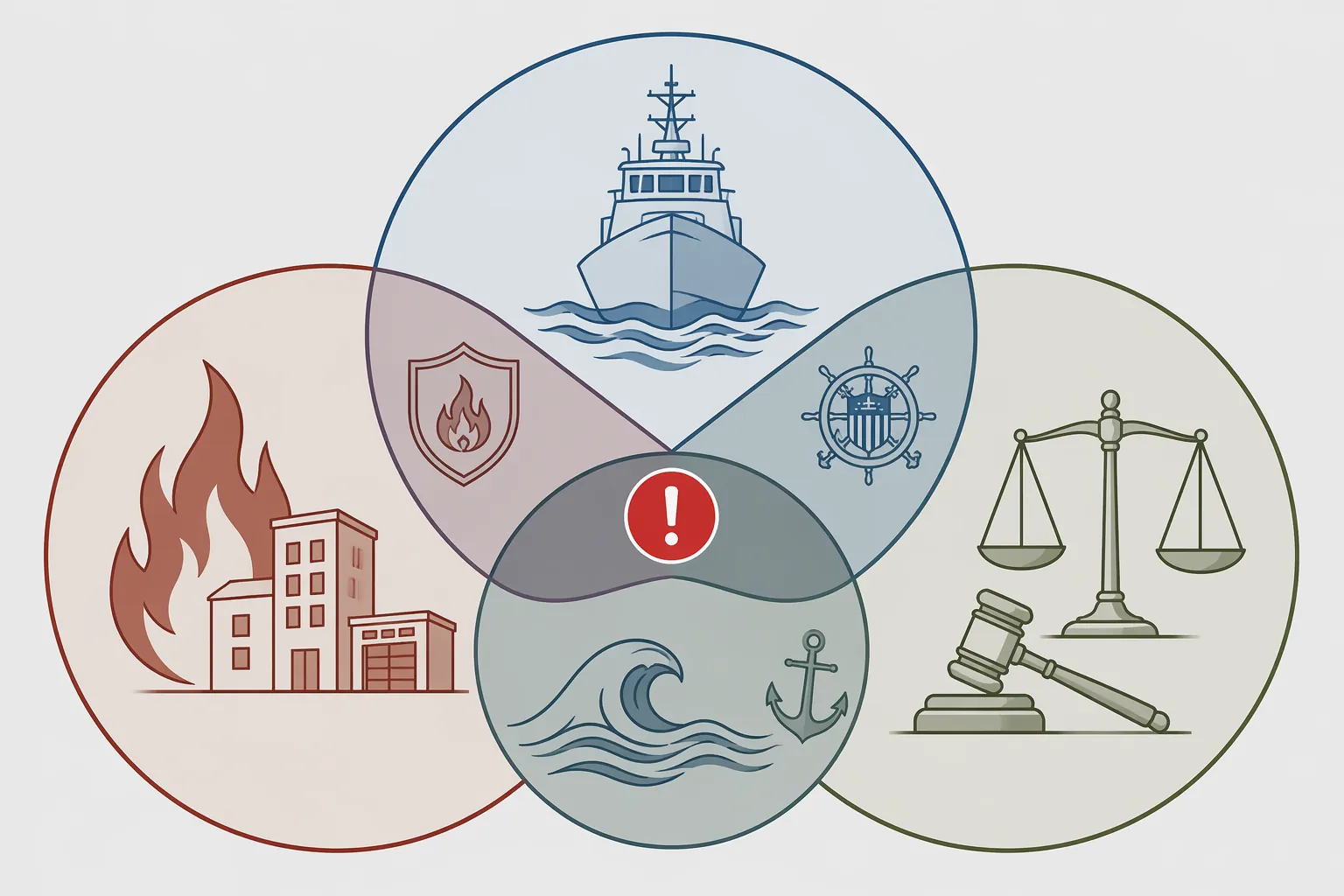
That is where AI legal research can become least helpful while appearing most helpful. A model can identify “premises liability,” “maritime negligence,” “Coast Guard regulation,” “state fire code,” “commercial general liability,” and “marine insurance” as relevant phrases. The mistake is to treat the list as analysis. Before a lawyer can rely on any of those pathways, someone has to decide what the structure legally is, what activity was occurring, what regulatory status applied, and whether the authority cited by the tool actually governs the forum and facts.
Three collisions matter most.
- New Hampshire premises liability versus general maritime tort concepts. The threshold question is not merely which theory sounds plausible; it is whether the floating restaurant’s legal classification places the claim in a maritime frame, a state premises frame, or a more specific mixed posture.
- State fire-code compliance versus Coast Guard commercial vessel regulation. A system that treats fire code, vessel inspection, and operational safety rules as interchangeable may cite authority that looks adjacent but does not answer the governing compliance question.
- CGL coverage, marine insurance, subrogation, and environmental response costs. A kitchen-sourced vessel fire can prompt ordinary property and liability questions, but it can also raise marine-policy issues, subrogation analysis, and remediation-cost questions tied to fuel sheen monitoring. Those issues should not be collapsed into a single generic “restaurant fire coverage” answer.
None of those questions should be resolved from the current public record. The point is more modest and more practical: a lawyer reviewing an AI answer should expect conflation at exactly these seams. If the tool cites a premises case without addressing maritime classification, or invokes maritime negligence without explaining why maritime law applies, the answer has skipped the part that matters. If it discusses fire-code duties without separating state and federal sources, it has probably organized vocabulary rather than law.
The investigation has a method; the output has a voice
The New Hampshire Division of Fire Safety’s Investigations & Incident Response materials describe the Fire Marshal’s investigative work in procedural terms: origin-and-cause determination, scene reconstruction, evidence collection, witness interviews, and K-9 accelerant detection where indicated. [3]
That process is slow for a reason. Origin-and-cause work is not a writing exercise. It depends on physical evidence, sequencing, witness accounts, site conditions, and the elimination of unsupported explanations. A generative system produces language by pattern, even when retrieval gives it current documents to summarize. The difference matters most before the official record has hardened.
A bad AI answer in this setting may not look absurd. It may look like a competent preliminary memo. It may say the fire “likely” resulted from negligent kitchen operations, “likely” triggers a particular exclusion, or “likely” falls under maritime negligence. Those adverbs are doing work the record has not yet earned. The Fire Marshal’s process asks what the evidence supports; the generated memo may ask what explanation best completes the pattern.
Citation checking is where this becomes less abstract. The familiar legal-AI failure is an invented case. The quieter failure is a real case used for the wrong proposition, from the wrong jurisdiction, or without the threshold facts that made it relevant. In a matter like The Dive fire, an associate should assume that every authority in an AI-generated memo needs to be opened in a primary legal database, not merely recognized by name.
Verification steps before relying on any AI-generated analysis
The practical response is not to ban research tools. The practical response is to demote them. For this file, an AI answer can be a starting list of questions, not an authority for conclusions.
- Confirm event facts against official or primary sources first. Treat news accounts as reported facts, not final determinations. Preserve the distinction between “reported kitchen origin” and a completed origin-and-cause finding.
- Separate the legal lanes before researching doctrine. Put New Hampshire premises and fire-code questions in one lane, Coast Guard or vessel-regulatory questions in another, maritime tort questions in another, and insurance or subrogation questions in their own coverage lane.
- Make the classification question explicit. Do not accept an AI-generated label such as “maritime negligence,” “premises liability,” or “CGL fire exclusion” unless the memo explains why that frame applies to this structure, this waterway, this operation, and this policy language.
- Verify every cited case in a primary legal database. Confirm that the case exists, that the quoted language appears, that the jurisdiction is relevant, that the proposition is current, and that later authority has not limited it.
- Check statutes, regulations, and agency materials at the source. If a memo cites state fire requirements, Coast Guard rules, or environmental obligations, the responsible lawyer should read the operative text rather than rely on the tool’s paraphrase.
- Treat liability and coverage conclusions as hypotheses only. A preliminary AI output should not become a reservation-of-rights position, demand theory, subrogation strategy, or client-facing liability assessment without independent legal and factual review.
- Re-source the hallucination benchmark before publication or filing. The 17%–33% range is useful as a warning marker only if the original Stanford study, methodology, and scope are checked directly.
Coverage lawyers have an additional reason to slow down. A general commercial policy analysis and a marine-policy analysis may use overlapping words while asking different questions. The same is true of subrogation: the responsible party theory, the insured property, the vessel status, and the environmental response facts can change the route. An AI memo that moves directly from “kitchen fire” to a coverage result is not moving efficiently; it is skipping the file.
The working presumption for this incident
For The Dive fire, any AI-generated case citations, liability pathways, regulatory conclusions, or coverage answers should be treated as presumptively unreliable until checked against primary sources. That presumption is not a judgment about the tool’s usefulness in all legal work. It is a judgment about this file: three days old, still under investigation, factually unsettled, and positioned across legal domains that are easy to merge incorrectly.
Use the tool, if it saves time, to generate a research agenda. Do not let it be the first authority, the final authority, or the source of any citation that has not been independently verified.
References
- Fire destroys The Dive floating restaurant on Lake Winnipesaukee — WMUR, NBC Boston, CBS News, Boston.com, WHDH, July 2026
- Stanford RegLab/HAI 2025 legal AI research hallucination study — Stanford RegLab/HAI, 2025
- Investigations & Incident Response — New Hampshire Division of Fire Safety
Related records
Tool profile
How Meta's AI Spending Reshapes Law Firm ProfitabilityGoverning regulation
Browse the obligations tracker →Preventive workflow
Browse verification workflows →
Report a correction or tip
Spotted an outdated figure, a misstated fact, or a ruling this case record should reflect? Public comments are disabled for this content given the professional cost of a misreported case outcome, penalty amount, or rule text — use the structured correction channel instead.
Report a correction or tip for this record →