
DoW–Genesis Partnership Resets Compliance for AI Contractors
This article identifies the three highest-impact compliance obligations arising from the DoW–Genesis Mission partnership and explains how contractors can assess their organizational readiness for the new procurement and data-sharing terms.
- Jurisdiction
- US Federal
- Court
- U.S. Department of War
- AI tool named
- Genesis AI
- Ruling date
- Jan 9, 2026
- Source document
- View primary court order ↗
- Last verified
- Jul 26, 2026
Lex Machina Review is an independent risk-tracking and reference resource. Nothing on this site is legal advice, and using it does not create an attorney-client relationship. Every record is reviewed against primary sources but may not reflect the most current status of a matter — always verify directly against the cited court order, rule text, or a licensed attorney before relying on it.
Companion explanation — secondary to the source document above
The most important word in the new Department of War Genesis AI partnership regulation is not “acceleration.” It is “30 days.” Once a covered AI model is publicly released, the DoW’s January 2026 AI Acceleration Strategy makes parity with that public release a procurement criterion on a 30-day clock.[1] Secretary Hegseth then framed that parity obligation as a primary basis for competition in his January 12 remarks.[2] For a contractor, that converts a commercial model update into a government-contracting event.
That is a practical shock. A public release no longer sits safely inside product, engineering, or marketing. It may trigger validation work, export-control review, intellectual-property clearance, security documentation, customer notices, and a procurement response before the next source-selection window closes. If counsel first sees the issue when a proposal team asks whether the company can certify parity, the company may already be late.

The point is not that every vendor must ship every public feature into every classified or controlled environment. The point is narrower and more consequential: parity is being treated as a condition of awardability. Once the government makes that condition explicit, the contractor must be able to explain, with records, what the public model does, what the government-facing model does, what differences remain, and why those differences are lawful, technically necessary, or contractually permitted.
The Materials Point To One Compliance Architecture
The timing matters. Executive Order 14363 launched the Genesis Mission on November 24, 2025, directing the Department of Energy to implement “uniform and stringent data access and management processes” and “rigorous vetting and authorization of users and collaborators.”[3] The DoW’s January 9 AI Acceleration Strategy then supplied the defense-procurement edge, including the model-parity requirement.[1] Three days later, Hegseth’s public framing made parity sound less like an internal modernization preference and more like a competition rule.[2]
The funding signal arrived alongside the policy signal. The DoW–Genesis Mission release commits $200 million in FY2026 and $1.3 billion in FY2027, while the Digital Biosecurity Forge scales from $30 million to $150 million.[4] Those figures do not prove that every implementation detail is final. Appropriations beyond FY2026 remain a real dependency, and statutory-name continuity around the Department of War as successor to the Department of Defense should be treated carefully until agencies and Congress finish the necessary housekeeping. But for procurement planning, the direction is hard to miss.
Holland & Knight’s February 2026 analysis is useful here because it follows the contracting pressure points rather than stopping at policy ambition. It identifies the collision among intellectual property, data rights, export controls, commercial acceptable-use policies, and the government’s new “any lawful use” language.[5] That is expert legal commentary, not an implementing regulation. Still, it reads the same documents that contractors will be negotiating against.
| Date or Window | Material | Contractor Issue |
|---|---|---|
| Nov. 24, 2025 | Executive Order 14363 launches the Genesis Mission | Data access and user authorization become mission infrastructure, not back-office process |
| Jan. 9, 2026 | DoW AI Acceleration Strategy | Public model releases can start a 30-day parity clock |
| Jan. 12, 2026 | Hegseth public framing | Model parity is presented as a primary procurement criterion |
| Within 180 days | Standardized “any lawful use” contract language described in legal analysis | Commercial use restrictions may need to yield to federal contract terms |
| Within seven days | Appeal path for data-access denials described in legal analysis | Data-release decisions need defensible records fast |
The Three Obligations That Change Award Readiness
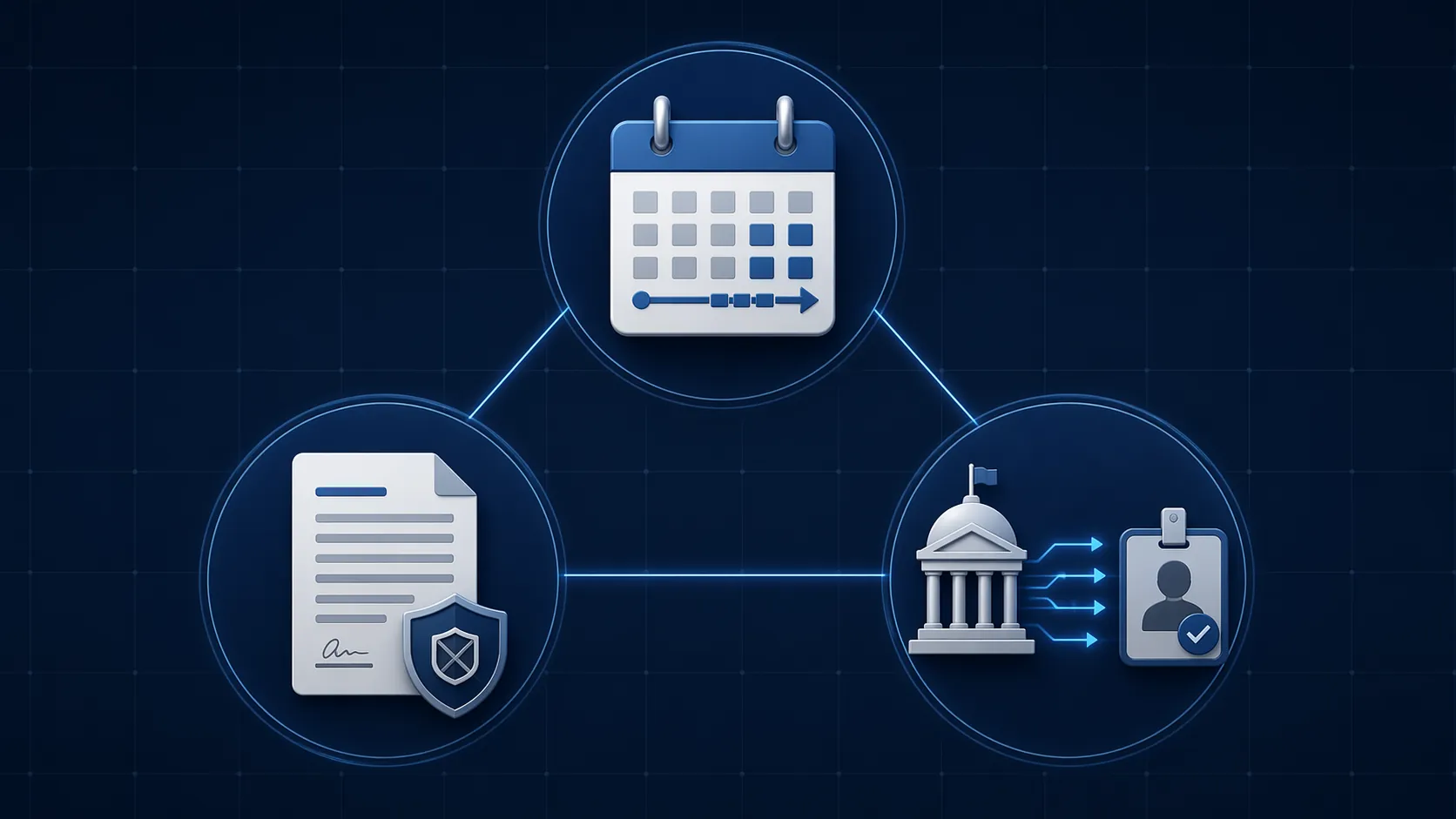
The DoW–Genesis materials are best read through three obligations, because those are the obligations most likely to decide whether a contractor can sign, perform, and survive audit. They are not abstract AI governance themes. They are contract-readiness questions: can the company prove parity, accept lawful-use terms, and handle directed data release to cleared users?
1. Model Parity Turns Product Release Into Procurement Evidence
The 30-day parity window is deceptively short because it does not measure only engineering effort. It measures the contractor’s ability to connect engineering evidence to contracting evidence. If the public model changes on Monday, someone must know whether the government model needs the same capability, whether the capability can enter the relevant environment, whether an exception is justified, and who can approve the representation that goes into a proposal or performance report.
A mature contractor will need a release inventory that distinguishes public, government, classified, export-controlled, and customer-specific model variants. It will also need a validation function that can compare behavior across those variants without pretending that identical marketing labels mean identical technical capability. “Parity” may involve benchmarks, feature availability, latency, tool integrations, retrieval access, safety filters, and deployment constraints. The DoW materials make parity a procurement criterion; they do not eliminate the need to define what parity means for a particular system.[1][2]
That definition cannot be left to engineers alone. Export-control counsel may need to determine whether a newly released capability changes access rules for foreign persons or international support teams. IP counsel may need to decide whether a public release relies on third-party components, licensed training material, evaluation data, or tooling that cannot be passed through to the government environment on the same terms. Procurement counsel may need to decide whether the company can certify compliance, disclose a deviation, or request an exception before award.
This is where broad AI-governance documents often fail contractors. A policy saying the company “reviews models before deployment” does not answer the parity question. The file needs to show the public release date, the responsible model owner, the government variant affected, the parity assessment performed, unresolved deltas, legal constraints, approval authority, and the contracting position taken. If independent verification is part of the company’s evidence base, counsel should also understand where that verification comes from and whether federal research or validation capacity is changing around it; that issue sits close to the concerns discussed in How Federal Research Cuts Undermine Legal AI Verification.
The harder cases will not be the releases that can be matched cleanly. They will be releases that the commercial business wants to announce quickly, while the government team knows that deploying the same capability into a DoW environment requires additional security testing, data-rights review, export analysis, or authority-to-operate work. The 30-day clock does not abolish those obligations. It compresses the time available to reconcile them.
2. “Any Lawful Use” Is Not A Branding Problem
The second obligation is the one most likely to expose a gap between commercial AI policy and federal contracting reality. Holland & Knight describes a requirement to standardize “any lawful use” language in all DoW AI service contracts within 180 days, creating direct tension with commercial acceptable-use policies and safety guardrails.[5] If that language appears in the contract, a vendor cannot assume that its public website restrictions, platform safety taxonomy, or ordinary enterprise terms will quietly control the government’s use.
The question is not whether the contractor has AI ethics principles. The question is whether the contractor can identify every contractual, technical, and operational limit that might prevent a lawful DoW use. A commercial acceptable-use policy may prohibit categories that are sensible for a public platform but problematic when the customer is the military. A safety control may block outputs related to weapons, targeting, biological risk, cyber activity, or intelligence analysis. Some restrictions may be legally required; others may be discretionary. The contract team must know which is which before it promises “any lawful use.”
This creates a drafting problem and a systems problem. The drafting problem is familiar: define the order of precedence among the federal contract, product terms, acceptable-use policies, security addenda, data-rights clauses, and flow-downs. The systems problem is less forgiving. If the model or platform is hard-coded to refuse broad categories of defense-related use, a negotiated clause will not make performance possible. Conversely, disabling controls for one federal customer may create safety, audit, or misuse exposure elsewhere if the vendor cannot segregate environments and permissions.
Contractors also need to resist the temptation to solve this through a side letter after award. If the company’s commercial policy prohibits conduct the DoW expects to be permitted when lawful, the exception must be visible in the proposal strategy, pricing, engineering plan, security plan, and subcontractor flow-downs. A prime contractor that accepts lawful-use language but relies on a model provider, cloud vendor, red-team tool, or data supplier with conflicting restrictions has purchased a fourth-party performance problem. That vendor-concentration concern parallels the dependency issues discussed in Oracle Pentagon Deal Signals New AI Vendor Risk for Law Firms.
Export controls belong in the same file, not in a separate legal universe. A use may be lawful for the DoW and still require controls on who can access the model, data, source code, evaluation environment, or support ticket. The federal customer’s operational need does not erase export-analysis steps. It does, however, make late discovery much more expensive. Contractors working across allied or multinational defense programs should treat the international-law and export-control dimension as a live readiness issue, not a theoretical caveat; a related risk vector appears in US-Israel Military AI Merger Creates New International Law Risks.
3. CDAO-Directed Data Release Changes The Default Assumption
The third obligation concerns data access. The cited legal analysis describes CDAO authority to direct release of any DoW data to cleared users, with denials appealable to the Under Secretary within seven days.[5] That is a sharp procedural change. It does not mean data boundaries disappear. It means the contractor should not build its governance model around slow, discretionary, program-level denial as the practical default.
Executive Order 14363 points in the same direction from the DOE side by requiring uniform and stringent data access and management processes, plus rigorous vetting and authorization of users and collaborators.[3] Federal News Network’s February 2026 commentary usefully narrows the conclusion: data boundaries are being redefined, not abolished, and mosaic risk becomes operational rather than theoretical when cleared users can combine data sources at speed.[9] That is the right caution. Access can expand while classification, privacy, export, proprietary, and mission restrictions still matter.
For contractors, the governance task is to make release decisions reviewable under compressed timelines. A denial file should identify the data set, requesting user or class of users, clearance basis, asserted restriction, harm analysis, alternative access proposal, decision authority, and appeal posture. If the Under Secretary appeal path can be invoked within seven days, the record cannot be assembled leisurely after the dispute matures.[5]
Mosaic risk deserves particular attention because it is often where policy language lags operational reality. A single data set may look releasable. The same data set, combined with model outputs, logistics records, biosecurity data, contractor telemetry, or partner-provided information, may reveal something the original steward did not intend to expose. A contractor that merely labels data by owner or program may miss the risk created by aggregation.
Adjacent Signals: Funding, Manufacturing, And Faster Boards
The Genesis architecture is not only a DoW matter. Covington’s discussion of the DOE RFA reports $293.76 million in total funding, a U.S.-manufacturing preference, and cost-share requirements of 20 percent for research and development and 50 percent for demonstration projects.[6] Those terms do not impose the same obligation as the 30-day parity window or lawful-use clause. They do, however, point in the same procurement direction: funding is being paired with domestic capability, cost participation, and documented execution capacity.
The Barrier Removal Board adds another source of pressure by compressing testing, authority-to-operate, and contracting timelines. The research materials do not support treating the board as a substitute for enforceable contract terms or statutory obligations. It is better understood as an acceleration mechanism that makes weak internal coordination visible sooner. Contractors relying on other transaction authority, prototype arrangements, or hybrid acquisition paths should also keep enforcement limits in view; that issue is adjacent to the concerns discussed in Why the SpaceX-Pentagon AI Contract May Be Harder to Enforce.
There is also a statutory backdrop. Executive action and procurement clauses can move faster than formal rulemaking, but they do not occupy the whole field. The AI incident reporting, prohibited-system, and cybersecurity issues discussed in The FY2027 NDAA Transforms AI into a Statutory Compliance Regime would sit beside, not beneath, the DoW–Genesis contract architecture.
The Readiness Questions Counsel Should Ask Before Award
Spencer Fane’s analysis identifies ten core AI governance expectations aligned with the NIST AI Risk Management Framework and ISO/IEC 42001.[7] That kind of benchmark is useful, but only if it is translated into the procurement obligations actually in play. A company can have a polished AI governance framework and still be unable to meet a 30-day parity representation, a lawful-use clause, or a seven-day data-access appeal record.
- Model parity: Can the company identify every public release that affects a DoW-facing model, complete a parity assessment within 30 days, document exceptions, and support the resulting procurement representation?
- Commercial policy conflict: Can the company map acceptable-use policies, safety guardrails, product terms, and subcontractor restrictions against a federal “any lawful use” obligation before contract signature?
- Data release: Can the company approve, condition, or deny release of DoW data to cleared users with a record strong enough to survive a seven-day appeal path?
- ATO and testing compression: Can security, testing, contracting, and engineering teams respond on Barrier Removal Board timelines without bypassing export, IP, privacy, or classification controls?
- Flow-downs: Can the prime contractor force model providers, cloud vendors, data suppliers, and evaluators to meet the same obligations the prime is accepting?
The flow-down point is often where readiness claims become thin. A prime may be able to write a parity process for its own application layer, but the underlying foundation model provider may reserve the right to withhold features, change safety filters, limit defense use, restrict benchmarking, or block particular data categories. If the prime cannot control or at least document those dependencies, its parity representation may rest on assumptions it cannot enforce.
Scarinci Hollenbeck’s Mondaq analysis puts the competitive point bluntly: access will not be equal, and organizations with mature compliance infrastructure will move to the front of the line.[8] That conclusion should not be read as an official preference rule. It is a practical procurement forecast. In a compressed environment, the contracting office will have less patience for vendors that need bespoke exceptions, unresolved commercial-policy conflicts, or post-award engineering discoveries before they can perform.
The lowest-risk answer is not to promise unlimited flexibility. It is to know where the company can comply, where it needs an exception, and where the business model itself conflicts with the federal use case. Some contractors will decide not to offer particular public capabilities into DoW environments. Some will segregate federal deployments more aggressively. Some will renegotiate upstream provider terms. Those are business decisions, but they need to be made before the proposal representation is on the page.
What Becomes Less Awardable
There are still uncertainties. Law-firm analyses are not agency rules. Funding beyond FY2026 may shift with appropriations. The Department of War name change still leaves statutory cross-reference questions that should not be hand-waved in formal advice. State AI laws and international obligations may create additional pressure in particular deployments, but the research record here does not support treating those conflicts as the center of the DoW–Genesis framework.
Even with those caveats, the contracting consequence is already visible. When model parity becomes a procurement criterion, “any lawful use” becomes standardized contract language, and data-release authority shifts toward cleared-user access, AI governance stops being mainly a risk committee topic. It becomes evidence of award readiness.
Contractors without that evidence are not merely accepting more compliance risk. They are becoming less awardable.
References
- DoW AI Acceleration Strategy Memo, war.gov, Jan. 9, 2026
- Hegseth speech, war.gov, Jan. 12, 2026
- Executive Order 14363, The White House, Nov. 24, 2025
- DoW–Genesis Mission press release, war.gov
- Holland & Knight analysis, Holland & Knight, Feb. 2026
- DOE RFA, Inside Government Contracts, Mar. 17, 2026
- Spencer Fane analysis, Spencer Fane
- Scarinci Hollenbeck/Mondaq analysis, Mondaq
- Federal News Network commentary, Federal News Network, Feb. 2026
Related records
Tool profile
How Meta's AI Spending Reshapes Law Firm ProfitabilityGoverning regulation
Browse the obligations tracker →Preventive workflow
Browse verification workflows →
Report a correction or tip
Spotted an outdated figure, a misstated fact, or a ruling this case record should reflect? Public comments are disabled for this content given the professional cost of a misreported case outcome, penalty amount, or rule text — use the structured correction channel instead.
Report a correction or tip for this record →