
KC Sanctioned for AI Hallucinations in Murder Case
In DPP v GR [2025] VSC 490, the Supreme Court of Victoria rebuked a King's Counsel and his junior for filing written submissions that contained AI-hallucinated case citations, invented legislative references, and fabricated parliamentary quotes, causing a 24-hour adjournment in a murder trial. The case adds a critical criminal-law, non-US jurisdiction data point to the AI-sanction record and signals that no level of counsel seniority excuses the failure to independently verify AI-generated content.
- Jurisdiction
- Victoria, Australia
- Court
- Supreme Court of Victoria
- Judge
- Justice James Elliott
- AI tool named
- Not identified
- Ruling date
- Aug 14, 2025
- Source document
- View primary court order ↗
- Last verified
- Jul 27, 2026
Lex Machina Review is an independent risk-tracking and reference resource. Nothing on this site is legal advice, and using it does not create an attorney-client relationship. Every record is reviewed against primary sources but may not reflect the most current status of a matter — always verify directly against the cited court order, rule text, or a licensed attorney before relying on it.
Companion explanation — secondary to the source document above
Justice James Elliott’s order in Director of Public Prosecutions v GR is the kind of AI-risk record that should be read from the judgment first and the headlines second. On 14 August 2025, in the Supreme Court of Victoria, the court rebuked Rishi Nathwani KC and his junior for filing written submissions in a murder proceeding that contained AI-generated false legal material: fabricated case citations, invented legislative references, and fake parliamentary material. The tool was not identified. The failure cost the court a 24-hour adjournment in proceedings involving a 16-year-old defendant with mental impairment [1].
This Risk Digest entry concerns an Australian criminal proceeding and the professional-responsibility consequences of unverified AI-assisted legal submissions. It is not legal advice and it should not be read as saying the AI errors caused the defendant’s ultimate outcome.
| Risk Digest field | Record |
|---|---|
| Case | Director of Public Prosecutions v GR [2025] VSC 490 |
| Court and jurisdiction | Supreme Court of Victoria, Australia |
| Judge and date | Justice James Elliott, 14 August 2025 [1] |
| Proceeding type | Murder prosecution involving a 16-year-old defendant with mental impairment [1] |
| Counsel identified | Rishi Nathwani KC and junior counsel for the defence [1] |
| AI tool | Not identified in the judgment or reporting reviewed |
| Core defect | AI-generated written submissions containing fabricated case citations, non-existent legislative references, and invented parliamentary material [1] |
| Immediate consequence | A 24-hour adjournment [1] |
| Verification posture | Primary reliance should remain on the judgment; the available PDF copy is AWS-hosted, and AustLII access should be checked before citation or reuse |
| Caution | The defendant’s not-guilty-by-reason-of-mental-impairment outcome should not be tied causally to the defective submissions |
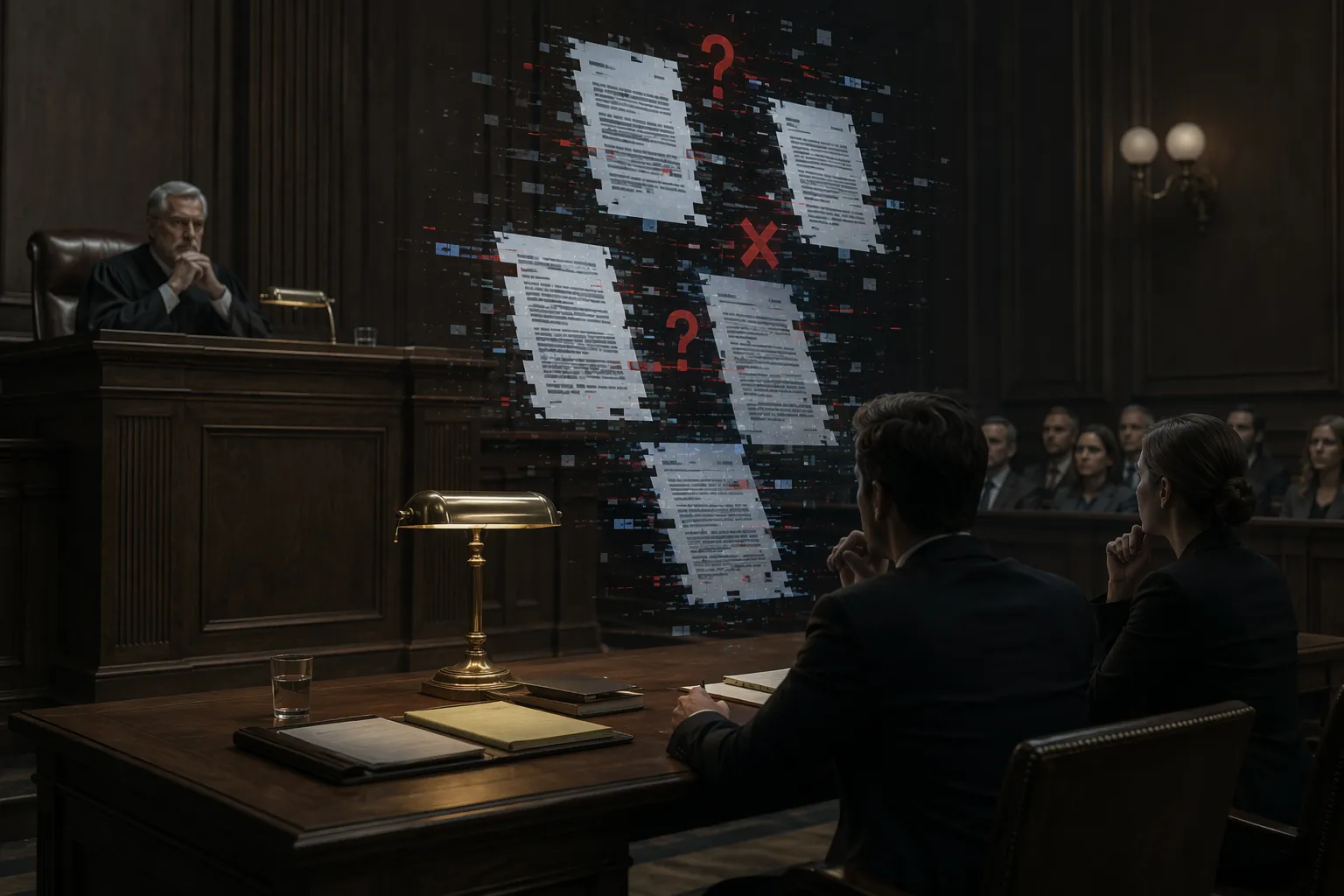
What the court had to stop and repair
The problem was not a lawyer using AI somewhere in the drafting process. The problem was filed court material that the lawyers had not independently and thoroughly verified before placing it before a judge in a serious criminal matter. That distinction matters because courts do not sanction vibes; they sanction conduct in the record.
The written submissions filed for the accused contained legal authorities and legislative material that could not bear the weight placed on them. The judgment identifies three categories of false material that belong in any partner briefing on this case:
- Fabricated case citations: the submissions referred to cases that were not real authorities for the propositions advanced [1].
- Invented legislative references: the submissions cited legislation that did not exist [1].
- Fake parliamentary material: the submissions included invented quotes from a state parliamentary speech [1].
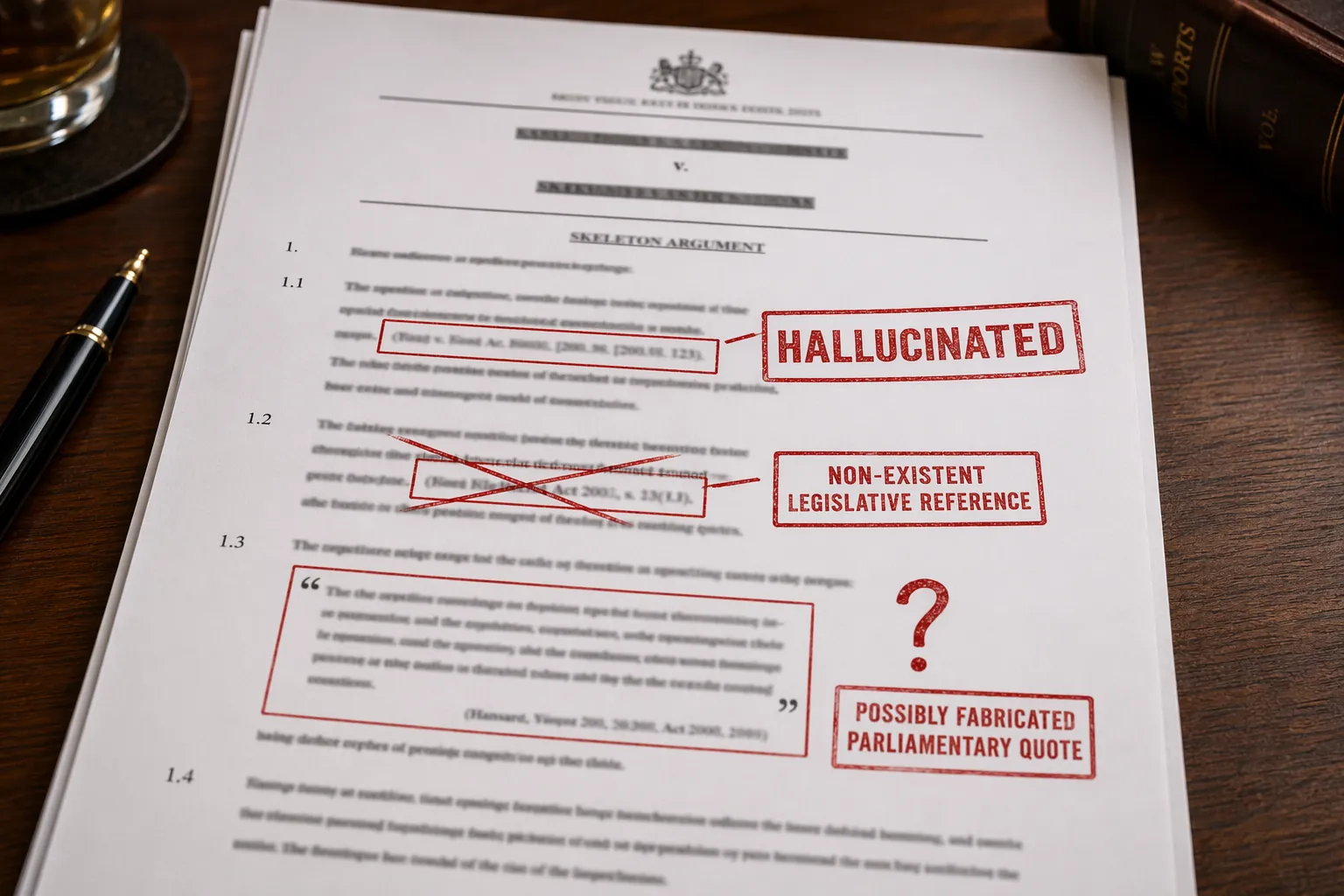
Those are not typographical errors. They are archival defects. A later lawyer, court officer, appellate reader, or journalist trying to reconstruct what happened would encounter a court file polluted with sources that never existed. That is why the word “hallucination,” useful as shorthand, is too soft if it stops the analysis. The file did not merely contain strange AI prose. It contained legal material that could misdirect the court’s attention and consume institutional time.
The harm became practical immediately. The court had to adjourn the proceeding for 24 hours. In a civil sanctions order, that lost day would still matter. In a murder proceeding involving a child defendant with mental impairment, the lost day is harder to treat as clerical inconvenience. Judges, court staff, prosecutors, defence counsel, and the accused all wait while the record is cleaned [1].
The rebuke was aimed at verification, not AI use in the abstract
Justice Elliott’s central statement deserves to be quoted because it is the operational rule this case will be remembered for: “It is not acceptable for artificial intelligence to be used unless the product of that use is independently and thoroughly verified” [1].
That sentence does not leave much room for the comfortable version of AI risk management in which senior counsel’s eye is assumed to be a sufficient safeguard. The filed material came from a defence team led by a King’s Counsel. The judgment still treated verification as a duty that had to be performed, not a status that could be inferred from professional rank [1].
The junior counsel’s position does not disappear either. The useful lesson for chambers and litigation teams is not that a senior lawyer got embarrassed. It is that every lawyer whose name or work product helps move AI-generated material into the court record needs a verification path that is more concrete than trust in the person above or below them.
Nor was the warning limited to the defence. The record also shows a second verification failure: the prosecutor adopted the defence’s AI-generated submissions without verifying them. That detail is easy to miss because the public story naturally centers on the lawyers who generated the defective text. It should not be missed. Shared reliance is one of the more ordinary ways false legal material becomes harder to remove from a record [1].
The court’s reaction also did not arrive in a vacuum. The Supreme Court of Victoria had issued AI-use guidelines in May 2024, and Justice Elliott referenced those guidelines in the rebuke. The point is not that every jurisdiction’s guideline language will match Victoria’s. The point is that by August 2025 this was no longer a novelty problem that could credibly be treated as an unforeseeable quirk of a new drafting aid [1].
Why this Australian case should travel
Many AI-hallucination sanctions records familiar to U.S. readers sit in a civil-litigation pattern: fabricated cases in briefs, often followed by a sanctions hearing, apology, and a reminder that lawyers must read what they file. DPP v GR belongs in the same family, but it is not the same entry.
First, it is a criminal-law data point from a non-U.S. common-law court. Second, it arose in a murder proceeding rather than an ordinary commercial or personal-injury dispute. Third, it involved a King’s Counsel. Available hallucination-case trackers make it safest to record the matter as the first identified AI-hallucination incident involving a KC, while avoiding any claim that unreported incidents do not exist [2].
That third feature matters because hierarchy often works as a psychological control in legal organizations. Junior lawyers are checked. Pro se litigants are doubted. Vendors are scrutinized. Senior lawyers, especially senior advocates, are more often trusted until something breaks. DPP v GR is now part of the answer to that habit: seniority may explain why others relied on the work, but it does not verify a citation.
Australian and international coverage treated the episode as more than a local embarrassment. ABC reported the apology after the AI-generated submissions were filed in the Victorian murder case, while The Guardian highlighted the judge’s criticism of lawyers acting for a boy accused of murder [3][4]. Courthouse News Service carried Associated Press coverage for U.S. legal readers, and CBS and NBC likewise reported the fake quotes and made-up cases [5][6][7].
The media accounts are useful confirmation, but they should not replace the order. The important record is not that a famous rank of lawyer was named in news stories. The important record is that a superior court identified specific false legal materials, tied them to AI-generated submissions, recorded the adjournment, and stated the verification duty in terms broad enough to reach senior and junior counsel alike [1].
The defendant’s outcome should be stated, then kept in its lane
The defendant was ultimately found not guilty by reason of mental impairment. That fact belongs in the record because otherwise readers may wonder what became of the criminal proceeding. It should not be used to imply that the defective AI-generated submissions caused the result, changed the verdict, or produced the mental-impairment outcome. The supported conclusion is narrower: the errors disrupted the proceeding and caused a 24-hour adjournment [1].
That narrowness is not a weakness. It is the discipline the case itself demands. A fabricated authority in a murder proceeding is serious enough without adding an unsupported causal theory. The court lost time. The lawyers had to answer for filed false material. The verification duty was restated in unmistakable terms. Those are the facts that can safely carry the risk signal.
What to record in a risk file
For a litigation risk team, the useful entry is compact but sharp. DPP v GR should be indexed as a criminal-law, Australian common-law AI-hallucination incident involving senior counsel, unverified filed submissions, false authorities, non-existent legislative material, fabricated parliamentary content, a prosecutor’s adoption failure, and a 24-hour adjournment.
- Do not record the tool as ChatGPT, Claude, Copilot, or any named system. The tool was not identified in the judgment or reporting reviewed.
- Do not record the case as a verdict-impact example. The supported harm is disruption of the proceeding and judicial rebuke.
- Do record the shared-reliance warning. The prosecutor’s failure to verify before adopting the submissions is part of the risk pattern.
- Do record the seniority point. The involvement of a KC makes this a poor fit for any training slide that treats AI-filing failures as mainly a junior-lawyer or pro se problem.
Firms building verification controls can pair this record with verification-workflow training and with broader assessments of legal AI hallucination risk in court filings. The connection is not that elite counsel and self-represented litigants make the same mistakes for the same reasons. The connection is that the court record receives the same false citation either way.
DPP v GR is therefore not a morality play about chatbots. It is a court-record case. A serious criminal court lost a day because lawyers filed unverified AI-generated legal material, and the court treated that as unacceptable. Independent verification was not relaxed by counsel seniority, by criminal-case stakes, or by the absence of an identified tool.
References
- Director of Public Prosecutions v GR [2025] VSC 490, Supreme Court of Victoria, 14 August 2025
- AI Hallucination Cases: Australia, OBITER
- Senior lawyer apologises after filing AI-generated submissions in Victorian murder case, ABC News, 15 Aug 2025
- Judge criticises lawyers acting for boy accused of murder for filing misleading AI-created documents, The Guardian, 14 Aug 2025
- Australian lawyer apologizes for AI-generated errors in murder case, Courthouse News Service / AP
- Lawyer apologizes for fake quotes, fabricated judgments generated by AI in murder case, CBS News
- Australian lawyer sorry for AI errors in murder case, including fake quotes and made up cases, NBC News
Related records
Tool profile
Browse tool evaluations →Governing regulation
Browse the obligations tracker →Preventive workflow
Browse verification workflows →
Report a correction or tip
Spotted an outdated figure, a misstated fact, or a ruling this case record should reflect? Public comments are disabled for this content given the professional cost of a misreported case outcome, penalty amount, or rule text — use the structured correction channel instead.
Report a correction or tip for this record →