
The James Duckett case shows why AI evidence needs stronger gatekeeping
Analyzes the James Duckett 1987 murder case, where FBI hair analysis later disavowed by the DOJ was admitted without adversarial testing, and draws a structural parallel to the current risk of admitting AI-generated evidence under Daubert and Rule 702.
- Jurisdiction
- US-Florida
- Court
- Florida Supreme Court
- AI tool named
- AI-generated evidence
- Ruling date
- Mar 26, 2026
- Source document
- View primary court order ↗
- Last verified
- Jul 29, 2026
Lex Machina Review is an independent risk-tracking and reference resource. Nothing on this site is legal advice, and using it does not create an attorney-client relationship. Every record is reviewed against primary sources but may not reflect the most current status of a matter — always verify directly against the cited court order, rule text, or a licensed attorney before relying on it.
Companion explanation — secondary to the source document above
The part of the James Duckett case that matters most for execution-stay and evidence review did not begin at the crime scene. It began at the end of the case, when the Florida Supreme Court stopped an execution on March 26, 2026 so DNA testing could be performed, a stay described as Florida’s first such execution stay since James Dailey’s in 2019.[1] By then, Duckett had been on death row for decades. The court-ordered testing came after defense requests that had stretched across more than twenty years.[1]
That late pause did not produce the clean answer that capital litigation is often asked to produce. The Florida Department of Law Enforcement testing returned inconclusive results and consumed the critical biological sample, leaving no material for further testing.[2] The stay was later lifted, and Duckett was executed on July 28, 2026 at 1:19 p.m.[3] The state went forward insisting that the conviction rested on evidence beyond the challenged forensic point. The defense went to the end arguing that the chance to test the evidence had arrived only after the evidence could no longer be meaningfully tested.
That is the part of the record worth keeping still for a moment. Duckett does not offer a tidy innocence story. It offers something more useful for courts now facing AI-generated evidence: a dated example of technical proof entering a courtroom with the weight of expertise, later official doubt arriving years too late, and the remaining physical record no longer able to bear the burden that late review placed on it.
The hair testimony came in before the warning did
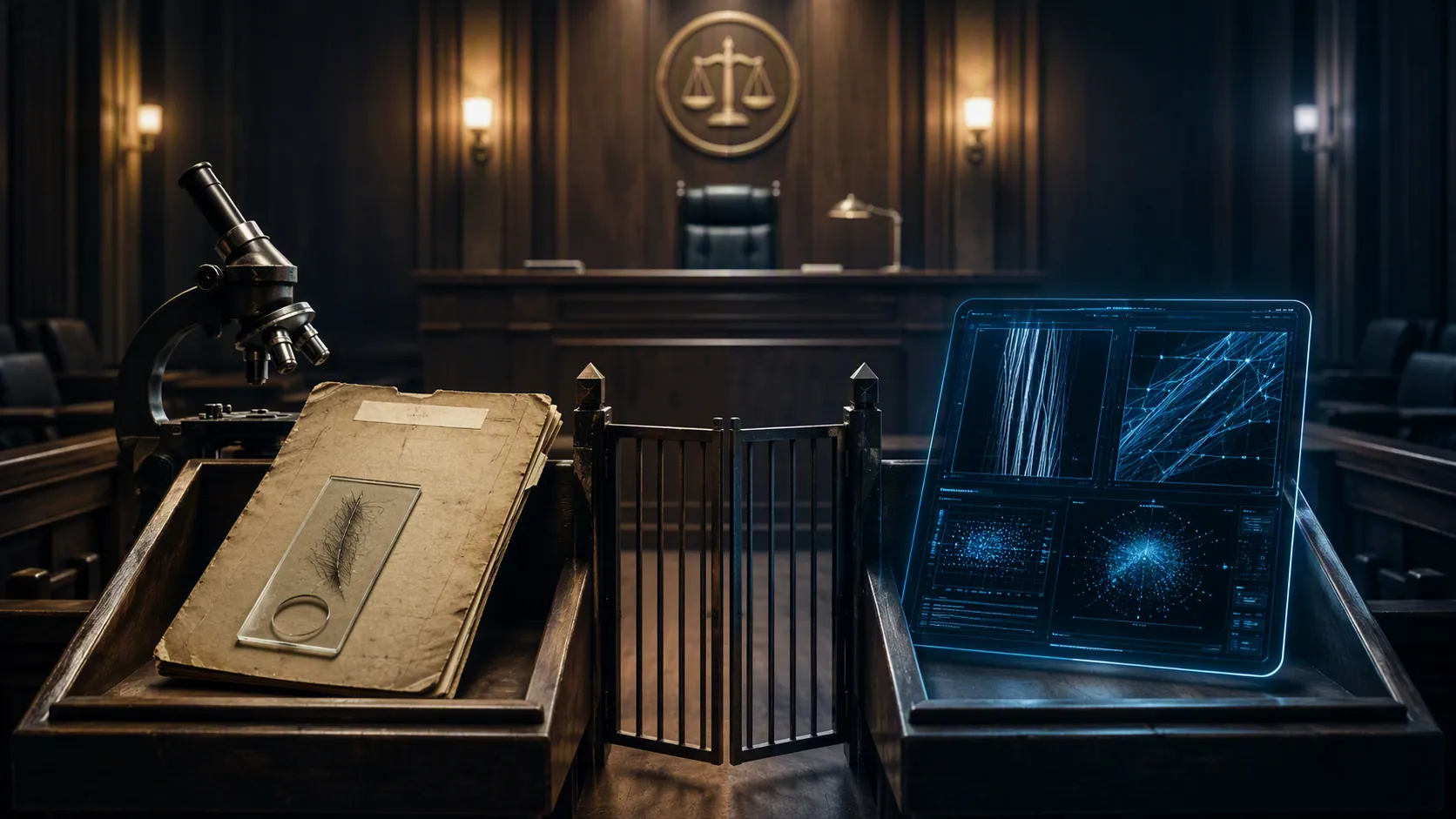
At Duckett’s trial, FBI analyst Michael Malone testified about pubic hair comparison evidence linking Duckett to the case. The later problem was not merely that hair microscopy aged poorly as a forensic discipline. The problem was narrower and more legally consequential: the Department of Justice later concluded that Malone’s testimony in Duckett’s case “exceeded the limits of science,” a finding documented in a 2012 letter to the State Attorney’s Office.[2]
That phrase matters because it identifies a gatekeeping failure in the language courts are supposed to understand. An expert may describe observed similarities. An expert may explain the limits of a comparison method. What the expert may not do, under any serious reliability standard, is make the method sound more individuating or conclusive than it is. Once that happens in front of a jury, the problem is no longer academic. The method’s limits have been converted into courtroom authority.
The disclosure timeline makes the injury harder to cabin. Defense and advocacy accounts state that the 2012 DOJ-related letter was not disclosed to Duckett’s counsel until roughly 2026.[2] If that account is right, then the defense was not merely fighting old forensic testimony. It was fighting testimony that an official review had already flagged, without timely access to the flag.
This distinction matters for lawyers who are tempted to treat post-conviction review as a sufficient backstop. A later letter can identify the overstatement. It cannot cross-examine the analyst at trial. It cannot change how jurors heard the word “match,” if that is how the testimony functioned. It cannot preserve a biological sample already consumed. Post-conviction process can sometimes correct a conviction; it cannot recreate the adversarial conditions that should have existed before technical evidence was admitted.
The surrounding record did not make the reliability problem smaller
The hair evidence was not the only contested feature of Duckett’s conviction. Gwen Gurley, identified in defense accounts as the sole eyewitness placing Duckett at the scene, gave six separate sworn recantations.[2][4] Those accounts state that she said investigators instructed her what to say and threatened her with jail.[2][4] A recantation is not self-proving. Six sworn recantations by the only witness placing a defendant at the scene are also not a procedural nuisance to be waved off as ordinary post-trial noise.
The late-record problem ran in the same direction. Duckett’s defense reportedly received more than 10,000 pages of records from four agencies two days before a post-conviction filing deadline, with unredacted records arriving at 8:03 p.m. the night before the filing was due.[1][2] Those details do not prove what was inside the records. They do show the shape of the disadvantage: the party challenging the conviction was expected to identify, analyze, and plead from a record produced on a schedule that made careful adversarial testing difficult.
Then came the DNA testing. The Florida Supreme Court’s March 2026 stay briefly created the appearance of a meaningful forensic pause. But FDLE’s testing was inconclusive and consumed the sample, foreclosing further testing.[2] The state’s position was that the testing was conducted appropriately and that other evidence supported the conviction. Even accepting that position as a litigation position, the risk remains visible: when the remaining sample is consumed, the system’s confidence shifts from retesting to trust in the process that consumed it.
The state’s evidence theory still has to be stated fairly
The prosecution did not rest its public position on hair comparison alone. State Attorney Bill Gladson’s office maintained that the evidence independently established Duckett’s guilt beyond a reasonable doubt, citing fingerprints on a patrol car hood, tire tracks, and witness testimony.[5] Contemporary execution-day coverage likewise described Duckett as a former police officer convicted in the rape and murder of an 11-year-old girl in 1987.[3]
That matters because a reliability analysis is not the same thing as an innocence finding. A court can conclude that some evidence was overstated without concluding that the verdict necessarily lacked all support. A prosecutor can point to cumulative evidence without answering every question about whether a jury heard an expert give more certainty than the method allowed. Those are different legal moves. They should not be collapsed into each other.
The capital posture makes the distinction less comfortable, not less necessary. Duckett was executed on the same day as another Florida prisoner, in what news accounts described as Florida’s first same-day double execution since 1964.[6] That fact supplies gravity, but it should not become the center of the evidentiary analysis. The harder question is what the court system had already allowed into the record before the final warrant clock began to run.
What Duckett shows about technical evidence
The useful lesson from Duckett is structural. Technical evidence can become dangerous when four conditions appear together: the method is presented with more certainty than it can support; the opponent lacks timely access to the materials needed to test it; later review identifies the problem only after the verdict has hardened; and the underlying evidence cannot be meaningfully reproduced, retested, or reexamined.
| Reliability condition | Duckett record |
|---|---|
| Expert stayed within the method | DOJ later concluded Malone’s hair-comparison testimony exceeded the limits of science.[2] |
| Opponent could test the evidence in time | Defense accounts say the DOJ-related warning from 2012 was not disclosed to counsel until roughly 2026.[2] |
| Record could support later review | More than 10,000 pages reportedly arrived two days before a post-conviction deadline, with unredacted records arriving the night before filing.[1][2] |
| Physical evidence remained available | FDLE testing returned inconclusive results and consumed the critical sample, preventing further testing.[2] |
None of those conditions requires bad faith. A lab can follow its protocol and still leave the opposing party with no sample. A prosecutor can believe other evidence proves guilt and still possess late-disclosed information that would have mattered to cross-examination. A court can apply the law available at the time and still create a record that later looks fragile because the expert’s certainty outpaced the method.
That is why the timing of reliability review is not a housekeeping issue. Daubert and Rule 702 are often discussed as if they are filters for excluding bad science. They are also timing rules. They ask the court to decide, before the evidence shapes a verdict or ruling, whether the proponent has shown that the expert’s opinion reliably applies a reliable method to sufficient facts. If the court postpones that inquiry until after the system has acted on the evidence, the later proceeding may be reviewing a record that can no longer be rebuilt.
The AI evidence parallel is about gatekeeping, not analogy by slogan
No cited source in Duckett’s case claims that FBI hair microscopy and AI-generated evidence are the same. They are not. Hair comparison involved human microscopic comparison and expert testimony about physical trace evidence. AI-generated evidence can involve model outputs, automated classifications, synthetic reconstructions, probabilistic scoring, document analysis, voice or image processing, or expert work product assisted by tools whose internal operation may be opaque to the opposing party.
The parallel is procedural. Courts are again being asked to admit technical outputs whose apparent precision may exceed what the underlying method can prove. The risk is not that every AI output is junk. The risk is that a model result can enter the record as if it were a neutral technical fact before the opponent can inspect the input data, reproduce the output, test alternative settings, evaluate error modes, or determine whether the tool was used outside its validated purpose.
The Duckett record makes one point especially hard to avoid: preservation is part of reliability. If an AI system generates an output that later becomes evidence, the relevant materials cannot be limited to a screenshot or a conclusory expert report. The parties may need the input files, prompts or configuration, model or tool version, preprocessing steps, output logs, confidence scores if used, human edits, and enough documentation to test whether the result can be reproduced. Without those materials, cross-examination becomes theater around a black box.
The most important AI-evidence questions under Daubert and Rule 702 are therefore practical, not decorative:
- Can the proponent identify the tool, version, training or reference materials to the extent relevant, and the specific settings used?
- Can the opposing party reproduce the output or meaningfully test why reproduction is impossible?
- Has the expert separated what the system actually produced from the expert’s own interpretation?
- Does the claimed use match the system’s demonstrated limits, or is the expert using technical vocabulary to outrun validation?
- Were inputs, outputs, intermediate files, and audit logs preserved before litigation incentives made reconstruction unreliable?
Those questions are not anti-technology. They are the ordinary demands of adversarial proof applied before the proof becomes irreversible. A party offering AI-assisted analysis may be able to answer them. If so, the evidence may survive scrutiny. If not, the court should not let the aura of computation do the work that foundation, testing, and disclosure are supposed to do.
Late correction is not the same as meaningful testing
Duckett’s case is uncomfortable because each late-stage safeguard arrived carrying its own limitation. The DOJ-related conclusion about Malone’s testimony identified overstatement, but defense accounts say it reached counsel years after it should have mattered most.[2] The record production supplied volume, but on a schedule that made use of the material difficult.[1][2] The DNA stay allowed testing, but the testing was inconclusive and consumed the sample.[2] The process kept moving, yet the defense function kept encountering evidence after its practical value had deteriorated.
That is the warning for AI evidence. A later disclosure that a model version changed, that source data was incomplete, that a vendor cannot reproduce an output, or that an expert overstated what the tool could determine may be important. It may also be too late. If the original inputs were not preserved, if the system is no longer available, if the output was embedded into an expert opinion without a separate audit trail, the court is not conducting reliability review in the same evidentiary world that existed before admission.
The point is not to turn Duckett into a universal template. His case does not prove that AI evidence is equivalent to FBI hair microscopy, and it does not resolve his guilt or innocence. It shows why courts should be wary of admitting technical evidence first and asking reliability questions later, especially when later testing may be impossible. Daubert and Rule 702 matter most before expert certainty hardens into a courtroom fact.
References
- Florida Supreme Court Stays Execution of James Duckett, Death Penalty Information Center
- James Duckett: A Case Marked by Unanswered Questions, Floridians for Alternatives to the Death Penalty
- Florida executes ex-police officer convicted of murder, PBS NewsHour, July 28, 2026
- DNA Testing and Withheld Evidence Raise Doubts in Florida Murder Case, Davis Vanguard
- Statement on the Execution of James Duckett, Office of State Attorney Bill Gladson
- Florida double-execution live recap, Tallahassee Democrat, July 28, 2026
Related records
Tool profile
How Meta's AI Spending Reshapes Law Firm ProfitabilityGoverning regulation
Browse the obligations tracker →Preventive workflow
Browse verification workflows →
Report a correction or tip
Spotted an outdated figure, a misstated fact, or a ruling this case record should reflect? Public comments are disabled for this content given the professional cost of a misreported case outcome, penalty amount, or rule text — use the structured correction channel instead.
Report a correction or tip for this record →