
What Surveillance Video Legally Proves in the Elizabeth Waddell Case
The Elizabeth Waddell missing-person surveillance footage captures entry into water but no return. This article explains what a litigator can and cannot argue the video proves under US evidence law, focusing on negative video evidence and its limitations.
- Jurisdiction
- Grenada
- Court
- Grenada (no specific court)
- AI tool named
- Topaz Video AI
- Ruling date
- Jul 31, 2026
- Source document
- View primary court order ↗
- Last verified
- Jul 31, 2026
Lex Machina Review is an independent risk-tracking and reference resource. Nothing on this site is legal advice, and using it does not create an attorney-client relationship. Every record is reviewed against primary sources but may not reflect the most current status of a matter — always verify directly against the cited court order, rule text, or a licensed attorney before relying on it.
Companion explanation — secondary to the source document above
The hard part of analyzing the Elizabeth Waddell surveillance footage is not the first image. A fixed camera can show a person on a jetty. It can show movement toward water. It can show a water entry. The legal trouble begins with the image it does not show: a return.
Public reports describe a narrow sequence: Waddell walking on a jetty at about 11:36 a.m., entering the water at about 11:51 a.m., still visible swimming at about 12:04 p.m., and a friend checking the shore at about 12:46 p.m.; police have said no return was captured on the surveillance footage.[1] That last phrase is doing more work than it may safely bear. “No return captured” is a camera-bound statement. It is not, by itself, a complete account of what happened after the last visible swimming image, after the friend’s check, or outside the camera’s field of view.

That distinction matters because video evidence usually arrives in court with two different jobs. First, the proponent must get it admitted. Then the factfinder must decide what it actually proves. A recording may clear the first hurdle and still be weak on the second, especially when the argument depends on what the recording failed to show.
What the footage affirmatively proves, if authenticated
If the Waddell footage were assessed under the familiar U.S. evidence framework, the starting point would be Federal Rule of Evidence 901: the proponent must offer evidence sufficient to support a finding that the item is what the proponent claims it is. For surveillance video, courts often treat the recording as a “silent witness.” The video can speak for itself if there is enough foundation about the camera system, the recording process, the handling of the file, and the absence of material alteration.
On the known timeline, an authenticated recording could support several concrete propositions. It could support that a person identified as Waddell appeared on the jetty at the reported time. It could support that she moved toward and entered the water. It could support that she was visible swimming within the recorded window. Those are affirmative visual facts, assuming the identification and system foundation hold.
| Reported moment | What the video can support | What it does not alone establish |
|---|---|---|
| 11:36 a.m. | A person identified as Waddell appears walking on the jetty. | Why she went there, what she intended, or whether anyone outside the frame was relevant. |
| 11:51 a.m. | The person enters the water. | The later path taken after leaving the visible entry area. |
| 12:04 p.m. | The person remains visible swimming. | Her condition after she is no longer visible. |
| 12:46 p.m. | A friend checks the shore, according to public reports. | That every possible exit, return route, or shoreline area was observed by the camera. |
| After 12:46 p.m. | No return image was captured within the disclosed account of the footage. | That no return occurred anywhere, by any route, or outside the camera’s view. |
The table looks simple because the legal discipline is simple at first: keep the image tied to the proposition. A frame showing water entry is strong evidence of water entry. A frame not showing return is not the same kind of evidence unless the proponent can also establish the conditions under which a return would necessarily, or at least probably, have been captured.
Authentication is usually mundane, and that is the point
Authentication fights over surveillance video rarely turn on grand claims about truth. They turn on who knew the system, who retrieved the file, whether the clip is complete enough for the offered purpose, and whether anything happened during copying or storage that makes alteration a real concern.
Reddick v. State is useful because it shows that a proponent does not always need the system technician. A lay witness familiar with the recording system may supply enough foundation under the silent-witness doctrine, depending on the facts.[2] State v. Jones points in the same practical direction: the North Carolina Court of Appeals accepted officer testimony as sufficient to authenticate surveillance video even though the officer lacked direct familiarity with the camera system.[3]
But the same body of law also resists shortcuts. State v. Moore excluded a cell-phone recording of surveillance footage where the chain of custody was broken, while State v. Snead held that a complete chain of custody is not always required for surveillance video.[3] Those cases are not contradictory in the way non-lawyers sometimes assume. They show that courts ask whether the available foundation is enough for the particular recording and the particular use being made of it.
That is why the Waddell footage cannot be analyzed as though a U.S. judge has already admitted it. The case is an ongoing missing-person matter, not a decided U.S. evidence ruling. Grenada’s Electronic Evidence Act governs the original footage, and any later U.S.-connected proceeding would raise its own choice-of-law and authentication questions. U.S. evidence law is useful here as a predictive framework for litigators, not as a report of an existing ruling.
The missing return image is negative video evidence
The phrase “negative video evidence” is not meant to make the footage sound exotic. It describes a common evidentiary move: using the absence of an image to argue the absence of an event. In the Waddell case, the proposed inference would be that because the camera did not capture a return, she did not return.
That inference can have some force, but only after the camera is treated as a limited instrument rather than a neutral witness with perfect recall. A camera sees what its lens covers, during the intervals it records, at the resolution and frame rate available, after compression, under the lighting and weather conditions present, from one fixed perspective. The legal value of “not on the video” depends on all of those things.
The broader research on camera evidence supports that caution. Murray and colleagues, as discussed by Peters and Black, found that body-worn cameras captured only 66.2% of critical incidents officers perceived, and recorded suspect weapons 49% of the time compared with 75% officer perception.[4] That study was about body-worn cameras, not a fixed shoreline surveillance camera, so it should not be overread. Its narrower lesson is enough: absence from a recording is not automatically absence from reality.
Peters and Black also describe problems that can affect video interpretation even when the recording is genuine: compression artifacts, frame-rate gaps, wide-angle distortion, perspective effects, and lighting failures.[4] Those are not academic annoyances when a case turns on a return that was not seen. They are the facts that decide whether the non-image has meaningful probative value.
Field of view
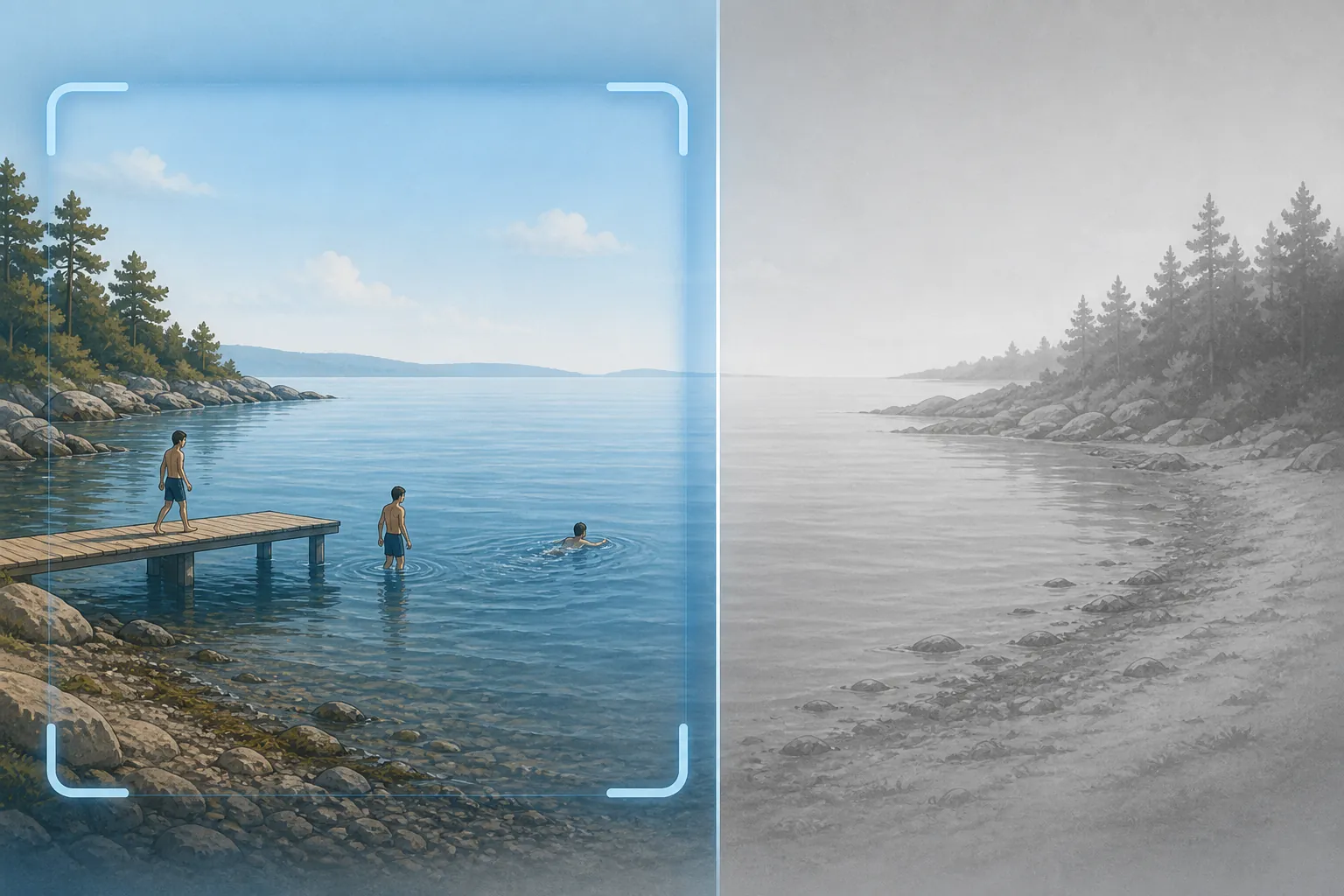
The most important undisclosed fact is the field of view. If the camera covered the only practical exit point from the water and the only path back to shore, the absence of a return image would carry more weight. If it covered only part of the jetty, one shoreline angle, or one return path, the same absence would be much weaker.
The public timeline does not disclose enough camera-specific information to resolve that question. A litigator could fairly say the footage did not capture a return within the camera’s view. Without more, the stronger sentence — that Waddell did not return — asks the camera to testify beyond its lens.
Time and continuity
The known sequence includes a visible swimming image at about 12:04 p.m. and a friend checking the shore at about 12:46 p.m.[1] That interval is not automatically empty just because the public account does not describe every frame. A full forensic review would need to know whether the recording was continuous, motion-triggered, overwritten in segments, exported as clips, or affected by any dropped frames or gaps.
Frame rate matters for the same reason. A low-frame-rate recording may miss brief movement through a peripheral area. Compression can also smear or obscure small figures against water, glare, or shoreline texture. These limits do not make video useless. They determine the safe boundary of the inference.
Perspective
Perspective can make conduct look more certain than it is. Granot and colleagues’ work on naive realism, and Lassiter and colleagues’ work on camera perspective bias in confession videos, are not shoreline cases; they concern the way viewers treat camera images as more complete and neutral than they may be.[4] The transferable point is modest but important: factfinders often need help separating what a video displays from what a viewer supplies.
That separation is especially important where a video ends with a human blank. A missing-person timeline invites narrative completion. Once viewers know there was no captured return, every wave, pause, or absence can start to feel like a clue. Courtroom use should resist that drift unless the underlying camera facts justify it.
Screenshots, enlargement, and the danger of artificial clarity
Still frames are often necessary in briefing and trial presentation. They are also dangerous because they can make a moving, low-information image look more definite than the recording permits. Cunningham v. Shelby County is the cautionary example: the Sixth Circuit rejected frame-by-frame screenshot analysis that created “artificial clarity.”[4]
In a Waddell-type record, enlarged frames might help orient a witness to the jetty, the water entry point, or the visible swimming area. They should not quietly become enhanced proof of a route, condition, or non-return unless the proponent can explain how the images were generated and why the process did not add certainty the original recording lacked.
The current authentication discussion is moving in that direction. Commentary on 2026 video evidence standards emphasizes that courts are increasingly attentive to metadata, chain of custody, system reliability, and alteration risk, especially as synthetic and manipulated media become easier to generate.[5] That does not mean every ordinary surveillance clip is suspect. It means the foundation has to match the claim being made.
AI enhancement is a caution, not the center of this record
There is no disclosed basis, on the materials provided, to say the Waddell footage was AI-enhanced. So enhancement should not become the center of the analysis. The relevant point is narrower: if a party later relies on enlarged, clarified, upscaled, or AI-processed versions of the recording, the legal question changes.
State v. Puloka shows why. A Washington trial court excluded Topaz Video AI-enhanced footage under Frye after the tool added 16 times the original number of pixels through opaque generative prediction; the same reporting notes SWGDE cautions against machine-learning upscaling in forensic casework.[6] The concern is not that software improves visibility. The concern is that generated pixels may look like recovered detail when they are partly prediction.
The deepfake problem also changes the burden of explanation around video evidence. The National Center for State Courts has warned that AI-generated evidence threatens public trust in courts, and the practical effect is that parties may increasingly have to rebut claims of manipulation even for video that once would have seemed routine.[7] For Waddell, that is a contingency: important if altered or enhanced versions are offered, but not a substitute for the more immediate questions about field of view, continuity, and camera coverage.
What a litigator can safely argue
A careful proponent can argue that the footage, if properly authenticated, is substantive evidence of the visible acts it records. The person identified as Waddell appears on the jetty. She enters the water. She is later visible swimming. A friend later checks the shore. The footage, as publicly described, does not capture a return.
A careful opponent does not need to argue that the video is worthless. The stronger objection is more precise: the absence of a return image proves only that no return was captured by that camera, under that system’s operating conditions, within that disclosed view and time window. If the proponent wants the absence to mean more, the proponent needs camera-specific facts.
- The camera’s exact field of view and whether it covered all plausible return routes.
- Whether the recording was continuous, motion-activated, clipped, or exported from a longer file.
- The frame rate, resolution, compression settings, and any known dropped-frame issues.
- Lighting, glare, weather, distance, and perspective conditions during the relevant window.
- The chain of custody for the original file and any copies, stills, enlargements, or enhanced versions.
Those facts could move the analysis. A camera that continuously covered the only viable exit point would make non-return within that location more probative. A camera with partial shoreline coverage, motion-triggered gaps, low frame rate, or glare would make the same absence less probative. The legal conclusion depends less on the emotional force of the image than on the mechanics of how the image was made.
The defensible boundary
Under FRE 901 and the silent-witness doctrine, the Waddell surveillance footage could support presence, movement along the jetty, water entry, and visible swimming within the recorded window, assuming a proper foundation. It could also support the narrower negative proposition that no return was captured within the camera’s constrained view. It cannot, without more disclosed camera-specific facts or corroborating evidence, prove what happened after 12:46 p.m. or outside the frame.
References
- Waddell surveillance timeline reporting, WRAL, ABC11, NBC News, CBS News, NY Post, and ABC News police-commissioner statements
- Authentication of Surveillance Video by Lay Witness Under Silent-Witness Doctrine, EDRM, 2024
- Surveillance Video: When It Comes In and When It Doesn’t, North Carolina Criminal Law Blog, 2024
- Video Doesn’t Lie? The Dangerous Myth Behind Camera Evidence, Police and Security News, May 26, 2026
- Video Evidence Authentication: Legal Standards for 2026, DigitalEvidence.ai
- When AI Invents the Pixels: Challenging AI-Enhanced Video Evidence in Criminal Cases, Criminal Legal News, December 15, 2025
- AI-generated evidence: threat to public trust in courts, National Center for State Courts
Related records
Tool profile
How Meta's AI Spending Reshapes Law Firm ProfitabilityGoverning regulation
Browse the obligations tracker →Preventive workflow
Browse verification workflows →
Report a correction or tip
Spotted an outdated figure, a misstated fact, or a ruling this case record should reflect? Public comments are disabled for this content given the professional cost of a misreported case outcome, penalty amount, or rule text — use the structured correction channel instead.
Report a correction or tip for this record →