
What Happened to Elize Matsunaga's Husband? Legal Timeline
A step-by-step procedural account of the Elize Matsunaga case from the 2012 arrest through conditional parole in 2022, explaining how Brazil's sentencing formula, the confession attenuant under Súmula 545 STJ, and the jury sovereignty doctrine shaped the final outcome.
- Jurisdiction
- Brazil
- Court
- Tribunal do Júri de São Paulo
- AI tool named
- No AI tool implicated
- Ruling date
- Dec 5, 2016
- Source document
- View primary court order ↗
- Last verified
- Jul 27, 2026
Lex Machina Review is an independent risk-tracking and reference resource. Nothing on this site is legal advice, and using it does not create an attorney-client relationship. Every record is reviewed against primary sources but may not reflect the most current status of a matter — always verify directly against the cited court order, rule text, or a licensed attorney before relying on it.
Companion explanation — secondary to the source document above
The legal answer to “what happened to Elize Matsunaga’s husband” begins in São Paulo criminal procedure, not in the usual true-crime fog. Marcos Kitano Matsunaga was killed in 2012; Elize Matsunaga was arrested on June 4, 2012; a jury convicted her in December 2016 of qualified homicide and corpse concealment; the published sentence reached 19 years, 11 months, and 1 day; the Superior Court of Justice later reduced the homicide term in March 2019 because the sentencing court had not applied the confession attenuant; a later STJ proceeding in June 2019 did not reopen the jury’s factual verdict; and later custody reporting places her on conditional parole in 2022 after sentence-execution progression from closed custody to less restrictive conditions.[1][2][3][4]
The strongest legal materials for the central arc are the published sentencing text reproduced by Conjur, Conjur’s reporting on the two 2019 STJ outcomes, and the later custody chronology collected in Portuguese-language case records. Conjur is legal journalism, not the STJ docket itself; that distinction matters. But for the sentencing arithmetic and the reported holdings, it is far sturdier than entertainment recaps that compress Brazilian procedure into atmosphere.

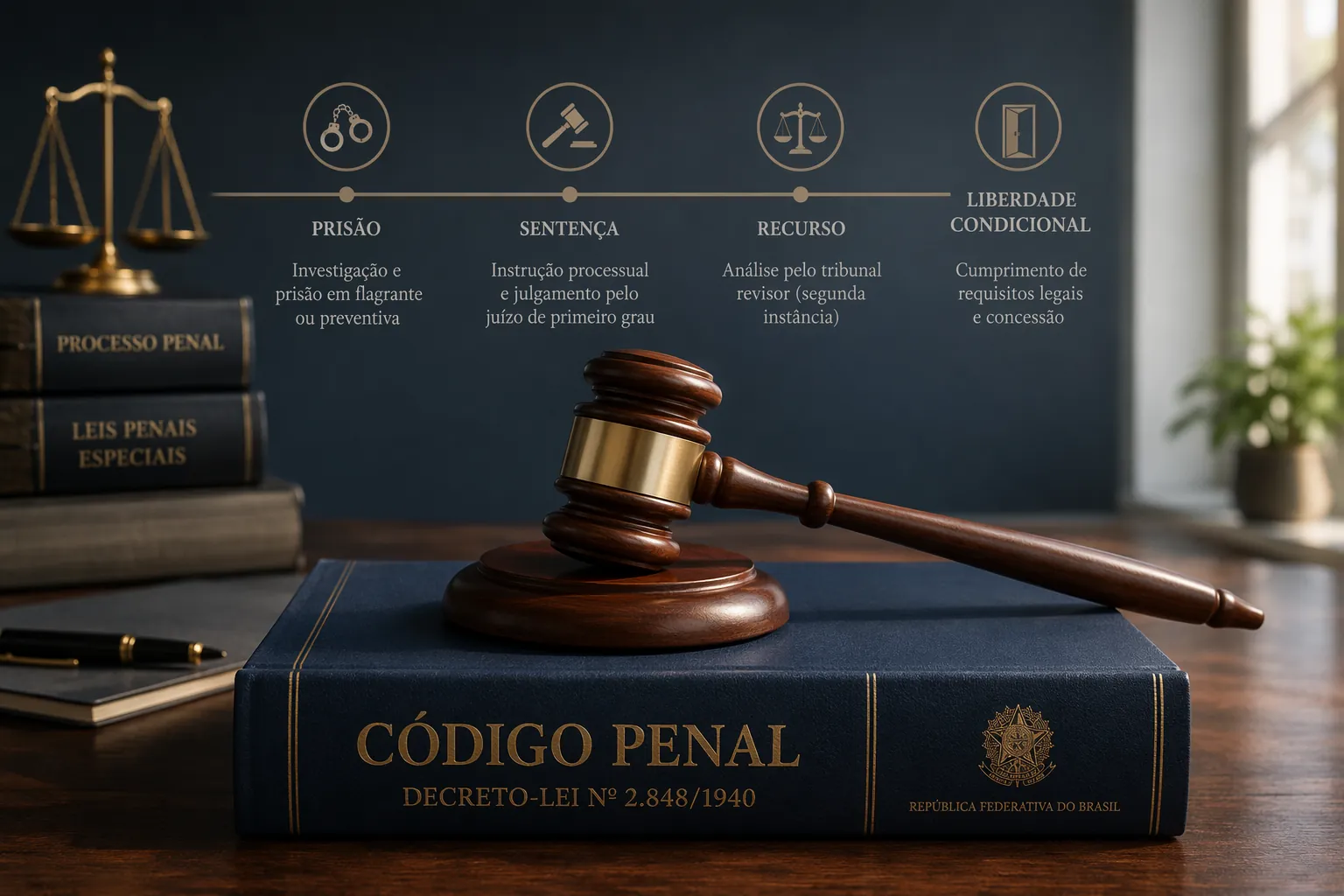
The procedural timeline in one view
| Date or period | Procedural event | Legal significance |
|---|---|---|
| June 4, 2012 | Elize Matsunaga was arrested. | The case entered the criminal-custody timeline that later mattered for sentence execution and release calculations.[2] |
| December 2016 | A São Paulo jury convicted her; the sentencing text was published on December 5, 2016. | The court imposed punishment for qualified homicide and corpse concealment, reaching 19 years, 11 months, and 1 day.[1] |
| March 22, 2019 | STJ ruling in HC 450.201 reduced the punishment. | The Fifth Panel recognized the confession attenuant under Article 65, III, “d” of the Penal Code, applying Súmula 545 STJ as reported by Conjur.[3] |
| June 27, 2019 | STJ denied a later defense appeal. | The court did not disturb the jury’s verdict, relying on the constitutional sovereignty of jury verdicts as a limit on appellate reweighing.[4] |
| 2012–2022 | Custody and sentence-execution progression. | The reported path ran from closed custody at Tremembé through semi-open work oversight and then conditional parole in 2022.[2] |
That is the legal spine. The rest of the case is important only when it explains why the jury found the qualifiers it did, why the judge calculated the sentence as he did, and why the STJ changed one part of the punishment while leaving the verdict itself intact.
What the jury found, not just what the story says
The homicide charge was not treated as a simple killing. The jury accepted three qualifiers under Article 121, paragraph 2 of the Brazilian Penal Code: motivo torpe, meio cruel, and recurso que impossibilitou a defesa da vítima — commonly rendered, with some loss of legal texture, as base motive, cruel means, and use of a resource that made the victim’s defense impossible. The conviction also included corpse concealment.[1]
The basic factual outline was that Marcos Matsunaga was shot, his body was dismembered, and the remains were concealed. Those facts are not decoration. The shooting and the circumstances of vulnerability fed the qualified-homicide analysis; the postmortem disposal supported the separate corpse-concealment conviction. CCTV material and cell-phone evidence appear in case chronologies and media accounts as evidentiary context, but they are not the reason the 2016 sentence has to be read carefully.[2]
English-language coverage often moves too quickly from confession to conclusion. In Brazilian jury procedure, however, a confession does not dissolve the jury’s task. A defendant may admit conduct, dispute intent, dispute qualifiers, dispute timing, or give a version that the prosecution treats as incomplete. The legal question later before the STJ was not whether she was innocent. It was whether the confession, even if partial or qualified, had contributed to the conviction in a way that required mitigation at sentencing.
The 2016 sentence: 18 years and 9 months plus the concealment term
The published sentencing text is the first place where the case becomes unusually legible. The judgment imposed 18 years and 9 months for the qualified homicide and 14 months for corpse concealment, with the final published result stated as 19 years, 11 months, and 1 day.[1]
The number deserves to be read as a calculation, not as a mood. The homicide sentence carried the main punitive weight because the jury had accepted multiple qualifiers. The corpse-concealment sentence was separate: it punished the later concealment of the body, not the death itself. In rough visible arithmetic, 18 years and 9 months plus 14 months yields 19 years and 11 months; the published dispositive total also contains 1 day, which should not be silently rounded away when describing the outcome.[1]
That final sentence was severe, and it was severe for identifiable reasons. The jury’s acceptance of qualified homicide moved the case into a harsher legal category; the separate concealment count added punishment for the treatment of the body after death; and the initial sentencing judge did not give the confession the mitigating effect that the STJ later said it required.
HC 450.201: why the STJ reduction was not a vague “technicality”
On March 22, 2019, Conjur reported that the STJ’s Fifth Panel reduced the sentence in HC 450.201 by recognizing the mitigating effect of confession. The homicide sentence moved from 18 years and 9 months to 16 years and 3 months — a reduction of 2 years and 6 months.[3]
The doctrinal hinge was Article 65, III, “d” of the Penal Code, which treats confession as an attenuating circumstance, and Súmula 545 of the STJ. As reported, Súmula 545 provides that when a confession is used to form the sentencer’s conviction, the attenuant applies even if the confession was partial or qualified.[3]
That rule is more precise than the usual shorthand. It does not say every statement by a defendant automatically reduces punishment. It does not say the court must accept the defendant’s entire version. It says that if the confession contributed to the conviction, the sentencing court must account for it as a mitigating factor. Brazilian doctrine often describes this problem through the divisibility of confession: the court may reject the exculpatory or minimizing parts while still recognizing the inculpatory part’s evidentiary contribution.
That is why the STJ’s intervention changed the sentence without changing the crime of conviction. The jury’s findings on qualified homicide and corpse concealment remained in place. The legal correction occurred at the punishment-calculation stage: the court recognized an attenuant that the earlier sentencing calculation had not given effect to, and the visible consequence was the 2-year-and-6-month reduction in the homicide component.[3]
Calling that a reduction “on a technicality” obscures more than it explains. Sentencing rules are not ornamental. If a legal system tells judges that a confession used to support conviction must mitigate punishment, then failure to apply that rule is a sentencing error. The STJ did not need to sentimentalize the defendant to correct the arithmetic.
The later STJ denial: jury sovereignty as a limit, not a melodrama
The second 2019 STJ outcome is just as important because it shows the opposite kind of appellate move. On June 27, 2019, Conjur reported that the STJ denied a defense appeal and maintained the conviction, invoking the sovereignty of jury verdicts.[4]
Jury sovereignty is often overread. It is not a theatrical declaration that every factual allegation was correct in every detail. It is a limiting rule on appellate review. Where the Tribunal do Júri has made factual findings within its constitutional domain, the reviewing court does not simply substitute its own reading of the evidence because another interpretation could be imagined.[4]
Placed beside HC 450.201, the point is clean. The STJ could correct a sentencing-law error concerning the confession attenuant. It would not, through the later appeal, re-try the factual basis of the jury’s verdict as though the jury had never spoken. One proceeding adjusted the penalty; the other preserved the verdict.
Sentence execution: from closed custody to conditional release
The post-conviction story is where many summaries become stale. A nominal sentence is not the same thing as a continuous stay in the same prison regime until the last calendar day. Brazilian execução penal allows regime progression and release mechanisms when legal requirements are met. The later custody chronology records Elize Matsunaga at Tremembé, then in semi-open conditions with work oversight through a FUNAP sewing workshop, and later on conditional parole in 2022.[2]
This is the difference between saying “she was sentenced to nearly 20 years” and saying “she remained in closed custody for nearly 20 years.” The first describes the 2016 punishment before the STJ reduction. The second would describe a custody status, and custody status changes under execution-law rules. A reader who wants legal accuracy has to keep those categories separate.
The reported 2022 conditional parole also explains why older English-language accounts can now mislead even when they were not necessarily careless at the time. Some 2021 coverage still framed her as incarcerated through the nominal sentence period, before later reporting and case chronologies reflected conditional release.[5][6][2]
What is current in 2026, and what still needs official checking
Current 2026 recaps consistently report conditional parole in 2022 and describe a post-release life in the interior of São Paulo, including use of the name Elize Araújo Giacomini and work outside prison. Those details are useful only with a caveat: official prison-administration confirmation was not independently accessed for this article. They should be treated as current reporting, not as a substitute for up-to-date Brazilian administrative records.
The same restraint applies to psychological material. Later accounts describe evaluations that found no psychopathy while discussing depressive disorder, narcissistic traits, and emotional-development issues, but the original evaluation files were not independently retrieved here. Those materials may interest viewers of the Netflix treatment. They do not alter the procedural sequence: arrest, jury conviction, sentencing calculation, STJ mitigation correction, appellate deference to the jury, and sentence-execution progression.
So the legally useful version of the Matsunaga case is neither “she walked free” nor “the sentence was reduced on a technicality.” The case shows a Brazilian jury imposing punishment for triply qualified homicide and corpse concealment; the STJ later enforcing confession-mitigation doctrine without undoing the verdict; a separate STJ ruling declining to reweigh the jury’s factual decision; and execution-law rules permitting movement from closed custody to conditional release. For present custody status, parole conditions, or name-change details, the responsible final step is still the least glamorous one: check current Brazilian administrative records before treating any recap as definitive.
References
- Elize Matsunaga é condenada por crime hediondo; leia a sentença, Conjur, December 5, 2016
- Assassinato de Marcos Matsunaga, Wikipédia
- STJ reduz pena de Elize Matsunaga por reconhecimento de confissão, Conjur, March 22, 2019
- STJ nega recurso e mantém condenação de Elize Matsunaga, Conjur, June 27, 2019
- Elize Matsunaga Now: Where Is the Killer From Netflix's Once Upon a Crime Today?, Newsweek, 2021
- Elize Matsunaga: Once Upon a Crime Is Netflix’s Newest True Crime Obsession, Esquire, 2021
Related records
Tool profile
How Meta's AI Spending Reshapes Law Firm ProfitabilityGoverning regulation
Browse the obligations tracker →Preventive workflow
Browse verification workflows →
Report a correction or tip
Spotted an outdated figure, a misstated fact, or a ruling this case record should reflect? Public comments are disabled for this content given the professional cost of a misreported case outcome, penalty amount, or rule text — use the structured correction channel instead.
Report a correction or tip for this record →