
What Emma Coronel's Docket Says About Life After Prison
Emma Coronel's life after prison is usually told through interviews; this record goes to the federal docket in United States v. Coronel Aispuro for the verifiable facts — charges, plea, sentence, release date, and post-custody status — so readers can check the public narrative against the actual court filings.
- Jurisdiction
- US Federal
- Court
- U.S. District Court
- AI tool named
- No AI tool implicated
- Source document
- View primary court order ↗
- Last verified
- Aug 25, 2026
Lex Machina Review is an independent risk-tracking and reference resource. Nothing on this site is legal advice, and using it does not create an attorney-client relationship. Every record is reviewed against primary sources but may not reflect the most current status of a matter — always verify directly against the cited court order, rule text, or a licensed attorney before relying on it.
Companion explanation — secondary to the source document above
Searches for “emma coronel interview life after prison el chapo” usually lead with the interview frame: the appearance, the quote, the post-custody image, the question of what changed after federal prison. That is not the same as a verified case record. For Emma Coronel Aispuro, the starting point for any careful account is the federal case captioned United States v. Coronel Aispuro—not the most recent public retelling of what life now looks like.
A docket-anchored version of the story asks narrower questions than an interview does. What charge was filed? What plea was entered? What sentence did the court impose? What custody record reflects release? What legal status, if any, remained after physical custody ended? Those questions do not describe a private life. They describe the boundary conditions around public claims about that life.
| Record point | What it can verify | What it cannot verify |
|---|---|---|
| Federal case | That the matter exists as a court proceeding under the stated caption | The meaning of every later public statement about the case |
| Charges | What prosecutors formally alleged in court filings | A complete biography or moral account of the defendant |
| Plea | What the defendant admitted or accepted in the proceeding | A lifestyle narrative rewritten from an interview |
| Sentence | What punishment the judge imposed | The exact amount of time ultimately spent in custody without checking custody records |
| Release and post-custody status | Whether physical custody ended and whether supervision or other legal consequences remained | A clean break from all federal consequences unless the judgment and custody records support that conclusion |
The record check belongs before the reinvention story
There is an easy way to flatten this case: describe Emma Coronel as El Chapo’s wife, mention prison, then move quickly into the language of life after release. That order is convenient for a profile. It is weak for verification.
The federal court record does not need to answer every question a reader may have about family life, self-presentation, remorse, work, publicity, or private adaptation. It cannot. But it does answer a different set of questions with more discipline than interviews usually provide. It fixes the procedural sequence. It separates what was alleged from what was admitted. It separates the sentence imposed from the custody experience that followed. It also prevents “released from prison” from being treated as shorthand for “free of all federal consequence” unless the record says so.
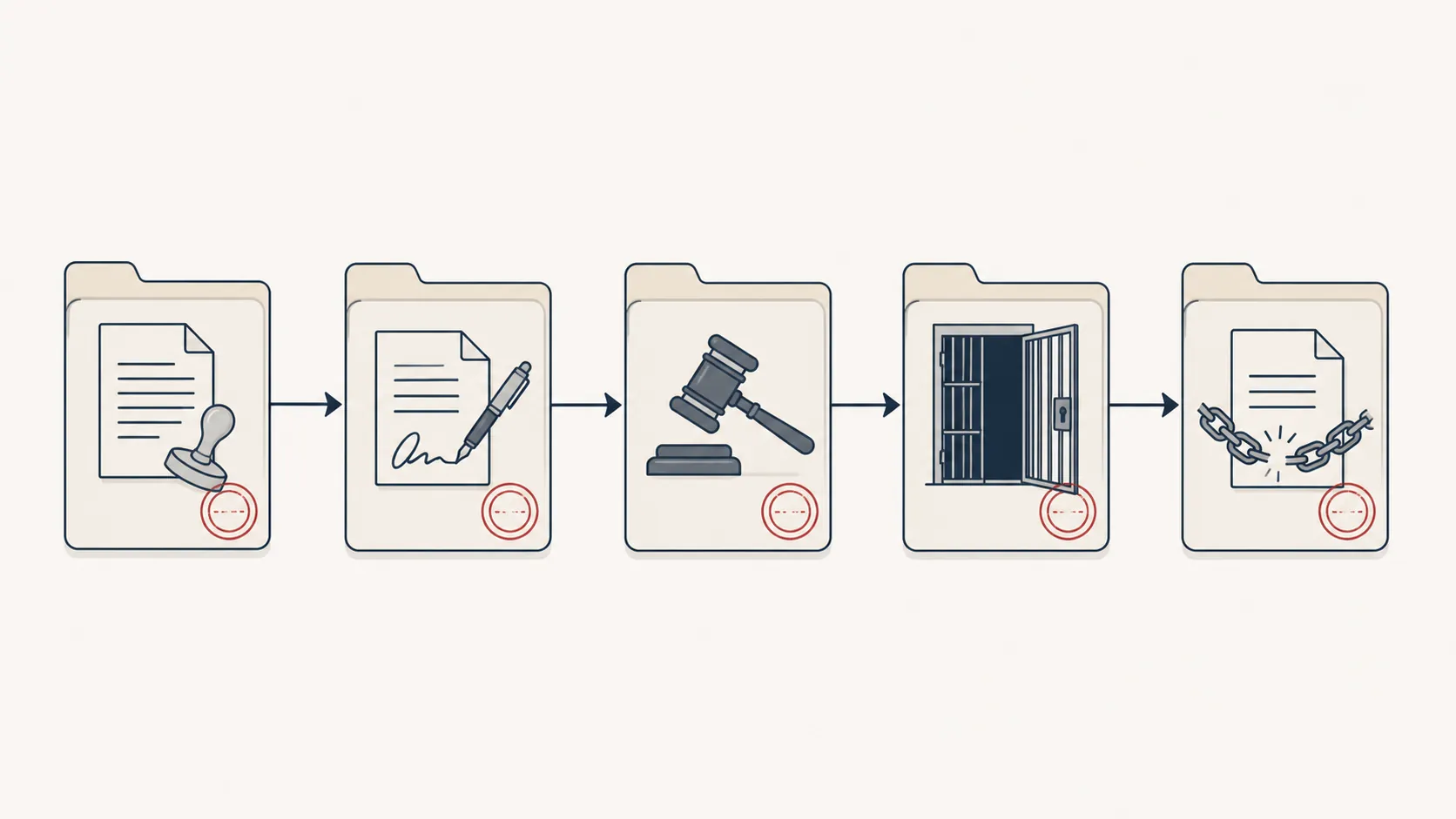
Charge, plea, sentence, release: why the order matters
A charge is a formal accusation. It is not a conviction, and it is not a full historical account. In a public narrative, a charge can become a headline label. In a docket, it has a narrower function: it tells the reader what the government brought into court and under what legal theory the case began.
A plea changes the posture of the case. It is not a magazine confession and should not be rewritten as one. A plea record shows what was entered in court, under the rules and consequences of a criminal proceeding. That distinction matters because interview language can soften, dramatize, or reorganize events around personality. A plea does not work that way. It is procedural, specific, and bounded by the record.
A sentence is another common place for confusion. The sentence imposed by a judge is the court’s punishment. The time a person ultimately spends in custody can be affected by custody calculations, credits, placement, and release administration. Those are not details to guess at from a public appearance. If a story says someone is “out,” the next question is not whether the person appeared relaxed, polished, emotional, or changed. The next question is what the custody record and judgment show.
Release from custody is also not the same thing as the end of the case’s legal shadow. Many federal judgments include post-custody terms. Whether such terms apply in a particular case has to be checked against the judgment and current record, not inferred from the fact that a person is no longer behind prison walls.
What an interview can add—and where it stops
An Emma Coronel interview about life after prison can explain why readers are asking the question now. It can show how she chooses to present the period after custody. It can supply tone, emphasis, and self-description. Those are real parts of public life, but they are not substitutes for the case file.
The trouble begins when an interview frame becomes the case frame. A public conversation usually moves toward legibility: before and after, silence and return, punishment and rebuilding. A docket is less satisfying. It may show a filed charge, a plea, a judgment, a custody transition, and remaining obligations, but it will not tell the reader what any of that felt like. That limitation is not a defect. It is the reason the docket is useful.

The claims that need the case file most
Some statements about life after prison are harmlessly descriptive: where a person appeared, what they said in an interview, how they framed their own next chapter. Other statements need a court-record check before they should be repeated as fact.
- If a story states what Emma Coronel was convicted of, it should track the plea and judgment rather than a shortened public label.
- If a story states how long she was sentenced to serve, it should distinguish the sentence imposed from the time ultimately spent in custody.
- If a story says she is free, it should clarify whether that means released from physical custody or free of all post-custody obligations.
- If a story treats a post-prison interview as the authoritative account of the federal case, it should be brought back to the docket sequence.
This is not a demand that every human story be reduced to docket entries. It is a demand that legal claims remain legal claims. A person can describe her own life after prison in broad, emotional, or strategic terms. A reporter repeating the procedural facts has a different obligation.
A narrower, more accurate way to read the post-prison story
For readers trying to understand the case, the backbone remains procedural: the federal case, the charge as filed, the plea as entered, the sentence as imposed, the custody release as reflected in official records, and any post-custody status that remains. Everything else may add context or color, but it should not be allowed to replace those facts.
The docket does not tell the whole story of Emma Coronel’s life after prison. It tells the part that public accounts are most likely to blur—and the part any accurate account has to respect.
Related records
Tool profile
How Meta's AI Spending Reshapes Law Firm ProfitabilityGoverning regulation
Browse the obligations tracker →Preventive workflow
Browse verification workflows →
Report a correction or tip
Spotted an outdated figure, a misstated fact, or a ruling this case record should reflect? Public comments are disabled for this content given the professional cost of a misreported case outcome, penalty amount, or rule text — use the structured correction channel instead.
Report a correction or tip for this record →