
Empire State Building stunt climbers face multiple felony charges
This Risk Digest record maps the three felony charges, statutory elements, sentencing exposure, and collateral consequences facing the two Empire State Building climbers arrested July 1, 2026, sourced to the criminal complaint and prior climbing-case precedents.
- Jurisdiction
- New York, United States
- Court
- Criminal Court of the City of New York
- AI tool named
- No AI tool named
- Ruling date
- Jul 1, 2026
- Source document
- View primary court order ↗
- Last verified
- Aug 1, 2026
Lex Machina Review is an independent risk-tracking and reference resource. Nothing on this site is legal advice, and using it does not create an attorney-client relationship. Every record is reviewed against primary sources but may not reflect the most current status of a matter — always verify directly against the cited court order, rule text, or a licensed attorney before relying on it.
Companion explanation — secondary to the source document above
Risk Digest record. Last verified: Aug. 1, 2026. This is a public-record exposure map, not legal advice, and it should not be read as a prediction of plea terms, trial outcome, immigration action, or sentencing. The record below is built from cited public reporting, quoted complaint allegations, and statute text; it is not a substitute for the filed complaint, docket sheet, or counsel’s case file.
The legal bottom line on the Empire State Building stunt arrests is narrower than the headlines make it sound. Angelina Nikolau, 33, and Ivan Kuznetsov, also identified publicly by the social-media name Ivan Beerkus, 32, were arrested after the July 1, 2026 climb and arraigned on felony charges tied to the incident. The felony posture is not explained by “climbing a building” in the abstract. It rests on specific allegations: unlawful restricted access, damaged locks, interruption of a broadcast antenna, and emergency responders sent up after them.[1]
| Charge | Statute and class | What the state must prove | Complaint facts now doing the work | Available maximum |
|---|---|---|---|---|
| Third-degree burglary | New York Penal Law § 140.20; class D felony.[2] | Knowingly entering or remaining unlawfully in a building with intent to commit a crime therein.[2] | The reported theory is not ordinary public entry into the Empire State Building. It is alleged hidden overnight remaining and restricted-floor access after the public visit ended.[1] | Public legal summaries describe class D felony exposure as up to 2 1/3 to 7 years in prison.[3] |
| First-degree reckless endangerment | New York Penal Law § 120.25; class D felony.[4] | Under circumstances evincing depraved indifference to human life, recklessly engaging in conduct that creates a grave risk of death to another person.[4] | The prosecution theory appears to depend on the alleged risk to others, especially Emergency Service Unit officers who reportedly climbed roughly 1,250 feet after the defendants, plus the antenna-area conditions.[1] | Public legal summaries describe class D felony exposure as up to 2 1/3 to 7 years in prison.[3] |
| Second-degree criminal mischief | New York Penal Law § 145.10; class D felony.[3] | Intentional property damage above the statutory dollar threshold, reported here as damage exceeding $1,500.[3] | The complaint allegations reported by USA TODAY include two cut locks on the restricted 104th floor and an approximately $2,000 replacement figure.[5] | Public legal summaries describe class D felony exposure as up to 2 1/3 to 7 years in prison.[3] |
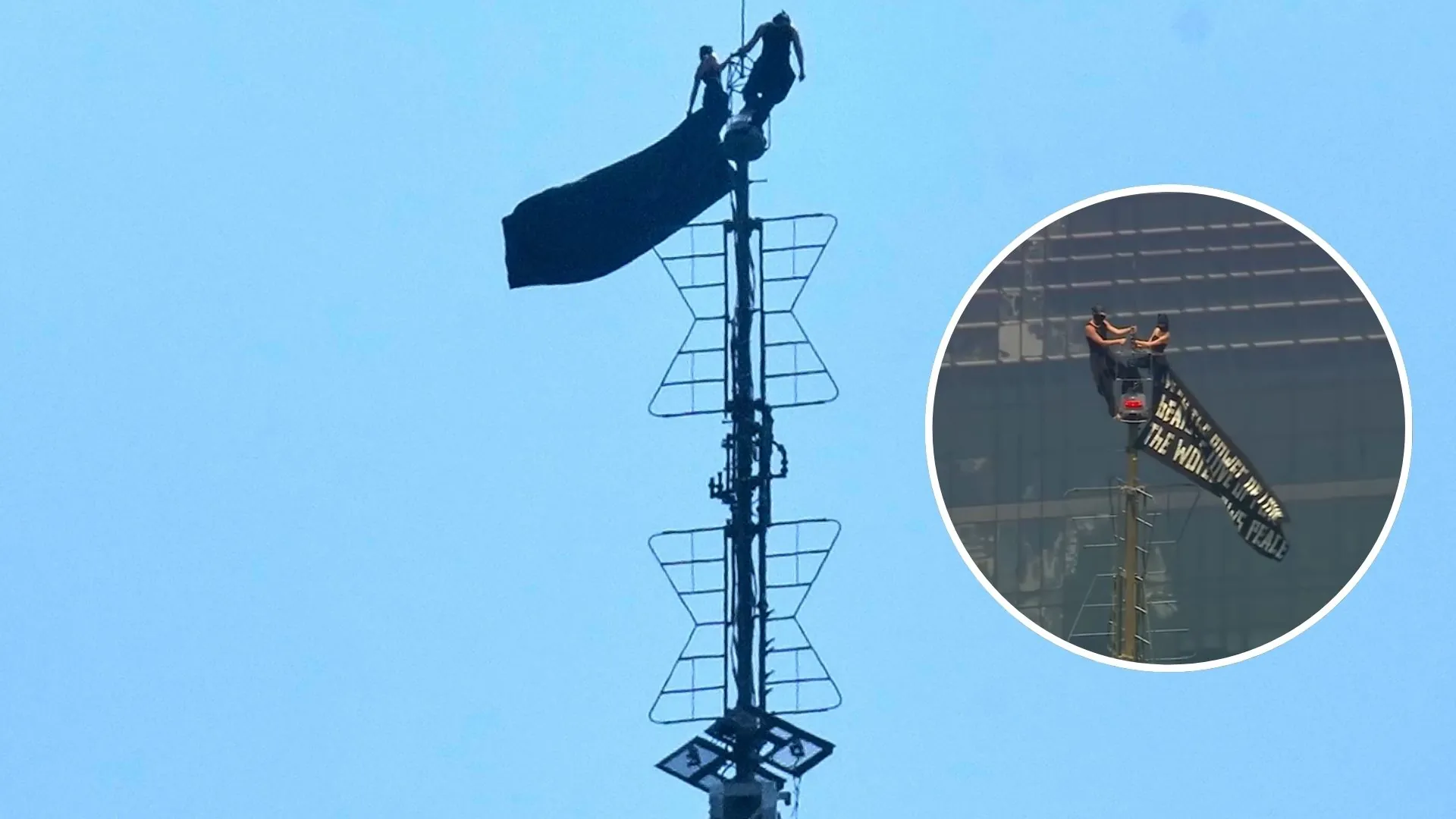
The burglary theory turns on restricted remaining, not sightseeing
Third-degree burglary is easy to misread here because the Empire State Building is a place ordinary visitors may lawfully enter during public access hours. That does not end the inquiry. New York Penal Law § 140.20 asks whether a person knowingly entered or remained unlawfully in a building with intent to commit a crime there.[2]
That is why the overnight and restricted-access allegations matter. The reporting describes a theory in which the pair allegedly entered as tourists, remained inside after regular access, and reached restricted upper areas rather than merely passing through a lobby or observation area open to ticketed visitors.[1][5] If prosecutors can prove only an unauthorized climb, that is a different case from proving unlawful remaining in a building with the required intent. The burglary count needs the latter.
The “intent to commit a crime therein” element is also not supplied by altitude. Prosecutors would need to connect the unlawful remaining to some intended crime inside the building. On the public record now available, the most obvious candidates are the alleged restricted access, lock cutting, and antenna interference—not the visual fact that the climb drew attention.
For readers tracking New York burglary elements across high-profile Manhattan cases, the same statutory hinge appears in this site’s earlier discussion of Today Show intruder hate crime charges: public visibility of the location does not answer the unlawful-entry and intent questions by itself.
The lock allegation is doing real statutory work
The criminal-mischief count is the cleanest example of a fact that changes legal category. Public reporting says the complaint alleged two locks were cut on the restricted 104th floor, with an approximately $2,000 replacement figure.[5] That number matters because the felony theory cited in public legal summaries depends on property damage above a monetary threshold reported as $1,500 for second-degree criminal mischief under Penal Law § 145.10.[3]
Without that kind of dollar figure, coverage tends to collapse into generic phrases such as “damaged property.” Here, the difference between a misdemeanor-style property count and a class D felony theory may turn on whether the state can prove the amount, ownership, causation, and intent attached to the two locks. A defense challenge does not have to romanticize the climb to contest that proof. It can ask who valued the replacement, whether labor was included, whether both locks are chargeable to the defendants, and whether the damage amount crosses the felony line beyond a conclusory estimate.
That is also why the reported $2,000 allegation should not be treated as a sentencing number. It is currently more important as a charging-threshold fact. Restitution may later become part of a disposition, but the cited record does not yet report a restitution order.
Reckless endangerment depends on risk to other people
First-degree reckless endangerment is the count most likely to be overstated in casual coverage. Penal Law § 120.25 requires conduct that, under circumstances evincing depraved indifference to human life, recklessly creates a grave risk of death to another person.[4] The statute is not satisfied merely because a defendant did something dangerous to himself or herself.
On the reported facts, prosecutors would be expected to focus on the people pulled into the danger zone: Emergency Service Unit officers, building security, and any workers or technicians affected by the antenna area. Public reporting describes ESU officers ascending roughly 1,250 feet after the climbers, and it also describes an interruption of a live broadcast antenna for about 30 minutes.[1][5] Those are the facts that give the reckless-endangerment theory its shape.
There is still a proof gap between a charging theory and an adjudicated felony. The state would have to prove not only that responders climbed and that the situation was risky, but that the defendants’ conduct met the mental-state and gravity requirements of the first-degree statute. Defense counsel Jason Krinsky has publicly characterized the matter as overcharged, a position that likely targets that gap as well as the stacking of felony theories.[7]
The climb-specific rule is a separate, thinner layer
New York City has a building-climb-specific rule in Administrative Code § 10-167, adopted through Local Law 42 of 2008 after earlier high-profile climbing incidents.[6] Secondary reporting has described that layer as a class A misdemeanor with possible exposure up to one year and a $1,000 fine, but the primary code text should be rechecked before treating that classification as the final word.[6]
The distinction is useful even with that caveat. A climb-specific ordinance addresses the unauthorized scaling behavior directly. The class D felony counts reported here depend on added allegations: unlawful remaining with intent, property damage above a threshold, and grave risk to others. Those are different legal boxes.
Pretrial posture: supervised release, not bail
After arraignment, the pair were released under supervision rather than held on bail. NBC New York, citing the court posture, reported that the felony set was non-bail-eligible under New York’s bail framework and that the next court date was scheduled for Aug. 24, 2026.[7]
That release decision should not be confused with a merits ruling. It says something narrower: at arraignment, the charged offenses and New York bail rules did not produce a cash-bail detention track in the way some readers might assume from the word “felony.” Supervised release still leaves the case pending, and missed appearances or new allegations could change the practical posture.
Maximum exposure is available; maximum sentencing is not the benchmark
Each of the three named felony theories is described in public legal summaries as a class D felony carrying potential prison exposure of up to 2 1/3 to 7 years.[3] That is the legally available outer frame, not a practical sentencing forecast. In a case like this, the more useful question is what prior protest or stunt-climb cases have actually produced when no one was physically injured and the case resolved without the statutory maximum.
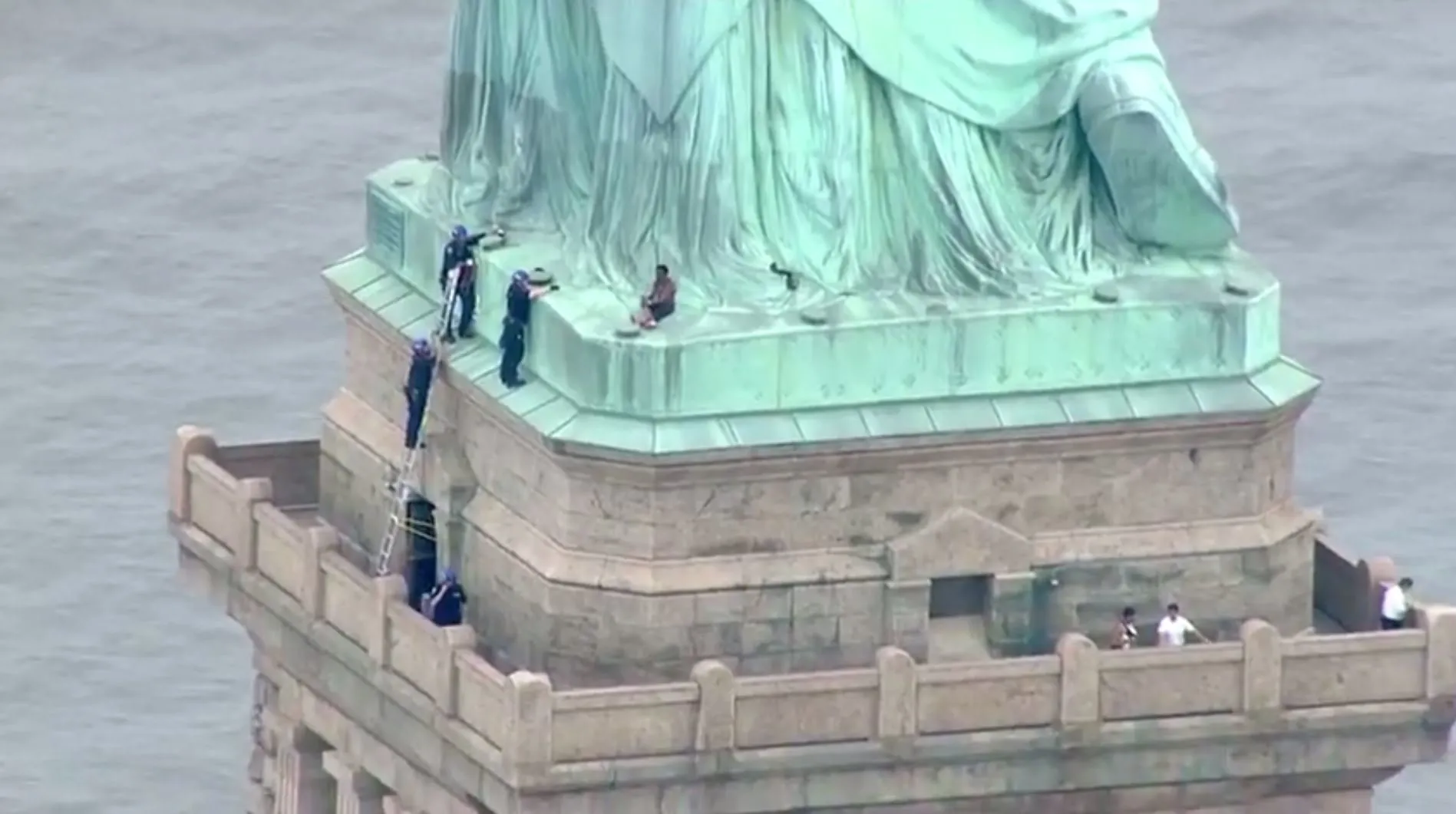
The closest sentencing comparator in the public materials is Therese Okoumou’s Statue of Liberty climb. Reuters reported that Okoumou was sentenced to five years of probation and 200 hours of community service after the 2018 Statue of Liberty incident.[9] That comparison has limits: different forum, different charges, different motive evidence, different plea or trial posture. It still keeps the current exposure discussion grounded. Probation and community service are not guaranteed, but they are more realistic reference points than treating the class D maximum as the expected result.
The Isaac Wright comparison cuts in the other direction. Public reporting on Wright’s Empire State Building-related matter described a 2024 climb that proceeded as a misdemeanor trespass case, with charges later dropped in October 2025 after court-ordered therapy.[10][11] That does not predict leniency for Nikolau and Kuznetsov. It shows the severity differential: once the record includes alleged lock cutting, restricted upper-floor access, antenna disruption, and responder exposure, prosecutors have more felony architecture than in a plain trespass-style case.
Collateral consequences remain mostly unreported
The cited public record does not report immigration proceedings, visa status, detainers, or removal action. That matters because collateral immigration exposure can be severe when noncitizens face felony charges, but the current record does not support writing that consequence into the case as if it has happened.
The safer formulation is conditional: if either defendant has a noncitizen status that makes criminal charges immigration-relevant, defense counsel would need to evaluate immigration consequences alongside the criminal case. Nothing in the cited record establishes that any immigration agency has acted.
What still needs docket-level verification
Several points remain unsettled as of Aug. 1, 2026, and they should be treated as verification flags rather than filled in from inference.
- Exact charge counts vary across outlets. 6abc reported eight total charges, while other reports emphasized the three felony theories mapped above.[8]
- A BASE-jumping-related charge appears in USA TODAY’s reporting but is not consistently reflected across the other cited accounts, so it should be treated as reported-only until the complaint or docket is rechecked.[5]
- The Administrative Code § 10-167 misdemeanor classification should be checked against the primary code text before publication in any charging chart that treats it as operative.
- No cited report shows a docket update between arraignment and this Aug. 1 verification date.
- The next public checkpoint is the reported Aug. 24, 2026 court date.[7]
The record is serious because of the alleged entry path, property damage, antenna disruption, and responder risk. It does not yet justify treating statutory maximums, immigration consequences, or every reported count as established outcomes.
References
- 2 arrested, arraigned after scaling top of Empire State Building, CNN
- NYS Penal Law Article 140, YPDcrime.com
- Empire State Building Climbers Face Felony Charges After Antenna Engagement Stunt, Law Commentary
- NYS Penal Law Article 120, YPDcrime.com
- Empire State Building couple climb arrest court, USA TODAY
- Climbing Buildings Is to Become Illegal, The New York Times, 2008
- Empire State Building climber couple charged with felony, NBC New York
- Couple who scaled Empire State Building with banner now face 8 charges, 6abc/WPVI
- Statue of Liberty climber sentenced to community service, probation, Reuters
- NYPD Drops Charges Against Urbex Photographer Over Empire State Building Photo, PetaPixel
- Photographer Who Scales Buildings to Get the Perfect Shot Arrested at Opening Night of His First Solo Exhibition, Smithsonian Magazine
Related records
Tool profile
How Meta's AI Spending Reshapes Law Firm ProfitabilityGoverning regulation
Browse the obligations tracker →Preventive workflow
Browse verification workflows →
Report a correction or tip
Spotted an outdated figure, a misstated fact, or a ruling this case record should reflect? Public comments are disabled for this content given the professional cost of a misreported case outcome, penalty amount, or rule text — use the structured correction channel instead.
Report a correction or tip for this record →