
Why employer liability fails for mail carrier heat stroke deaths
This analysis examines the June 2023 death of Eugene Gates Jr. in Dallas and five prior USPS carrier fatalities to explain why federal OSHA enforcement has not held the employer liable, and where the real liability risk may shift to state law.
- Jurisdiction
- United States (Federal)
- Court
- Occupational Safety and Health Review Commission
- AI tool named
- No AI tool
- Ruling date
- Feb 1, 2023
- Source document
- View primary court order ↗
- Last verified
- Jul 25, 2026
Lex Machina Review is an independent risk-tracking and reference resource. Nothing on this site is legal advice, and using it does not create an attorney-client relationship. Every record is reviewed against primary sources but may not reflect the most current status of a matter — always verify directly against the cited court order, rule text, or a licensed attorney before relying on it.
Companion explanation — secondary to the source document above
The legally infuriating part of Eugene Gates Jr.'s death is not hard to state. On June 20, 2023, a 36-year USPS letter carrier was working in Dallas with a reported heat index of 113°F, in a postal vehicle without air conditioning, after having been disciplined the month before for “stationary events” tied to time spent stopped on the route. He died of heat stroke. OSHA later issued a serious General Duty Clause citation carrying a proposed penalty of $15,625.[1][2][3][4]
For anyone evaluating a heat stroke death mail carrier employer liability case, that collision of facts is the problem in miniature. The harm is foreseeable. The death is documented. The employer is not a small business surprised by one freak day of weather. Yet the federal enforcement consequence, at least through OSHA, arrives as a modest serious citation rather than a liability event that materially changes institutional exposure.

That does not mean the legal record supports the easy version of the story: USPS knew heat was dangerous, therefore USPS is federally liable whenever a carrier dies. Federal OSHA cases do not work that way. A pattern may establish notice, but notice is not the whole case. Under the General Duty Clause, OSHA still has to prove a recognized hazard, likely death or serious harm, and feasible, effective abatement. In the USPS heat cases, the third element has been the place where legal consequence has gone to die.
Gates Is The Case, But Not The Whole Legal Record
Gates' death came after years of postal heat enforcement activity. Reporting on the Dallas case described him as a veteran carrier working during extreme heat, in a vehicle without air conditioning, and under workplace scrutiny for time spent stopped on the route.[1][2] That last detail matters because it converts “rest breaks” from a safety abstraction into a contested work-time fact. In a heat case, rest is not merely humane. It is one of the obvious abatement measures lawyers reach for when they try to prove that the employer had feasible ways to reduce exposure.
OSHA did cite USPS after Gates' death. But the agency classified the violation as serious, not willful, and the cited penalty was $15,625.[3][4] That number is not meaningful because it shocks the conscience; it is meaningful because it does not. It shows the scale mismatch between a fatal heat stroke and the federal enforcement instrument available for a serious violation.
The agency could say, in effect, that USPS exposed Gates to a recognized heat hazard. It could not, through that citation alone, impose a sanction proportionate to death. And for counsel assessing whether OSHA enforcement creates leverage in a later employer-liability dispute, the Gates citation has to be read against the Commission decision that arrived four months before he died.
The February 2023 OSHRC Decision Is The Legal Turn
In February 2023, the Occupational Safety and Health Review Commission vacated four of five consolidated USPS heat-hazard citations. The citations arose from postal carrier heat incidents in multiple cities, including a Des Moines case involving carrier Linda Watzlawick, who died in 2012. The Commission did not announce that heat is harmless, or that USPS carriers cannot face serious heat hazards. Its reasoning was narrower and more damaging to OSHA's practical enforcement position: OSHA had not carried its burden to prove feasible abatement with sufficient specificity.[5][6]
That distinction is the piece of the record most likely to be lost in a public account of preventable deaths. The General Duty Clause is not a heat standard. It is a backstop provision requiring employers to furnish employment and a place of employment free from recognized hazards that are causing or likely to cause death or serious physical harm. When OSHA uses it for heat illness, the agency must do more than say “heat was dangerous” and “more rest would have helped.” It must identify feasible measures that would materially reduce the hazard and prove them in a way the Commission can enforce.
The Commission faulted OSHA's proof on proposed abatements such as work/rest cycles and reducing outdoor exposure, including the failure to identify specific costs for those measures.[5][6] That is a procedural sentence with very real consequences. It means OSHA may recognize the hazard, document the exposure, and still lose because the proposed remedy is not proven with the specificity required in litigation.
| What OSHA Could Show | What The General Duty Clause Still Required |
|---|---|
| Letter carriers faced dangerous heat during route work | A feasible abatement measure that would materially reduce the hazard |
| USPS had prior knowledge of heat illness risks | Proof specific enough for the Commission to order and enforce |
| Rest, route changes, or reduced exposure were plausible safety responses | Evidence of implementation feasibility, including costs where required |
| A worker death or serious illness occurred | A violation supported by each legal element, not just by moral causation |
This is why the absence of a federal heat standard matters. OSHA began heat-rulemaking with an advance notice of proposed rulemaking in October 2021, but no final federal heat standard was in effect as of July 2026.[7] Without a heat-specific standard, OSHA must keep returning to the General Duty Clause and litigating the same proof architecture: recognized hazard, serious harm, feasible abatement, and employer knowledge.
A heat standard would not make every death compensable, and it would not erase defenses. But it would change the legal task. Instead of proving from scratch what adequate heat abatement should have looked like on a given route, OSHA could point to regulatory duties. In the USPS cases, the lack of that standard left OSHA trying to convert general heat-safety concepts into enforceable abatement orders after the fact.
The Pattern Shows Knowledge; It Does Not Automatically Supply Liability
The death pattern is not incidental. At least six USPS letter carriers have reportedly died of heat stroke since 2012: Watzlawick in Des Moines in 2012, Peggy Frank in Woodland Hills in 2018, Gates in Dallas in 2023, Warren Johnson in North Carolina in 2024, Stephen Workman in Texas in 2025, and David Taylor in Dallas in 2025.[8][9][10] The reported sequence repeatedly involves route work, extreme heat, and long-life postal vehicles without factory air conditioning.
The Peggy Frank citation shows how OSHA tried to treat recurrence as legally significant. After Frank died in Woodland Hills during high heat in 2018, OSHA proposed $149,664 in penalties and characterized the violation as repeated.[8] That proposed amount should not be treated as a final adjudicated recovery without confirming later settlement or review. But the posture matters: OSHA was not seeing each carrier death as an isolated weather accident.
The fleet context sharpens the same point. USPS has relied on more than 140,000 Grumman Long Life Vehicles built from 1987 to 1994 with no factory air conditioning, and replacement vehicles have been delayed, with deployment not complete as of Q3 2026.[11][12] That fact does not prove that any particular manager violated the General Duty Clause on any particular day. It does make it difficult to pretend the risk was unknowable.
The Center for Public Integrity, as discussed in later commentary on the Gates case, reported that OSHA had cited USPS for heat hazards affecting more than 900 employees between 2012 and 2019.[3] Again, the legal use of the number is narrower than the moral use. It supports knowledge, recurrence, and scale. It does not, by itself, solve the Commission's demand for specific feasible abatement proof.
What The $15,625 Citation Actually Measures
The Gates citation is easy to misread as a valuation of life. It is not that, formally. It is the statutory penalty consequence OSHA could attach to a serious violation. That is precisely why it is so unsatisfying as an accountability device. The penalty measures the limits of the enforcement scheme more than it measures the gravity of the death.
For a federal agency with reported annual revenue around $78 billion, a $15,625 serious citation is economically minor.[4] Gates' widow and union leaders reportedly described the penalty as a “slap in the face,” a reaction that is not hard to understand.[3] But for lawyers, the more durable point is not outrage. It is leverage. A penalty at that level does not create settlement pressure comparable to a wrongful-death verdict, punitive exposure, or a regulatory order requiring costly operational change.
Nor does a serious citation carry the narrative force of a willful finding. A willful classification would signal intentional disregard or plain indifference under OSHA's framework. The available reporting on Gates points to a serious citation, not a willful one.[3][4] Counsel can criticize that enforcement choice, but should not plead or brief the case as if OSHA made a willfulness finding it did not make.
Federal OSHA Is A Poor Vehicle For Full Accountability
The USPS heat-death record leaves plaintiff-side lawyers with a difficult answer. A mail carrier heat stroke death may be morally compelling, factually documented, and tied to a repeated institutional hazard. That does not mean federal OSHA enforcement will hold the employer liable in a way that changes the economics of the loss.
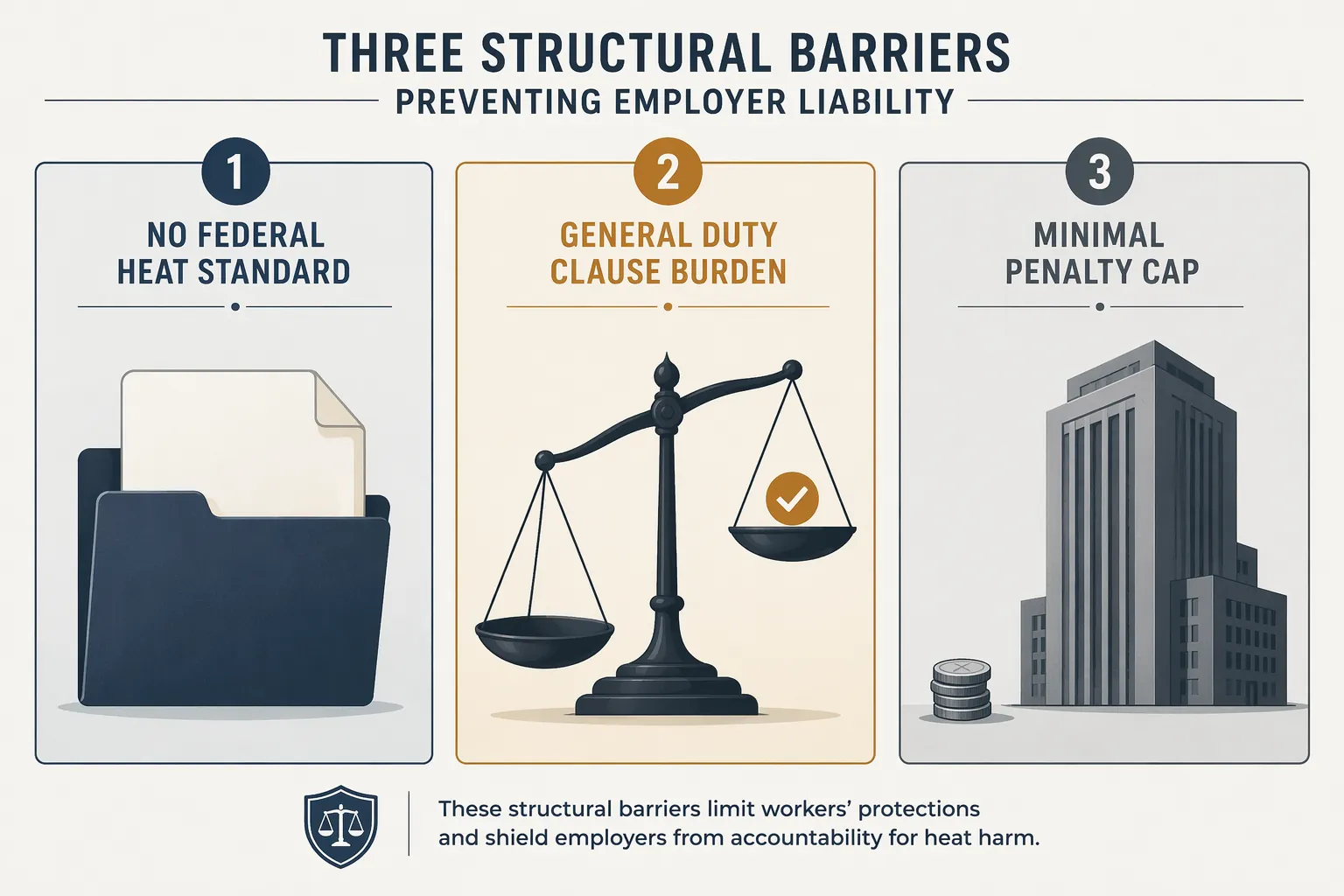
Three features drive that failure. First, no final federal heat standard was in effect as of Q3 2026, despite OSHA's heat-rulemaking process beginning with an advance notice in 2021.[7] Second, the General Duty Clause forces OSHA to litigate feasible abatement in detail, and the Commission has already vacated most of a consolidated USPS heat docket because OSHA did not prove that element adequately.[5][6] Third, even when OSHA issues a serious citation after a death, the penalty cap can leave the employer facing an amount that is institutionally trivial.
This is not a conclusion that USPS can ignore heat without legal risk. It is a narrower conclusion: federal OSHA liability, on the existing record, has been structurally weak as an accountability mechanism for USPS carrier heat deaths. The pattern helps prove knowledge. The LLV fleet helps prove scale. The Gates discipline history helps show why rest breaks were not just a theoretical abatement. But the enforceable federal violation still has to survive the proof burden that defeated OSHA in February 2023.
Where The Risk May Shift
The more serious liability risk for delivery employers may sit outside the federal OSHA path. State tort law, state OSHA plans, workers' compensation exclusivity rules, gross-negligence exceptions, collective-bargaining obligations, disability-accommodation frameworks, and contractor-specific duties may all matter more in a particular case. They also vary sharply by employer and jurisdiction.
That distinction is especially important when comparing USPS to private-sector delivery companies. UPS, FedEx, Amazon contractors, and other logistics employers do not all sit in the same liability posture as a federal postal employer. A USPS enforcement record can establish warnings about heat, route pressure, vehicle design, and feasible rest. It cannot be imported wholesale into a private-sector wrongful-death or state-plan OSHA analysis without doing the state-law work.
For counsel deciding whether to take the next heat-stroke death case, the practical lesson is unpleasant but useful. The facts that make a death foreseeable are not always the facts that make federal employer liability meaningful. In the USPS record, the gap is not evidentiary silence. It is a liability system that can document a preventable death pattern and still produce, at the federal OSHA level, a citation small enough to be absorbed without materially changing the employer's exposure.
References
- Dallas Mail Carrier Dies Amid Extreme Heat, NBC DFW
- Extreme Heat Is Killing Workers in the U.S., Scientific American
- USPS Fined $15,625 for Heat Death of Dallas Letter Carrier Eugene Gates, Confined Space
- Postal Service Fined for Heat-Related Death of Letter Carrier, Government Executive
- OSHRC Vacates Four of Five General Duty Clause Citations Issued to Postal Service for Heat Hazards, Jackson Lewis, 2023
- Secretary of Labor v. United States Postal Service, OSHRC Docket No. 16-1813, Occupational Safety and Health Review Commission, February 2023
- Heat Injury and Illness Prevention in Outdoor and Indoor Work Settings, Occupational Safety and Health Administration
- U.S. Department of Labor Cites U.S. Postal Service Following Heat-Related Death of Mail Carrier in Woodland Hills, California, U.S. Department of Labor, January 17, 2019
- Postal workers are dying in extreme heat, USA Today
- Second Dallas postal worker dies in June amid heat wave, World Socialist Web Site, 2025
- USPS Long Life Vehicles and Heat Exposure, WorkersCompensation.com
- Postal Service's Next Generation Delivery Vehicles Face Deployment Delays, Federal News Network
Related records
Tool profile
How Meta's AI Spending Reshapes Law Firm ProfitabilityGoverning regulation
Browse the obligations tracker →Preventive workflow
Browse verification workflows →
Report a correction or tip
Spotted an outdated figure, a misstated fact, or a ruling this case record should reflect? Public comments are disabled for this content given the professional cost of a misreported case outcome, penalty amount, or rule text — use the structured correction channel instead.
Report a correction or tip for this record →