
What environmental regulations apply to orbital AI data centers?
Orbital AI data centers are being proposed at unprecedented scale but face a regulatory vacuum on environmental review. This article examines the Earthjustice petition demanding NEPA compliance and the legal risk for companies developing or procuring space-based AI compute.
- Jurisdiction
- US Federal
- Court
- Federal Communications Commission
- AI tool named
- Orbital AI data centers
- Ruling date
- Jul 8, 2026
- Source document
- View primary court order ↗
- Last verified
- Jul 25, 2026
Lex Machina Review is an independent risk-tracking and reference resource. Nothing on this site is legal advice, and using it does not create an attorney-client relationship. Every record is reviewed against primary sources but may not reflect the most current status of a matter — always verify directly against the cited court order, rule text, or a licensed attorney before relying on it.
Companion explanation — secondary to the source document above
The live regulatory question for orbital AI data centers is no longer whether orbital compute sounds cleaner than a power- and water-hungry facility on land. It is whether a federal satellite license can still pass through the Federal Communications Commission without environmental review when the licensed object is not a communications satellite in the ordinary sense, but part of a proposed orbital data-center system.
That question became harder to treat as theoretical on July 8, 2026, when Earthjustice, joined by DarkSky International, Public Employees for Environmental Responsibility, and Environment America, petitioned the FCC to prepare a Programmatic Environmental Impact Statement before issuing licenses for space-based data-center systems.[1] As of July 25, 2026, the FCC has not answered that petition. The petitioners have also made the litigation threat plain, which means companies developing or buying orbital AI compute now have a docket-centered risk event to track, even before the agency takes a position.
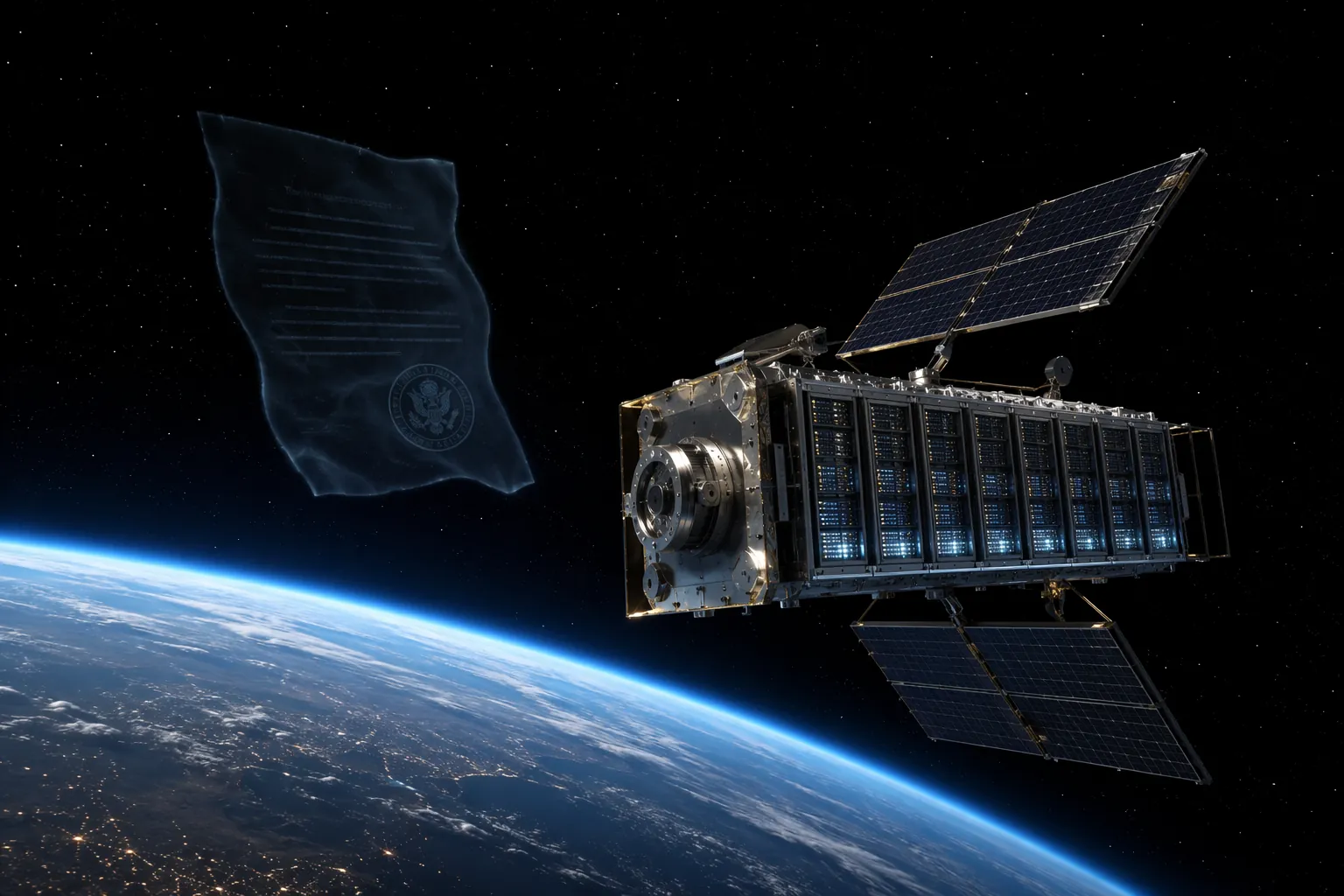
The risk is not that NEPA clearly applies today to every orbital AI data-center proposal. The risk is that the older assumption on which many projects may be modeled—that FCC satellite licensing is categorically outside ordinary NEPA review—is now being attacked at the point where the proposed scale has changed.
The pending petition is about the FCC license, not a general ban on orbital compute
The July petition asks the FCC to pause the ordinary licensing path for orbital data-center constellations long enough to conduct a programmatic review under the National Environmental Policy Act. NEPA does not itself set emissions limits, allocate water, or declare a technology unlawful. Its central function is procedural: when a federal agency takes a major federal action with potentially significant environmental effects, the agency must take a hard look at those effects before it acts.
For terrestrial data centers, the regulatory map is familiar even when it is contested. Projects may face air permitting questions, electricity procurement scrutiny, water-use constraints, zoning disputes, state legislation, and public utility fights. In orbit, those hooks do not disappear as environmental concerns; they become harder to attach to the activity that matters. A server rack outside state territory does not draw water from a county aquifer. Its cooling and power model does not sit neatly inside a state siting statute. The federal licensing act that remains visible is the communications-style authorization needed to operate satellites.
That is why the FCC matters. If the Commission treats satellite licensing for orbital AI data centers as categorically excluded from NEPA review, then the principal federal gatekeeping decision may proceed without the environmental study the petitioners seek. If the FCC changes course, even partially, NEPA analysis could become part of the licensing timeline. If the agency declines to act, the dispute may move from petition practice to litigation over the refusal to review.
The categorical exclusion looks different at proposed data-center scale
The FCC’s historical posture matters because categorical exclusions are not unusual in federal environmental practice. Agencies use them for classes of actions that normally do not have significant environmental effects. The legal pressure point is whether that historical judgment can bear the weight of proposed orbital data-center constellations measured not in dozens or hundreds of satellites, but in very large fleets.
Industry tracking cited in mid-2026 described applications or proposals associated with SpaceX, Starcloud, Orbital, Blue Origin, and Cowboy Space totaling more than 1.26 million orbital data-center satellites before the FCC, compared with roughly 15,000 active satellites today.[2][3] Within that aggregate, the reported proposals included SpaceX at 1 million satellites, Starcloud at about 88,000 satellites and roughly 20 gigawatts, and Orbital at about 100,000 satellites and roughly 10 gigawatts.[2]
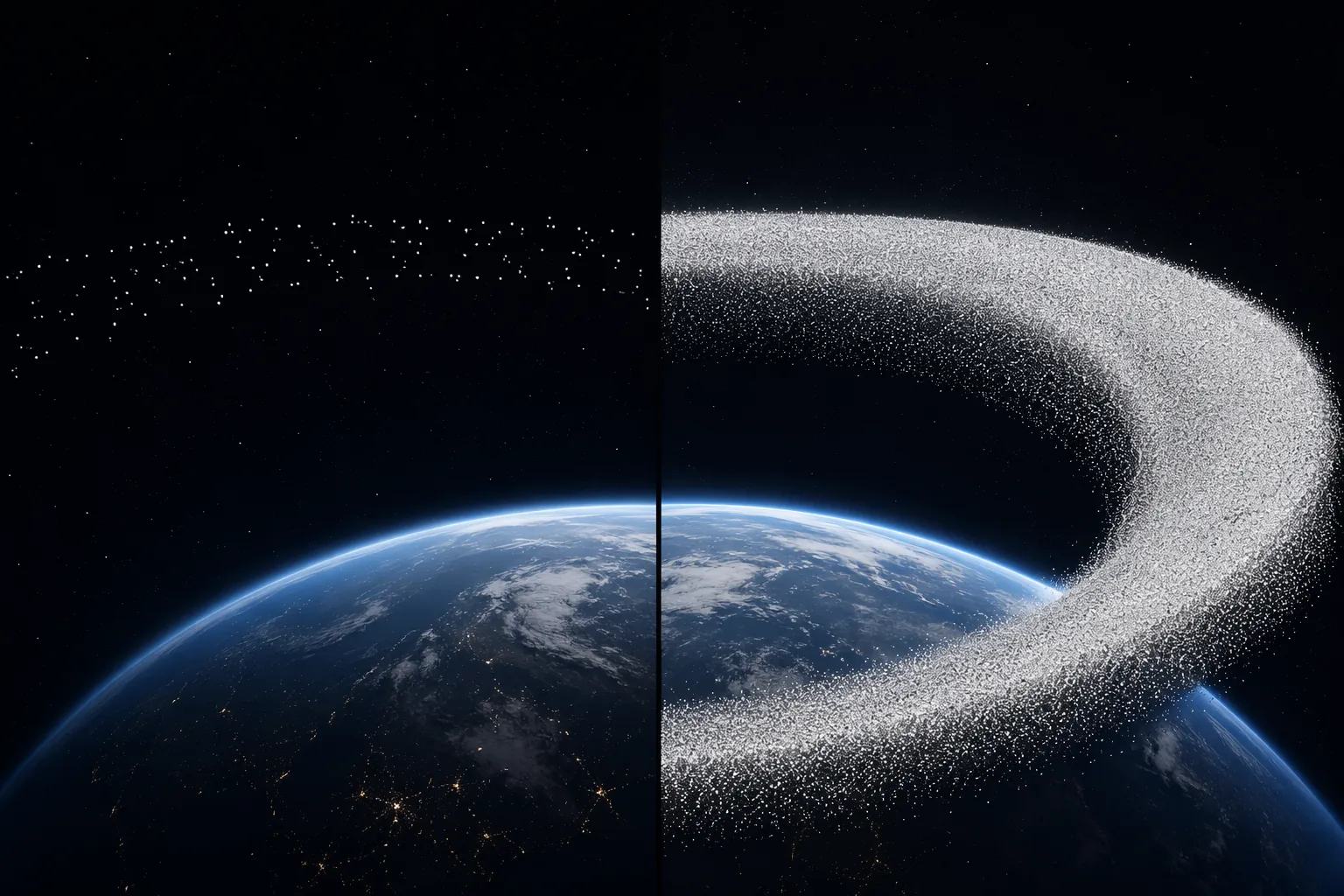
Those numbers need careful handling. They are proposed or application-scale figures, not an operating constellation in the sky. They may be reduced, delayed, denied, redesigned, or never built. But NEPA disputes often begin before construction, not after. The petitioners’ point is not that 1.26 million satellites are already causing the asserted impacts; it is that licensing decisions made now could authorize a class of activity too large to fit comfortably inside the FCC’s older environmental shortcut.
Government accountability work gives that argument institutional footing without deciding the present case. GAO has previously criticized the adequacy of environmental review for large satellite constellations, including in reports addressing the regulatory management of increasingly crowded orbital activity.[4] That does not mean GAO has concluded that every orbital data center must receive an environmental impact statement. It does mean the FCC is not encountering the scale problem for the first time.
| Regulatory question | Current status as of July 25, 2026 |
|---|---|
| Has the FCC granted the Earthjustice petition? | No known FCC response yet. |
| Is NEPA review clearly a licensing condition for orbital AI data centers? | Not clearly. That is the contested issue. |
| Are the million-plus satellite figures operational facts? | No. They are reported proposals or applications. |
| Does the petition create legal risk before the FCC acts? | Yes. It creates a procedural record and an explicit path toward challenge. |
Why environmental groups want the review before licenses issue
The environmental objections are not confined to the data center’s computing workload. They run through the physical system required to put, operate, replace, and eventually dispose of hardware in orbit. The petition and related reporting point to rocket launch emissions, light pollution affecting wildlife, atmospheric effects from reentry, and orbital debris risks.[1][6]
Launch emissions are the most immediate example because orbital compute still begins with terrestrial rockets. A Georgetown Environmental Law Review analysis described soot associated with launch campaigns using a comparison to roughly 7 million diesel dump trucks.[5] That comparison is an advocacy-adjacent legal analysis claim, not an FCC finding. It is still relevant because NEPA review often turns on whether an agency has reasonably examined plausible environmental effects, not whether every estimate has already been accepted by the agency.
Light pollution is a different category of harm. It is not a smokestack problem; it concerns how reflective constellations alter the night sky and affect wildlife behavior. Atmospheric effects from reentry raise another issue: large numbers of satellites do not merely launch once and remain forever. Replacement cycles and end-of-life disposal can make reentry part of the environmental footprint. Orbital debris risk adds still another dimension because collision cascades can affect other operators and future orbital use, not just the applicant’s own assets.[6]
None of those concerns automatically answers the legal question. NEPA review depends on agency action, the scope of effects the agency must consider, and the administrative record. But the harms help explain why the petitioners chose a programmatic environmental impact statement rather than project-by-project comments on individual applications. If multiple companies are seeking authorization for a new class of orbital infrastructure, the environmental theory is system-wide.
The terrestrial backlash explains the attraction, but not the legal result
Orbital AI compute is arriving in a policy climate already skeptical of terrestrial data-center expansion. In April 2026, MultiState tracked data-center legislation advancing in 27 states, reflecting state-level resistance or oversight around the infrastructure buildout.[8] That context helps explain why a customer or developer might welcome a computing model that appears to bypass local water fights, grid interconnection battles, and state siting politics.
But avoiding one regulator does not eliminate another. A land-based data center may have state and local friction because its impacts are physically located. An orbital data center may have fewer local permitting hooks precisely because its impacts are distributed across launch, orbital operations, spectrum use, atmospheric reentry, and debris management. That distribution can look like regulatory freedom until a federal licensing agency becomes the only realistic place to ask for an environmental record.
Law-firm and governance commentary has already treated FCC licensing as a central chokepoint for space-based data centers and warned that feasibility debates can obscure governance exposure.[9][10] That is the practical issue for procurement teams as much as for launch providers. A buyer of orbital AI capacity may not hold the FCC license, but its deployment schedule, service-level assumptions, and public claims about environmental benefits can still depend on licensing timelines outside its direct control.
What the petition changes before the FCC decides
A petition does not rewrite NEPA. It does, however, change the record. Before July 8, a company could describe the NEPA issue as an unsettled but largely dormant feature of satellite licensing practice. After July 8, the FCC has a direct request from named public-interest groups asking it to conduct a programmatic environmental review before issuing licenses for orbital data-center proposals.[1]
That matters because procedural risk often develops before merits risk is resolved. The agency may ask for comment. It may deny the petition. It may incorporate some environmental inquiry without accepting the petitioners’ full theory. It may do nothing for long enough that opponents frame inaction as reviewable failure. Each path creates different timing, record-building, and disclosure consequences.
Earthjustice has also signaled that the petition is not merely symbolic. A representative told The Register, “If we have to sue so that they comply, we will.”[7] That statement does not prove litigation will be filed, or that plaintiffs would win. It does make clear that an FCC refusal or continued categorical treatment could become the next procedural target.
For in-house counsel, the immediate question is narrower than whether orbital AI compute is environmentally defensible. It is whether contracts, investor materials, and customer-facing sustainability claims assume a licensing path that may be challenged. For environmental litigators, the question is whether the FCC record contains enough agency reasoning to defend continued categorical exclusion at this scale. For agency staff, the problem is more basic: a licensing framework built for communications satellites is being asked to process infrastructure that looks, economically and environmentally, like a data-center sector trying to leave the surface.
Three possible FCC paths
The FCC’s response will determine whether the present moment remains a regulatory vacuum, becomes a NEPA review fight inside the agency, or turns into litigation over refusal to review. The legal exposure differs sharply depending on which path the Commission chooses.
| FCC path | Likely risk consequence |
|---|---|
| Grant review or open a programmatic process | Licensing timelines may lengthen, applicants may need more environmental analysis, and buyers may need to revisit deployment assumptions. |
| Deny the petition with reasoning | The dispute may move to the adequacy of the agency’s explanation and whether the categorical exclusion can lawfully cover the proposed scale. |
| Do not act or delay | Petitioners may try to frame agency inaction as part of a litigation strategy, while companies face uncertainty without a clarified licensing standard. |
The least stable assumption is that orbital location alone removes environmental review from the business plan. Terrestrial Clean Air Act and water-use rules may lose their ordinary purchase once compute leaves Earth, but that does not settle the NEPA question attached to a federal license. The petition’s practical force is that it identifies the FCC license as the place where environmental review could be demanded before the industry scales.
As of July 25, 2026, NEPA compliance is not clearly established as a licensing condition for orbital AI data centers. The million-satellite figures remain proposed, not built. The FCC has not answered. Those limits are important. They are also why the proceeding is worth watching: the next legally significant development is not a launch milestone or a market forecast, but the FCC’s treatment of the petition now sitting before it.
References
- Coalition Calls for Rigorous Federal Review of Space-Based Data Center Proposals, Earthjustice, July 8, 2026.
- Data Centers in Space, Luminix, mid-2026.
- Environmental groups seek FCC pause on orbital data center constellations, SpaceNews.
- Large Constellations of Satellites: Mitigating Environmental and Other Effects, U.S. Government Accountability Office.
- Data Centers May Be Skyrocketing - Literally, Georgetown Environmental Law Review.
- Reckless space-based data centers lack environmental review, drawing criticism, Space.com.
- Orbital datacenter gold rush needs an environmental review, FCC told, The Register, July 10, 2026.
- Federal AI Data Center Policy Meets Resistance from State Lawmakers, MultiState, April 2026.
- Bringing Order to Orbit: FCC Grapples with Licensing Space-Based Data Centers, Greenberg Traurig, March 2026.
- Orbital data centers' feasibility gap is a governance risk, Brookings.
Related records
Tool profile
How Meta's AI Spending Reshapes Law Firm ProfitabilityGoverning regulation
Browse the obligations tracker →Preventive workflow
Browse verification workflows →
Report a correction or tip
Spotted an outdated figure, a misstated fact, or a ruling this case record should reflect? Public comments are disabled for this content given the professional cost of a misreported case outcome, penalty amount, or rule text — use the structured correction channel instead.
Report a correction or tip for this record →