
What the en banc court held in the EPA green bank clawback suit
Verified record as of Aug. 4, 2026: the en banc D.C. Circuit kept EPA from terminating the GGRF grants or clawing back the roughly $19.97B at issue, but the equally divided vote on the remaining relief left the forum and repeal questions open. This record separates what the judgment decided from what remains open, with primary-source links and confirmed-versus-reported status flags.
- Jurisdiction
- D.C. Circuit
- Court
- U.S. Court of Appeals for the District of Columbia Circuit (en banc)
- Judge
- Tanya Chutkan
- AI tool named
- No AI tool named
- Ruling date
- Aug 4, 2026
- Source document
- View primary court order ↗
- Last verified
- Aug 4, 2026
Lex Machina Review is an independent risk-tracking and reference resource. Nothing on this site is legal advice, and using it does not create an attorney-client relationship. Every record is reviewed against primary sources but may not reflect the most current status of a matter — always verify directly against the cited court order, rule text, or a licensed attorney before relying on it.
Companion explanation — secondary to the source document above
Verified status as of Aug. 4, 2026
| Item | Verified record |
|---|---|
| Last verified | Aug. 4, 2026 |
| Case | Climate United Fund v. Citibank, N.A., D.C. Circuit Nos. 25-5122 and 25-5123 |
| Court | U.S. Court of Appeals for the District of Columbia Circuit, en banc |
| Posture | Preliminary-injunction appeal; en banc per curiam judgment filed without memorandum |
| Amount at issue | Roughly $19.97B in obligated Greenhouse Gas Reduction Fund grant money challenged as frozen, terminated, or subject to clawback |
| Confirmed-status answer | EPA remains barred for now from effectuating the March 11, 2025 termination notices and from clawing back the disputed GGRF funds while the case proceeds |
| Source hierarchy | Court docket and court PDFs are treated as confirmed; Bloomberg Law reporting is attributed where it describes judicial disagreement not visible in the judgment |
| Review note | Legal-background editorial review; reviewer name was not supplied in the source packet |
| Disclaimer | This record is for litigation-status verification and is not legal advice |
For the epa green bank fund clawback lawsuit, the current verified answer is narrow. On Aug. 4, 2026, the en banc D.C. Circuit kept EPA from effectuating the March 11, 2025 termination notices and from clawing back the disputed Greenhouse Gas Reduction Fund money for now. It did not decide the merits, did not settle whether the Tucker Act sends the grant-termination dispute to the Court of Federal Claims, and did not create a precedential answer on the repeal issue because the remaining injunction relief was affirmed by an equally divided court under D.C. Circuit Rule 40(d).[1]
The litigation is the consolidated Climate United Fund dispute over EPA’s freeze and termination of obligated funds held in Citibank accounts for National Clean Investment Fund and Clean Communities Investment Accelerator grantees and related green-bank subawardees. The Climate Case Chart identifies the lead D.D.C. case as No. 1:25-cv-00698 before Judge Tanya Chutkan and lists grantees including Climate United Fund, Coalition for Green Capital, Power Forward Communities, Justice Climate Fund, and Inclusiv, plus state green-bank subawardee appellees. It places the challenged obligated funds at roughly $19.97B within the $27B GGRF structure.[2]
What the en banc judgment actually did
The operative Aug. 4 filing is a per curiam judgment without memorandum. That matters. There is no majority opinion to mine for a broad rule, no merits analysis to quote as controlling law, and no publicly visible merits split beyond the judgment’s own disposition language and the participation list. Judges Srinivasan, Millett, Pillard, Wilkins, Katsas, Rao, Walker, Childs, Pan, and Garcia participated; Judge Henderson did not participate.[1]
The judgment divided Judge Chutkan’s April 15, 2025 preliminary injunction into two pieces. First, the en banc court affirmed paragraph two of the injunction. That paragraph bars EPA from effectuating the March 11, 2025 termination notices. On that piece, the judgment says “affirmed,” without the equal-division qualifier.[1]
Second, the court affirmed the remaining portions of the injunction by an equally divided court under D.C. Circuit Rule 40(d). Those remaining provisions are the reason the funds remain protected from immediate clawback or non-disbursement action, but the posture is materially different from a reasoned en banc holding. A tie affirmance leaves the district-court order in place; it does not give practitioners a precedential D.C. Circuit answer on the underlying forum and statutory questions.[1]
The same-day clerk’s order is not a footnote for docket completists. It directed issuance of the mandate and provided that the April 16, 2025 administrative stay would dissolve seven days later. In operational terms, the temporary appellate pause that had affected the injunction was set to end on that schedule, leaving the affirmed preliminary-injunction protections as the live court-imposed constraint unless another court order intervenes.[1]
Bloomberg Law reported the same day that the court split over the effect of the One Big Beautiful Bill Act repeal and over whether the now-defunct GGRF’s statutory language or the individual grant agreements govern EPA’s pull-back power. Bloomberg also reported that four of the ten participating judges said the plaintiffs had not shown that the termination-block remained warranted after repeal. That is useful reporting, but it is not the same thing as a precedential vote chart in the judgment itself.[3]
Climate United’s public response, as quoted by Bloomberg, was that there “remains no legal basis for terminating our grant award and clawing back funds that were already disbursed.” That is a party statement, not the court’s holding. The holding is the injunction posture: paragraph two affirmed outright; the rest affirmed by equal division.[3][1]
How the case reached that posture
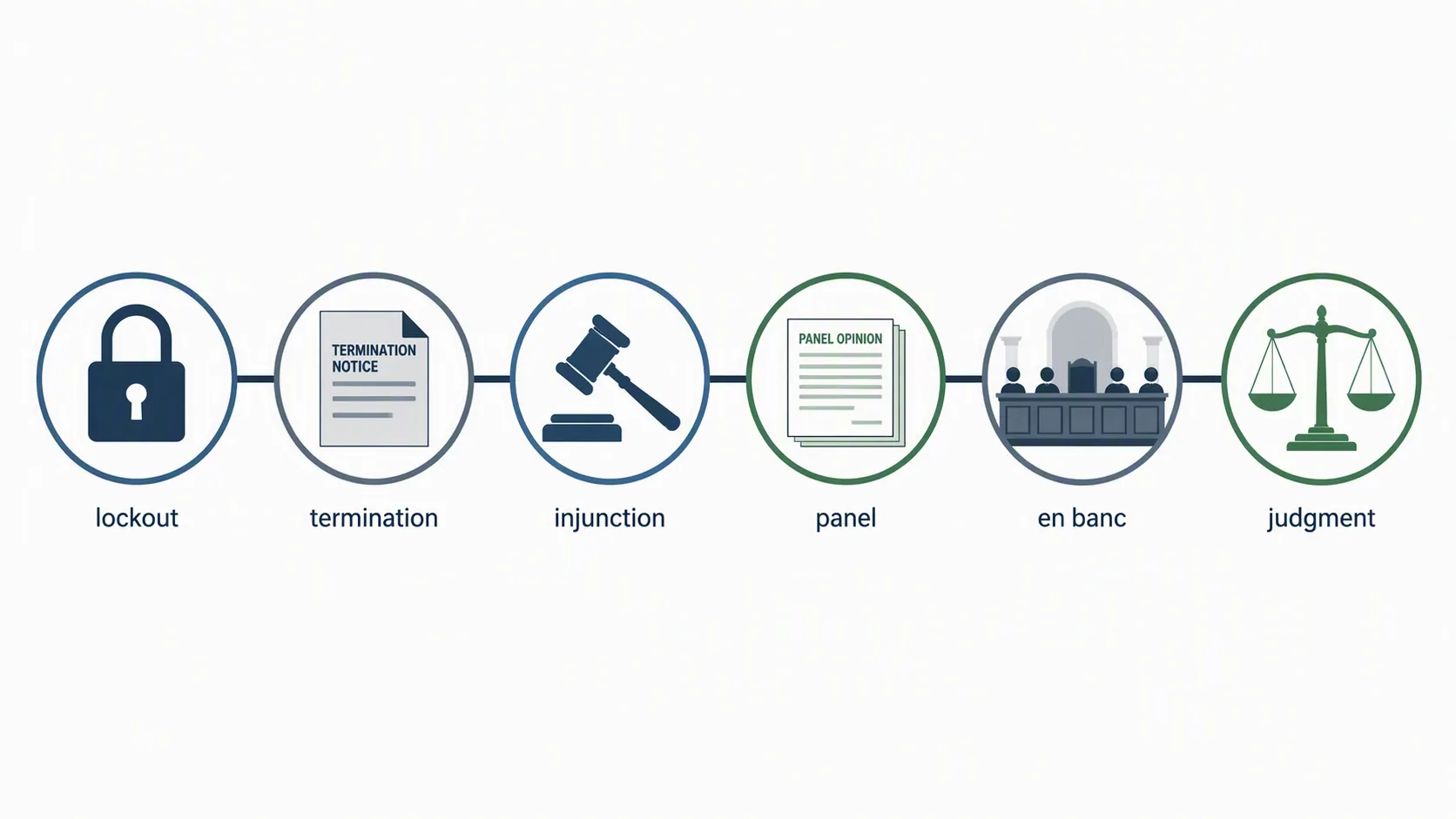
| Date or period | Procedural event | Why it matters now |
|---|---|---|
| Feb. 18-20, 2025 | Account lockout period described in the litigation record | Set up the emergency posture over access to obligated grant funds |
| Mar. 11, 2025 | EPA termination notices | These are the notices paragraph two of the injunction bars EPA from effectuating |
| Apr. 15-16, 2025 | Judge Chutkan entered a preliminary injunction; the D.C. Circuit entered a partial administrative stay the next day | Created the order later reviewed by the panel and the en banc court |
| Sept. 2, 2025 | A D.C. Circuit panel opinion vacated the injunction on jurisdictional grounds | The panel ruling was later vacated when rehearing en banc was granted |
| Dec. 17, 2025 | The D.C. Circuit granted rehearing en banc | Vacated the panel judgment and put the full court in charge of the appeal |
| Feb. 24, 2026 | En banc argument | Placed the injunction, forum, and repeal questions before the full participating court |
| Mar. 9 and Mar. 19, 2026 | Supplemental briefing order and briefing on the effect of OBBBA repeal | Raised whether repeal changed the basis for all or part of the injunction |
| Aug. 4, 2026 | En banc judgment and clerk’s mandate/stay order | Left the preliminary injunction in place as described, without a precedential merits resolution |
The procedural history is easiest to overread at the panel stage. The Sept. 2, 2025 panel opinion, authored by Judge Rao and joined by Judge Katsas with Judge Pillard dissenting, vacated the injunction on the theory that district courts lack jurisdiction over arbitrary grant-termination claims and that those claims belong in the Court of Federal Claims.[4] But that panel judgment did not survive as the governing appellate disposition: the D.C. Circuit granted rehearing en banc on Dec. 17, 2025, vacating the panel judgment.[5]
That leaves the panel opinion as a warning about the forum issue, not as the current controlling judgment in this case. Counsel can still expect the Tucker Act point to matter; counsel should not brief the panel result as the live D.C. Circuit disposition after the en banc judgment.
The money is protected for now, but the injunction is not final relief
The practical consequence of the Aug. 4 judgment is significant for grantees and subawardees: EPA remains restrained from using the March 11 termination notices as the basis to end the grants, and the remaining affirmed injunction provisions keep the disputed funds from being clawed back while the case continues. The case-record amount is roughly $19.97B in obligated GGRF money, a figure that covers the challenged grant funds rather than the entire $27B program.[2][1]
That is still preliminary relief. The plaintiffs have not obtained a final judgment that EPA’s termination theory is unlawful. EPA has not received a final appellate ruling that the district court lacks power to hear the dispute. The en banc court’s equal division on the remaining portions keeps the order alive without doing the work a precedential majority opinion would do.
The distinction is not academic for grant administration. A recipient deciding whether accounts are usable, whether subawards can move, or whether to book clawback risk needs the injunction’s present effect. A lawyer writing a memo on jurisdiction needs to say something different: the forum problem remains unresolved at the en banc level.
What remains open
The Tucker Act forum question
The live record does not produce a settled D.C. Circuit rule on whether this dispute belongs in district court or the Court of Federal Claims. The vacated panel opinion accepted the Court of Federal Claims route for arbitrary grant-termination claims.[4] The en banc judgment, by contrast, left the injunction standing without a precedential majority explanation on the remaining relief.[1]
For comparison across federal grant-termination cases, the forum-risk pattern resembles the problem tracked in California Rail Funding Cut Leaves the Forum Question Open and the two-track jurisdictional split discussed in 9th Circuit's DEI Grant Ruling Creates a Two-Track System. Those comparisons are not controlling authority for the GGRF appeal; they are useful because they show why the remedy label can decide where a grant recipient is allowed to sue.
The OBBBA repeal argument
The One Big Beautiful Bill Act issue also remains open. The Sabin Center described the en banc court’s supplemental-briefing order as asking whether, after OBBBA §60002 repealed IRA §60103 and rescinded only the roughly $19M unobligated balance, the plaintiffs’ IRA and constitutional claims still supported all or part of the preliminary injunction. The briefs were filed March 19, 2026.[6]
The Aug. 4 judgment did not answer that repeal question in a precedential opinion. Bloomberg’s report that four participating judges viewed the termination-block as unwarranted after repeal is a litigation-risk signal, especially if EPA attempts renewed action framed around the changed statutory landscape. It is not a holding that repeal authorized clawback of already obligated or disbursed funds.[3]
Further review and renewed agency action
The docket also reflects Supreme Court activity that should be described without embellishment: a cert-before-judgment petition, No. 25-48, was docketed July 15, 2025, denied Oct. 6, 2025, and followed by denial of rehearing on Jan. 12, 2026. The petitioner identity is not verified in the provided materials and should not be supplied from inference.[1]
Nothing in the Aug. 4 en banc judgment forecloses ordinary next moves in high-stakes preliminary-injunction litigation: further district-court proceedings, renewed agency action if EPA claims a new legal basis, or later Supreme Court activity. The verified point is more modest and more useful: the current appellate judgment leaves the injunction in force in the way the judgment describes.
Confirmed, reported, and not decided
| Status flag | Statement | Source posture |
|---|---|---|
| Confirmed | The en banc court filed a per curiam judgment without memorandum on Aug. 4, 2026. | Court docket |
| Confirmed | Paragraph two of Judge Chutkan’s injunction was affirmed. | Court judgment |
| Confirmed | The remaining injunction portions were affirmed by an equally divided court under D.C. Circuit Rule 40(d). | Court judgment |
| Confirmed | The clerk ordered the mandate to issue and the April 16, 2025 administrative stay to dissolve seven days later. | Court docket |
| Reported | Bloomberg Law reported disagreement among participating judges over the effect of OBBBA repeal and over whether statutory text or grant agreements governed EPA’s pull-back power. | Attributed reporting |
| Not decided as precedent | Whether the Tucker Act requires the claims to proceed in the Court of Federal Claims. | No en banc majority merits opinion |
| Not decided as precedent | Whether OBBBA repeal authorizes EPA to terminate or claw back these obligated funds. | No en banc majority merits opinion |
| Not final relief | Whether the plaintiffs ultimately win on the merits. | Preliminary-injunction posture |
Parallel clean-energy and grant-termination disputes may help counsel compare agency tactics, forum traps, and preliminary-injunction standards. They do not change this docket’s current answer. For neighboring grant-freeze examples, see DOE admitted it canceled grants based on political identity of states and Agencies admit viewpoint bias in UC Berkeley grant freeze case. Those records are comparison points, not authority that supplies missing holdings in the GGRF appeal.
As of Aug. 4, 2026, EPA remains barred from terminating the GGRF grants through the March 11 notices or clawing back the roughly $19.97B at issue while the litigation continues. The en banc result should not be cited as a merits victory, a settled Tucker Act forum ruling, or a precedential answer to the repeal question.[1][2]
References
- Climate United Fund v. Citibank, N.A., CourtListener.
- Climate United Fund v. Citibank, N.A., Climate Case Chart / Sabin Center.
- Trump's Clawback of Climate Grants Frozen by Full DC Circuit, Bloomberg Law, Aug. 4, 2026.
- Climate United Fund v. Citibank, N.A., Nos. 25-5122, 25-5123, U.S. Court of Appeals for the District of Columbia Circuit, Sept. 2, 2025.
- Order, Climate United Fund v. Citibank, N.A., Nos. 25-5122, 25-5123, U.S. Court of Appeals for the District of Columbia Circuit, Dec. 17, 2025.
- Uncertain Remedies for Frozen Federal Climate Funding, Columbia Law School Sabin Center Climate Law Blog, Mar. 6, 2026.
Related records
Tool profile
How Meta's AI Spending Reshapes Law Firm ProfitabilityGoverning regulation
Browse the obligations tracker →Preventive workflow
Browse verification workflows →
Report a correction or tip
Spotted an outdated figure, a misstated fact, or a ruling this case record should reflect? Public comments are disabled for this content given the professional cost of a misreported case outcome, penalty amount, or rule text — use the structured correction channel instead.
Report a correction or tip for this record →