
What the Fairlife ransomware attack means for dairy supply contracts
When a ransomware attack shuts down a major dairy producer, supply contracts face disruptions that standard force majeure clauses may not cover. This analysis examines how the Fairlife incident tests force majeure, UCC allocation rules, and what counsel should do to protect their clients' positions.
Lex Machina Review is an independent risk-tracking and reference resource. Nothing on this site is legal advice, and using it does not create an attorney-client relationship. Every record is reviewed against primary sources but may not reflect the most current status of a matter — always verify directly against the cited court order, rule text, or a licensed attorney before relying on it.
Companion explanation — secondary to the source document above
The contract problem began before anyone outside the incident team could know the full technical story. On July 16, 2026, Coca-Cola disclosed in a Form 8-K that a cyber incident at its Fairlife subsidiary had caused Fairlife to halt U.S. dairy production for an indefinite period.[1] Reuters reported the same day that Fairlife had stopped production after a cyberattack.[2] For counsel on either side of a dairy supply agreement, that is enough to start the clock.
Fairlife is not selling machine parts that can sit in a warehouse while the parties sort out causation. Its product lines include ultra-filtered milk, Core Power protein shakes, and Fairlife Nutrition Plan products, all of which move through a time-sensitive refrigerated supply chain.[2] If production is down but some finished goods, work-in-process, substitute capacity, or later restored output remains available, the immediate legal question is not simply whether ransomware happened. It is who receives product, who waits, who gets notice, and whether the supplier can later prove that its choices were fair rather than convenient.

This discussion is necessarily limited. Fairlife’s actual supply contracts are not public. The practical conclusions therefore work from the known production halt, standard sale-of-goods principles, ordinary dairy supply practices, and general contract law—not from any representation about the language in Fairlife’s undisclosed agreements.
Force majeure is the first clause everyone will forward, not the last answer
In the first few hours after a production halt, force majeure has a certain conference-room gravity. It offers familiar words: events beyond reasonable control, acts of government, disasters, labor disruption, sometimes breakdown of equipment, sometimes interruption of utilities or suppliers. Older dairy supply agreements may have been drafted around weather, contamination events, transportation failures, strikes, plant damage, and regulatory shutdowns. Some will mention “computer systems,” “cyberattack,” “malicious code,” “network disruption,” or “ransomware.” Many will not.
That difference matters. A cyberattack is not automatically outside a force majeure clause just because the clause does not use the word “ransomware,” but the omission makes the argument more dependent on broad catch-all wording and governing-law treatment of foreseeability. Courts and contract counterparties tend to ask a narrower set of questions than the business team expects: Was the event covered by the clause? Was performance prevented or only made more expensive? Was the event beyond reasonable control? Was it foreseeable enough that the parties should have drafted for it? Did the affected party give timely notice and mitigate?
The foreseeability fight is now harder for sellers than it was a decade ago. Cutter Consortium and Steptoe & Johnson identified more than 40 documented force majeure declarations across industrial sectors between 2022 and 2025 and treated cyber disruption as part of the modern force majeure planning environment, not a remote curiosity.[4] That does not settle any single contract dispute. It does mean a supplier invoking a general force majeure clause after a ransomware shutdown should expect the buyer to ask why cyber events were not expressly addressed if they were material to production continuity.
The food-sector analogy most lawyers will reach for is JBS. The 2021 ransomware attack shut down North American beef plants, and JBS later said it paid an $11 million ransom.[5] The legal lesson is not that every food ransomware incident qualifies for force majeure. It is that major food processors have already lived through ransomware-driven production interruptions at a scale large enough to affect supply obligations. After that kind of event, “we never contemplated ransomware” becomes a thinner sentence.
The opposite overstatement is also wrong. Some contracts will be drafted broadly enough to cover cyber disruption. Some will include specific cyber language. Some governing-law decisions may accept ransomware as a qualifying force majeure event if the clause is written that way and the affected party can show causation, lack of reasonable control, and compliance with notice conditions. The weak position is not invoking force majeure. The weak position is invoking it as if the word “cyberattack” alone excuses every missed shipment, every allocation choice, and every failure to communicate.
Partial impairment moves the dispute into allocation
If Fairlife or any similarly situated supplier had no ability to ship anything, the dispute would center on excuse, notice, mitigation, and duration. Most real shutdowns are messier. There may be finished inventory in the channel, unaffected lines, third-party co-manufacturing options, staggered restart capacity, or production that comes back in stages. Once performance is only partially impaired, the legal center moves from “Can the seller claim force majeure?” to “How did the seller allocate what remained?”
For sales of goods, UCC § 2-615 supplies the operating discipline when a seller’s performance has been made impracticable in whole or in part by a qualifying contingency. Where only part of the seller’s capacity to perform is affected, the seller must allocate production and deliveries among customers in a manner that is fair and reasonable.[3] Official Comment 11 is especially important because it recognizes preference for regular contract customers and states that allocation among them is to be prorated evenly regardless of price.[3]
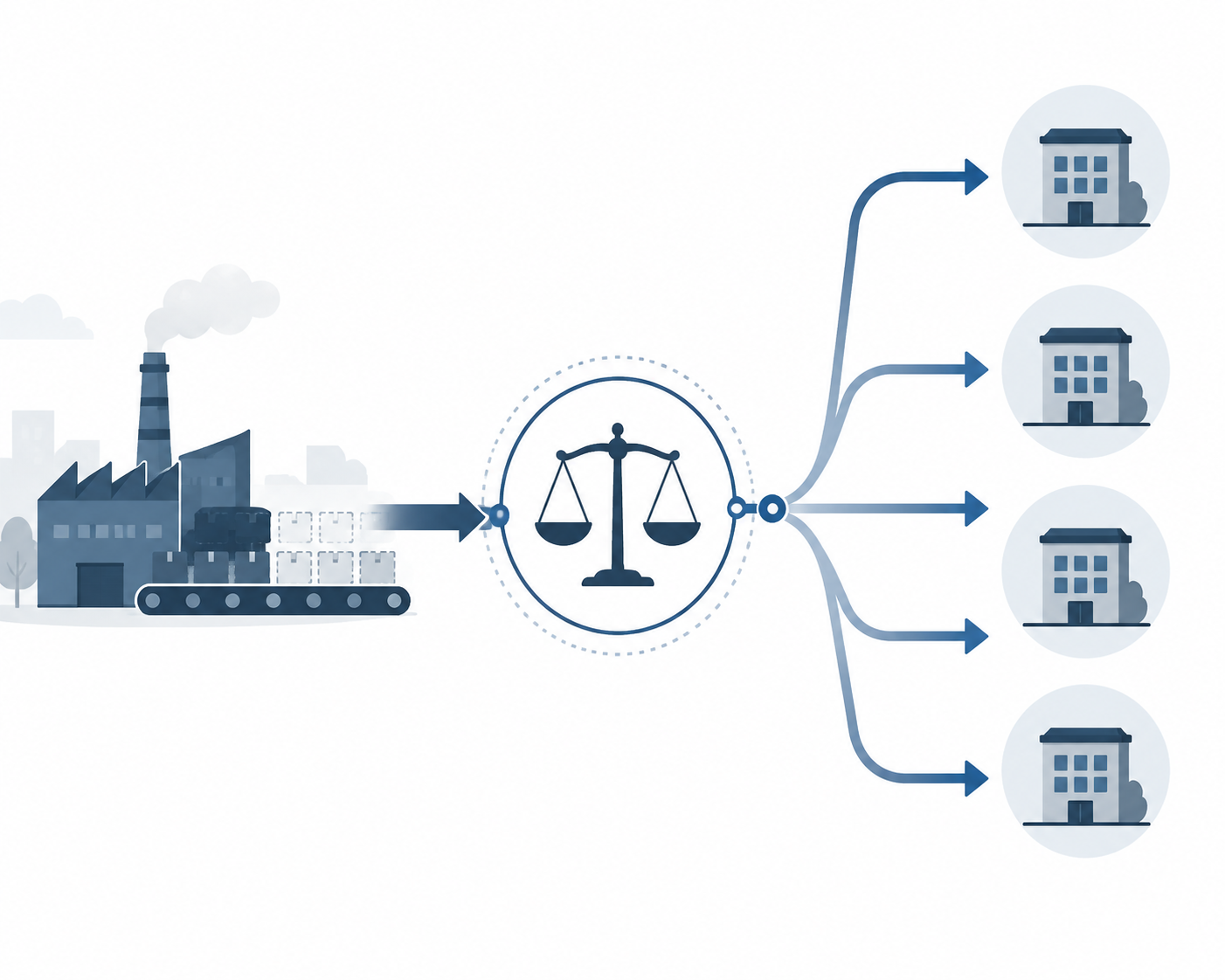
That framework is less dramatic than force majeure and more dangerous to mishandle. It asks for contemporaneous discipline. A seller cannot simply serve the highest-margin customers first, favor the loudest account, protect a strategic retailer without explanation, or use a cyber shutdown to exit an unattractive contract. The later dispute file will ask what production was actually available, which customers were contract customers, what baseline was used, what allocation formula was chosen, whether similarly situated customers were treated similarly, and whether any deviations had a documented operational reason.
The allocation file should be built while facts are still incomplete
Counsel do not need a final forensic report before preserving the allocation record. They need an operational snapshot that can be defended later. In a perishable dairy disruption, that snapshot should be refreshed often because product life, cold-chain capacity, line availability, and restart timing can change the legally relevant facts within hours.
- Identify all open contract customers separately from spot, promotional, affiliate, discretionary, or prospective customers.
- Freeze the relevant baseline: historical volumes, committed quantities, purchase orders, forecasts incorporated into the contract, and any minimum or maximum obligations.
- Measure available supply by usable category, not by comforting aggregate numbers: finished product, releasable inventory, production line, SKU, shelf life, geography, and cold-chain feasibility.
- Choose and record the allocation method before exceptions are made, especially if contract customers are not receiving pro rata treatment.
- Document why any customer received more or less than the formula would otherwise provide, using operational reasons rather than commercial preference.
- Preserve mitigation evidence: substitute production inquiries, co-packer outreach, inventory transfers, expedited logistics options, customer substitutions, and rejected alternatives.
The hardest records are often the most important ones: the customer that was not favored, the shipment that was redirected, the account team request that was refused, the exception that was allowed because a product would otherwise expire, and the executive instruction that counsel narrowed before it became a discrimination problem. A fair allocation does not have to make every customer happy. It does have to be explainable after the commercial emergency has passed.
Notice should preserve positions without overclaiming
The first notice after a ransomware shutdown should usually do less than the business wants and more than the lawyers are comfortable saying. It should identify the disruption, reserve rights, state that facts are developing, identify the affected performance if known, and avoid making final legal conclusions before causation and duration are understood. If the contract has a force majeure notice deadline, comply with it. If the seller may later rely on UCC § 2-615, give notice that deliveries may be delayed, reduced, or allocated, and that the allocation methodology is being developed or applied based on available production and contractual commitments.
Buyers have their own preservation work. A buyer that receives a general force majeure notice should ask for the clause relied upon, the specific obligations affected, the expected duration if known, the allocation method, the treatment of similarly situated contract customers, and mitigation steps. That request should be firm without forcing an early fight over facts the seller may not yet have. The buyer’s better leverage often comes from disciplined information requests and reservation of remedies, not from declaring breach before the allocation pattern is visible.
Both sides should be careful with privilege. Legal advice about contract rights should be protected where possible, but the underlying allocation facts will usually need to be disclosed or proved. If the only clean explanation for who got product lives in counsel’s privileged notes, the company may have made the wrong person the recordkeeper. Operations, supply-chain, sales, finance, and legal should agree on a nonprivileged allocation log that can survive production in a later dispute.
Industry context matters only because it changes what was foreseeable
The food and agriculture ransomware background should not distract from the contract work, but it is relevant to foreseeability and drafting expectations. Food and Ag-ISAC’s 2025 ransomware landscape report treated ransomware as a sector-level issue for food and agriculture organizations.[6] The Record reported that ransomware attacks on the food and agriculture industry had doubled, using that trend to describe a worsening threat environment for the sector.[7] Those materials do not prove that any particular dairy shutdown was preventable, and they do not decide whether any particular force majeure clause applies. They do make it harder to treat cyber disruption as an exotic contingency that reasonable contracting parties had no reason to address.
Operational technology context has the same limited use. TXOne Networks has described how ransomware can affect food-chain operations by disrupting production environments rather than merely stealing back-office data.[8] For contract purposes, the important distinction is not the malware family or the intrusion path. It is whether the incident prevented production, reduced output, delayed release, interrupted quality checks, affected cold-chain movement, or made delivery impracticable for reasons that connect directly to the seller’s obligations.
As of July 18, 2026, the Fairlife incident still has important unknowns: the full scope of affected systems, whether data was exfiltrated, whether a ransom was demanded or paid, how long production will remain halted, and how much supply can be shipped from remaining inventory or restored operations. Those facts may matter greatly to damages, mitigation, disclosure, insurance, and cybersecurity obligations. They are not a reason to wait on contract preservation.
What counsel should preserve now
The practical file should be built for the dispute that may never come. That means it should be accurate enough to use in litigation, restrained enough not to concede more than necessary, and current enough to guide shipments while the incident is still moving.
- Contract text: force majeure language, cyber-specific provisions, notice deadlines, allocation clauses, exclusivity terms, minimum-purchase obligations, service levels, cure rights, and termination rights.
- Notice history: who sent notice, when it was sent, what it said, what rights were reserved, and whether any update obligations were triggered.
- Causation evidence: how the cyber incident affected production, release, warehousing, transportation, order management, or customer delivery.
- Allocation records: available quantities, customer categories, baseline volumes, formulas used, exceptions granted, and reasons for deviations.
- Mitigation record: substitute supply, alternate production, partial shipment, SKU substitution, customer prioritization criteria, and communications rejecting or accepting alternatives.
- Commercial communications: sales pressure, customer threats, affiliate requests, executive directions, and any statements that could later suggest favoritism or opportunism.
This is not just defensive housekeeping. The party with the better contemporaneous record often controls the practical settlement range. A supplier that can show a documented, evenhanded allocation has a different conversation from one that can only say it was doing its best. A buyer that can show timely objection, targeted information requests, and substitute-supply efforts has a different damages file from one that waited for a final incident report.
For dairy supply contracts, the Fairlife ransomware attack is narrower and more urgent than the cybersecurity headlines suggest. Force majeure may help if the contract language and facts support it, but it is not a blanket excuse. Where production is impaired rather than eliminated, UCC § 2-615’s fair-and-reasonable allocation standard is likely to become the working rule for remaining supply. Ransomware has moved from remote contingency to foreseeable supply-chain risk; dairy contracts that do not say how cyber shutdowns affect allocation leave counsel operating under statutory reasonableness instead of drafted certainty.
References
- Coca-Cola Form 8-K, U.S. Securities and Exchange Commission, July 16, 2026.
- Coca-Cola says Fairlife halts U.S. production after cyber attack, Reuters, July 16, 2026.
- UCC § 2-615 and Official Comments, Legal Information Institute.
- The Role of Force Majeure Protocols in Maintaining Supply Chain Health, Cutter Consortium.
- Cyberattack and Ransomware Attack Force Majeure Considerations, King & Spalding.
- Navigating the 2025 Food and Agriculture Sector Ransomware Landscape, Food and Ag-ISAC.
- Ransomware attacks on food and agriculture industry have doubled, The Record.
- From Farm to Fallout: Ransomware's Impact on the Food Chain, TXOne Networks.
Related records
Tool profile
Browse tool evaluations →Governing regulation
Browse the obligations tracker →Preventive workflow
Browse verification workflows →
Report a correction or tip
Spotted an outdated figure, a misstated fact, or a ruling this case record should reflect? Public comments are disabled for this content given the professional cost of a misreported case outcome, penalty amount, or rule text — use the structured correction channel instead.
Report a correction or tip for this record →