
Fatal Texas Boat Crash Tests AI Compliance Rules for Counsel
A July 25 Kleberg County boat crash that killed a 16-year-old will likely produce a Texas wrongful death lawsuit. This Risk Digest record maps the elevated AI-sanction exposure any attorney faces when using generative AI in that litigation, citing Texas' local AI rules, Ethics Opinion 705, and 25+ documented hallucination sanctions.
- Jurisdiction
- Texas
- Court
- Southern District of Texas
- AI tool named
- Generative AI
- Ruling date
- Jul 25, 2026
- Source document
- View primary court order ↗
- Last verified
- Jul 28, 2026
Lex Machina Review is an independent risk-tracking and reference resource. Nothing on this site is legal advice, and using it does not create an attorney-client relationship. Every record is reviewed against primary sources but may not reflect the most current status of a matter — always verify directly against the cited court order, rule text, or a licensed attorney before relying on it.
Companion explanation — secondary to the source document above
The official record is short, and that matters. Texas Parks and Wildlife Department said a jon boat carrying three occupants collided with a center console boat at about 6:15 a.m. on July 25, 2026, near the Bird Island Basin boat ramp in Kleberg County. TPWD said a 16-year-old was ejected and died, and that the Texas Game Warden Boat Accident Reconstruction Team is investigating the collision. TPWD’s July 26 statement did not release names, charges, a cause determination, alcohol findings, life-jacket findings, or fault allocations.[1]
That is the verified starting point for any discussion of a fatal boat crash in Texas involving a 16-year-old killed in an active legal investigation. It is enough to make wrongful death litigation plausible. It is not enough to write a liability story.
No petition is part of the current record. Still, a death on navigable water near a public boat ramp can move quickly from investigation to retention letters, preservation demands, pre-suit discovery discussions, insurance correspondence, and eventually pleadings. Those documents are often drafted before every official report is complete. If a Texas lawyer uses generative AI in that window, the risk is not abstract. The problem is the filing environment waiting on the other side.
Why Kleberg County changes the AI-compliance analysis
Kleberg County points the federal path toward the Southern District of Texas. That does not mean a future case must be filed in federal court; a Texas wrongful death case may begin in state court, and no filing exists yet. But if removal, diversity jurisdiction, admiralty arguments, federal motion practice, or related proceedings bring the matter into federal court, counsel should expect Southern District AI obligations to govern any AI-assisted submission.[2]
The Southern District’s General Order 2025-04 does not use the same affirmative AI-disclosure header model adopted elsewhere. That difference can mislead a lawyer who treats “no header” as “no rule.” The order still requires independent legal judgment and an accuracy review before submitting AI-drafted content, tied to the lawyer’s Rule 11 obligations.[2]
| Texas forum | AI-filing obligation identified in current guidance | Practical consequence in the Bird Island Basin matter |
|---|---|---|
| Southern District of Texas | General Order 2025-04 requires independent legal judgment and accuracy review for AI-drafted content; no affirmative disclosure header is required under the description in the current tracker.[2] | A brief, petition, removal paper, or motion cannot rely on AI output unless counsel independently verifies the law and factual assertions before submission. |
| Northern District of Texas | Local Rule 7.2(f) uses an affirmative disclosure header model for AI-generated content.[2] | If related federal work lands there, the document format itself may need to identify AI use. |
| Eastern District of Texas | Local Rule CV-11(g) imposes a verification mandate for AI-generated filings.[2] | Counsel must be prepared to certify that AI-assisted legal work has been checked, not merely generated. |
| Texas Business Court | Rule 10(c) requires an accuracy check for AI-generated content.[2] | This is unlikely to be the natural venue for a personal-injury wrongful death claim, but it shows how broadly Texas courts have moved toward express AI verification duties. |
For a lawyer assigned to the Bird Island Basin file, the immediate lesson is not to memorize four different formulations. It is to build the file as though every AI-assisted sentence may later be challenged by a judge who expects the signer to know exactly where the citation, fact, and inference came from.
Ethics Opinion 705 reaches drafts before they become filings
The Texas ethics layer is broader than local filing rules. Texas Ethics Opinion 705, issued in February 2025, treats AI-generated content as work produced through a nonlawyer assistant for purposes of Rule 5.03. The opinion requires independent verification of citations, factual assertions, and legal analysis before the material is used in a filing or client communication.[2]
That matters because many mistakes in a personal-injury file happen before anyone is standing at the courthouse counter. A demand letter can overstate what TPWD has confirmed. A client update can describe a cause theory as though it were an investigative finding. A preservation letter can identify the wrong vessel owner if an AI tool fills in gaps from public-looking but unverified material. A draft petition can turn “collision under investigation” into a claim about speed, lookout, intoxication, lighting, or operator conduct without a record to support it.
The ethical duty is not satisfied by asking the tool to “check itself.” It is also not satisfied by assigning an associate or paralegal to clean up the output without a documented review path. If AI output is treated as nonlawyer-assistant work, supervision has to look like supervision: someone competent reviews the source material, tests the law, and decides what can be said.
What the current crash record permits—and what it does not
The TPWD statement permits a narrow factual spine: date, approximate time, location near the Bird Island Basin boat ramp, the two vessel descriptions, three occupants in the jon boat, ejection of a 16-year-old, death, and involvement of the Texas Game Warden Boat Accident Reconstruction Team.[1]
It does not permit counsel to state that alcohol contributed. It does not permit a life-jacket conclusion. It does not identify operators, owners, passengers, weather, lighting, vessel speed, navigational decisions, equipment defects, lookout failures, warnings, or criminal exposure. It also does not tell counsel whether any civil defendant will contest jurisdiction, causation, comparative responsibility, damages, or admissibility of later reconstruction findings.
This is where generative AI becomes especially dangerous in early wrongful death work. The tool is often most fluent when the record is least complete. It can produce a familiar negligence paragraph, a plausible maritime-sounding duty discussion, or a confident discovery outline before the file has the accident report, witness statements, vessel records, reconstruction materials, medical records, or insurance information needed to support those assertions.
The sanction record is no longer theoretical
Courts have already punished lawyers for AI-generated legal work that contained fabricated or unsupported authority. The Texas AI guidance tracker identifies at least 25 documented AI-hallucination sanction matters, including Texas examples such as Elizondo v. City of Laredo, where a $2,500 sanction followed fake citations, and Wilson v. KIPP Texas, reported in October 2025.[2] Reuters separately reported in February 2025 that AI hallucinations in court papers had become a recurring source of trouble for lawyers.[3]
Gauthier v. Goodyear is a useful warning because the mistake pattern is ordinary: hallucinated cases appeared in a filing, and the court imposed a $2,000 sanction.[4] Law360 also reported a Texas lawyer being sanctioned $15,000 for AI-generated fake citations in briefs.[5] The dollar amount varies, but the judicial reaction is consistent enough to matter: when a lawyer signs or submits the paper, the court looks to the lawyer, not the tool.
For the Bird Island Basin matter, the sanction risk is not limited to fake case law. A hallucinated factual assertion can be just as damaging if it enters a pleading, discovery response, motion, expert outline, or client-facing liability analysis. A court may see an invented case citation first because it is easy to prove. A family, opposing counsel, insurer, or expert may find the invented accident fact first because they know the record.
A usable verification workflow for the likely litigation file
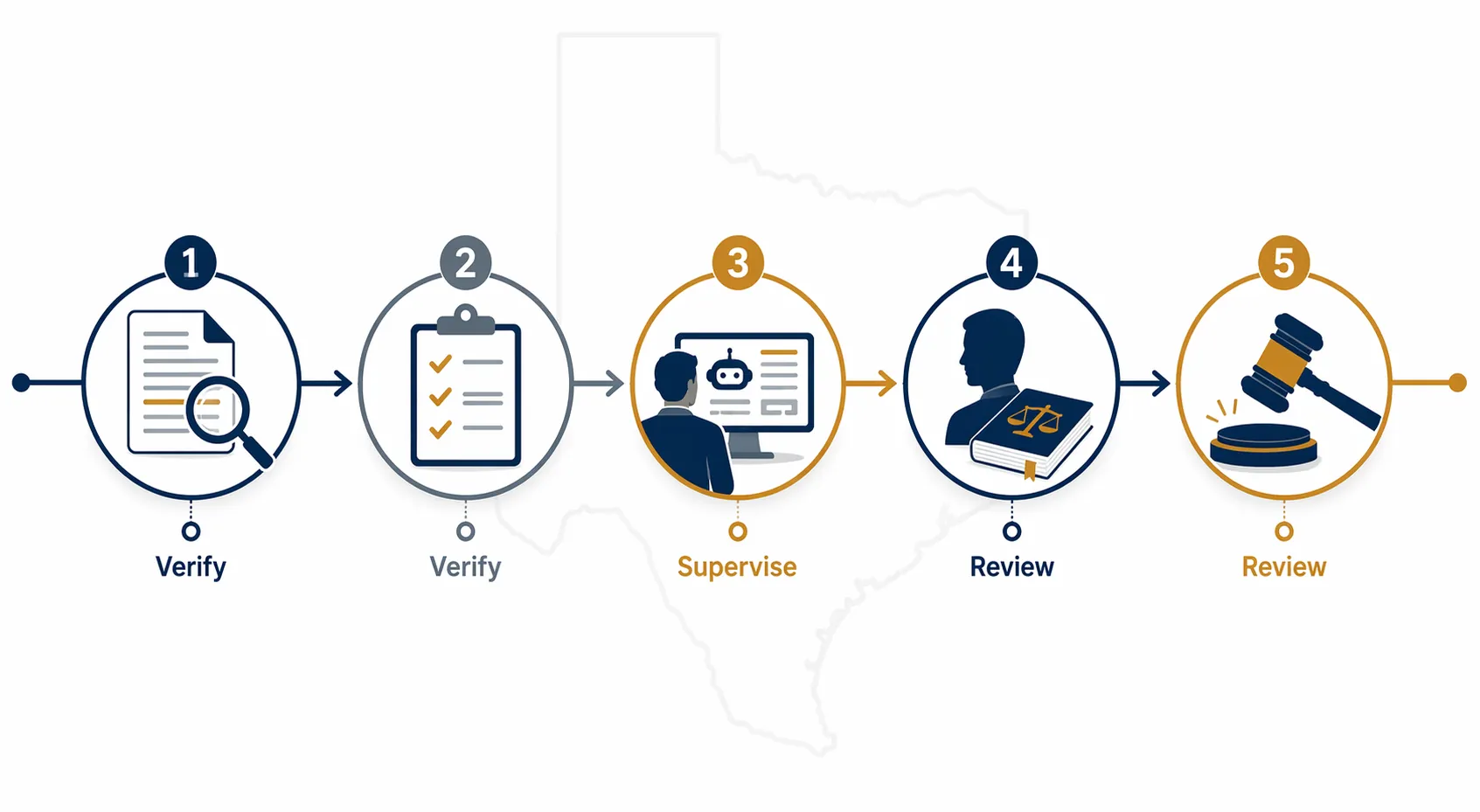
A firm can use AI in this matter only if it can separate drafting assistance from evidentiary authority. The control should begin at intake, not after a motion is ready to file.
| Work product | AI-specific failure mode | Required human check before use |
|---|---|---|
| Pre-suit demand or insurer letter | The draft states unconfirmed facts about operator conduct, alcohol, life jackets, visibility, or fault. | Limit incident facts to the TPWD statement, client-provided information that has been separately recorded, and later official or discovery material. Label theories as theories. |
| Original petition or complaint | The draft imports boilerplate negligence theories that imply facts not yet known. | Tie every factual allegation to a source in the file. If the point depends on investigation, plead it with appropriate limits rather than as an established fact. |
| Removal, remand, or jurisdictional briefing | The draft cites nonexistent cases or misstates federal venue, admiralty, diversity, or local AI-rule requirements. | Open and verify every case, statute, rule, and local order in an authoritative research platform or official court source before signature. |
| Discovery requests | The draft asks for categories based on assumed facts rather than the actual crash record. | Use AI for formatting and completeness only after a lawyer identifies the real factual targets: vessels, operators, ownership, communications, maintenance, safety equipment, witnesses, scene conditions, and reconstruction materials. |
| Discovery responses or objections | The draft uses generic objections or factual denials that do not match the client’s verified knowledge. | Review against client interviews, documents, investigation materials, and applicable procedural rules. Do not let AI supply facts the client has not confirmed. |
| Accident-reconstruction analysis | The draft turns assumptions into measurements or treats a model output as expert evidence. | Keep AI-generated analysis separate from expert opinions unless a qualified human expert reviews, adopts, and can explain the methodology and source data. |
| Client communications | The draft overstates liability, odds of success, timing, or what the government investigation has found. | A lawyer must independently verify legal analysis and factual descriptions before the communication leaves the firm. |
The Texas Game Warden Boat Accident Reconstruction Team’s involvement adds a second reason to slow down. Reconstruction evidence often arrives in pieces: measurements, vessel damage documentation, diagrams, witness accounts, electronic data if any exists, and expert interpretation. AI can help organize a chronology or build a checklist of missing materials. It should not be allowed to infer the collision mechanics from a short media statement and then present that inference as fact.[1]
Citation review has to be source-level, not screen-level
The lawyer who reviews an AI-assisted brief should not merely confirm that the citation looks normal. The reviewer should open the case, confirm that it exists, confirm the court and date, read the cited passage, check that the proposition matches the holding, confirm the procedural posture, and check for negative treatment. If a quote appears, the quote should be compared against the source text. If a parenthetical appears, it should be rewritten from the reviewer’s own reading, not accepted because it sounds plausible.
That work is tedious. It is also exactly the work courts expect when a lawyer signs a filing. The Texas sanction examples do not punish lawyers for being curious about AI. They punish the filing of legal work that counsel did not adequately verify.
Fact review should preserve unknowns
A fact-control sheet for this file should begin with the TPWD statement and a separate column for source status. “Confirmed by TPWD” is different from “reported by client,” “reported by witness,” “shown in photograph,” “stated by insurer,” “contained in discovery,” and “expert inference.” AI-assisted drafts should be checked against those labels before they are sent outside the firm.
- Confirmed public facts should remain limited to the date, approximate time, location, vessel descriptions, occupant count in the jon boat, ejection and death of the 16-year-old, and the active Game Warden reconstruction investigation.[1]
- Unconfirmed categories should stay out of factual assertions unless later evidence supports them: alcohol, life jackets, lighting, weather, speed, lookout, operator experience, criminal charges, mechanical failure, and comparative responsibility.
- Legal theories should be separated from investigative findings. A negligence theory is not the same thing as an official cause determination.
- Any AI-generated chronology should identify the source for each entry rather than blending public facts, lawyer assumptions, and anticipated discovery.
Supervision cannot be delegated to the software
Opinion 705’s Rule 5.03 framing is especially important in a busy personal-injury practice. A paralegal may ask a tool to summarize TPWD materials. An associate may use AI to draft discovery. A marketing or intake employee may prepare a family-facing explanation of what happens after a fatal crash. If those outputs contain legal analysis or factual statements about the case, a lawyer’s review is required before use.[2]
The review should leave a record. Not a theatrical memo for every AI-assisted step, but enough file discipline to show who checked citations, who checked accident facts, who approved client communications, and which source materials controlled the final version. If a court later asks how a false citation or unsupported assertion entered the document, “the AI generated it” will not answer the question that matters.
The pre-filing questions counsel should answer
Before any AI-assisted document tied to the Bird Island Basin crash is filed, served, or sent to a client, the responsible lawyer should be able to answer these questions without returning to the tool for reassurance:
- What portions of the document were generated, edited, summarized, translated, or reorganized with AI assistance?
- Does the document contain any statement about fault, intoxication, safety equipment, vessel speed, lighting, operator identity, ownership, charges, or cause that is not supported by the present record?
- Has each case, statute, rule, local order, quote, and parenthetical been opened and checked against an authoritative source?
- If the document is headed to federal court, which Texas federal district’s AI rule applies, and does the document meet that district’s form and verification requirements?
- If the document is a client communication rather than a court filing, has a lawyer still verified the legal analysis and factual assertions under Opinion 705’s nonlawyer-assistant framework?
- If the document discusses accident reconstruction, does it distinguish official investigative material, retained-expert analysis, lawyer inference, and AI-generated organization?
- Can the signing lawyer personally defend the factual and legal basis of the document without relying on the tool’s output?
Those questions are not a special burden created by one tragic crash. They are the ordinary obligations of litigation practice applied to a file where the public facts are sparse, the stakes are high, and Texas courts have moved faster than many jurisdictions in making AI review duties explicit.
The bounded risk judgment
The Bird Island Basin crash should not be used as a vehicle for unsupported claims about who caused the collision. TPWD has said the matter remains under investigation, and the public record does not supply the missing liability facts.[1]
But as a litigation-risk record, the case is already concrete enough to evaluate AI exposure. If generative AI is used in a wrongful death matter arising from this fatal crash, sanction risk is materially elevated because the likely federal venue sits inside Texas’ developed AI-rule landscape, Texas Ethics Opinion 705 requires independent verification of AI-assisted legal and factual work, and courts have already imposed penalties for hallucinated legal filings. The danger is not that this crash is unusual. The danger is that a familiar wrongful death workflow may move faster than the verification duties now attached to it.
References
- Official Media Statement: Fatal Multi-Vessel Collision, Bird Island Basin, Kleberg County — Texas Parks and Wildlife Department, July 26, 2026
- Texas AI Ethics Guidance for Law Firms — Legal AI Governance
- AI 'hallucinations' in court papers spell trouble for lawyers — Reuters, February 2025
- AI-hallucinated citations warrant sanctions — Courthouse News, November 2024
- Texas Atty Dinged For AI-Generated Fake Citations In Briefs — Law360, February 2025
Related records
Tool profile
How Meta's AI Spending Reshapes Law Firm ProfitabilityGoverning regulation
Browse the obligations tracker →Preventive workflow
Browse verification workflows →
Report a correction or tip
Spotted an outdated figure, a misstated fact, or a ruling this case record should reflect? Public comments are disabled for this content given the professional cost of a misreported case outcome, penalty amount, or rule text — use the structured correction channel instead.
Report a correction or tip for this record →