
What Fauci’s Deletion Emails Mean for AI Records Risk
The Morens indictment and the Fauci “delete this email” directives create a legally grounded risk framework that extends to AI-generated communications. This article explains why the same records-destruction theory under 18 USC § 1519 applies to chatbot logs and AI drafts, and what steps litigators and in-house counsel should take now.
- Jurisdiction
- US Federal
- Court
- United States District Court
- AI tool named
- AI chatbot
- Ruling date
- Apr 28, 2026
- Source document
- View primary court order ↗
- Last verified
- Jul 30, 2026
Lex Machina Review is an independent risk-tracking and reference resource. Nothing on this site is legal advice, and using it does not create an attorney-client relationship. Every record is reviewed against primary sources but may not reflect the most current status of a matter — always verify directly against the cited court order, rule text, or a licensed attorney before relying on it.
Companion explanation — secondary to the source document above
Anthony Fauci’s July 29, 2026 invocation of the Fifth Amendment belongs in a narrow lane. It is not a referendum on lockdowns, COVID-origin politics, or the long-running fight between Fauci and Rand Paul. For legal teams, the useful legal-policy angle is much plainer: a congressional committee surfaced written deletion instructions, placed them next to a subpoena fight, and pushed the dispute into a contempt posture that is still developing as of July 29, 2026.[1]
That posture is important, but it is not the strongest legal anchor. The stronger anchor is the April 28, 2026 indictment of former senior NIAID official David Morens, because the Department of Justice pleaded a records-destruction theory around ordinary communications: concealment of federal records, destruction or alteration of records during a federal investigation, and routing government business through a personal Gmail account to evade FOIA capture.[2]
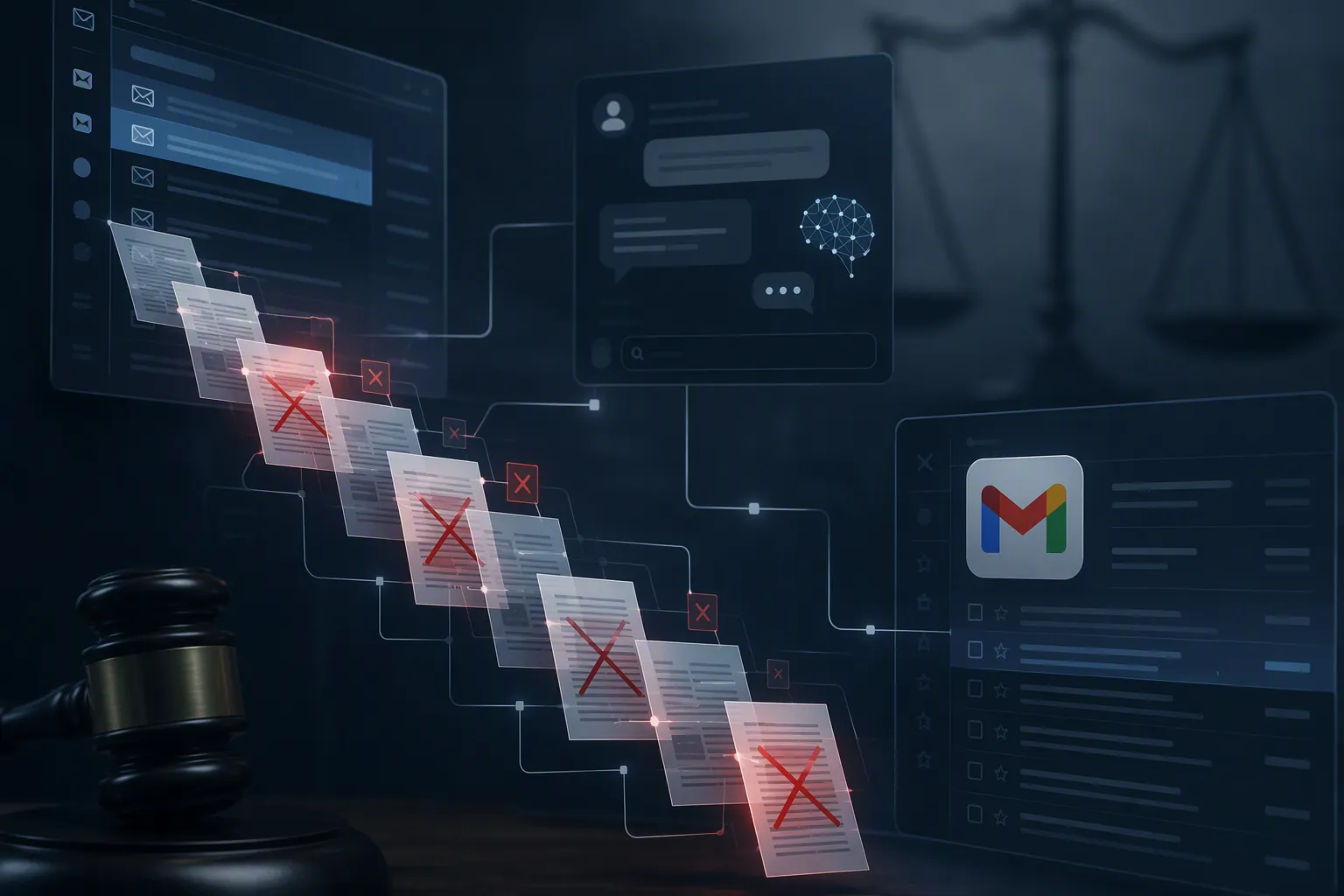
A charging document is not a conviction, and the Fauci excerpts are selective committee disclosures. Those cautions matter. But the records-risk signal does not require a prediction about who wins a contempt fight or whether any later enforcement action succeeds. It requires only recognizing what the government has already said it can charge when communications are allegedly concealed, deleted, altered, or pushed off-channel.
The Morens indictment is the records map
The DOJ announcement describes Morens as a former senior official at the National Institute of Allergy and Infectious Diseases and says the indictment charged him with concealing federal records during the COVID-19 pandemic. The alleged conduct includes using a personal Gmail account for government business, deleting federal records, and making false statements connected to records requests and investigations.[2]
For discovery and records professionals, the channel choice is not a side detail. The indictment’s theory treats the personal-account workaround as part of the concealment problem, not as a harmless preference for convenience. Once the communication is government business or otherwise responsive to a lawful records process, the fact that it sat outside the official system can become evidence of how the record was kept away from review.
The indictment also matters because it ties everyday records behavior to 18 U.S.C. § 1519. The statute covers anyone who “knowingly alters, destroys, mutilates, conceals, covers up, falsifies, or makes a false entry” in a record, document, or tangible object with the intent to impede, obstruct, or influence an investigation or the proper administration of a matter within federal jurisdiction, or in relation to or contemplation of such a matter. The maximum penalty is imprisonment for up to 20 years.[3]
That language is broad in a way practitioners sometimes underprice. It does not ask whether the record was created in Microsoft Outlook rather than Gmail. It does not limit itself to formal memoranda. It does not require the record to look dignified when printed. The operative questions are closer to the ones a litigation records lead asks under pressure: what was the record, who controlled it, what process was pending or foreseeable, what instruction was given, and what happened after the instruction.
The DOJ’s Morens theory is therefore procedural before it is political. If the government can plead concealment and destruction around informal messages, deleted records, and personal Gmail routing, the lesson for law firms and in-house teams is not that every informal communication is criminal. The lesson is that informality does not keep a communication outside a preservation analysis.
Why the Fauci deletion excerpts sharpen the intent problem
The Fauci materials enter differently. HSGAC Chair Rand Paul’s September 2025 disclosure quoted a February 2, 2020 Fauci email saying, “please delete this email after you read it,” and a July 20, 2020 exchange saying, “These are deleted… Do people keep these?”[4] Those excerpts are now part of the committee’s case for further testimony and enforcement, and NPR reported that Fauci invoked the Fifth Amendment at the July 29, 2026 hearing.[1]
Those sentences should not be made to do more work than the record supports. The full chains may matter. Committee disclosures are adversarial by design. The contempt process remains unresolved. But anyone who has managed a preservation dispute knows why those words are the ones that get highlighted, enlarged, and placed on a timeline.
“Please delete this email after you read it” may have felt administrative in the moment. In a later obstruction analysis, it can look like an instruction tied to intent. The same is true of “Do people keep these?” The question reads differently after subpoenas, FOIA requests, committee inquiries, or agency investigations begin circling the subject matter. It becomes less about storage hygiene and more about state of mind.
This is where the Morens indictment and the Fauci excerpts line up without becoming the same case. Morens supplies the charged legal theory. The Fauci excerpts supply the recognizable sentence-level fact pattern: short, informal deletion language that a sender may later want to characterize as housekeeping, but that a records reviewer may have to explain as potential evidence of concealment.
There is also a public-records reminder here. The National Freedom of Information Coalition has emphasized in a separate explainer that widely discussed Fauci emails were obtained through FOIA, not leaked.[5] That distinction is not cosmetic. FOIA-obtained records exist because a public-records process reached them. A deletion instruction aimed at that kind of material lands differently from a private preference about inbox clutter.
A Global Biodefense analysis described the Morens indictment as a records case with political fingerprints, which is a useful caution for readers tempted to treat every development as neutral procedure.[6] Political context can shape timing, framing, and attention. It does not erase the preservation problem. A document either exists, was deleted, was routed elsewhere, was preserved, or was not. The records officer left answering those questions does not get much protection from the fact that the surrounding fight is ugly.
The channel is different; the preservation question is not
Official email, personal Gmail, chat exports, AI prompt histories, AI-generated drafts, and automated summaries are operationally different. They sit in different systems, have different retention defaults, and may be controlled by different administrators. That is a systems problem. It is not a reliable legal boundary.
The risk question is whether the content is government-facing business, litigation-relevant work product, agency-responsive material, or information subject to a preservation obligation. If it is, the interface that generated or held it becomes part of the custodian map. A Gmail inbox is not magic. Neither is a chatbot history pane.
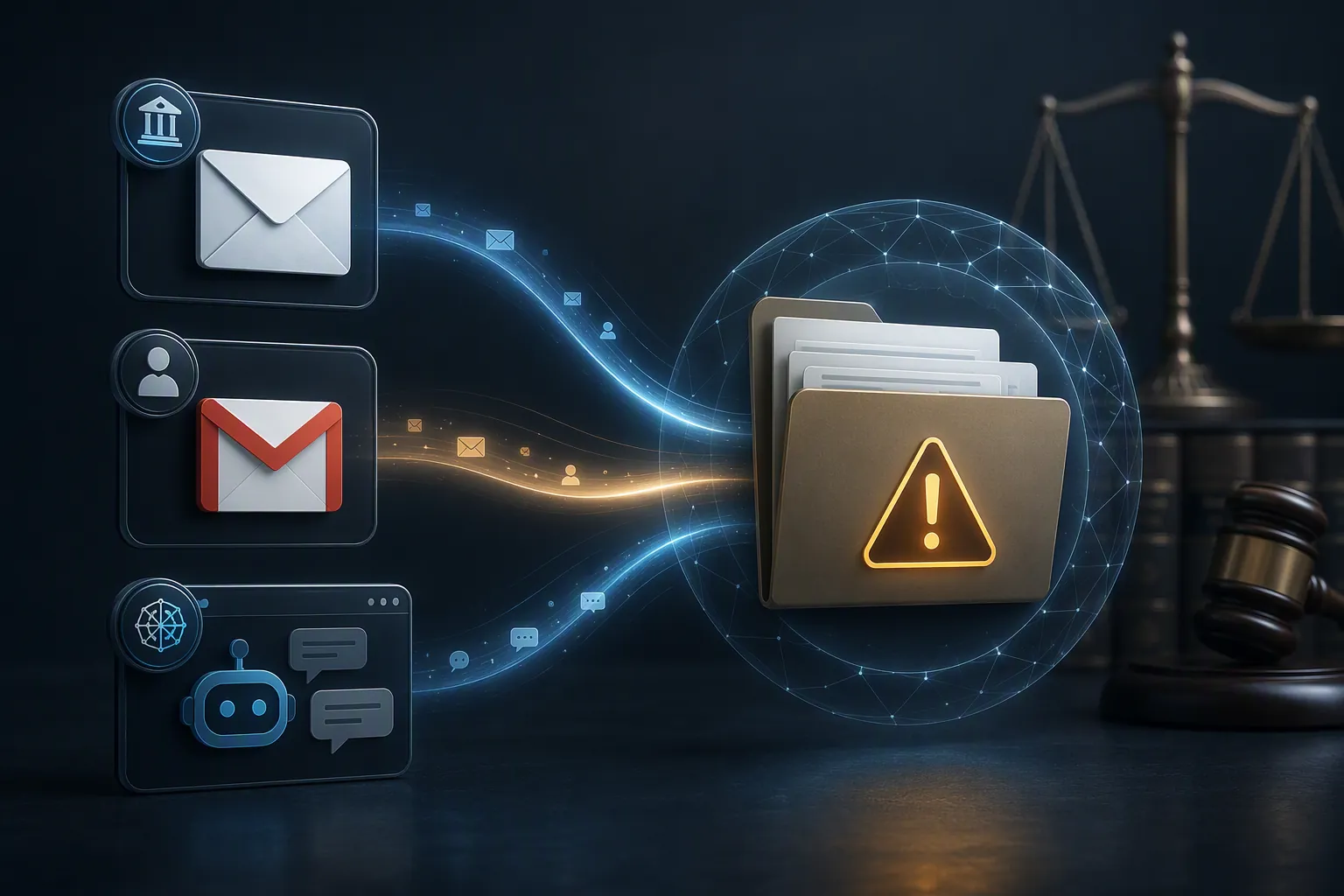
The AI extension is a legal-risk inference, not a reported holding. No court has applied the Morens indictment to chatbot logs or AI-assisted legal drafting on the facts described here. Still, the preservation theory is visible enough. If a lawyer uses an AI tool to summarize agency communications, draft responses to a regulator, prepare talking points for a congressional inquiry, or analyze documents under a legal hold, the resulting prompt history, output, draft, and export may carry records significance.
The harder problem is not whether AI output can ever be a record. It can, depending on context. The harder problem is that many AI workflows were introduced as convenience layers before anyone built the records architecture around them. The work happens, the model produces a draft, the user copies useful text elsewhere, and the original prompt-and-response trail remains in a vendor console, browser session, temporary workspace, or disabled history setting.
| Workflow location | Records-risk question | Practical consequence |
|---|---|---|
| Official email or document-management system | Does the content relate to government-facing work, a request, an investigation, or a litigation hold? | Preservation can usually follow existing retention, hold, and export procedures. |
| Personal Gmail or other personal account | Was official or client work routed away from approved systems? | The off-channel choice can become part of a concealment or supervision inquiry. |
| AI chatbot history or prompt log | Do prompts and outputs reveal substantive work, source material, instructions, or draft positions? | The history may need to be preserved, exported, or locked down once a duty attaches. |
| AI-generated draft copied into a brief, memo, letter, or response | Can the team reconstruct what was generated, edited, approved, and filed? | Version control and document-management capture become more important than the novelty of the tool. |
| Automated summary or extraction tool | Was the output used to make decisions about responsive documents, facts, or positions? | Quality-control records and system settings may become discoverable process evidence. |
This is also where records teams should resist vendor-shaped thinking. A platform may call something a “conversation,” “history,” “temporary chat,” “workspace,” or “draft.” Those labels help administrators find settings. They do not decide whether the material is potentially responsive, privileged, work product, or subject to hold.
What legal teams should change before the subpoena arrives
The immediate task is not to write a memo declaring all AI output a federal record. That would be overbroad and probably unworkable. The better task is to make sure AI-assisted work can be located, preserved, reviewed, and explained when the underlying matter requires it.
Start with the custodian map. If attorneys, investigators, consultants, or policy teams use AI tools for government-facing work, the map should identify which tools are approved, where prompts and outputs are stored, who can export them, what default retention settings apply, and whether administrators can suspend deletion. A legal hold that names email and shared drives while ignoring AI workspaces is already incomplete for the teams that use those workspaces substantively.
Bring AI drafts back inside approved systems. If a model helps draft a response to an agency, a congressional committee, a public-records request, or litigation correspondence, the working draft should not live only in the AI interface. It should be saved into the document-management or matter-management environment where access controls, versioning, privilege review, and retention rules already operate.
Stop personal-account routing with the same seriousness that email policies already claim to require. The Morens indictment makes the Gmail point uncomfortable because the alleged workaround is easy to understand: government business conducted in a personal account to avoid FOIA capture.[2] An AI-era equivalent could be a lawyer or consultant moving prompts, source documents, or generated drafts into a personal account or personal AI subscription because the official environment is slower or more restrictive. Convenience will not be the first explanation a reviewer reaches for if the routing coincides with an inquiry.
Document retention settings before the dispute becomes live. If an AI tool deletes histories after a set period, disables history by default, trains on or does not train on submitted prompts, or allows administrators to export logs only under certain plans, those facts should be known before a preservation notice is issued. Waiting until the partner asks “Do we have that?” is how a settings screen becomes an exhibit.
Treat deletion instructions as escalation events. A message telling someone to delete an email, chat, prompt, draft, export, or summary should not be handled as routine cleanup when the subject matter touches a dispute, public-records request, government inquiry, or foreseeable investigation. The right response is to pause, preserve, and involve counsel responsible for the hold or records process. If privilege applies, protect the communication; do not bury the event.
A similar transparency problem appears outside the public-health context. Federal records and public-facing materials can become contested when they disappear from official channels, a concern also raised in Navy Photo Removal and Records Purges Raise Transparency Concerns. The technology changes; the later accountability question remains brutally familiar: who removed what, under whose authority, and after what duty had attached?
The AI records lesson is already visible
The safest reading of the current record is scoped. Fauci’s invocation of the Fifth Amendment does not prove the committee’s allegations. The HSGAC excerpts are not a full evidentiary record. The Morens indictment is an allegation, not an adjudication. And no court has yet held, on this fact pattern, that an AI chatbot log should be treated like the email and Gmail records described in the indictment.
But legal teams do not need that final case to see the preservation risk. DOJ has already pleaded a records-destruction case around concealment, deletion, alteration, and off-channel routing in ordinary communications. Section 1519 is written broadly enough that technological novelty is unlikely to be the comforting distinction some teams want it to be. If AI-generated legal work concerns government-facing business, investigations, public-records processes, or litigation-relevant analysis, it should not be treated as an ephemeral convenience merely because it passed through a model interface.
The practical move is available now: preserve chatbot logs when they relate to covered work, move AI drafts into approved systems, prohibit personal-account workarounds, record retention settings before holds issue, and escalate deletion language instead of normalizing it. Otherwise, the next subpoena will not ask whether the tool felt informal. It will ask whether the record existed, who knew, and why it is gone.
References
- Fauci invokes Fifth Amendment in Rand Paul’s coronavirus origins hearing, NPR, July 29, 2026.
- Former Senior NIAID Official Indicted for Concealing Federal Records During COVID-19 Pandemic, U.S. Department of Justice, April 28, 2026.
- 18 U.S. Code § 1519 - Destruction, alteration, or falsification of records in Federal investigations and bankruptcy, Legal Information Institute.
- Chairman Rand Paul Uncovers New Evidence of Fauci Deleting Official Records, U.S. Senate Committee on Homeland Security and Governmental Affairs.
- No, Those Fauci Emails Weren’t Leaked. Yes, They Were Obtained Using FOIA, National Freedom of Information Coalition.
- A Records Case With Political Fingerprints: The Morens Indictment Demands Scrutiny, Global Biodefense, April 28, 2026.
Related records
Tool profile
How Meta's AI Spending Reshapes Law Firm ProfitabilityGoverning regulation
Browse the obligations tracker →Preventive workflow
Browse verification workflows →
Report a correction or tip
Spotted an outdated figure, a misstated fact, or a ruling this case record should reflect? Public comments are disabled for this content given the professional cost of a misreported case outcome, penalty amount, or rule text — use the structured correction channel instead.
Report a correction or tip for this record →