
Did the 2025 Government Shutdown Pause Federal Filing Deadlines?
A court-by-court breakdown of which federal filing deadlines were extended, stayed, or left standing during the 43-day 2025 government shutdown, plus a post-reopening verification checklist for counsel with active civil and appellate cases.
- Jurisdiction
- US Federal
- Court
- D.D.C.; Tenth Circuit; Ninth Circuit
- Judge
- James Boasberg
- AI tool named
- No AI tool implicated
- Ruling date
- Nov 13, 2025
- Source document
- View primary court order ↗
- Last verified
- Aug 1, 2026
Lex Machina Review is an independent risk-tracking and reference resource. Nothing on this site is legal advice, and using it does not create an attorney-client relationship. Every record is reviewed against primary sources but may not reflect the most current status of a matter — always verify directly against the cited court order, rule text, or a licensed attorney before relying on it.
Companion explanation — secondary to the source document above
The short answer for federal court deadlines during the 2025 government shutdown is this: no blanket federal filing pause occurred. A shutdown was not, by itself, deadline relief. Unless a statute, rule, docket entry, or court-specific shutdown order changed the obligation in the case, counsel still had to file, respond, appear, or seek relief on time.
This is not legal advice. It is for counsel and docketing teams checking active federal civil and appellate matters after the 2025 lapse in appropriations. Source links were last checked for this article on Aug. 1, 2026. Where a court order is a PDF, do not lift operative language from this article into a filing; open the order, confirm the version on the court site, and quote from the court’s document.
The national operating timeline matters only because it explains why there was confusion. On Oct. 1, 2025, the federal judiciary said courts would continue operations using available fee balances and other no-year funds, and that electronic filing and public access systems would remain available.[1] On Oct. 17, the judiciary announced that those funds would be exhausted and that, beginning Oct. 20, courts would continue only limited operations permitted under the Anti-Deficiency Act.[2] Reopening and reset orders then began to matter immediately, including D.D.C.’s Nov. 13 standing order following restoration of appropriations.[3]
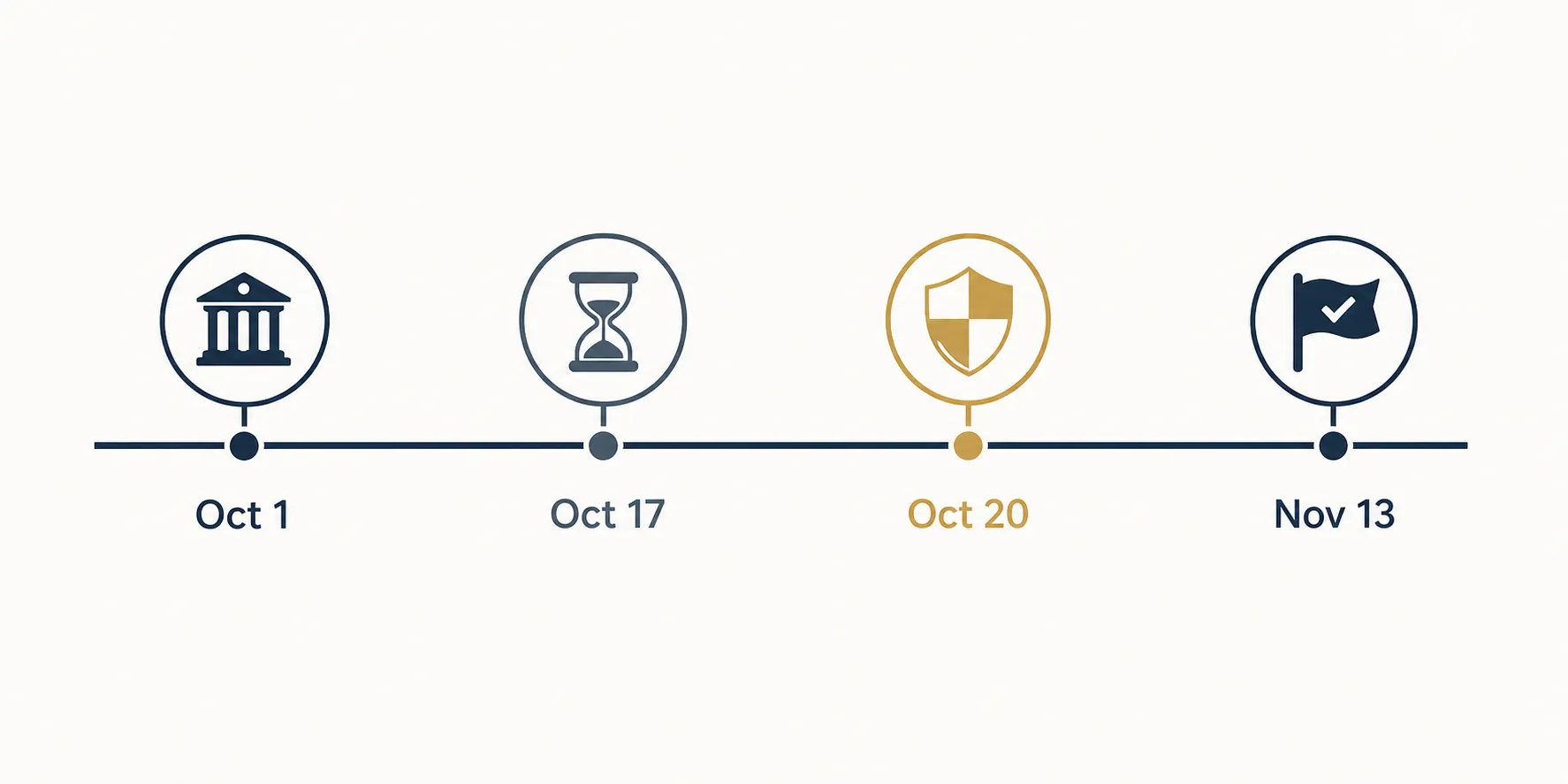
| Date | Operational point | Docket consequence |
|---|---|---|
| Oct. 1, 2025 | Judiciary continued operations using available balances.[1] | No national deadline suspension followed from the shutdown starting. |
| Oct. 17, 2025 | Judiciary announced funding would run out.[2] | Courts prepared for a narrower operating posture, but counsel still needed court-specific orders. |
| Oct. 20, 2025 | Limited operations continued under Anti-Deficiency Act exceptions.[2] | Emergency, criminal, and other excepted work did not become automatically dormant. |
| Nov. 13, 2025 | Courts began applying reopening and reset orders after appropriations were restored.[3] | Previously extended or stayed deadlines had to be recalculated under the applicable order and docket entries. |
What stayed live when the shutdown began
The most dangerous assumption was that a closed government meant a closed federal docket. It did not. CM/ECF remained available for electronic filing, and PACER remained available for docket access during the shutdown.[1][4] That fact removes the easy after-the-fact explanation that a filing simply could not be made.
Court operations were constrained, but not erased. Reporting during the lapse described continued handling of criminal matters, jury operations, and urgent proceedings such as temporary restraining orders, preliminary injunctions, and habeas matters.[4][5] Those categories matter because many shutdown orders carved out urgent proceedings even where they otherwise extended or stayed deadlines. A lawyer who had an emergency-relief calendar could not safely infer that a civil deadline extension covered that hearing, response, or evidentiary submission.
Nor did the phrase “limited operations” answer the filing question. It described what the judiciary could fund and staff after appropriations lapsed. It did not rewrite the Federal Rules, local rules, individual chambers orders, or appellate briefing schedules across all courts.
The deadline answer was court by court
The operative divide after Oct. 1 was not “shutdown” versus “no shutdown.” It was whether the specific court entered an order that applied to the specific case, deadline, party posture, and proceeding type. Four patterns were especially important for docket-risk review.
| Court or source | Treatment described in available materials | Risk point for counsel |
|---|---|---|
| D.D.C. | The Hill reported that Chief Judge James Boasberg’s Oct. 1 order extended deadlines in civil matters involving the United States, with emergency relief excluded.[6] D.D.C. later issued Standing Order No. 25-59 after restoration of appropriations.[3] | Do not apply the extension to every D.D.C. civil case. Check whether the United States was a party and whether the proceeding was excluded. |
| Tenth Circuit | The Tenth Circuit issued an Oct. 1 general order stating that the shutdown did not automatically extend filing deadlines and that relief had to be sought case by case.[7] | A pending appeal in that circuit required the ordinary deadline analysis unless the court granted relief in the case. |
| Ninth Circuit | The Ninth Circuit entered a shutdown Phase 2 order, then issued a clerk’s order resetting deadlines after appropriations were restored.[8] | A stayed deadline was not self-executing forever. The reset order had to be applied to the actual docket. |
| Other district courts | Bloomberg Law reported that at least 10 district courts issued automatic-extension or pause standing orders.[9] | Treat that as a lead, not a rule. Each district order must be pulled from the issuing court and checked against the case. |

D.D.C.: limited relief, not a district-wide holiday
D.D.C. is a good example of why the case caption mattered. Available reporting described an Oct. 1 executive order extending deadlines only in civil matters involving the United States, while excluding emergency relief.[6] That is a narrower proposition than “D.D.C. deadlines were extended.” It requires at least three checks: whether the matter was civil, whether the United States was involved in the relevant capacity, and whether the filing related to an excluded emergency proceeding.
The reopening order created a second calculation point. D.D.C. Standing Order No. 25-59, dated Nov. 13, addressed extensions in civil matters involving the United States following restoration of appropriations.[3] For docketing staff, that meant the Oct. 1 order was not the end of the task. The file needed the reopening order too, because the answer after Nov. 13 depended on how the court treated the earlier extension once operations resumed.
This is where malpractice exposure usually hides. A lawyer can correctly remember that D.D.C. issued shutdown relief and still miss the deadline if the case did not fit the order, if an emergency carveout applied, or if the reset date was calculated from the wrong reopening instruction.
Tenth Circuit: no automatic extensions
The Tenth Circuit took the cleaner but less forgiving route. Its Oct. 1 general order stated that the shutdown did not automatically extend filing deadlines and that parties seeking relief had to request it in the case.[7] That order is the antidote to the “federal courts were affected, so my deadline moved” argument.
In practical terms, an appellate deadline in the Tenth Circuit remained a live deadline unless the rules, the docket, or a granted motion changed it. If a party needed more time because a federal agency client, government counsel, or record source was unavailable, the safer path was a motion supported by the shutdown facts, not a unilateral calendar adjustment.
Ninth Circuit: a stay is only half the analysis
The Ninth Circuit materials show the second common trap: even where a court stayed deadlines, counsel still had to know how the stay ended. The court issued a shutdown Phase 2 order during the lapse.[8] After appropriations were restored, the clerk issued a separate order resetting deadlines.[10]
That sequence matters because a stayed deadline does not automatically become whatever date appears convenient after reopening. The docketing question becomes: what deadline was stayed, how much time remained when the stay took effect, what event restarted the clock, and did the clerk’s reset order impose a new fixed date instead of a simple tolling calculation? The answer has to come from the order and the docket, not from the shutdown headline.
Other district courts: treat reported automatic extensions as leads
Bloomberg Law reported that at least 10 district courts issued automatic-extension or pause standing orders.[9] That is useful for triage, but it is not enough for a deadline memo. The phrase “automatic extension” can conceal different triggers, covered parties, excluded proceedings, and reset mechanics.
For publication-quality or file-quality work, each reported district order must be independently checked on the court’s own site. If the order is not readily accessible, the docketing note should say exactly what was checked, what was unavailable, and what conservative date was preserved pending confirmation.
The reset problem after Nov. 13
The hardest work began after reopening, not during the first press reports. Once paid operations resumed, teams had to reconcile at least four layers: the original scheduling order or rule-based deadline, the shutdown order, any excluded-proceeding language, and the reopening or reset order. A docket entry entered after Nov. 13 could also supersede the standing-order calculation for that case.
A simple example shows the problem. Suppose a response was due during the shutdown in a civil case involving the United States. If the court extended covered deadlines, the response may have moved. But if the filing related to a preliminary-injunction schedule, if the court carved out emergency relief, or if the judge entered a case-specific order preserving the existing date, the standing order may not help. After reopening, the team still has to ask whether the reset order gives a new date, restarts a suspended period, or leaves the judge’s case-specific schedule untouched.
The same problem runs in the other direction. If a lawyer filed early because CM/ECF was available, a later automatic extension did not necessarily create a new opportunity to revise the filing. If opposing counsel assumed a reset and did not file, the moving party still needed to check whether default, waiver, or motion practice was appropriate under that court’s order and the assigned judge’s docket entries.
This is why a shutdown deadline review should not be assigned as a general research question. It is a docket-by-docket verification exercise. The answer for one case in D.D.C. did not answer a Tenth Circuit appeal. The answer for one Ninth Circuit deadline did not answer a deadline excluded from the stay or changed by a later clerk’s order.
Post-reopening verification checklist
Start with the docket, not with an article, news alert, or firmwide assumption. The checklist below is designed for an active matter review and belongs with the file record. If your organization maintains a broader process library, keep the completed workpaper with the Verification Workflows materials and surface any unresolved exposure in the Risk Digest. Missed-deadline consequences that raise professional-responsibility issues should be routed to the Regulation & Ethics review channel.
- Identify the court, case number, assigned judge or panel, and case type. Do not group all federal cases together.
- Pull the live docket from PACER or the court’s system and save the relevant docket sheet page showing current deadlines and post-shutdown entries.
- Pull every shutdown standing order, general order, administrative order, and clerk order issued by that court during the lapse.
- Pull every reopening, restoration, or reset order issued after appropriations were restored. Do not assume the original shutdown order explains the restart.
- Check party posture. Where an order applies only to civil matters involving the United States, confirm whether the United States, an agency, or a federal officer was a party in the capacity covered by the order.
- Check carveouts. Emergency relief, TROs, preliminary injunctions, habeas matters, criminal proceedings, and other excepted work may have been excluded from a general extension.
- Compare the standing-order calculation against any case-specific order. A judge’s docket entry may preserve, modify, or supersede the general treatment.
- Recalculate the date in writing. State the original deadline, the order relied on, the restart event, the new date, and who performed the check.
- Preserve the verification record: docket sheet, orders, calculation note, and any motion or stipulation seeking clarification.
- If uncertainty remains, calendar the most conservative plausible deadline and seek clarification from the court rather than relying on a shutdown-wide assumption.
The 2025 shutdown created deadline variability, not automatic relief. The safest post-reopening act is independent verification against the applicable court order and the actual docket entries in the case.
References
- Judiciary Still Operating as Shutdown Starts — United States Courts — Oct. 1, 2025
- Judiciary Funding Runs Out; Only Limited Operations to Continue — United States Courts — Oct. 17, 2025
- Standing Order in re extension of deadline in civil matters involving the United States following restoration of appropriations — U.S. District Court for the District of Columbia — Nov. 13, 2025
- Federal Courts Do Not Have Funds for Full Operations as Result of Government Shutdown — Ballard Spahr Consumer Finance Monitor — Oct. 22, 2025
- The ongoing government shutdown is impacting the federal judiciary — Federal News Network — Oct. 30, 2025
- Shutdown impacts federal court, Trump cases — The Hill — Oct. 1, 2025
- General Order - Government Shutdown Due to Lapse in Appropriations — U.S. Court of Appeals for the Tenth Circuit
- Shutdown Phase 2 Order — U.S. Court of Appeals for the Ninth Circuit
- Government Shutdown Trump Court Cases — Bloomberg Law
- Clerk Order deadlines final — U.S. Court of Appeals for the Ninth Circuit
Related records
Tool profile
How Meta's AI Spending Reshapes Law Firm ProfitabilityGoverning regulation
Browse the obligations tracker →Preventive workflow
Browse verification workflows →
Report a correction or tip
Spotted an outdated figure, a misstated fact, or a ruling this case record should reflect? Public comments are disabled for this content given the professional cost of a misreported case outcome, penalty amount, or rule text — use the structured correction channel instead.
Report a correction or tip for this record →