
What the Fetterman-McCormick Spotted Lanternfly Bill Would Do
A primary-source-verified record of S.5200, the bipartisan spotted lanternfly research bill introduced by Sen. Fetterman with Sen. McCormick: what it would change, where it stands in the Senate, and how the press-release economic figures trace back to the Penn State study.
- Jurisdiction
- US Federal
- Court
- Senate Committee on Agriculture, Nutrition, and Forestry
- AI tool named
- No AI tool named
- Ruling date
- Jul 30, 2026
- Source document
- View primary court order ↗
- Last verified
- Aug 4, 2026
Lex Machina Review is an independent risk-tracking and reference resource. Nothing on this site is legal advice, and using it does not create an attorney-client relationship. Every record is reviewed against primary sources but may not reflect the most current status of a matter — always verify directly against the cited court order, rule text, or a licensed attorney before relying on it.
Companion explanation — secondary to the source document above
The Fetterman-McCormick spotted lanternfly bill is, at the document level, narrower than the headline version. S.5200 was introduced on July 30, 2026, by Sen. John Fetterman, Democrat of Pennsylvania, and referred to the Senate Committee on Agriculture, Nutrition, and Forestry; Congress.gov listed it at the Introduced stage, not passed, enacted, or scheduled as a final federal intervention.[1]
The cosponsor line needs a small verification flag. GovTrack listed Sen. Dave McCormick, Republican of Pennsylvania, and Sen. Ron Wyden, Democrat of Oregon, as original cosponsors as of August 3, 2026.[2] Fetterman’s release, however, also names Sen. Kirsten Gillibrand, Democrat of New York.[3] That may be a timing or data-sync issue, but it is not the sort of discrepancy a tracker should smooth over. Use Congress.gov as the controlling bill-status source and recheck the cosponsor field before publishing a definitive list.
| Item | Verified record |
|---|---|
| Bill | S.5200, Spotted Lanternfly Research and Development Act |
| Introduced | July 30, 2026 |
| Sponsor | Sen. John Fetterman, D-PA |
| Reported original cosponsors | GovTrack: McCormick, R-PA, and Wyden, D-OR; Fetterman release also names Gillibrand, D-NY |
| Current Senate status | Introduced; referred to Senate Committee on Agriculture, Nutrition, and Forestry |
| Practical effect if enacted | Would add spotted lanternfly control to an existing high-priority research and extension grant framework |
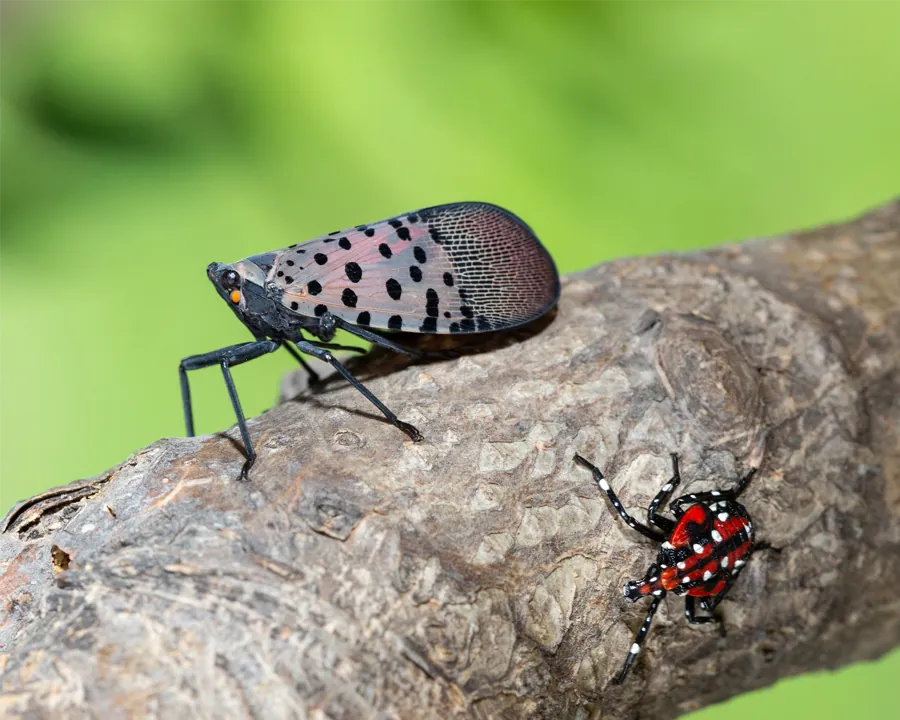
What the bill would actually change
The operative change is best read through the House companion text, because the Senate text was not yet available in the materials reviewed while the House version supplies the amendment language. H.R.4708 would amend Section 1672(d) of the Food, Agriculture, Conservation, and Trade Act of 1990, codified at 7 U.S.C. 5925(d), by adding “spotted lanternfly control” to the list of high-priority research and extension initiatives eligible for grants developing and disseminating research-based tools and treatments.[4]
That makes the one-sentence tracker entry fairly plain: S.5200 would make spotted lanternfly control eligible within an existing National Institute of Food and Agriculture competitive-grant structure for high-priority research and extension work, assuming the Senate text matches the available companion language.
The limiting words matter. This is not a direct appropriation to Pennsylvania growers. It is not a federal quarantine order. It is not a pesticide registration or use rule. It does not, on the language available, command a state agriculture department, vineyard, nursery, or homeowner to take a specific control measure. It changes eligibility inside a research-and-extension grant program.
For universities, extension systems, and research institutions, that distinction is still meaningful. A named high-priority topic can affect whether a spotted-lanternfly-control proposal fits comfortably inside a NIFA competition. But the bill does not itself select grantees, dictate project design, or guarantee that a particular state will receive money. Those consequences would depend on later appropriations, program administration, applications, peer review, and awards.
The $324 million figure is a scenario, not a current-loss number
The economic number most likely to travel is also the one most likely to be flattened. The sponsor release says the spotted lanternfly “could cost Pennsylvania’s economy $324 million annually if not contained.”[3] That is a fair shorthand only if the reader understands what the underlying study measured.
The number traces to a Penn State and Center for Rural Pennsylvania analysis using an IMPLAN input-output model. The study reported several scenarios, not one live statewide damage total: $50.1 million per year and 484 jobs for current damage within the southeastern Pennsylvania quarantine zone; $89.2 million per year and 843 jobs for adjacent counties; $324.9 million per year and 2,810 jobs for an expected case if the insect spreads statewide; and $554.0 million per year and 4,987 jobs for a worst-case scenario.[5]
| Study scenario | Reported annual economic impact | Reported jobs impact | How to describe it |
|---|---|---|---|
| Current damage within the southeastern Pennsylvania quarantine zone | $50.1 million | 484 jobs | Current/quarantine-zone scenario in the study |
| Adjacent counties | $89.2 million | 843 jobs | Expansion scenario beyond the current quarantine-zone case |
| Expected case if spotted lanternfly spreads statewide | $324.9 million | 2,810 jobs | The source of the commonly rounded $324 million claim |
| Worst case | $554.0 million | 4,987 jobs | Upper scenario, not the sponsor-release headline number |
So “costs Pennsylvania $324 million” is too loose. “Could cost Pennsylvania about $324.9 million annually if the pest spreads statewide,” with the study’s scenario structure intact, is the safer sentence. That difference is not pedantry. It separates current measured harm in the quarantine-zone scenario from modeled statewide exposure.
This is the same verification problem that appears whenever a press-release number starts as a conditional model output and becomes a present-tense public fact. For a similar example of tracing claims back to the licensed or source document, see Verifying Licensed Claims.
What to do with the press-release geography
The 2026 Fetterman release says the spotted lanternfly has spread to 51 counties in Pennsylvania.[3] The 2023 predecessor release used the same 51-county figure.[6] A later news account in August 2026 reported detections in all 67 Pennsylvania counties and 18 other states. That kind of conflict should be timestamped to the source rather than treated as a single current biological map. County counts for invasive-species detections move faster than congressional press copy, and different outlets may use different agency updates, detection thresholds, or publication dates.
For this bill-tracking purpose, the spread figure is background, not the legal trigger. S.5200 does not turn on a county threshold. The amendment would add a research-and-extension topic to a statutory grant list; it would not activate only after a specified number of Pennsylvania counties or other states report detections.
The bill family: predecessor and House companion
This is not the first version of the proposal. In the 118th Congress, S.1837 carried the same spotted-lanternfly research-and-development purpose and was sponsored by Fetterman with a bipartisan group including Sens. Bob Casey, J.D. Vance, Kirsten Gillibrand, Chuck Schumer, and Sherrod Brown.[7] It did not advance to a floor vote.
The current House companion, H.R.4708, was introduced on July 23, 2025, by Rep. Joe Morelle, Democrat of New York, with bipartisan cosponsorship that includes Pennsylvania and New York members. The House bill also includes reauthorization language extending program authorization from 2023 to 2030 across six subsections.[8]
The companion bill is useful for two reasons: it confirms the bill family and, through the GovInfo text, shows the operative amendment language now available for close reading. It should not be used as a substitute for final Senate text once S.5200’s text is posted.
Status means introduced, not enacted
As of the last-verified record for this article, S.5200 remains at the Introduced stage in the Senate and has been referred to the Agriculture, Nutrition, and Forestry Committee.[1] That committee assignment matters because it is the normal gate for this kind of agriculture-research amendment, but it is not movement by itself. Referral is not markup. Introduction is not passage. A bipartisan Pennsylvania-facing press release is not enacted law.
GovTrack may display a statistical prognosis for enactment, but that kind of percentage is a model estimate, not a legislative event. The hard status fact is the chamber stage and committee referral. If the bill later receives text, markup, report language, amendment, passage, or inclusion in a larger farm-bill vehicle, those should be logged as new events rather than inferred from the bill’s introduction.
Clean tracker language
A defensible tracker note would read: “S.5200, introduced July 30, 2026, by Sen. Fetterman and referred to the Senate Agriculture Committee, would add spotted lanternfly control to the high-priority research and extension initiatives eligible for competitive NIFA grants under 7 U.S.C. 5925(d), assuming Senate text matches the House companion; it does not directly appropriate funds or create new regulatory mandates.”
A defensible economic note would read: “Sponsor materials cite a possible $324 million annual Pennsylvania impact; the underlying Penn State/Center for Rural Pennsylvania study reports $324.9 million as an expected statewide-spread scenario, distinct from its lower current/quarantine-zone scenario and higher worst-case scenario.”
That leaves the bill where the documents place it: a narrow eligibility amendment with bipartisan appeal and a plausible research-policy purpose, still only introduced, with one much-repeated dollar figure that should travel with its scenario label attached.
References
- S.5200 - Spotted Lanternfly Research and Development Act, Congress.gov, https://www.congress.gov/bill/119-congress/senate-bill/5200
- S.5200: Spotted Lanternfly Research and Development Act, GovTrack, https://www.govtrack.us/congress/bills/119/s5200
- Fetterman, McCormick, Wyden Introduce Bill to Stop Spread of Spotted Lanternflies, Office of Senator John Fetterman, July 2026, https://www.fetterman.senate.gov/fetterman-mccormick-wyden-introduce-bill-to-stop-spread-of-spotted-lanternflies/
- H.R.4708 - Spotted Lanternfly Research and Development Act, GovInfo, https://www.govinfo.gov/content/pkg/BILLS-119hr4708ih/html/BILLS-119hr4708ih.htm
- Scientists examine potential economic impact of spotted lanternfly in Pa., Penn State, https://www.psu.edu/news/research/story/cientist-examine-potential-economic-impact-potted-lanternfly-pa
- Fetterman, Casey, Vance, Bipartisan Group of Senate Colleagues Introduce Bill to Stop the Spread of Spotted Lanternfly, Office of Senator John Fetterman, https://www.fetterman.senate.gov/fetterman-casey-vance-bipartisan-group-of-senate-colleagues-introduce-bill-to-stop-the-spread-of-spotted-lanternfly-2/
- S.1837 - Spotted Lanternfly Research and Development Act, Congress.gov, https://www.congress.gov/bill/118th-congress/senate-bill/1837/text
- H.R.4708 - Spotted Lanternfly Research and Development Act, Congress.gov, https://www.congress.gov/bill/119th-congress/house-bill/4708
Related records
Tool profile
How Meta's AI Spending Reshapes Law Firm ProfitabilityGoverning regulation
Browse the obligations tracker →Preventive workflow
Browse verification workflows →
Report a correction or tip
Spotted an outdated figure, a misstated fact, or a ruling this case record should reflect? Public comments are disabled for this content given the professional cost of a misreported case outcome, penalty amount, or rule text — use the structured correction channel instead.
Report a correction or tip for this record →