
Flock Safety Drones Create a Fourth Amendment Gap No Court Has Addressed
Flock Safety's Alpha drone functions as a flying automated license plate reader with a 50-square-mile coverage area, but no appellate court has evaluated this capability under the Fourth Amendment. This article explains the technical divergence from fixed cameras and the unresolved legal risk for jurisdictions deploying the system today.
- Jurisdiction
- US Federal
- Court
- U.S. District Court for the Eastern District of Virginia (Schmidt v. Norfolk)
- AI tool named
- Flock Safety Alpha
- Ruling date
- Jun 15, 2024
- Source document
- View primary court order ↗
- Last verified
- Jul 27, 2026
Lex Machina Review is an independent risk-tracking and reference resource. Nothing on this site is legal advice, and using it does not create an attorney-client relationship. Every record is reviewed against primary sources but may not reflect the most current status of a matter — always verify directly against the cited court order, rule text, or a licensed attorney before relying on it.
Companion explanation — secondary to the source document above
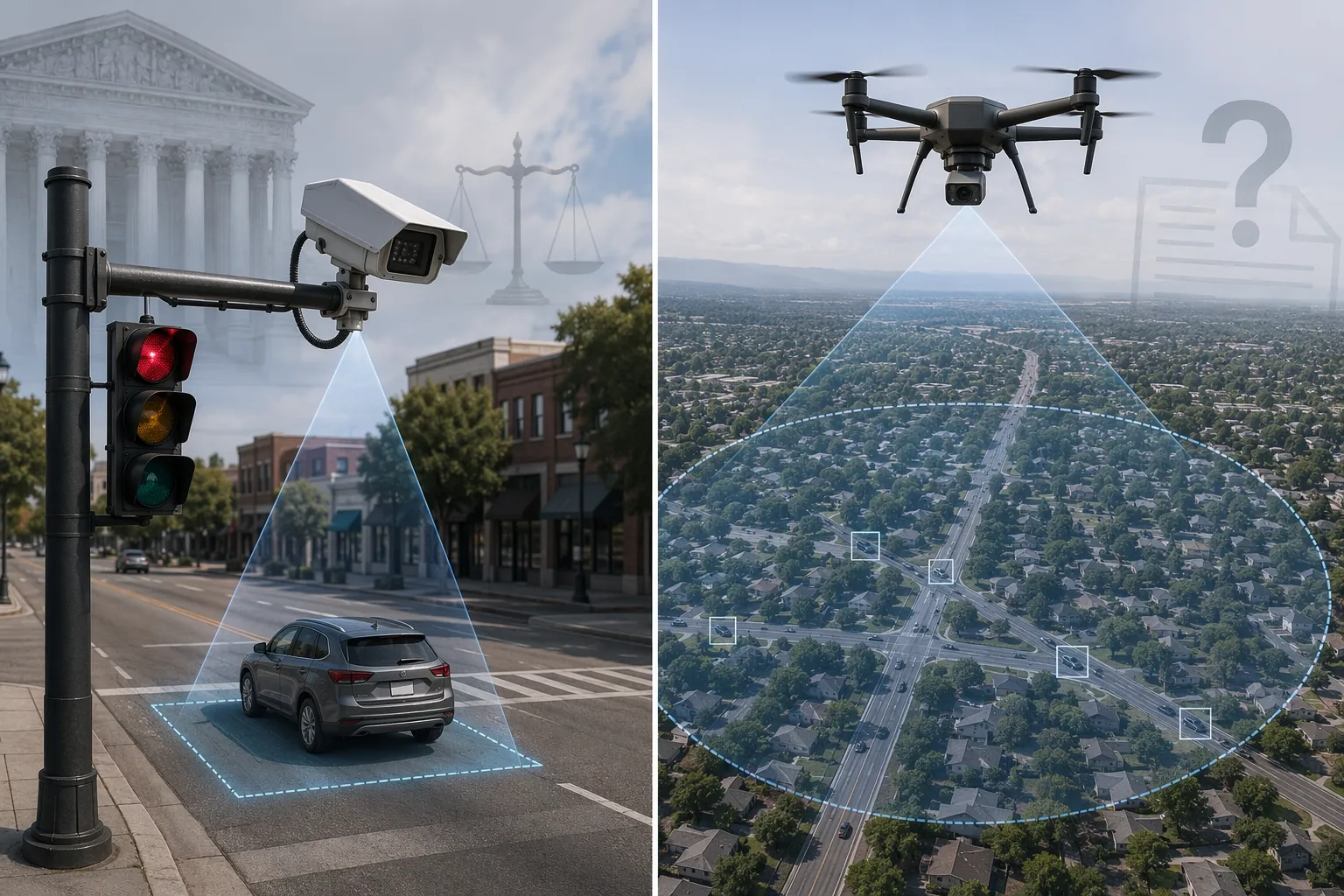
The legal issue with Flock Safety drones in law enforcement is not that drones are new or that automated license plate readers are new. It is that the cases agencies cite for warrantless ALPR use involve a materially different object: fixed cameras watching known road points. Flock’s drone-as-first-responder materials describe something else—an aircraft that can launch automatically, cover a broad area, and function as what the company’s vice president of aviation called “flying LPR cameras.” That phrase matters because it collapses two bodies of doctrine that have not yet been cleanly joined by a court. [1][2][3]
A city can point to fixed-camera ALPR decisions and say courts have been comfortable with plate capture at intersections. That is not the same as saying a court has approved drone-mounted ALPR operating over a jurisdiction. The comfort zone is narrower than many procurement memos make it sound.
The fixed-camera cases do not answer the drone question
The current ALPR case law most often invoked by police agencies and vendors is built around stationary infrastructure. In Schmidt v. City of Norfolk, the federal district court upheld Norfolk’s use of 175 fixed Flock cameras with 21-day retention, but the opinion, as summarized by Flock, expressly distinguished that deployment from “tracking the whole of a person’s movements.” [4]
That caveat is not decorative. It is the hinge. A fixed ALPR camera at a known road point records a vehicle when the vehicle passes that point. It may be constitutionally tolerable because the system does not, on the facts before the court, reconstruct the whole of a person’s movements. A drone-mounted reader changes the record a future court would review: where the camera was, why it moved, what it could see, how long it persisted, and whether its output allowed police to follow a vehicle across a meaningful portion of daily life.
Simonson, McCarthy, and Yang sit in the same general fixed-camera universe. Flock’s Fourth Amendment white paper presents those cases as favorable ALPR authority, while also identifying Commonwealth v. Bell as a trial-court outlier holding warrantless ALPR unconstitutional. None of those materials identifies a published appellate decision evaluating Flock Alpha or another drone-mounted ALPR as a flying plate reader. [5]
| Legal object | What the cited materials describe | Why the distinction matters |
|---|---|---|
| Fixed ALPR camera | Pole-mounted or fixed-location camera capturing vehicles passing known points | The case record can be framed as limited observation at discrete locations |
| Flock DFR / Alpha drone | Aerial system described by Flock as launching quickly, covering about 50 square miles, and reading plates from altitude while vehicles are moving | The case record may look less like intersection capture and more like mobile, area-wide tracking |
What Flock says Alpha can do
Flock’s own product materials do much of the constitutional work here. They describe Alpha as part of a drone-as-first-responder system that can launch in 86 seconds, cover approximately 50 square miles, and read plates from 2,000 feet while vehicles are moving at 60 mph. Those are vendor claims, not independently verified field-performance findings, but they are still important because they define the capability a city is buying and the capability a litigant will put into the record. [1][2]
The EFF reported in September 2025 that Flock’s vice president of aviation described the drones as “flying LPR cameras.” That is a useful admission, not because it proves illegality, but because it prevents the system from being treated as ordinary aerial observation with a camera incidentally attached. If the marketed function includes plate reading, dispatch response, and area coverage, a suppression motion will not need to invent the ALPR character of the system. [3]
The difference between a pole-mounted camera and a drone is not merely that one is airborne. It is the combination of mobility, altitude, launch automation, dispatch integration, and coverage area. A fixed camera waits for traffic to pass. A drone can be sent toward an incident, repositioned as the incident moves, and used to observe roads that were not preselected as camera points. The Fourth Amendment question becomes harder once the government system is capable of joining plate identity to an aerial path across a broad area.
That does not make the system omniscient. The materials do not establish that Alpha tracks every car in a jurisdiction, that every launch becomes a continuous tail, or that every plate read is reliable in every environment. Overstatement would make the legal risk easier to dismiss. The narrower point is stronger: the capability Flock markets is not the capability analyzed in the fixed-camera cases.
Leaders is the pressure point, not the ALPR wins
The closest adverse analogy is not a single pole-mounted license plate reader. It is Leaders of a Beautiful Struggle v. Baltimore Police Department, where the Fourth Circuit held Baltimore’s aerial surveillance program unconstitutional. The program covered roughly 90% of Baltimore for 12 hours per day over 45 days. [6]
Leaders does not decide the Flock DFR question either. It involved a different system, different facts, and a different surveillance architecture. But it supplies the doctrinal pressure that fixed-camera ALPR opinions tend to avoid: when government observation becomes persistent enough to reveal patterns of movement, courts may stop treating each observation as a harmless public-view fragment.
Schmidt’s limiting language points in the same direction. The Norfolk court upheld the fixed-camera deployment while distinguishing “tracking the whole of a person’s movements.” [4] A Flock DFR record built from drone launches, aerial repositioning, and plate reads across a wide operating area gives a future plaintiff or criminal defendant a cleaner way to argue that the system has crossed the line Schmidt left open.
That is why “ALPRs have survived constitutional challenge” is too broad a sentence for council packets. Some fixed ALPR deployments have survived. Some courts have treated certain plate reads as less invasive because cars are exposed on public roads. But a drone-mounted ALPR designed for rapid response and broad aerial coverage is not just another camera bolted to a higher pole.
What a first challenge would likely fight over
A first suppression motion or Section 1983 complaint involving Flock DFR data would probably begin with the technical record. The plaintiff or defendant would want the launch logs, dispatch trigger, flight path, altitude, plate-read events, retention settings, audit logs, and any downstream searches tied to the plate. The city would want to characterize each read as a public-road observation of a visible license plate. The fight would be over whether the court should evaluate those events one by one or as a movement-revealing system.
The fixed-camera cases help the city only up to a point. They give counsel arguments about public exposure, limited retention, and the absence of a reasonable expectation of privacy in a license plate displayed on a public road. They do not give counsel an appellate holding that a flying ALPR with Flock’s claimed capabilities may be deployed without a warrant across a large area.
The record will also matter because Flock’s specifications are marketing-side materials. A court may care less about the clean product-page claim than about what actually happened in the challenged flight: Was the drone dispatched to a specific emergency? Did it loiter? Did it follow one vehicle? Did officers query prior reads? Was the data retained, shared, or searched later for investigative leads? The Fourth Amendment analysis will not be improved by treating every drone launch as the same event.
For broader drone-search doctrine, readers can compare the analysis in Autonomous Police Drones Create a Fourth Amendment Vacuum. The narrower point here is the ALPR-specific gap: the technology being purchased is a plate-reading drone, while the favorable cases largely concern fixed plate-reading cameras.
The surrounding risk record is getting harder to ignore
The Flock DFR issue does not arrive in a quiet legal environment. In November 2025, EFF and the ACLU of Northern California filed SIREN v. San Jose, challenging a fixed-camera ALPR system alleged to include about 500 cameras, one-year retention, and roughly 4 million warrantless searches per year under California law. The plaintiffs argued that the system “provides an intimate window into a person’s life.” [7]
Washington then enacted SB 6002, effective March 30, 2026, creating comprehensive ALPR restrictions that include a 21-day retention cap, a warrant requirement for private-entity data, a statutory suppression remedy for knowing violations, and mandatory attorney general registration by September 30, 2026. [8] Those rules do not decide the federal Fourth Amendment question, but they show that legislatures are beginning to treat ALPR governance as a live legal risk rather than a routine camera purchase.
Security and evidence handling also belong in the risk file, though they should not be confused with the constitutional merits. EFF’s 2025 year-in-review described research involving Flock camera hardware accessed through an Android debug tool and Condor camera feeds streamed to the open internet. The current patch status and exact timelines would need to be verified before anyone described those as active vulnerabilities, but the reported issues are enough to flag authentication, chain-of-custody, and evidentiary-reliability questions in any case built on Flock data. [9]
Cities are also revisiting Flock contracts for reasons that include immigration-surveillance concerns and governance unease. NPR reported in February 2026 on cities ditching Flock license plate readers, and Business Insider reported in July 2026 that LAPD let its agreement with Flock expire. [10][11] For contract-exit and procurement risk, see How Flock Safety's New Terms Complicate Municipal Contract Exit. For a broader litigation map, see How Flock Safety's Three Lawsuit Tracks Create Exposure.
The unresolved issue is material now
The cleanest statement is also the narrowest one: Flock DFR has not been held unconstitutional on the materials reviewed here, and every drone launch is not automatically a Fourth Amendment search. Emergency response, targeted deployment, short flight duration, retention limits, audit trails, and warrant practices may all matter to a future court.
But municipalities deploying the system today are relying on precedent that did not evaluate this capability. Schmidt involved 175 fixed cameras and 21-day retention, with language distancing the case from whole-movement tracking. [4] Flock’s Alpha materials describe rapid launch, large-area coverage, high-altitude plate reading, and moving-vehicle plate capture. [1][2] Leaders shows that persistent aerial surveillance can move into a different constitutional category. [6]
That gap should be treated as unresolved and material in any suppression motion, civil-rights complaint, procurement review, or city-council risk assessment involving Flock DFR data. The first serious record will need primary-source verification of the product claims, deployment settings, flight logs, retention rules, and the cited cases before anyone can safely say whether the fixed-camera ALPR cases carry the drone-mounted system with them.
References
- Flock DFR, Flock Safety.
- Law Enforcement Drones, Flock Safety, July 24, 2026.
- That Drone in the Sky Could Be Tracking Your Car, Electronic Frontier Foundation, September 2025.
- Federal Court Confirms License Plate Readers Are Constitutional, Flock Safety.
- Automated License Plate Readers and the Fourth Amendment: A Public Safety by Design Perspective from Flock, Flock Safety.
- Leaders of a Beautiful Struggle v. Baltimore Police Department, U.S. Court of Appeals for the Fourth Circuit, 2021.
- Lawsuit Challenges San Jose's Warrantless ALPR Mass Surveillance, Electronic Frontier Foundation, November 2025.
- What to Know About the New Restrictions on Flock, MRSC, April 27, 2026.
- EFF's Investigations Expose Flock Safety's Surveillance Abuses, Electronic Frontier Foundation, December 2025.
- Why some cities are ditching their Flock license plate readers, NPR, February 17, 2026.
- LAPD Lets Agreement With Flock Safety Expire, Business Insider, July 14, 2026.
Related records
Tool profile
Browse tool evaluations →Governing regulation
Browse the obligations tracker →Preventive workflow
Browse verification workflows →
Report a correction or tip
Spotted an outdated figure, a misstated fact, or a ruling this case record should reflect? Public comments are disabled for this content given the professional cost of a misreported case outcome, penalty amount, or rule text — use the structured correction channel instead.
Report a correction or tip for this record →