
Ford Bronco Engine Fire Recall 2026: Legal Recourse for Owners
The July 2026 Ford Bronco recall (NHTSA 26V468) covers a wiring-harness fire risk on 565,691 vehicles, but the free dealership repair may not end all owner remedies. This record explains when a recall alone does—and does not—trigger lemon-law protections, what conditions strengthen a buyback or class-action claim, and how a prior Ford fire-defect class action was reopened after NHTSA found the initial fix insufficient.
- Jurisdiction
- United States
- Court
- U.S. District Court for the Eastern District of Michigan
- AI tool named
- No AI tool involved
- Ruling date
- Jul 25, 2026
- Source document
- View primary court order ↗
- Last verified
- Jul 25, 2026
Lex Machina Review is an independent risk-tracking and reference resource. Nothing on this site is legal advice, and using it does not create an attorney-client relationship. Every record is reviewed against primary sources but may not reflect the most current status of a matter — always verify directly against the cited court order, rule text, or a licensed attorney before relying on it.
Companion explanation — secondary to the source document above
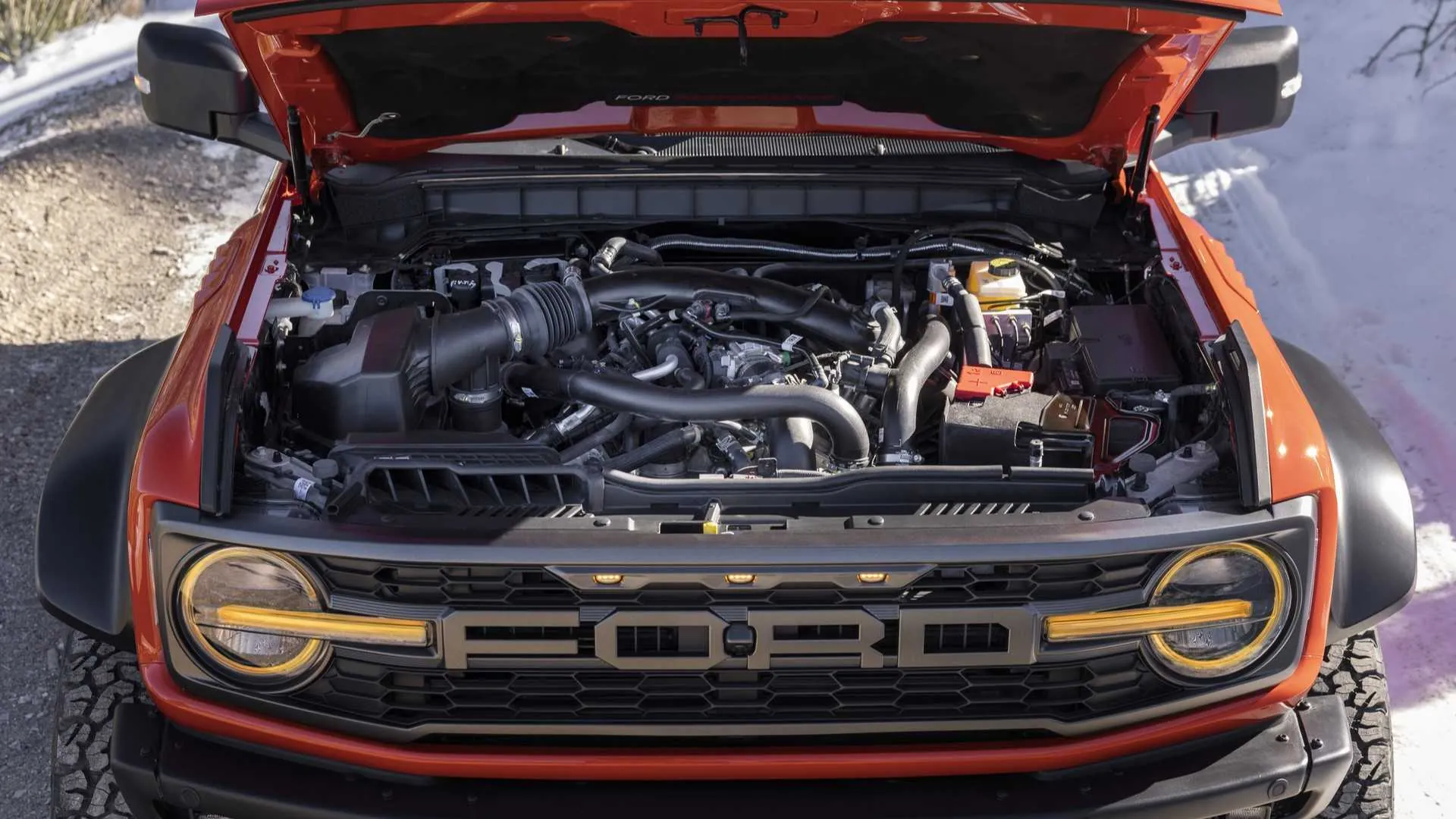
The useful starting point for the Ford Bronco engine fire recall legal recourse question in 2026 is not the word “fire.” It is the record number: NHTSA 26V468, Ford recall 26S55, covering 565,691 model-year 2021–2026 Ford Bronco and Bronco Raptor vehicles. Ford’s reported defect is an engine-compartment wiring harness that may lack enough abrasion protection; exposed wires can short-circuit and create a fire risk. Ford estimates that about 1% of the recalled population has the defect, and the record reported through AP identifies 15 fire incidents between October 15, 2024, and June 20, 2026, with no reported injuries.[1]
That set of facts supports a narrower conclusion than many recall headlines suggest. The recall entitles owners to Ford’s free remedy. It does not, by itself, establish that every recalled Bronco is a lemon, that every owner is entitled to a buyback, or that a class action has already become viable.
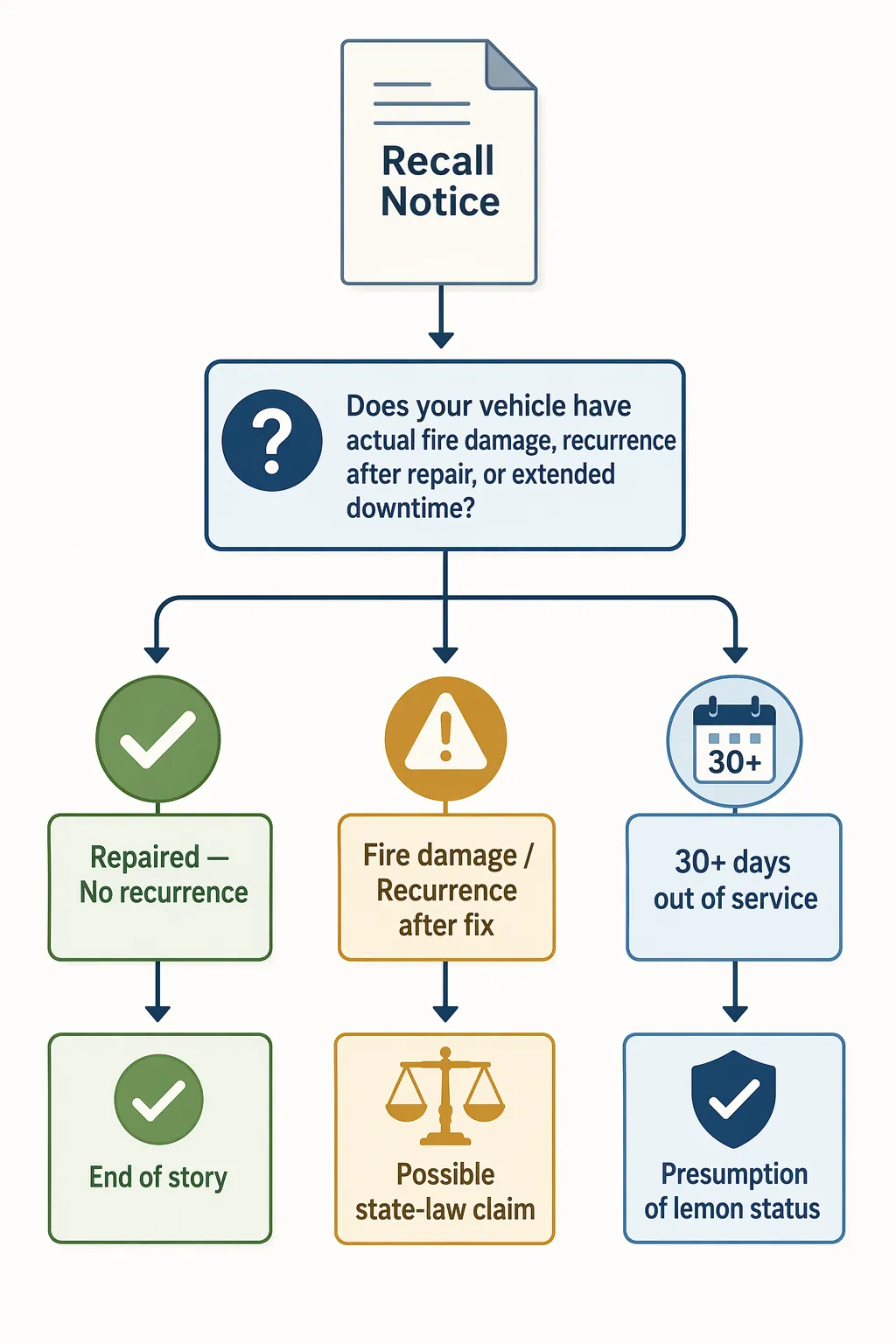
The owner’s legal posture changes if the vehicle has its own damage history: an actual fire, a second failure after the dealer repair, repeated failed safety repairs, or a cumulative out-of-service record long enough to trigger state lemon-law presumptions. The recall notice is the beginning of that analysis, not the end of it.
The Recall Fix Is Real Relief, But Not Always Complete Relief
Ford’s announced remedy is a dealership repair: technicians are to apply convolute sheathing and abrasion tape to the wiring harness. Owner notification letters are scheduled to begin August 24, 2026.[2]
For many owners, that may be the entire practical event. A Bronco receives the recall repair, the vehicle returns to service, no warning signs recur, and no property damage occurred before the appointment. In that posture, the recall file alone is usually weak support for a buyback demand.
That does not make the recall legally meaningless. It creates a documented safety-related defect population, identifies the manufacturer’s proposed cure, and gives owners a date-stamped repair event. If the same hazard returns after the sheathing-and-tape repair, the owner is no longer arguing from an abstract recall notice. The owner is pointing to a failed remedy on the individual vehicle.
| Owner posture | What the recall record likely means |
|---|---|
| Included in 26V468, no symptoms, no repair yet | Free recall repair; weak standalone basis for lemon-law relief |
| Repaired once, no recurrence, no downtime beyond the appointment | Usually a completed recall event, not a buyback record |
| Fire, smoke, melting, or electrical damage before repair | Potential warranty, insurance, product-liability, or state-law claim depending on proof and damages |
| Same or related problem after recall repair | Stronger record because the offered remedy may not have cured the vehicle |
| Long dealer hold, parts delay, or repeat visits causing substantial days out of service | Possible lemon-law significance, especially in states with downtime presumptions |
A Recall Is Not an Automatic Lemon-Law Ticket
State lemon laws generally ask a vehicle-specific question: did the manufacturer or its authorized repair facility fail to repair a defect after a legally significant number of attempts, or was the vehicle out of service long enough to trigger statutory protection? Law-firm materials discussing Ohio, California, and other Ford recall contexts all draw the same basic boundary: a recall alone does not automatically make a vehicle a lemon.[3][4][5]
The boundary matters because 565,691 recalled vehicles is not the same thing as 565,691 viable lemon claims. Ford’s reported 1% defect estimate, if accepted for recall-scope purposes, points to a much smaller group of vehicles expected actually to contain the defect.[1] The estimate does not eliminate owner rights, but it does restrain the legal inference that can be drawn from inclusion in the recall population.
The same discipline applies to the fire history. Fifteen documented fires are enough to make the safety concern concrete. The no-injury status is also part of the record and should stay in the analysis.[1] Omitted, it would make the risk sound more legally developed than the public record currently supports.
The 15-fire count and 1% estimate are reported by AP from NHTSA Part 573 recall material; this article relies on that reporting rather than an independent crawl of the underlying PDF.[1]
Where the Owner’s Record Starts to Matter
A Bronco owner trying to evaluate legal recourse after the 2026 recall should separate three records that often get blended together.
- The defect record: whether the vehicle falls within NHTSA 26V468 and Ford 26S55, and whether it had symptoms consistent with exposed or shorting wires.
- The repair record: when the dealer performed the sheathing-and-tape remedy, how long the vehicle stayed at the dealer, and whether any parts or scheduling delay kept it out of service.
- The post-repair record: whether the vehicle later showed smoke, burning smell, electrical malfunction, visible harness damage, warning lights, or another dealer-confirmed recurrence.
The owner with no symptoms and a completed repair has a different file from the owner whose Bronco suffered fire damage before the notice arrived. The owner whose vehicle spends weeks waiting for parts has a different file from the owner whose dealer completes the repair in one visit. The owner who returns with the same hazard after the remedy has the most important question of all: whether the manufacturer’s fix worked on that vehicle.
Actual Fire Damage
If a Bronco sustained fire, smoke, melting, or electrical damage before the recall repair, the free fix may not address the entire loss. The dealership remedy may protect the harness going forward, but it does not necessarily resolve property damage, loss-of-use, diminished value, insurance deductibles, towing charges, or other consequential losses. Whether those losses support a claim depends on the state-law theory, warranty documents, causation proof, and the vehicle’s repair history.
The recall record may help connect the type of hazard to the type of damage, but it does not prove that every Bronco fire came from this harness condition. Owners need photographs, service records, fire reports if any exist, insurance findings, diagnostic notes, and communications showing what Ford or the dealer attributed the event to.
Recurrence After the Sheathing-and-Tape Repair
A recurrence after the recall repair is legally different from a recall notice sitting unopened in the glovebox. It gives the owner a before-and-after sequence: the manufacturer identified a safety remedy, the dealer applied it, and the vehicle still presented a related hazard. That sequence can support warranty or lemon-law arguments more strongly than recall inclusion alone.
The strongest recurrence record is specific. “Burning smell from engine compartment two days after recall 26S55 performed” is more useful than “vehicle still unsafe.” “Dealer found harness abrasion in same area” is more useful than “Ford recall failed.” The legal significance comes from the traceable repair failure, not from the owner’s understandable frustration.
Extended Days Out of Service
Downtime can matter even when the final repair is successful. Many lemon-law frameworks look not only at repeated repair attempts but also at the cumulative number of days the vehicle was unavailable for warranty repair. For this recall, the relevant evidence is not just the appointment date. It is the full interval from drop-off to return, including any dealer hold, parts delay, inspection delay, or repeat visit for the same safety condition.
Owners should preserve repair orders showing the odometer, complaint, cause, correction, and in-and-out dates. If a dealer asks the owner to keep driving while waiting for the recall remedy, that communication should be saved too. It may matter later if the vehicle develops symptoms before the appointment.
California Shows the Clearest Lemon-Law Presumption, But It Is Not a National Rule
California’s Song-Beverly Consumer Warranty Act is the cleanest example of how a Bronco recall file can become more than a recall file. California lemon-law materials describe a presumption after two or more repair attempts for a defect that could cause death or serious injury, or after 30 or more cumulative calendar days out of service for warranty repair.[3]
A fire-risk defect fits naturally within the safety-critical side of that framework. If a California owner’s Bronco presents the wiring-harness fire risk, Ford or its dealer attempts repair, and the same safety defect remains after two attempts, the owner’s record starts to look like the kind of file Song-Beverly is designed to evaluate. The same is true if the vehicle crosses the 30-day cumulative out-of-service threshold for covered repair issues.[3]
That does not mean California’s thresholds travel with the vehicle. Other states use different presumptions, different notice requirements, different mileage or ownership-period limits, and different remedies. A Texas, Ohio, Florida, or New York owner should not treat California’s two-attempt safety rule as controlling law. It is useful because it shows the kind of vehicle-specific facts that can move a recall from free repair into independent legal recourse: failed safety repair or substantial downtime.
The practical takeaway is careful but important. If the recalled Bronco is repaired once and behaves normally afterward, the owner may have no lemon-law record beyond the recall itself. If the vehicle returns for the same fire-risk condition, or sits out of service long enough to meet the governing state threshold, the owner is no longer relying only on NHTSA 26V468. The owner has a repair-history claim to evaluate.
What a Buyback Argument Would Need
A buyback is not the ordinary remedy announced in this recall. Ford’s recall remedy is repair, not automatic repurchase. A buyback argument would need facts showing that repair was not enough for the individual vehicle: repeated nonconformity, substantial impairment, safety-critical repair failure, prolonged downtime, or damage that cannot be adequately resolved through the recall procedure.
The owner’s file should answer basic questions before any demand letter tries to answer legal ones.
- Was the vehicle within the model years and configuration covered by NHTSA 26V468?
- Did the owner receive or confirm the Ford 26S55 recall notice?
- Did the dealer perform the convolute sheathing and abrasion tape remedy?
- How many days was the vehicle unavailable for diagnosis or repair?
- Did smoke, fire, burning odor, warning lights, electrical malfunction, or visible harness damage occur before or after the repair?
- What did the repair order say about cause, correction, and whether the concern was duplicated?
Those facts do not guarantee a buyback. They determine whether the owner is asking for a legal remedy based on a defective vehicle history, or merely pointing to a recall population that includes many vehicles Ford does not expect to contain the defect.
The Class-Action Question Is Premature, But the Prior Ford Fire Case Matters
As of July 25, 2026, the public record does not show a class action or individual lawsuit filed specifically over NHTSA 26V468. That may change, but any present class-action analysis is necessarily prospective.
The better comparison is procedural, not predictive. In Letson v. Ford, a prior Ford fuel-injector fire-defect class action in the Eastern District of Michigan, Ford obtained dismissal in February 2024 after arguing that its recall rendered the class claims moot.[6] Later, after NHTSA found the recall remedy insufficient, the court reopened the case in November 2024, according to plaintiffs’ counsel Hagens Berman.[7]
That sequence does not prove Bronco wiring-harness plaintiffs will succeed. It shows why recall adequacy can become the central litigation issue. A manufacturer may argue that the government-supervised recall gives owners all necessary relief. Plaintiffs may respond that the remedy does not actually cure the defect, does not cover all losses, or leaves owners with a continuing safety risk. If the safety agency later rejects or questions the remedy, the litigation posture can change.
For the 2026 Bronco harness recall, that means the class-action question will likely turn less on the existence of the recall than on what happens after the remedy begins: whether dealers can complete repairs, whether post-repair incidents appear, whether Ford modifies the remedy, and whether NHTSA takes further action. A recall can be a defense to class claims when it works. It can become evidence in the dispute when it does not.
How Owners Should Build the Risk Record
The most useful owner action is not to declare the vehicle a lemon on the day the notice arrives. It is to preserve the facts that a lawyer, arbitrator, manufacturer, insurer, or court would later need to separate a completed recall repair from a failed remedy.
- Save the recall notice and any Ford or dealer communications about scheduling, parts, and driving instructions.
- Keep every repair order, including visits where the dealer says it could not duplicate the concern.
- Record drop-off and pickup dates so cumulative days out of service can be calculated accurately.
- Photograph visible damage, warning messages, smoke residue, melted components, or towing conditions before the vehicle is altered.
- Report post-repair symptoms promptly and describe them in concrete terms: location, smell, smoke, warning light, noise, or operating condition.
- Ask the dealer to identify whether the concern relates to the recalled harness area and to state the correction performed.
The file should also preserve the absence of facts. If there was no fire, no recurrence, and no extended downtime, that matters too. A clean repair history may make legal escalation unnecessary and may also prevent an owner from overreading the recall notice.
The Line Between Recall Repair and Legal Recourse
NHTSA 26V468 creates a safety and warranty event for covered 2021–2026 Bronco and Bronco Raptor vehicles. Ford’s offered repair is the first remedy: a no-cost dealer installation of protective sheathing and abrasion tape. For owners whose vehicles are repaired once and do not experience the defect, that may be where the matter ends.
Independent legal recourse depends on the individual vehicle’s record after that point. Actual fire damage, recurrence after the recall repair, repeated failed safety repairs, and substantial cumulative days out of service can move the file into lemon-law, warranty, product-liability, insurance, or class-action territory. California’s Song-Beverly Act supplies the clearest current example through its safety-defect and 30-day presumptions, but those thresholds are not universal.
The recall notice alone is not a buyback ticket. It is a dated record of a safety defect, a proposed manufacturer cure, and a point from which the owner’s own repair history begins to matter.
References
- Ford recalls over 565,000 Bronco SUVs because of fire risk, AP News
- Ford Bronco, Bronco Raptor Recalled over Engine Fire Risk, Car and Driver
- Ford Bronco Recall: 565,691 SUVs Face Engine Fire Risk, California Lemon Attorneys
- Ford Recalls 2021-2026 Models Due to Safety Risks, Ohio Lemon Law
- Ford Bronco Sport, Margarian Law
- Ford Motor’s Recall Renders Defective Car Part Class Action Moot, Bloomberg Law, February 2024
- Ford Escape and Bronco Fuel Injector Fire Hazard Defect, Hagens Berman, November 2024
Related records
Tool profile
How Meta's AI Spending Reshapes Law Firm ProfitabilityGoverning regulation
Browse the obligations tracker →Preventive workflow
Browse verification workflows →
Report a correction or tip
Spotted an outdated figure, a misstated fact, or a ruling this case record should reflect? Public comments are disabled for this content given the professional cost of a misreported case outcome, penalty amount, or rule text — use the structured correction channel instead.
Report a correction or tip for this record →