
Who pays under French law when wildfires hit wine harvests?
Wildfire is not a recognized calamité agricole in France, so wine-harvest losses from the 2025 Aude and 2026 Gironde fires fall outside the FNGRA solidarity regime and are mostly uninsured. This brief maps the channels that do exist — private multirisk policies, lab-verified smoke-taint and retardant-contamination claims, and ad hoc state and tax relief — and the evidentiary burden each places on the grower.
- Jurisdiction
- France
- Court
- No court ruling identified
- AI tool named
- No AI tool implicated
- Ruling date
- Feb 3, 2026
- Source document
- View primary court order ↗
- Last verified
- Aug 2, 2026
Lex Machina Review is an independent risk-tracking and reference resource. Nothing on this site is legal advice, and using it does not create an attorney-client relationship. Every record is reviewed against primary sources but may not reflect the most current status of a matter — always verify directly against the cited court order, rule text, or a licensed attorney before relying on it.
Companion explanation — secondary to the source document above
For a French winegrower looking at wildfire-damaged vines, the first legal answer is negative: do not start with the FNGRA solidarity regime. The French government’s published answer to Assemblée nationale QE n°1091 states that fire does not fall within the calamités agricoles regime and therefore does not come under the Fonds national de gestion des risques en agriculture, or FNGRA.[1]
| Record point | Status |
|---|---|
| Jurisdiction | France |
| Loss class | Wine-harvest loss from wildfire, smoke exposure, or fire-retardant contamination |
| Primary statutory answer | No standing FNGRA route for fire losses under the government position in QE n°1091.[1] |
| 2026 fire status | No court ruling on the 2026 Gironde fires identified in the materials reviewed. |
| Last verified | Aug. 2, 2026, UTC |
| Scope note | Legal information for claim triage and documentation; not legal advice. |
That answer matters because the public shape of the loss looks like a national agricultural disaster. Preliminary reporting on the 2026 Gironde fire described about 42,000 hectares burned, 220,000 people evacuated, and 39,000 businesses affected.[2] Those figures explain why growers, insurers, tax authorities, laboratories, and appellation bodies are already being pulled into the same file. They do not, by themselves, identify a payer.
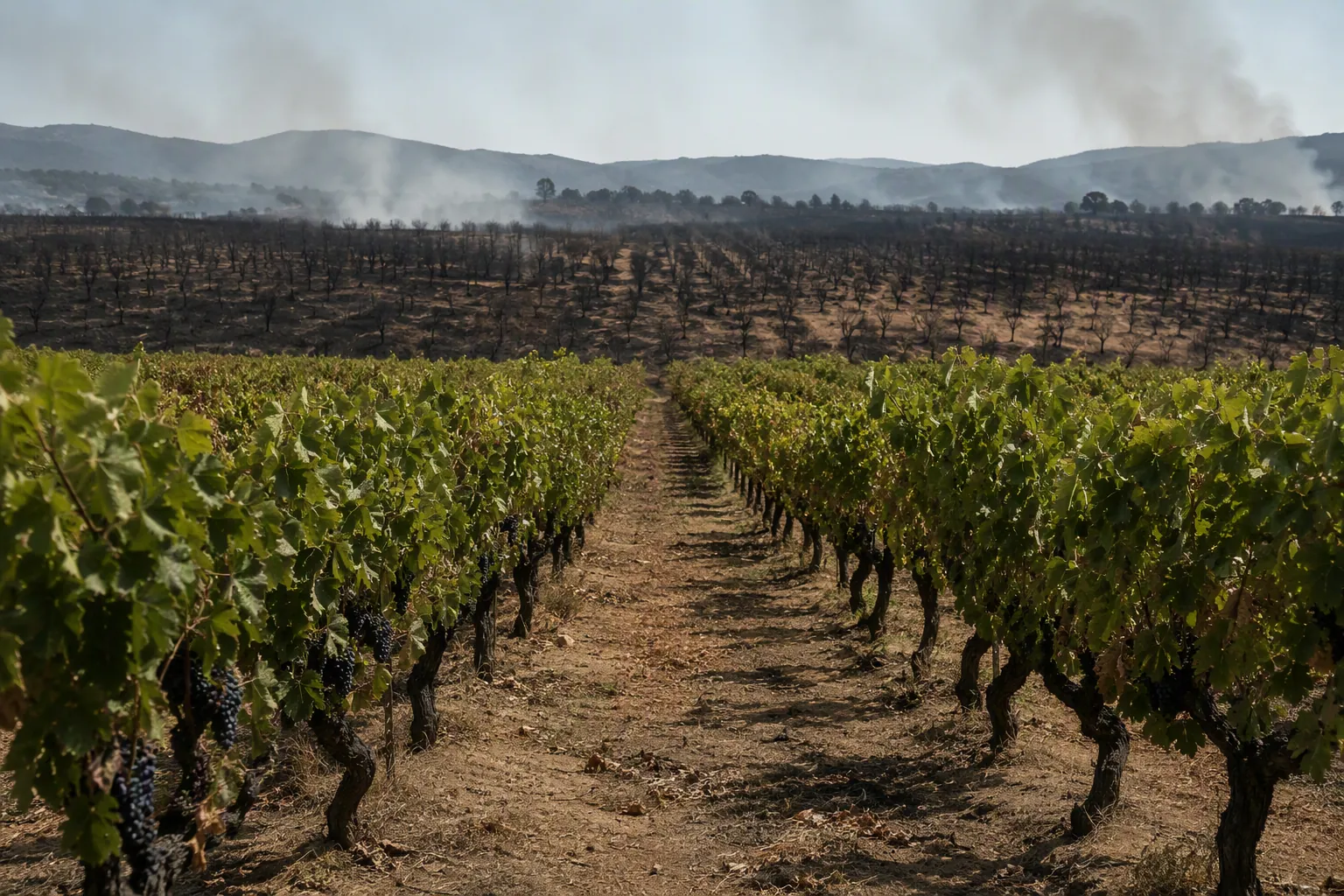
The Aude precedent: relief without ordinary indemnity
The 2025 Aude fire is the useful comparison because the French state has already described what it did when wildfire affected vineyards but the calamités agricoles channel was unavailable. In that event, the government cited 16,000 hectares burned, more than 1,000 hectares of vines affected, and around 200 farms concerned.[1]
The state response was real, but it was not an ordinary indemnity right. QE n°1091 lists a €7 million emergency treasury fund, fully spent for 161 farms; €1.1 million in property-tax relief; and €1 million in MSA contribution relief.[1] Those are important cash-flow channels for a farm whose grapes cannot be sold into the normal stream. They are also event-specific measures administered through public decision, not a standing compensation architecture that a grower can invoke merely by proving fire damage.
The same answer describes temporary wine-sector workarounds: AOC specification waivers for Fitou, Languedoc, and Corbières, and a sourcing solution allowing entrepositaires to obtain grapes, must, or wine outside ordinary constraints.[1] Those measures help preserve production and commercial continuity. They do not make a smoke-tainted or destroyed harvest whole.
The government also referred to €103.5 million in permanent grubbing-up aid paid to 5,240 winegrowers, within more than €1 billion of exceptional wine-sector credits since 2020.[1] That figure belongs in the file because it shows the scale of broader sector intervention. It should not be misread as a wildfire-harvest indemnity program.
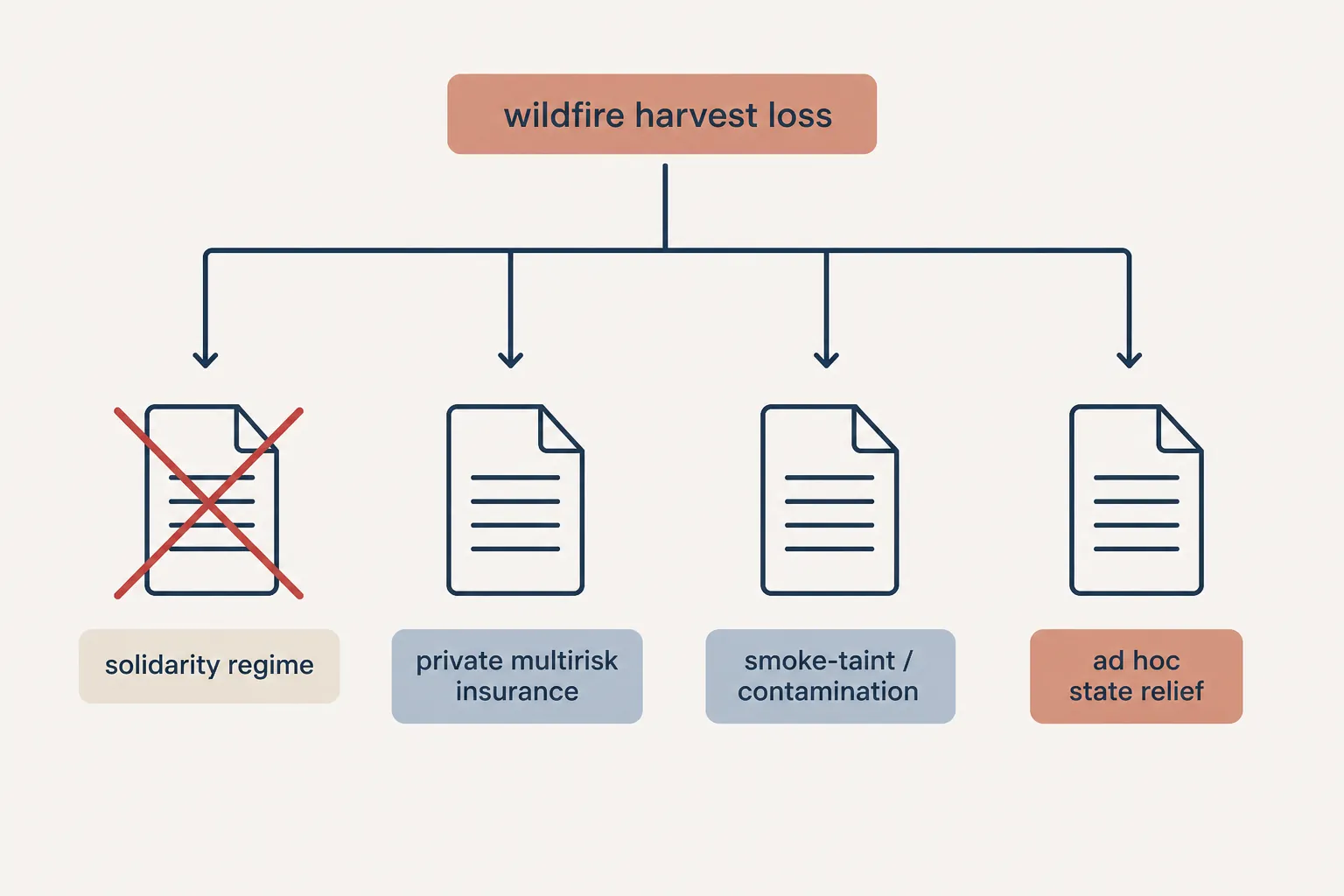
Where the 2022 crop-insurance reform fits — and where it does not
France’s 2022 reform of agricultural climate-risk management is relevant, but it does not erase the fire problem. Loi n° 2022-298 du 2 mars 2022 established the modern three-tier structure: a grower-retained deductible layer, subsidized multirisk climate insurance, and a national solidarity indemnity layer for severe losses within the reformed framework.[3] The article-level mechanics should be checked against Légifrance before any pleading or client memorandum relies on them, but the broad structure is enough for claim triage.
The critical point is that the reform did not turn fire into a calamité agricole for FNGRA purposes. QE n°1091 gives the government’s position directly: fire is outside that regime.[1] A grower may have a private crop or multirisk agricultural policy. A grower may also benefit from an event-specific emergency fund. Neither fact creates a general statutory wildfire indemnity for wine-harvest losses.
The insurance-penetration figure in the government answer also needs careful handling. QE n°1091 says that about 30% of winegrowers in Hérault were insured against this type of risk.[1] That is a département-specific figure. It is not a national wine-sector statistic, and it should not be used as if it described all French vineyards.
| Possible route | What it can do | What the grower must be able to show |
|---|---|---|
| FNGRA / calamités agricoles | No ordinary route for fire under the government position. | Not enough to show burned vines or lost harvest; fire is outside the regime described in QE n°1091.[1] |
| Subsidized or private multirisk agricultural insurance | Potential contractual indemnity if the policy covers the peril and loss type. | Policy in force, insured crop or stock, covered peril, valuation, notice, mitigation, exclusions, and proof of loss. |
| Smoke-taint claim | Possible claim where policy language and evidence support physical or quality loss. | Exposure timing, grape status, lab results, sensory or production consequences, and avoidability. |
| Fire-retardant contamination claim | Potentially distinct contamination theory, depending on facts and policy wording. | Application or drift evidence, affected parcels or lots, chemical or residue testing, segregation, and disposition records. |
| Ad hoc state, tax, MSA, or appellation relief | Liquidity relief, tax or contribution relief, temporary production flexibility. | Eligibility under the event-specific administrative measure; these channels do not equal ordinary indemnity. |
The private-policy file starts before the grape is crushed
If a grower has multirisk agricultural insurance, the legal work moves from public law to contract. The questions become less dramatic and more decisive: which parcels are scheduled, which crops or stock are insured, whether the relevant peril is named or excluded, whether smoke exposure is treated as physical loss, whether harvested grapes are treated differently from grapes still on the vine, and what notice or mitigation duties were triggered.
Counsel should resist collapsing “wildfire damage” into one category. Burned trellis, scorched vines, destroyed grapes, smoke-tainted grapes, rejected must, contaminated stock, and lost appellation use can sit in different coverage buckets. A policy may respond to one and not another. The grower’s file should therefore preserve the path from parcel to lot to attempted use or disposal, not merely a general statement that the vineyard was affected by a wildfire.
Smoke taint is an evidence problem before it is a coverage argument
Smoke-taint claims tend to become arguments about physical loss, valuation, and mitigation. They should begin as a laboratory and chain-of-custody file. Coverage commentary on wine-grape smoke claims focuses on volatile phenols such as guaiacol and 4-methylguaiacol, the difference between grapes still on the vine and harvested product, and whether the loss could have been avoided or reduced by testing, segregation, altered vinification, or non-harvest.[4]

The on-vine versus harvested distinction matters because the insured property may change legal and practical character as soon as grapes are picked. Before harvest, the question may be whether exposed fruit is damaged enough to justify non-harvest, destruction, or separate handling. After harvest, the question may shift to whether grapes, must, or wine have suffered a covered loss, whether they can be blended or redirected, and whether later commercial rejection proves the earlier physical condition.
A usable smoke-taint file should make time visible. It should record the fire period, wind and smoke conditions if available, phenological stage, véraison status, intended harvest date, sampling date, lab submission date, test result, decision date, and disposition. If officials are still issuing provisional statements, the grower’s own record becomes more important, not less.
- Keep parcel maps tied to sample identifiers and harvest lots.
- Separate on-vine samples, harvested grapes, must, and finished wine in the documentation.
- Record who decided to harvest, delay, segregate, test, redirect, or destroy, and on what information.
- Preserve laboratory reports, sampling protocols, invoices, photographs, weighbridge tickets, cellar records, buyer communications, and appellation correspondence.
- Do not treat a buyer’s refusal as a substitute for proof of the grapes’ condition at the relevant time.
Fire-retardant contamination should be kept separate from smoke taint. Smoke taint concerns smoke-derived compounds and their effect on grape or wine quality. Retardant contamination concerns material deposited on vines, grapes, soil, equipment, or harvested product. The proof package may therefore require different testing, different parcel evidence, and different causation analysis. Reporting on the 2025 Aude fire treated retardant contamination as a distinct loss concern for winegrowers, which is exactly how the claim file should treat it.[5]
For the 2026 season, smoke-taint extent remains provisional as of Aug. 2, 2026. Northeastern’s 2026 coverage described testing activity in the French wine sector, including the InterSud viti-incendie portal and ICV/Dubernet laboratory context, but the decisive exposure window from véraison through harvest is not closed at this date.[6] A grower who does not yet know whether grapes are commercially usable should still be building the record that will make the later answer credible.
The U.S. smoke-taint cases help translate the dispute, not decide it
For U.S. counsel, the nearest analogy is the smoke-taint coverage dispute that followed California wildfires. The FBM discussion of wine smoke-taint coverage describes how disputes can turn on whether grapes were on the vine or harvested, whether smoke taint is physical loss, and how exclusions added after major Napa and Sonoma fires affected the coverage analysis.[7]
That analogy should stay in its lane. Kunde Enterprises v. National Surety Corp. and U.S. exclusion practice may help an English-language claims team ask better questions about testing, harvest status, and policy wording.[7] They do not answer whether a French grower is eligible for FNGRA assistance, and they do not override the French government’s stated position that fire is outside the calamités agricoles regime.[1]
A practical claims sequence for affected growers
The sequence below is not elegant, but it matches the available channels. It avoids the common mistake of treating public disaster language as if it were a payment trigger.
- Identify every policy first: crop, farm property, stock, business interruption if applicable, equipment, liability, and any cooperative or négociant-linked cover.
- Give notice without overdescribing the legal theory. The first notice can preserve rights while the grower is still determining whether the loss is burn damage, smoke taint, retardant contamination, loss of appellation use, or a combination.
- Separate physical categories: vines, grapes on the vine, harvested grapes, must, wine, cellar stock, equipment, and land.
- Start laboratory testing and retain the sampling chain. For smoke taint, the file should support volatile-phenol analysis and the timing of exposure. For retardant, it should support the contamination pathway and affected lots.
- Document mitigation decisions in real time: why harvest proceeded, why it was delayed, why lots were segregated, why fruit was destroyed, or why a buyer or appellation body rejected use.
- Track administrative relief separately from insurance. Tax relief, MSA relief, emergency treasury aid, and appellation waivers have different administrators, forms, deadlines, and proof standards.
- Do not use the Hérault insurance figure as a national assumption. Ask the insured-status question parcel by parcel and grower by grower.
Why the gap is likely to recur
Climate attribution should not be used to prove causation for a particular vineyard claim. It does, however, explain why this compensation gap is not a one-season curiosity. World Weather Attribution has linked climate change to an increased likelihood of compounding drivers of severe wildfire conditions in France and Spain.[8] More frequent severe-fire conditions would put the same legal architecture under pressure again: visible agricultural loss, limited ordinary statutory compensation, and uneven reliance on private insurance and ad hoc relief.
As of Q3 2026, absent a new legal or administrative measure, French winegrowers affected by wildfire harvest losses must document toward private insurance, lab-supported smoke-taint or contamination claims, and event-specific public relief. The open risk is not that there will be no sympathy for the loss. It is that sympathy may produce discretionary aid in one fire and less in another, without creating a dependable compensation right.
References
- Assemblée nationale QE n°1091, Assemblée nationale, Feb. 3, 2026, link
- Bordeaux/Gironde forest fire coverage, AP News, link
- LOI n° 2022-298 du 2 mars 2022 portant réforme des outils de gestion des risques climatiques en agriculture, Légifrance, Mar. 2, 2022, link
- When Wine Grapes and Wildfire Smoke Meet: The Smoke Taint Claim, Property Insurance Coverage Law Blog, link
- Aude wildfire retardant-contamination coverage, Insurance Journal / Bloomberg, Aug. 8, 2025, link
- Smoke-taint wine wildfires coverage, Northeastern University, July 30, 2026, link
- Wine Smoke Taint Blurs Insurance Coverage Distinctions, FBM, link
- Climate change increases likelihood of compounding drivers of severe wildfire conditions in France and Spain, World Weather Attribution, link
Related records
Tool profile
How Meta's AI Spending Reshapes Law Firm ProfitabilityGoverning regulation
Browse the obligations tracker →Preventive workflow
Browse verification workflows →
Report a correction or tip
Spotted an outdated figure, a misstated fact, or a ruling this case record should reflect? Public comments are disabled for this content given the professional cost of a misreported case outcome, penalty amount, or rule text — use the structured correction channel instead.
Report a correction or tip for this record →