
What Law Governs a French Warship Firing in the Channel?
No court proceeding exists — or is likely — for either 2026 English Channel warning-shot incident; any cited ruling on them is fabricated by definition. This record separates confirmed facts from disputed accounts and lays out the UNCLOS and use-of-force framework counsel would actually apply.
- Jurisdiction
- France / United Kingdom / international (UNCLOS)
- Court
- No court proceeding
- AI tool named
- No AI tool implicated
- Source document
- View primary court order ↗
- Last verified
- Aug 3, 2026
Lex Machina Review is an independent risk-tracking and reference resource. Nothing on this site is legal advice, and using it does not create an attorney-client relationship. Every record is reviewed against primary sources but may not reflect the most current status of a matter — always verify directly against the cited court order, rule text, or a licensed attorney before relying on it.
Companion explanation — secondary to the source document above
As of 2026-08-03, there is no court judgment, arbitral award, penalty notice, tribunal order, or sanctions decision resolving either 2026 English Channel warning-shot incident. For any legal analysis of a French warship firing in the English Channel, that is not a footnote. It is the first control against a bad brief: any citation to a decided case about these facts is fabricated by definition.
This is a Risk Digest companion record, not legal advice and not a sanction record. Its useful function is narrower: keep the July French patrol-boat incident and the June Russian frigate incident separate, mark what is confirmed and what is disputed, and then map only the legally material facts to the maritime-use-of-force framework.
| Record field | Status |
|---|---|
| Category | risk-digest |
| Record type | Disputed-fact incident ledger; no adjudicated outcome |
| Last verified | 2026-08-03 UTC |
| Legal-review field | Named legal reviewer not supplied in the source packet; do not cite this page as reviewed by a named individual until that field is populated |
| Advice status | Non-advice legal-risk analysis |
| Penalty / sanction field | N/A |
| Likely remedy channel | Diplomatic or governmental communication, not a court claim on the present record |
| Verification warning | Facts are recent, contested, and unsuitable for automated conversion into a legal holding |
Two incidents, not one Channel story
The phrase “in the Channel” hides the first legal fork. A patrol boat about 3 nautical miles off Cap Gris-Nez is being assessed in a different legal setting from a frigate about 20 nautical miles south of the Isle of Wight. Before anyone reaches for “international waters,” the coordinates have to be kept in their own files.
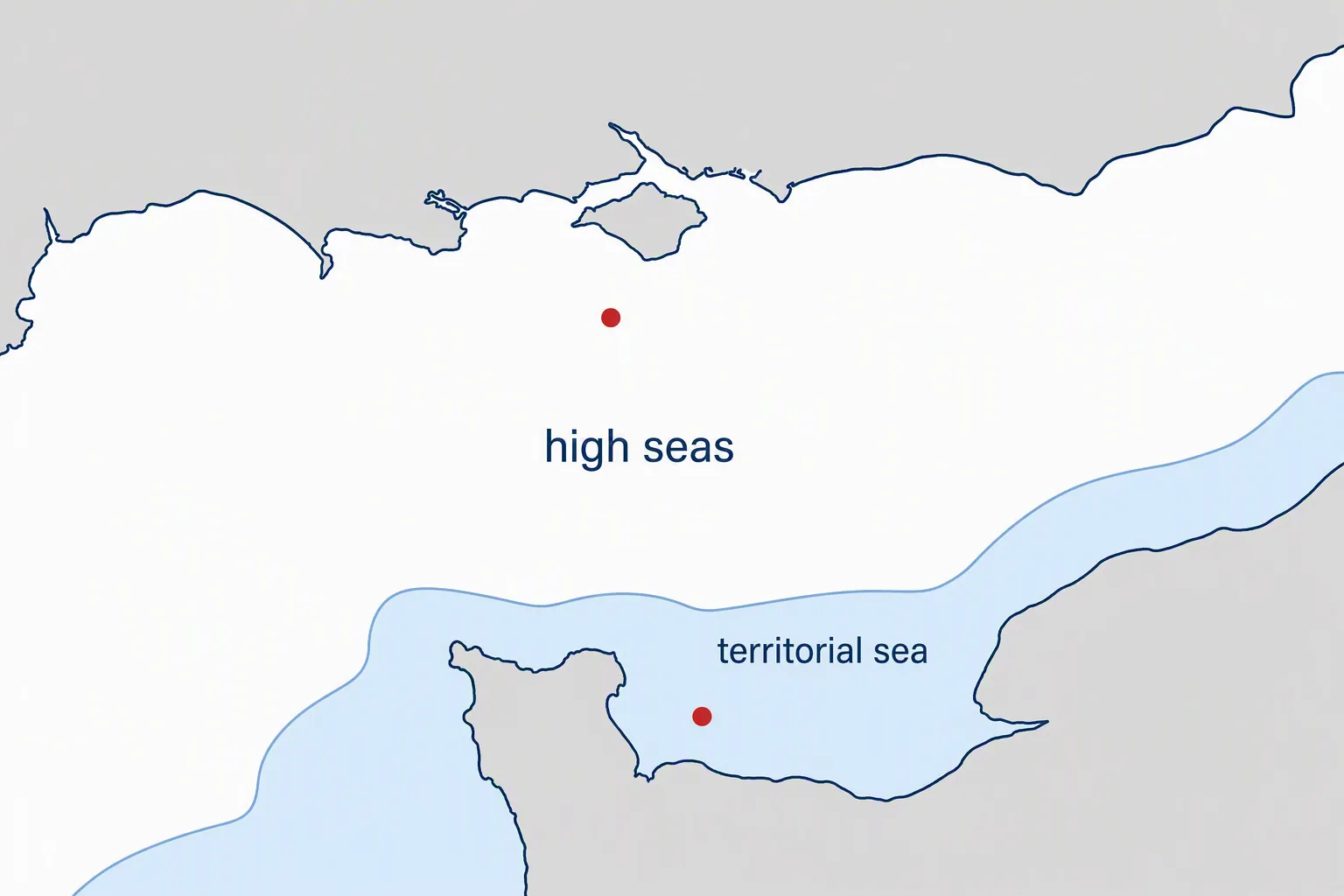
28 July 2026: French PSP Flamant near Cap Gris-Nez
| Issue | Record status |
|---|---|
| Date and vessel | Reported incident on 28 July 2026 involving the French patrol boat PSP Flamant and a fishing boat carrying UK Shadow Home Secretary Chris Philp during a BBC interview at sea [1]. |
| Approximate location | Reported about 3 nautical miles off Cap Gris-Nez, placing the incident close to the French coast and inside France’s 12 nautical mile territorial sea on the reported location [1]. |
| Shot count | BBC journalist Michael Keohan reported counting 17 shots; this is a reporter account, not a forensic firing record [1]. |
| Nature of firing | French authorities, relayed through AFP and reported by France24, described the event as a routine handgun firing exercise, not a hostile engagement [2]. |
| Range / exposure | France’s Maritime Prefecture position, as relayed through AFP, was that the British vessel was outside the firing range [2]. |
| Warning signals | French authorities said signals required by international standards were displayed; Keohan and skipper Matt Coker reported that they saw no warnings, and Coker said there was no VHF notice or flags [1][2]. |
| Political follow-up | Philp said he would seek answers from French ambassador Hélène Tréheux-Duchêne; the UK government described the issue as a matter for the French authorities [3]. |
| Legal posture | No proceeding or penalty is identified in the available record; the material legal dispute is whether adequate warning signals were actually given and received. |
The July file should not be treated as a simple “warning shots at a politician” story. If the French account is right, a state patrol vessel was conducting a routine firing exercise with required signals displayed and the other vessel outside the range. If the skipper and journalist are right, a civilian boat heard repeated shots without flags or VHF notice. Those are not cosmetic differences. They go to the point at which a lawful drill can become a dangerous warning protocol.
16 June 2026: Russian Admiral Grigorovich near the Isle of Wight
| Issue | Record status |
|---|---|
| Date and vessel | Reported incident on 16 June 2026 involving the Russian frigate Admiral Grigorovich and the UK-registered yacht Bright Future [4]. |
| Approximate location | Reported about 20 nautical miles south of the Isle of Wight, which puts the legal analysis outside the territorial-sea frame used for the July Cap Gris-Nez incident [4]. |
| Private sailors | The BBC identified the couple aboard as the Kelveys and reported their account of warning shots fired near them [4]. |
| Russian account | Russia claimed radio calls, flares, and a close approach by the yacht; the reported approach distance appears in the source packet as 150 meters and in later summaries as roughly 500 yards, so it should not be treated as a settled measurement record [4][5]. |
| Sailors’ denial | The Kelveys denied receiving radio calls, denied seeing flares, and denied the Russian account of the approach sequence [4]. |
| UK political characterization | Prime Minister Keir Starmer characterized the firing as reckless [5]. |
| UK defense assessment | The UK Ministry of Defence assessed the frigate as drifting and the shots as collision-avoidance rather than an attack on the yacht, according to the reported record [5]. |
| Legal posture | No court, arbitration, or penalty is identified; the material disputes are radio notice, flares, relative movement, and approach distance. |
The June incident is more openly alarming because the civilian crew’s account describes a frightening encounter with a Russian warship. It still cannot be flattened into one verified event. Russia’s asserted warning sequence, the Kelveys’ denial, Starmer’s “reckless” description, and the MoD’s collision-avoidance assessment are different kinds of statements. They do not cancel each other out, and they do not combine into proof.
The location decides which UNCLOS track is even available
UNCLOS does not answer a warning-shot question in the abstract. It first asks where the vessel was and what legal status attached to the ships involved. On the July report, about 3 nautical miles off Cap Gris-Nez sits inside the coastal state’s territorial sea. That puts innocent passage, coastal-state safety powers, and the immunity of warships in view. On the June report, about 20 nautical miles south of the Isle of Wight is not the same legal space; the analysis shifts toward high-seas navigation, collision avoidance, and the limited circumstances in which one state vessel may interfere with another vessel’s movement.
This is why “international waters” is an inadequate shortcut. The Channel contains traffic separation, overlapping security sensitivities, territorial seas, and high-seas spaces. A memo that uses the same label for Cap Gris-Nez and the waters south of the Isle of Wight has already lost the point that matters most.
For the July incident, the territorial-sea frame means France may regulate safety and navigation in its own waters, but that does not automatically validate gunfire near a civilian or lightly crewed vessel. For the June incident, the high-seas frame makes unilateral interference more difficult to justify, but it does not remove collision-avoidance duties or the possibility that a warship may use visible and audible signals to prevent an immediate navigational hazard.
The use-of-force rule is narrow: warnings first, force last
The controlling use-of-force principle is not that warning shots are always unlawful, and not that a navy may fire whenever a vessel is inconvenient. In M/V Saiga (No. 2), ITLOS stated that the use of force must be avoided as far as possible and, where unavoidable, must not go beyond what is reasonable and necessary in the circumstances; it also described a sequence in which warning measures precede direct force [6].
That formulation matters because warning shots sit in an uneasy place. They are usually treated as lower than disabling fire and far lower than lethal force, but they are still gunfire at sea. A 2025 Frontiers in Marine Science review places maritime law-enforcement force on a graduated ladder and discusses necessity, proportionality, and human-rights constraints, including the relevance of the right to life under ECHR Article 2 where state action creates lethal risk [7].
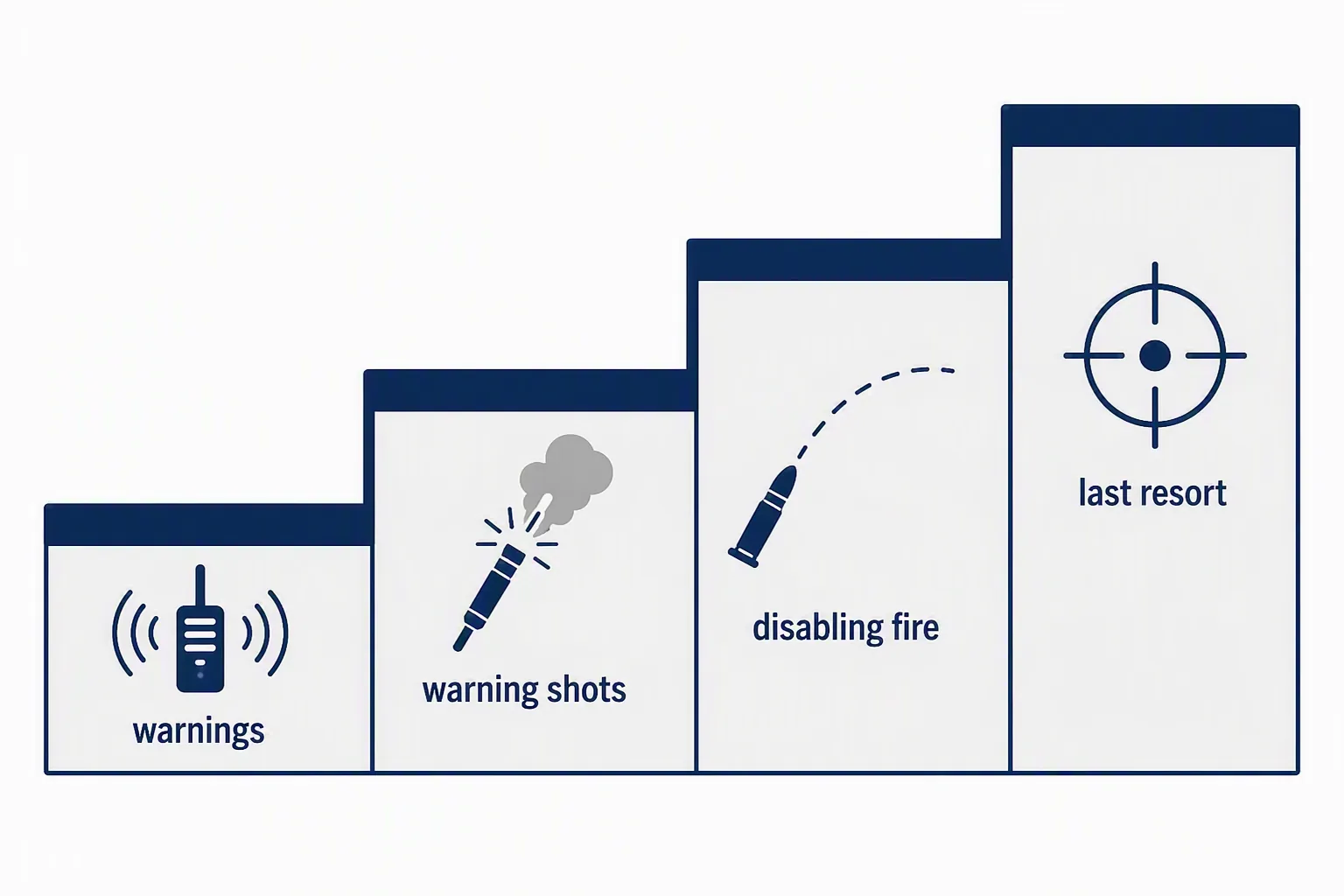
The older I’m Alone formulation, often summarized as a minimum-force standard, points in the same direction: even where a state vessel has authority to act, the measure chosen must be no more forceful than the situation requires. Pedrozo’s Lawfare discussion of Russia and innocent passage likewise treats warning shots and maritime restrictions as legally sensitive measures that cannot be made lawful by announcement alone [8].
A careful application therefore asks only a few hard questions. Was there authority to be where the state vessel was and to control the risk it claimed to be controlling? Were non-force signals used first? Were they clear enough for the target vessel to receive and understand? Was there an immediate navigational or safety need? Were the shots directed and spaced so that they warned rather than endangered? On this record, those questions cannot be answered cleanly for either incident.
July turns on the warning-signal dispute
The July legal problem is not the headline number of 17 shots by itself. The more important fact is whether the fishing boat had adequate notice before those shots were fired. France’s relayed position is that the required signals were displayed and the boat was outside the firing range. The opposing account is concrete: Keohan counted shots, and Coker, described as having 28 years at sea, said he saw no flags and heard no VHF warning [1][2].
If this were being prepared for a partner or an insurer, the next request would not be for another opinion paragraph. It would be for the firing-exercise notice, the patrol boat’s log, any VHF recording, AIS data if available, range charts, photographs of displayed signals, and statements from the fishing-boat crew. Without those materials, the law has nowhere firm to attach.
A lawful firing exercise can still be badly executed if the notice protocol fails in practice. Conversely, a frightened crew can honestly experience gunfire as directed at them even where the firing vessel believed it had marked a safe range. The present record supports both possibilities only as possibilities. It does not support a finding.
June turns on radio, flares, relative movement, and distance
The June record has a different evidentiary center. Russia’s justification depends on a sequence: radio calls, flares, an unsafe approach, and warning rifle shots. The Kelveys deny the warning elements. The MoD’s reported assessment points toward collision avoidance rather than an attack. Starmer’s political description supplies seriousness, not proof of the navigational geometry [4][5].
For legal analysis, “500 yards” or “150 meters” cannot be used casually as if either figure were a surveyed distance. The legally relevant distance is the closest point of approach in context: vessel size, speed, bearing, maneuverability, sea state, radio traffic, and whether either vessel was constrained in its ability to maneuver. The source packet contains disputed descriptions, not a reconstructed collision plot.
That distinction is not indulgent toward Russia. It is the discipline needed to avoid citing a political event as a legal conclusion. If radio calls and flares were actually made and ignored during a developing collision risk, warning shots may sit differently in the force analysis. If no such warnings occurred, the firing looks much harder to justify. Those are evidence questions before they are doctrine questions.
What is legally actionable now?
On the present record, very little is legally actionable in the litigation sense. The July incident has a plausible diplomatic path because Philp said he would contact the French ambassador, and the UK government treated the issue as one for French authorities [3]. That is a governmental channel, not a filed claim. The June incident may remain relevant to defense, diplomatic, or navigational-safety assessments, but the materials do not identify a court or tribunal track.
A private civil claim would run into immediate problems: state-vessel status, evidence located across jurisdictions, contested causation, no reported physical injury in the source packet, and the practical fact that warning-shot incidents involving state vessels are usually handled between governments unless an injury, detention, seizure, or loss creates a clearer hook. None of that makes the conduct harmless. It means the file should not be briefed as if a remedy already exists.
The defensible publication format is therefore an incident-risk ledger with a last-verified timestamp. The next companion pieces should be a verification workflow for disputed maritime incidents and a tool-reliability evaluation for AI-generated legal citations. Until then, the safe answer is simple but not satisfying: UNCLOS fixes the maritime zone; necessity, proportionality, last resort, and appropriate warning signals govern the use of force; and neither 2026 Channel incident has produced a legal ruling anyone can cite.
References
- French Navy carries out shooting drill in English Channel mid BBC interview, BBC
- British MP accuses French patrol boat of firing warning shots near him in Channel, France24
- Chris Philp to seek answers from France over naval firing exercise, BBC
- 'It was surreal': British couple describe warning shots fired near them by Russian warship, BBC
- Russian warship fires shots at vessel in English Channel, UK media say, Euronews
- M/V Saiga (No. 2), Judgment of 1 July 1999, International Tribunal for the Law of the Sea, 1 July 1999
- Forcible measures for maritime law enforcement by the coast guard, Frontiers in Marine Science, 2025
- Déjà vu—Russia's Illegal Restrictions on Innocent Passage in the Black Sea, Lawfare
Related records
Tool profile
How Meta's AI Spending Reshapes Law Firm ProfitabilityGoverning regulation
Browse the obligations tracker →Preventive workflow
Browse verification workflows →
Report a correction or tip
Spotted an outdated figure, a misstated fact, or a ruling this case record should reflect? Public comments are disabled for this content given the professional cost of a misreported case outcome, penalty amount, or rule text — use the structured correction channel instead.
Report a correction or tip for this record →