
How Forensic Audio Authentication Can Defeat the Deepfake Defense
After a Fukuoka politician claimed an incriminating recording was AI-generated, a 15-point frequency-spectrum match by an accredited lab rebutted the defense. This article explains the forensic protocol used and how practitioners can commission, evaluate, and present similar audio-authentication evidence in court.
- Jurisdiction
- Japan
- Court
- Fukuoka Prefectural Assembly
- AI tool named
- Unspecified AI voice synthesis
- Ruling date
- Jul 24, 2026
- Source document
- View primary court order ↗
- Last verified
- Jul 30, 2026
Lex Machina Review is an independent risk-tracking and reference resource. Nothing on this site is legal advice, and using it does not create an attorney-client relationship. Every record is reviewed against primary sources but may not reflect the most current status of a matter — always verify directly against the cited court order, rule text, or a licensed attorney before relying on it.
Companion explanation — secondary to the source document above
The useful part of the Fukuoka bribery scandal is not that a politician said an incriminating recording was AI-generated. That denial is now easy to imagine in any disputed-audio case. The useful part is what happened next: the recording was sent for forensic voice analysis, Japan Acoustic Lab reported a 15-point frequency-spectrum match, and the accused politician, former Fukuoka Prefectural Assembly vice speaker Nakao Masayuki, reportedly retreated from the AI claim before continuing to deny the underlying transaction by saying he had no recollection.[1][2]
That sequence is the pressure point for anyone dealing with disputed audio in the Fukuoka bribery scandal or a similar press-conference denial. A technical denial may be defeated without ending the factual dispute. The voice can be authenticated; the payment, intent, memory, coercion, or quid pro quo may still have to be proved the old way.
As of July 30, 2026, the publicly available record should be treated with care. The matter arises from Japan, not a U.S. federal or state court applying American evidence rules. The reported scandal concerns alleged pay-to-play payments in Fukuoka prefectural politics, with Asahi Shimbun reporting a total of ¥28.4 million, five former speakers or vice speakers admitting payments, and 30 of 47 former officials responding to its investigation.[1] Nakao resigned on July 24, according to the available reporting, but the forensic episode is not a U.S. precedent and should not be presented as one.[1]
The denial changed shape
Nakao’s reported movement from “AI-generated” to “I must have said that” is more important than the phrase itself. A deepfake claim puts the recording’s origin in issue. A retreat from that claim narrows the fight. It does not make the accused adopt the prosecution’s, investigator’s, or journalist’s whole theory of the case.
The Asahi account reports that, after being confronted with the forensic evidence, Nakao said, “Well, I must have said that then,” while still denying the alleged transaction by saying he had no recollection.[1] That is precisely where audio authentication earns its keep and precisely where its limits begin.
A lawyer facing the same pattern should resist two bad instincts. The first is to treat “AI-generated” as a mystical objection that makes ordinary proof useless. The second is to treat a favorable lab conclusion as a magic wand. The lab can help answer whether the voice is consistent with the challenged speaker. It may also help assess whether the recording shows signs of manipulation, depending on the work commissioned. It does not independently prove why the words were said, whether money changed hands, or whether the speaker remembers the event.
What the 15-point match actually gives a lawyer
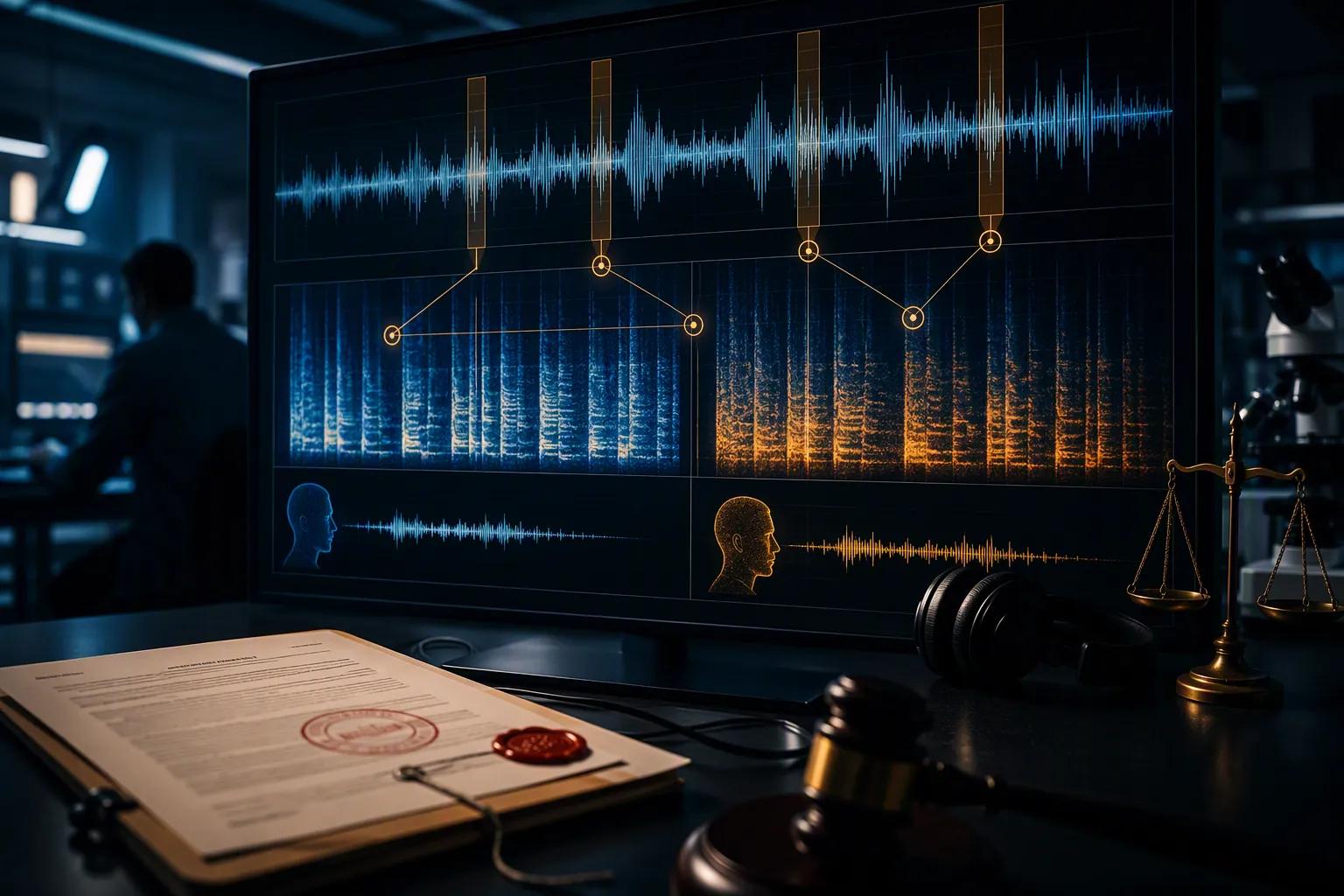
The most concrete public detail in the Fukuoka record is Japan Acoustic Lab’s reported frequency-spectrum comparison. Tokyo Reporter, citing media interviews with Director So Suzuki, reported that the lab found a 15-point match and expressed “over 99.99%” certainty that the voice belonged to Nakao. The same report described Japan Acoustic Lab as an accredited independent laboratory frequently used by police and courts in Japan.[2]
That is useful, but it should be quoted with its scaffolding still attached. The underlying expert report is not public in the materials available here. The “over 99.99%” figure reaches readers through news reporting and interviews, not through a filed declaration, cross-examined testimony, or a published judicial finding. For procurement officers and litigators, that distinction matters. Media reporting can identify a method worth studying; it cannot substitute for the report a court will need.
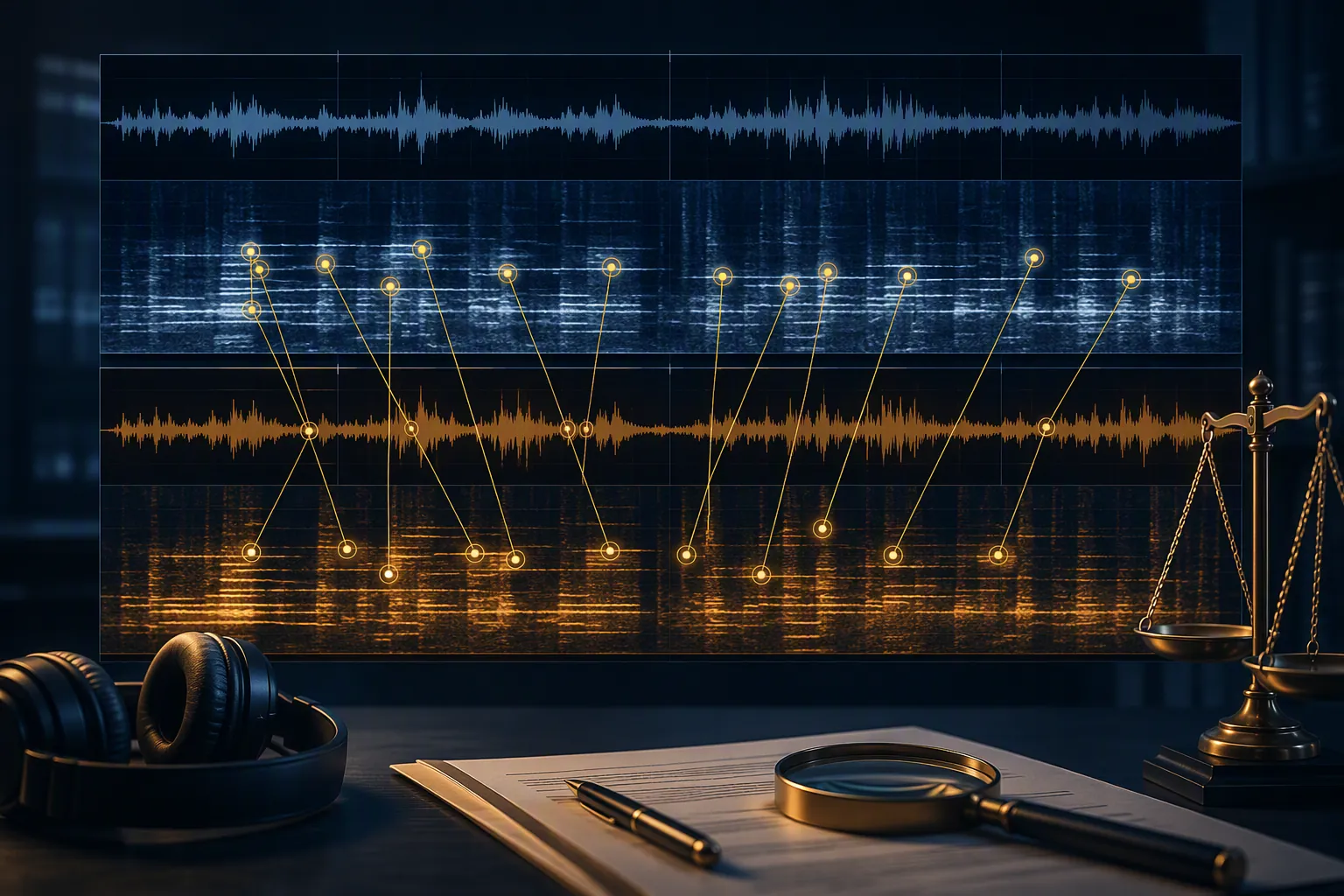
A 15-point frequency-spectrum match is not a generic “AI detector” label. It suggests a comparison of measurable acoustic features across known and questioned voice samples. The practitioner’s task is to turn that general idea into a commissioned scope of work: what files were examined, what known samples were used, what acoustic-phonetic features were compared, what conditions affected the comparison, and what conclusion the examiner is actually offering.
Commission the work as authentication, not as vibes
The first practical lesson is to avoid sending a disputed recording to a vendor with only the question, “Is this AI?” That framing invites a thin answer. A court-facing engagement should ask for separable conclusions, because the dispute itself may fracture once the first denial fails.
- Preserve the original recording, including metadata and the device or platform history where available, before any enhancement or clipping.
- Document chain of custody from collection through transfer, analysis, storage, and production.
- Provide known comparison samples whose source, date range, recording conditions, and speaker identity can be independently explained.
- Request acoustic-phonetic and frequency-spectrum comparison, rather than a bare “deepfake check.”
- Ask the expert to separate speaker-identification confidence from recording-integrity conclusions.
- Require the report to state limits: noise, compression, edits, sample length, language issues, recording channel, and any assumptions.
The separation between speaker identity and recording integrity is not pedantic. A lab may be able to say that the questioned voice strongly matches a known speaker while being more cautious about whether the recording is complete, edited, compressed, or contextually reliable. Conversely, a recording may show no obvious synthetic-generation artifacts while still lacking enough quality for a strong speaker-identification opinion. Those are different propositions, and opposing counsel will exploit any report that blurs them.
| Question for the lab | Why it matters in litigation |
|---|---|
| Does the questioned voice match known samples from the alleged speaker? | Addresses the specific denial that the voice is not the speaker’s. |
| What acoustic features were compared? | Lets the expert explain method rather than rely on a conclusion label. |
| Were signs of splicing, synthesis, or manipulation evaluated separately? | Prevents speaker identity from being confused with recording integrity. |
| What quality limits affected the opinion? | Prepares counsel for admissibility challenges and cross-examination. |
| What confidence language is scientifically supportable? | Keeps the report from overstating what the data can bear. |
Vendor credibility starts before the report arrives
A procurement team buying an audio-authentication tool or retaining a forensic vendor should not be dazzled by a dashboard that produces “real” or “fake.” The Fukuoka materials are valuable because they describe an independent lab, a comparative method, and a stated match threshold. The lesson is not that every case needs Japan Acoustic Lab. The lesson is that the decision-maker should be able to explain why this examiner, this method, and this source material deserve reliance.
A credible engagement file should answer basic questions before the merits fight begins. Who performed the analysis? What training, accreditation, or prior forensic use supports the work? Was the lab independent of the party’s litigation strategy? Did the expert receive the original file or a derivative? Were known samples cherry-picked, or were they chosen under a defensible protocol? Was the tool a black box, or can the examiner explain the observable features and comparison process?
The strongest reports are also modest in the right places. They do not pretend that a frequency-spectrum comparison resolves every evidentiary problem. They identify the speaker-comparison basis, state the confidence level in a form the expert can defend, explain whether and how manipulation was assessed, and preserve enough work product for another qualified examiner to understand the path taken.
Present the result against the deepfake defense
Once the report is in hand, the litigation move is not to announce that AI has been disproved in the abstract. The move is to tie the expert’s conclusion to the opponent’s actual claim. If the denial is “that is not my voice,” the speaker-comparison opinion matters. If the denial is “the clip was fabricated,” the integrity analysis matters. If the denial becomes “I may have said it, but I do not remember the payment,” the authentication fight has narrowed, and the lawyer must shift to corroboration.
This is why Nakao’s reported partial retreat is so instructive. The AI premise reportedly weakened after the forensic confrontation, but the factual dispute continued.[1] A court record should be built for that possibility from the beginning. The audio should be paired with witnesses who can explain collection, context, participants, dates, devices, surrounding communications, payment records, meeting logs, or other corroborating facts. Authentication evidence may open the door; it is not the whole room.
For U.S. lawyers, the Fukuoka episode sits usefully beside current evidence-rule debates, not inside them. Keller Anderle’s discussion of proposed FRE 901(c) and Rule 707 frames a courtroom concern that litigants may weaponize AI uncertainty by making unsupported deepfake claims and forcing the proponent of evidence into additional authentication work.[3] The Fukuoka pattern illustrates the practical burden problem: a party raises AI generation, a forensic response is commissioned, and the dispute narrows only if the record is strong enough to make the denial costly.
Huang v. Tesla is a useful U.S.-facing comparison for the same reason. Thomson Reuters has discussed the 2023 dispute as an example of courts confronting claims that recorded or public statements may be deepfaked, with judges having to navigate authentication in a legal environment where AI fabrication is technically plausible.[4] The comparison should stay limited. Huang does not turn Fukuoka into U.S. precedent, and Fukuoka does not settle American authentication doctrine. Together, they show the litigation pattern that practitioners should expect to see again.
Prepare the expert for method and limits
A good expert presentation is not just a conclusion with a decimal point. The expert should be ready to explain what a spectrogram is, what features were compared, why the known samples are appropriate, how compression or background noise affected the work, and what the stated confidence level means. If the opinion uses a phrase like “over 99.99%,” counsel should know whether that language reflects a validated statistical model, a lab convention, a likelihood expression, or a media simplification of a more technical conclusion.
The expert should also be kept out of arguments the method does not support. A speaker-identification expert should not become the witness for motive. A recording-integrity expert should not be asked to infer the transaction history from the words alone. If the client wants the audio to prove the entire story, the lawyer has to supply the missing evidentiary links through other witnesses and documents.
The cleanest direct examination is often chronological. Establish the materials received. Establish preservation and chain of custody. Establish the known samples. Explain the comparison method. State the observed matching features. Give the conclusion and its limits. Then stop before the expert drifts into advocacy. Cross-examination will find enough targets without inviting extra ones.
Where the proof stops
The Fukuoka case is useful because it is untidy in exactly the way real evidence disputes are untidy. The forensic result reportedly damaged a specific technical denial. It did not force a full factual concession. Nakao could retreat from “AI-generated” while continuing to deny recollection of the transaction.[1]
That is the expectation practitioners should carry into their own cases. Forensic audio authentication can collapse a deepfake defense when the work is independent, well-scoped, and explainable. It can make a vague AI accusation look like procedural fog rather than a serious evidentiary objection. It still leaves counsel with the ordinary burdens of litigation: corroboration, witness examination, source documentation, and persuasion of the fact-finder.
References
- Details on golf, cash bags arise in 'pay-to-play' ploy in Fukuoka, The Asahi Shimbun.
- Fukuoka deputy chairman linked to ¥28 million extortion scandal by 99.99% voice match, Tokyo Reporter.
- The New Courtroom Reality: Weaponized AI and the Rise of the 'Deepfake Defense', Keller Anderle.
- Deepfakes on trial: How judges are navigating AI evidence authentication, Thomson Reuters.
Related records
Tool profile
How Meta's AI Spending Reshapes Law Firm ProfitabilityGoverning regulation
Browse the obligations tracker →Preventive workflow
Browse verification workflows →
Report a correction or tip
Spotted an outdated figure, a misstated fact, or a ruling this case record should reflect? Public comments are disabled for this content given the professional cost of a misreported case outcome, penalty amount, or rule text — use the structured correction channel instead.
Report a correction or tip for this record →