
What the Ghirardelli strike's federal labor charge means
A verified status snapshot of the Ghirardelli workers strike and its federal labor charge: who filed it, under which NLRA section, and why the open NLRB case is an allegation under investigation rather than a finding.
- Jurisdiction
- US federal
- Court
- NLRB Region 32
- AI tool named
- No AI tool named
- Ruling date
- Mar 9, 2026
- Source document
- View primary court order ↗
- Last verified
- Aug 1, 2026
Lex Machina Review is an independent risk-tracking and reference resource. Nothing on this site is legal advice, and using it does not create an attorney-client relationship. Every record is reviewed against primary sources but may not reflect the most current status of a matter — always verify directly against the cited court order, rule text, or a licensed attorney before relying on it.
Companion explanation — secondary to the source document above
Status first: open federal charge, no Board finding
As of Aug. 1, 2026, the legally safe description of the Ghirardelli strike’s federal labor-law status is narrow: local reporting says UNITE HERE Local 2 filed a federal labor charge connected to the San Francisco flagship walkout, while the primary NLRB matter identified for this record remains open and does not show any Board decision, remedy, or penalty in the materials reviewed. The open NLRB Region 32 page located for case 32-CA-382555 lists a filing date of March 9, 2026 and an open status; because that filing date predates the July 30 walkout and the materials reviewed do not include a primary docket entry expressly tying that case number to the July strike charge, the case-number link should be repeated with that caveat, not as a settled docket match.[1]
| Record point | What can be said now |
|---|---|
| Forum | NLRB Region 32 is the identified regional forum; the located page is case 32-CA-382555, filed March 9, 2026, status open.[1] |
| Charging party / dispute | Named local reports describe a UNITE HERE Local 2 charge connected to the Ghirardelli San Francisco flagship strike.[2][3][4][5][6] |
| Reported allegation | The charge is reported to concern Ghirardelli’s alleged refusal to provide records showing revenue from a 6% customer healthcare fee or surcharge while bargaining over health-plan changes.[2][3][4][5][6] |
| Statutory hook | The theory is an NLRA § 8(a)(5) refusal-to-bargain theory, with § 8(a)(1) also implicated in the unlawful-interference framework.[7] |
| Legal status | Open charge / allegation under investigation. The materials reviewed do not show an NLRB finding that Ghirardelli violated the NLRA. |
That distinction is not cosmetic. A charge is how a federal labor-law allegation enters the NLRB system; it is not the same thing as a Board finding. A partner memo, client alert, or newsroom note should not turn “the union filed a federal charge” into “Ghirardelli broke federal labor law.” The former is supported by the current record; the latter is not.
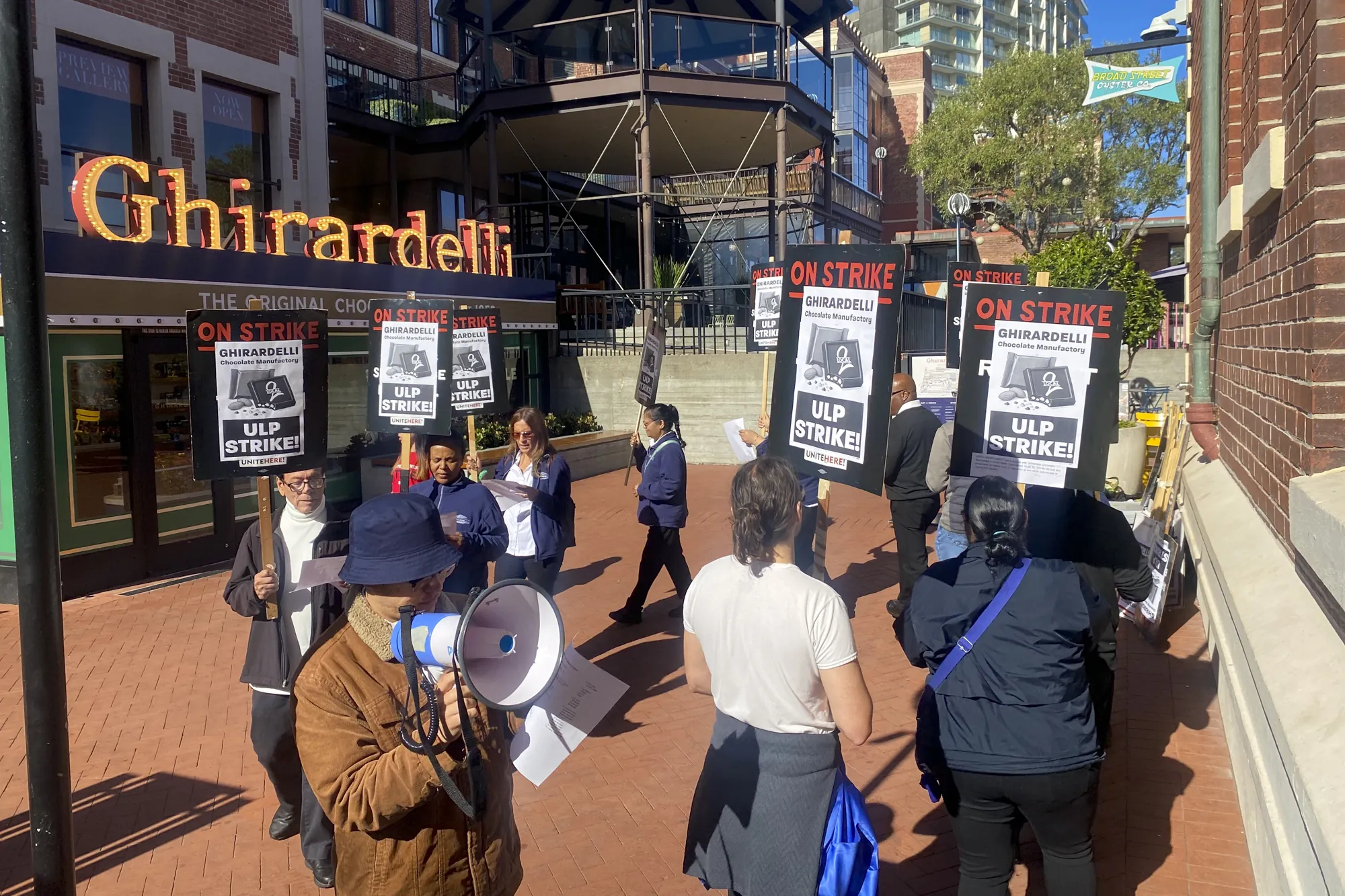
What the union says Ghirardelli withheld
The reported legal hinge is information, not the fact of a strike by itself. Local outlets describe the charge as tied to a 6% customer-facing healthcare fee or surcharge and the union’s demand for records showing how much revenue that charge generated. The union’s position, as reported, is that the revenue information mattered because the company was proposing a health plan that would shift workers away from the union-administered plan and expose them to higher out-of-pocket costs.[2][3][4][5]
For § 8(a)(5), that is the part to slow down. The National Labor Relations Act makes it an unfair labor practice for an employer “to refuse to bargain collectively” with employees’ representatives; § 8(a)(1) separately prohibits employer interference, restraint, or coercion in the exercise of protected rights.[7] In an information-refusal case, the union is not merely complaining that it dislikes a proposal. The charge, as reported, says the employer withheld information the union claims it needed to evaluate and bargain over that proposal.
That is why the 6% fee is more than a detail from a receipt. On the union’s theory, the fee matters because it was customer-facing and described as healthcare-related while the company was proposing plan changes the union said would increase workers’ medical costs. The NLRB has not decided on the present record whether Ghirardelli had a legal duty to provide those records, whether the records requested were required bargaining information, or whether any refusal occurred.
Why “unfair-labor-practice strike” changes the risk analysis
The classification of the walkout matters because reinstatement rights differ. The NLRB distinguishes between economic strikers and unfair-labor-practice strikers. Its public strike guidance says economic strikers keep employee status and cannot be discharged, but if they are permanently replaced, they are not entitled to immediate reinstatement when they offer to return; unfair-labor-practice strikers, by contrast, are entitled to reinstatement even if employees hired to do their work must be discharged, absent serious misconduct.[8][9]
That is the practical reason the label is load-bearing. If the NLRB ultimately finds that Ghirardelli unlawfully refused required information and that the strike was caused or prolonged by that unfair labor practice, the union’s “ULP strike” framing could carry stronger reinstatement consequences than an ordinary economic strike. If the Board does not make that finding, the label does not become true because it appeared on a picket sign or in a news story.
At this point, the materials reviewed show no Board decision, remedy, or penalty. The current status is still allegation and investigation.
The strike facts identify the dispute, but they do not prove the charge
The strike itself was visible and easy to summarize: workers walked out at Ghirardelli’s San Francisco flagship for a three-day strike running July 30 through Aug. 1, 2026, and local outlets reported that the store closed during the walkout.[3][4][5][6] SFist described the action as the first full walkout at the flagship since 1984.[6] Those facts help identify the matter. They do not answer the legal question.
The worker count should also be handled as reported, not harmonized. KQED, the San Francisco Standard, and KTVU described roughly 45 workers involved; SFist put the figure at about 50.[3][4][5][6] For most legal-risk uses, the difference is not material to the § 8(a)(5) theory. It is material to attribution discipline: if a note needs a headcount, it should name the outlet or use an approximate range.
The health-plan descriptions require the same treatment. KTVU reported the union-administered plan included a $50 emergency-room co-pay, while SFGATE, via Yahoo, reported the union warning that co-pays under the company proposal could rise to “hundreds or thousands” of dollars.[5][10] The research materials also flag a KTVU-quoted formulation attributed to Sonya Karabel using the much larger phrase “hundreds of thousands of dollars.” Because those formulations are not the same, they should not be blended into a single cleaned-up number.
Source limitations that should travel with the record
The strongest primary item is the NLRB case page showing an open Region 32 matter, case 32-CA-382555, filed March 9, 2026.[1] The weakest part of the docket record is the connection between that case number and the July 2026 strike charge. The date mismatch matters. Unless a current primary docket entry, charge document, complaint, or party filing ties 32-CA-382555 to the July walkout, the safer wording is that this is the identified open NLRB matter associated in the research record, not a fully verified case-number match.
The San Francisco Chronicle is cited in the research record for the federal-charge angle, but the article is paywalled in the materials reviewed. The same core charge description is corroborated by accessible local reporting from KQED, the San Francisco Standard, KTVU, and SFist.[2][3][4][5][6] That makes the existence and general shape of the reported allegation usable, while still leaving the precise docket linkage and any later procedural movement to be checked against primary NLRB materials before publication in a filing-sensitive context.
The fee language is also inconsistent across reports. Some describe a 6% “healthcare fee”; others use “surcharge.” Reports also vary in how they refer to the location, using Ghirardelli Plaza or Ghirardelli Square. Those differences do not defeat the basic identification of the dispute, but they are a warning against over-cleaning the record. The phrasing should stay close to the source being cited.
The end-state of the strike and any post-strike settlement were not verified in the reviewed materials as of Aug. 1, 2026. A later return to work, side agreement, withdrawal, settlement, complaint, dismissal, or Board order would change the status line. None of those outcomes appears in the record reviewed for this article.
Safe wording for briefings
A cautious briefing sentence would read: “UNITE HERE Local 2 workers at Ghirardelli’s San Francisco flagship conducted a July 30–Aug. 1, 2026 strike, and local reports say the union filed a federal labor charge alleging Ghirardelli refused to provide information about revenue from a 6% customer healthcare fee while bargaining over health-plan changes; an identified NLRB Region 32 matter remains open, and no Board violation finding or remedy has been reviewed.”
A sentence that goes too far would read: “Ghirardelli violated federal labor law by withholding healthcare-fee revenue records.” That may become a finding only if the NLRB reaches it through the labor-law process. It is not the present record.
For now, the significance is real but bounded. If the NLRB ultimately finds that required bargaining information was refused, the unfair-labor-practice strike classification could carry stronger reinstatement rights than an economic-strike classification. As of this verification date, the record supports a narrower conclusion: this is a live federal labor-law allegation with potentially significant reinstatement consequences, not a Board finding that Ghirardelli violated the NLRA.
References
- 32-CA-382555; National Labor Relations Board
- Ghirardelli strike federal labor charge; San Francisco Chronicle
- Iconic Ghirardelli San Francisco flagship store closed as workers strike; KQED
- SF Ghirardelli chocolate workers strike; The San Francisco Standard; July 30, 2026
- Ghirardelli Chocolate workers in San Francisco walk off job in 3-day strike; KTVU
- Union Workers at Ghirardelli's SF Flagship Store Begin Three-Day Strike, Prompting Closure; SFist; July 30, 2026
- 29 U.S. Code § 158 - Unfair labor practices; Legal Information Institute, Cornell Law School
- Strikes; National Labor Relations Board
- NLRA and the Right to Strike; National Labor Relations Board
- Flagship San Francisco Ghirardelli store; SFGATE via Yahoo
Related records
Tool profile
How Meta's AI Spending Reshapes Law Firm ProfitabilityGoverning regulation
Browse the obligations tracker →Preventive workflow
Browse verification workflows →
Report a correction or tip
Spotted an outdated figure, a misstated fact, or a ruling this case record should reflect? Public comments are disabled for this content given the professional cost of a misreported case outcome, penalty amount, or rule text — use the structured correction channel instead.
Report a correction or tip for this record →