
What the Ghirardelli ULP Strike Label Legally Changes
The Ghirardelli strike's legal stakes turn on its ULP classification: ULP strikers cannot be permanently replaced or discharged, while economic strikers can be. Here is how the union's 8(a)(5)/8(a)(1) allegations map to Board doctrine, and what changes if the NLRB rejects the charge.
- Jurisdiction
- US federal
- Court
- National Labor Relations Board
- AI tool named
- No AI tool named
- Ruling date
- Aug 1, 2026
- Source document
- View primary court order ↗
- Last verified
- Aug 1, 2026
Lex Machina Review is an independent risk-tracking and reference resource. Nothing on this site is legal advice, and using it does not create an attorney-client relationship. Every record is reviewed against primary sources but may not reflect the most current status of a matter — always verify directly against the cited court order, rule text, or a licensed attorney before relying on it.
Companion explanation — secondary to the source document above
Not legal advice: This article is a legal-information explainer, not advice for any worker, employer, union, or replacement employee. Strike classification turns on a live administrative record and should be checked against current NLRB filings before anyone relies on it.
Legal-background review: Dana Rowe, J.D., labor-and-employment editor. Last verified: Aug. 1, 2026, 00:00 UTC. Status at verification: strike reported as ongoing, with no settlement reported. Re-verification flag: required before treating the record as final.
The legally important phrase on the Ghirardelli sidewalk is not “closed,” “iconic,” or even “strike.” It is “ULP STRIKE!” That label, if the National Labor Relations Board ultimately agrees with the theory behind it, changes replacement and reinstatement rights for the roughly 45 UNITE HERE Local 2 workers who walked out of the Original Ghirardelli Chocolate & Ice Cream Shop in San Francisco’s Ghirardelli Square. But the sign is not the ruling.
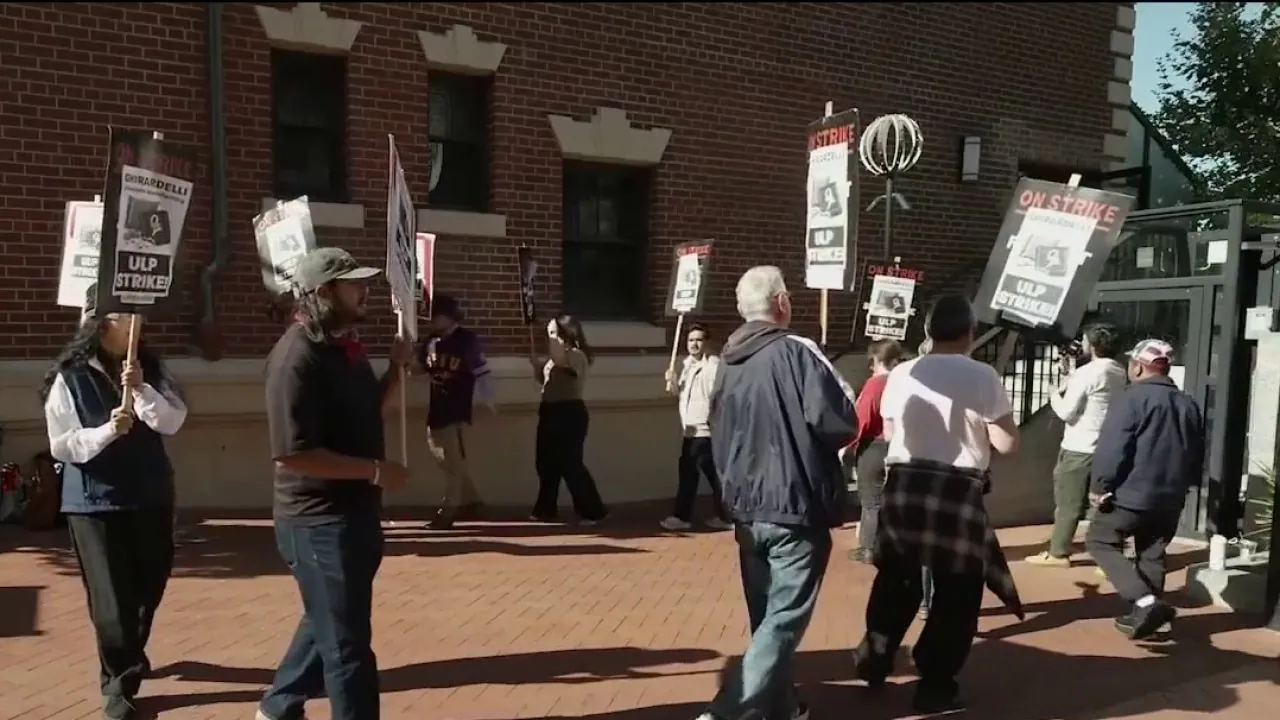
The public record available by Aug. 1 is narrow but consequential. Workers began a three-day walkout on Thursday, July 30, 2026, with the strike scheduled to run through about 10 p.m. Saturday, Aug. 1; coverage described about 45 workers at the flagship shop, picket signs reading “ON STRIKE” and “ULP STRIKE!,” and the company’s position that its proposals cover 100% of employee monthly premiums and that it has bargained in good faith. [1]
KQED described the closure as the first full-store strike at the site since 1984, a useful news fact but not the fact that decides the legal consequences. [2] The NLRB’s public case page also shows charge 32-CA-382555, filed March 9, 2026, in Region 32, with an 8(a)(3) allegation; that docket confirms an open Board matter but does not, by itself, resolve whether the July 30 walkout is legally a ULP strike. [3]
What the ULP label changes
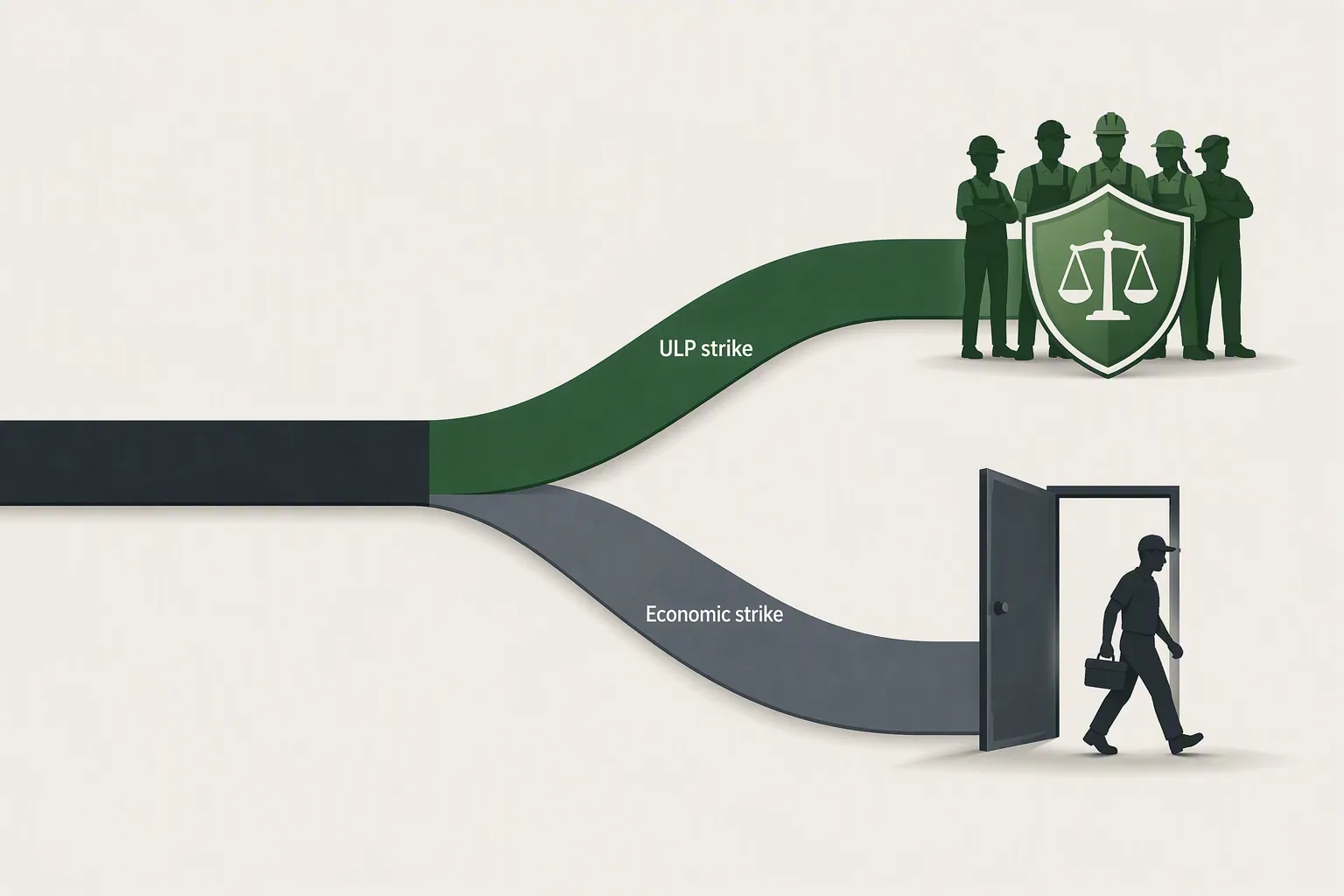
For labor-law purposes, “ULP strike” is not a press descriptor. It is a classification with job-right consequences. The NLRB’s public guidance draws the practical line this way: economic strikers may be permanently replaced, while unfair-labor-practice strikers may not be discharged or permanently replaced and are entitled to reinstatement when they make an unconditional offer to return, absent serious strike misconduct. [4]
| If the walkout is classified as | Replacement and reinstatement consequence |
|---|---|
| Unfair labor practice strike | The employer may not discharge or permanently replace the strikers; when they unconditionally offer to return, they must be reinstated even if replacements have to be discharged, absent serious misconduct. [4] |
| Economic strike | The strikers remain employees, but the employer may hire permanent replacements; if their jobs are filled, the returning strikers generally wait for reinstatement as positions open. [4] |
That is why the legal implications of the Ghirardelli walkout cannot be reduced to whether the shop closed for tourists. The live question is whether the employer conduct alleged by the union is both unlawful and causally connected to the decision to strike. If that link holds, the walkout carries ULP-striker protections. If it fails, the replacement framework changes.
The classification pathway runs through Mackay, not the flyer
The employer-side baseline is the rule associated with NLRB v. Mackay Radio: in an economic strike, the employer may continue operating and may hire permanent replacements. That does not mean economic strikers lose all statutory status. It means their immediate right to return is weaker if their positions have been filled. [4][5]
The ULP-striker line limits that employer right. When employees strike over an employer unfair labor practice, the Board treats them differently because the strike is not merely pressure over wages, benefits, or contract terms. It is a response to conduct the Act prohibits. Mastro Plastics and later Board doctrine matter here because they keep the ULP-strike category legally separate from ordinary economic pressure; Domsey Trading is part of the same chain in focusing attention on whether the unlawful conduct contributed to the strike. [5]
The causation standard is not that the unfair labor practice must be the only reason, the dominant reason, or the most loudly stated reason. The formulation quoted in the secondary literature from NLRB guidance asks whether the employer’s unfair practice “had anything to do with causing the strike.” [5] That standard is generous to workers in one sense: mixed motives do not automatically defeat ULP classification. But it is still a standard. A Board agent, an administrative law judge, or the Board itself must be able to connect unlawful employer conduct to the walkout.
The sign and the flyer can be evidence of what the union said it was protesting. They are not a substitute for the underlying unfair-labor-practice finding. The company’s denial works the same way in the opposite direction. Ghirardelli and Lindt & Sprüngli can say they bargain in good faith and offer premium coverage, and those statements matter to the factual dispute, but they do not end the classification inquiry either.
How the reported 8(a)(5) and 8(a)(1) theory would have to work
The union-side theory reported around the strike is not simply that workers dislike the company’s health-benefit proposals. The legally coherent version is narrower: the employer allegedly refused to provide information relevant to bargaining over health benefits, with the dispute reaching back to May 2025. If sustained, that kind of refusal can be framed as a failure to bargain in good faith under Section 8(a)(5), with a derivative Section 8(a)(1) theory because interference with collective-bargaining rights also interferes with employees’ protected Section 7 rights.
That theory has three practical pieces. First, the requested information must be relevant to bargaining. Health-benefit costs, premium allocation, plan structure, and employer assertions about coverage can be relevant when benefits are on the table. Second, there must be a refusal, delay, incomplete response, or other conduct that the Board treats as a failure to bargain in good faith. Third, the alleged violation must have contributed to the strike.
- The benefits dispute alone sounds economic.
- A refusal to provide relevant bargaining information can turn the case toward 8(a)(5).
- A strike caused in part by that unlawful refusal can fall into the ULP-strike category.
- The reinstatement and replacement consequences follow only if the Board sustains both the violation theory and the causal connection.
That map is an allegation-to-doctrine map, not a finding. The public docket entry for 32-CA-382555 that was available at verification reflects an 8(a)(3) allegation, not a confirmed public docket for the separate reported 8(a)(5)/8(a)(1) information-request theory. [3] Until a matching public charge, complaint, settlement, dismissal, or Board decision can be verified, the safer phrasing is that the union has advanced or been reported to advance a ULP theory tied to bargaining information, while the confirmed NLRB docket should be described according to its own public entry.
The losing path: mistaken belief does not preserve ULP-striker status
The control condition is Precision Concrete. A strike does not remain a ULP strike merely because workers believed, even sincerely, that the employer committed an unfair labor practice. If the Board rejects the underlying ULP theory, a strike based on that mistaken belief can be treated as an economic strike, bringing the Mackay Radio replacement rule back into the analysis. [5]
That is the employer-side consequence often missing from quick strike coverage. If management is dealing with economic strikers, it has lawful options that it does not have against ULP strikers. If management misclassifies a ULP strike as economic and permanently replaces workers who were legally protected from permanent replacement, the legal exposure changes sharply. The classification is not a public-relations adjective; it is a risk allocation rule.
The same point protects against overreading the workers’ materials. “Greedy Ghirardelli breaks the law” may be a useful window into the union’s theory, and “ULP STRIKE!” is the phrase that identifies the legal stakes. But a Board classification still has to do the work. The alleged information refusal must be unlawful, and it must have had something to do with causing the walkout.
What can be said as of Aug. 1, 2026
As of the last verification point, the three-day Ghirardelli walkout was still being reported as ongoing, and no settlement had been reported. [1] The available record supports a careful conclusion, not a completed classification: if the NLRB sustains the relevant 8(a)(5)/8(a)(1) theory and treats the alleged conduct as a contributing cause of the strike, the workers receive ULP-striker protection against discharge and permanent replacement. If the Board rejects the ULP theory, Precision Concrete supplies the warning label: the walkout can be treated as economic, and the Mackay replacement framework returns. [4][5]
One verification point should stay attached to this record: the separately reported federal labor charge concerning bargaining conduct has not been matched here to a confirmed public docket number and should not be conflated with 32-CA-382555. Paywalled, snippet-derived, or empty-crawl materials should be rechecked before the Ghirardelli strike record is treated as final.
References
- Ghirardelli Chocolate workers in San Francisco walk off job for 3-day strike — KTVU
- Iconic Ghirardelli San Francisco flagship store closed as workers strike — KQED
- 32-CA-382555 — National Labor Relations Board
- The Right to Strike — National Labor Relations Board
- Fair Responses to Unfair Labor Practices: Enforcing Federal Labor Law Through Nontraditional Forms of Labor Action — Columbia Law Review
Related records
Tool profile
How Meta's AI Spending Reshapes Law Firm ProfitabilityGoverning regulation
Browse the obligations tracker →Preventive workflow
Browse verification workflows →
Report a correction or tip
Spotted an outdated figure, a misstated fact, or a ruling this case record should reflect? Public comments are disabled for this content given the professional cost of a misreported case outcome, penalty amount, or rule text — use the structured correction channel instead.
Report a correction or tip for this record →