
Predict Executive Action Risk with Gorsuch's Major Questions Doctrine
This article applies Justice Gorsuch's Article I/II sorting principle from the Learning Resources tariff case to predict which executive actions face the highest major questions doctrine vulnerability. Litigators and in-house counsel can use this framework to rank risk across appropriations impoundment, IEEPA outbound investment restrictions, semiconductor export controls, and CFIUS divestitures.
- Jurisdiction
- US Federal
- Court
- Supreme Court of the United States
- Judge
- Neil Gorsuch
- AI tool named
- No AI tool named
- Ruling date
- Jan 1, 2026
- Source document
- View primary court order ↗
- Last verified
- Jul 29, 2026
Lex Machina Review is an independent risk-tracking and reference resource. Nothing on this site is legal advice, and using it does not create an attorney-client relationship. Every record is reviewed against primary sources but may not reflect the most current status of a matter — always verify directly against the cited court order, rule text, or a licensed attorney before relying on it.
Companion explanation — secondary to the source document above
The practical question after Learning Resources is not whether the major questions doctrine became tidy. It did not. The question is which executive action gets hit first when a court borrows Justice Gorsuch's Article I/Article II sorting move from the tariff case and applies it outside tariffs.
The answer starts with the government's own structural concession: in defending the tariffs, it did not claim that the president has inherent peacetime tariff authority. That made the case a pure Article I delegation problem. If the president has no independent constitutional power over the field, then the statutory authorization must do the work, and a court applying the major questions doctrine will ask how clearly Congress assigned that power.[1][2]
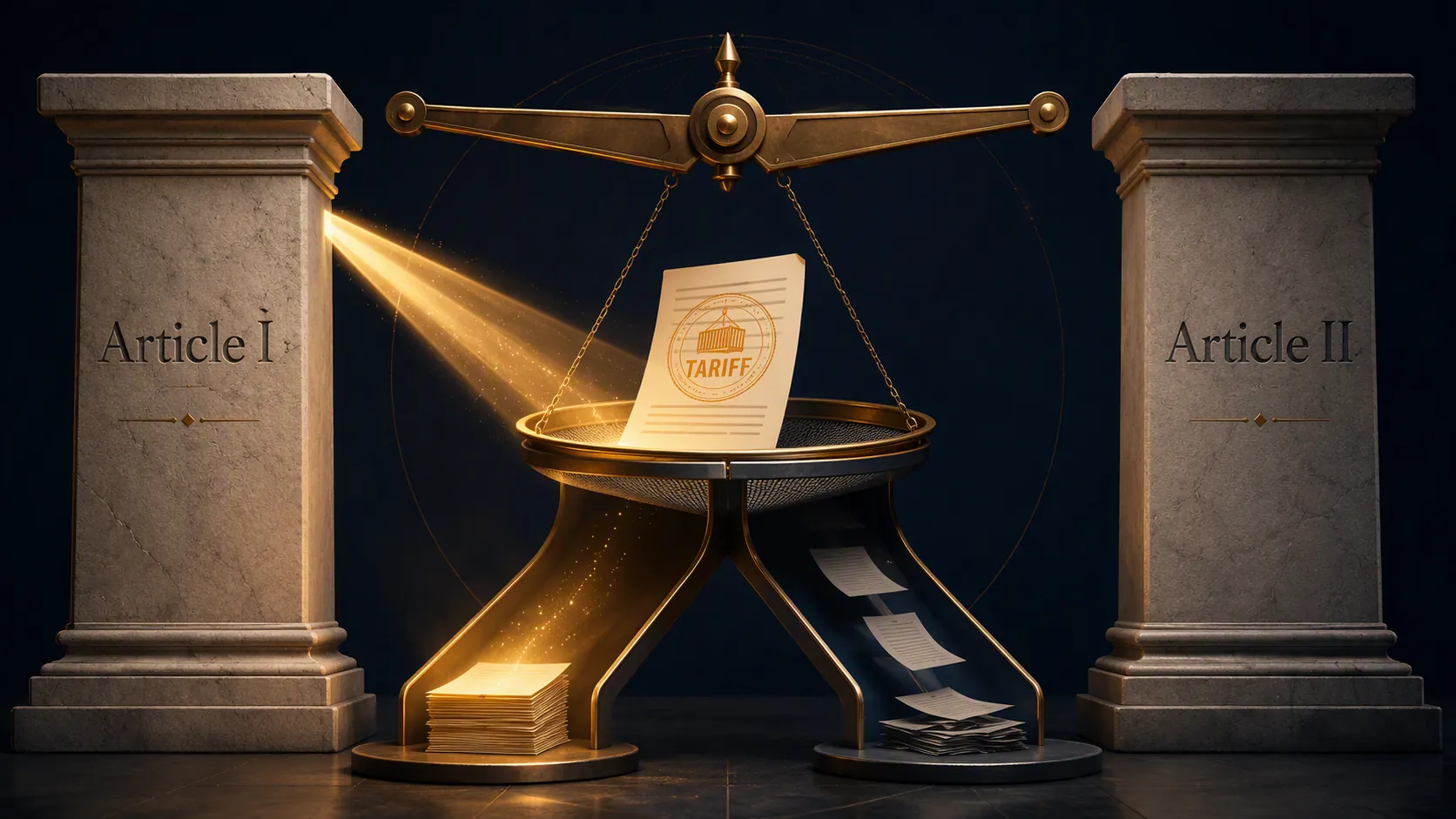
That is the useful part of Gorsuch's concurrence for litigators. Not because it controls the law. Yale JREG's vote-count analysis cautions that the concurrence's substantive-canon theory did not command a majority; only Chief Justice Roberts joined the relevant portion, while the broader Court left major questions doctrine more confined than a quick read of the fractured opinions might suggest.[3] But risk advice cannot wait for a clean majority opinion. If a framework is likely to shape complaints, preliminary-injunction briefs, and district-court opinions, it deserves to be stress-tested.
The working model is simple enough to be useful and dangerous enough to require humility: first ask whether the executive action is borrowing Article I power from Congress or rests partly on Article II authority; then ask how clear Congress had to be. The four categories below are not a checklist from Gorsuch. They are an application of that sorting principle to current executive-action exposure.
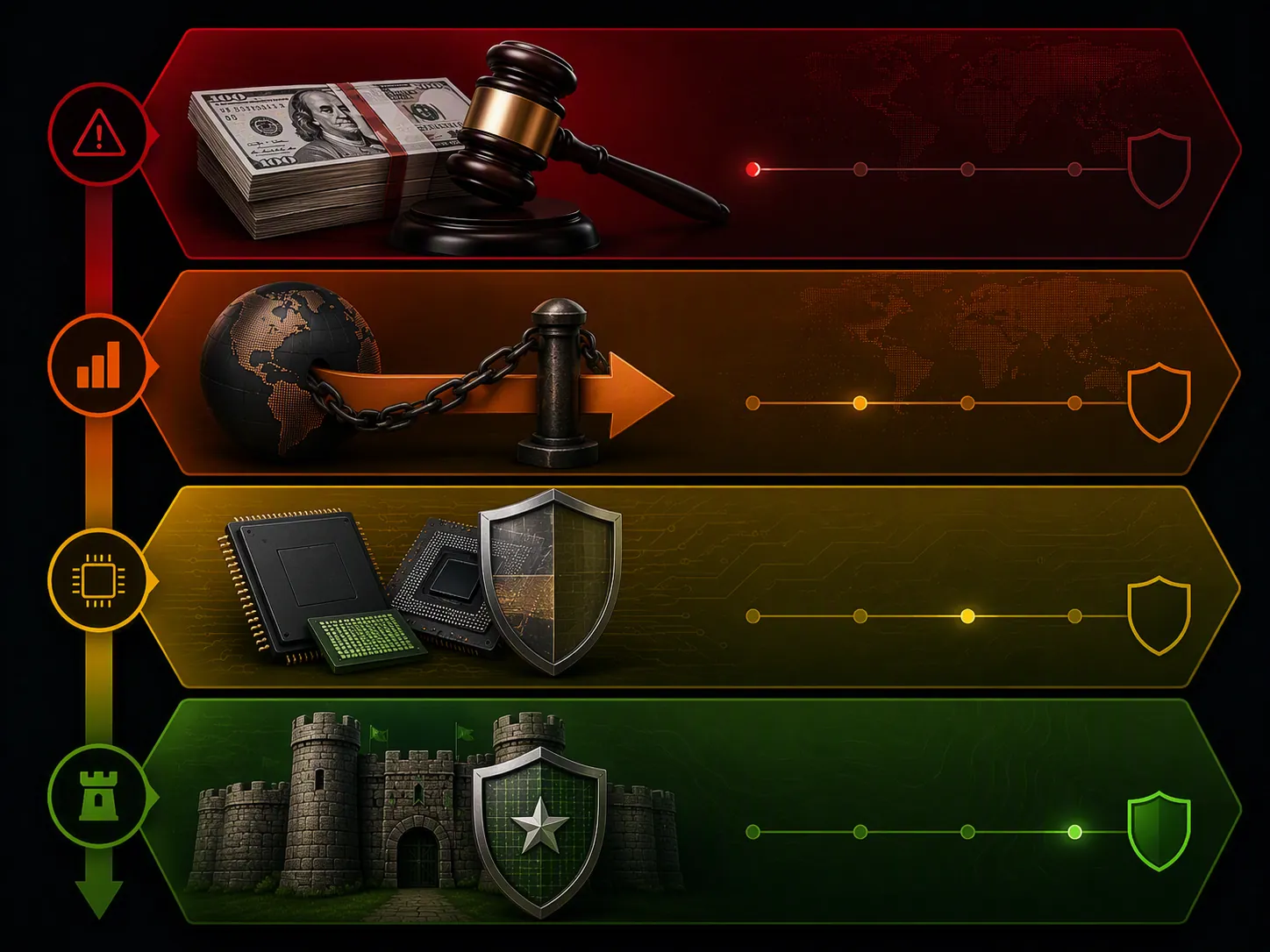
| Executive action | Article I/Article II posture | Major questions vulnerability |
|---|---|---|
| Appropriations impoundment | Pure Article I spending problem; no independent presidential spending authority | Highest |
| IEEPA outbound investment restrictions | Broad emergency statute used for a distinct form of economic control | High |
| Semiconductor export controls | Article II connection varies with military adjacency and statutory specificity | Middle, fact-sensitive |
| CFIUS forced divestitures | Targeted statutory scheme plus strongest national-security connection | Lowest |
Why The Tariff Case Produces A Risk Ranking
Learning Resources was fractured across multiple opinions, and commentators rightly read it as a separation-of-powers decision as much as an administrative-law decision.[4] The important move for this analysis is narrower. Gorsuch treated the tariff claim differently because tariff authority sits with Congress unless Congress clearly delegates it. Once the government gave up inherent peacetime tariff power, the executive branch had to point to statutory text capable of carrying an unusually large economic and political load.[1][2]
That is why generic national-security language should not end the inquiry. A statute can mention emergencies, threats, foreign actors, or economic pressure and still fail to answer the relevant question: did Congress clearly authorize this kind of executive control over this kind of domestic or economic consequence? Bloomberg Law's analysis captured part of the resulting instability by noting that the decision tangled nondelegation concerns into the major-questions debate.[5] For risk purposes, that tangle matters less as theory than as litigation leverage.
A lawyer advising before doctrine settles should not report only that the law is uncertain. The better question is where uncertainty is asymmetrical. Some executive actions require courts to approve a broad statutory reading in an area where the president has little or no independent constitutional power. Others sit inside a targeted statutory scheme and closer to the president's foreign-affairs or commander-in-chief functions. Those are not the same risk.
Highest Vulnerability: Appropriations Impoundment
Appropriations impoundment is the cleanest extension of the tariff logic because it removes even more ambiguity from the constitutional side of the ledger. Congress controls appropriations. The president does not have an independent Article II spending power that allows him to refuse to spend funds Congress has appropriated merely because the executive branch prefers a different fiscal policy.
Under Gorsuch's sorting principle, that makes the statutory clarity requirement severe. The question is not whether spending decisions can involve executive discretion at the margins. They can. The question is whether the executive branch may convert implementation discretion into a power to cancel, suspend, or materially redesign Congress's enacted spending decision. If the asserted authority does that, the action looks like a president borrowing the legislative power of the purse.
That posture is stronger for challengers than the tariff posture. Taxing and tariff statutes can at least invite arguments about delegation, implementation, and foreign commerce. Appropriations impoundment runs into a more categorical structural point: the Constitution gives Congress the spending decision, and the president's Article II hook is thin to nonexistent.
A plaintiff's brief built on Learning Resources would likely frame impoundment as the purest major-questions case: a vast claim of executive control over federal spending, asserted through statutory silence or general implementation language, in a field where Article II supplies no independent power. That does not mean every delayed obligation or administrative pacing decision becomes unconstitutional. It does mean that the more the action resembles a refusal to carry out Congress's spending command, the less room there is for ordinary deference.
The research record does not identify a pending impoundment challenge that has already adopted this precise Article I/Article II framing. That absence is important. This is not a report on an established litigation theory already accepted by lower courts. It is a vulnerability assessment. But if Gorsuch's framework travels, impoundment is where it travels with the least doctrinal friction.
High Vulnerability: IEEPA Outbound Investment Restrictions
IEEPA outbound investment restrictions are the closest analogue to the tariff dispute because they ask a broad emergency statute to support a different category of economic control. The tariff case turned on whether statutory terms could bear a power that Congress had not clearly assigned. The same kind of objection is available when the executive branch uses IEEPA to restrict outbound investment flows rather than to address the kinds of transactions Congress more directly contemplated when enacting the emergency-powers framework.[1][2]
The risk is not that IEEPA can never regulate cross-border economic conduct. That would overstate the point. The risk is categorical stretch. If a court sees outbound investment screening as a new industrial-policy or capital-allocation regime, then general statutory words begin to look like an inadequate basis for a major assertion of delegated congressional power.
The Article II side also matters. The president can point to foreign affairs, national security, and emergency authorities more naturally here than in impoundment. But Gorsuch's framework, as described by SCOTUSblog and Lawfare, does not treat Article II as a vapor that fills every statutory gap.[1][2] The connection must do legal work. A restriction targeted at concrete military or intelligence threats has a different profile from a broad outbound capital-control program justified by generalized strategic competition.
For litigation-risk ranking, the decisive questions are operational:
- Does the restriction resemble transaction blocking tied to an identified foreign threat, or does it function as a standing outbound investment licensing regime?
- Does the statute speak clearly to outbound investment as a category, or only to broader emergency regulation?
- Does the government identify a specific national-security pathway, or rely on the proposition that capital and technology always affect national power?
- Does the restriction alter private investment behavior prospectively across an industry, or address a narrower set of emergency transactions?
The farther the program moves toward a durable outbound investment code, the more it resembles the tariff problem: an open-ended emergency statute being pressed into service for a major economic-control power Congress did not clearly confer.
Middle Tier: Semiconductor Export Controls
Semiconductor export controls sit in the middle because the Article II connection is real but uneven. Controls on military-adjacent chips, advanced computing capacity tied to weapons development, or technology transfer with an intelligence use case give the executive branch a stronger constitutional footing than tariffs or impoundment. The commander-in-chief and national-security arguments are not decorative in that setting.
The risk rises as controls migrate away from that core. Civilian AI infrastructure, commercial cloud access, and semiconductor fabrication equipment used across ordinary industry may still implicate national security, but the hook becomes less specific. A court applying Gorsuch's sorting principle would likely ask whether Article II is doing identifiable work or whether the government has relabeled broad commercial regulation as security policy.
This is where a risk chart should resist a single label. The same regulatory program can contain defensible and vulnerable pieces. A narrow export restriction tied to military end users does not carry the same exposure as a sweeping control on commercially available AI-enabling infrastructure. The former has a statutory and constitutional story that a court can understand. The latter invites a major-questions challenge if the statutory text does not clearly authorize the sweep.
Counsel should separate the program into units before predicting outcome: item controlled, end user, country or actor targeted, statutory authority invoked, administrative findings made, and commercial spillover. If those facts point toward a military or intelligence use case, the risk moves down. If they point toward civilian industrial planning under a broad security label, the risk moves up.
Most Defensible: CFIUS Forced Divestitures
CFIUS forced divestitures are the least vulnerable category under this framework because they do not depend on the same kind of statutory improvisation. FIRRMA supplies a targeted statutory design: defined procedures, national-security factors, and a structure built for reviewing covered foreign investment. The research materials also identify FIRRMA's non-reviewability feature as a signal that Congress meant to cabin judicial second-guessing in this area.
That does not make every divestiture immune. A forced sale can still face statutory, procedural, due-process, or arbitrariness challenges. But the major-questions objection is weaker because Congress legislated in the precise neighborhood of the challenged action. The executive branch is not asking a court to find a new economic-control power hiding in broad emergency language. It is using a specialized foreign-investment review mechanism for foreign-investment national-security risk.
Article II is also at its strongest here. Foreign ownership of sensitive assets, control rights, data access, and proximity to defense or intelligence concerns fit more naturally within national-security judgment than ordinary domestic spending or generalized commercial regulation. In Gorsuch's terms, this is not a pure Article I delegation case in the same way the tariff dispute was described after the government's concession.[1][2]
How Much Weight To Put On The Model
The model has two limits. The first is precedential. Gorsuch's concurrence is not prevailing law, and Yale JREG's tally is a necessary brake on any claim that Learning Resources made his approach the Court's governing test.[3] Lower courts may instead read the decision through narrower linguistic-canon reasoning, through ordinary statutory interpretation, or through remedial and procedural vehicles that avoid the broader Article I/Article II sorting question.
The second limit is source discipline. The concurrence's significance here is reconstructed from detailed commentary by SCOTUSblog, Lawfare, Yale JREG, and related practitioner analysis, not from independently quoted language in the official opinion. For that reason, the analysis should not be treated as a quotation-driven account of Gorsuch's exact words. It is a litigation-risk application of the structural distinction those sources identify.[1][2][3][6]
Even with those limits, the framework is useful because it turns a vague warning into a ranking. A fractured Supreme Court decision rarely gives counsel a clean rule. It can still give counsel a way to order exposure: pure Article I claims with little or no Article II support first; broad statutory extensions into new economic-control territory next; mixed national-security controls according to specificity; targeted statutory schemes with a strong Article II connection last.
That produces the disciplined bottom line. Appropriations impoundment is the danger zone. Novel IEEPA outbound investment restrictions are close behind. Semiconductor export controls depend on how specifically the government ties the control to military or intelligence risk. CFIUS divestitures remain the most defensible because Congress built a targeted statutory scheme around the area where the president's national-security authority is strongest.
References
- The major debate over major questions in the tariffs decision is only the beginning, SCOTUSblog.
- Article I and the Major Questions Doctrine After Learning Resources, Lawfare.
- Tallying the Votes from Learning Resources, the Major Questions Doctrine Remains Relatively Confined, Yale JREG.
- Constitutional Duels in the Court's Rejection of Trump's Tariffs, Lawfare.
- Analysis: SCOTUS Tariff Opinion Muddies Nondelegation Doctrine, Bloomberg Law Analysis, Jan. 2026.
- Supreme Court's Tariffs Ruling Answers Some Mjor Qestions, Leaves Others Open, Arnold & Porter, Feb. 2026.
Related records
Tool profile
How Meta's AI Spending Reshapes Law Firm ProfitabilityGoverning regulation
Browse the obligations tracker →Preventive workflow
Browse verification workflows →
Report a correction or tip
Spotted an outdated figure, a misstated fact, or a ruling this case record should reflect? Public comments are disabled for this content given the professional cost of a misreported case outcome, penalty amount, or rule text — use the structured correction channel instead.
Report a correction or tip for this record →