
CCJ dismisses Guyana opposition leader extradition appeal
The CCJ dismissed the Guyana opposition leader's extradition appeal on 29 July 2026 — the Authority to Proceed stands, the interim stay is lifted, and committal before Senior Magistrate Judy Latchman resumes. The record, verified against the court's media release, covers the bench's three-way reasoning and the open question of whether the US charges are extraditable offenses.
- Jurisdiction
- Guyana
- Court
- Caribbean Court of Justice
- Judge
- Winston Anderson
- AI tool named
- No AI tool named
- Ruling date
- Jul 29, 2026
- Source document
- View primary court order ↗
- Last verified
- Aug 2, 2026
Lex Machina Review is an independent risk-tracking and reference resource. Nothing on this site is legal advice, and using it does not create an attorney-client relationship. Every record is reviewed against primary sources but may not reflect the most current status of a matter — always verify directly against the cited court order, rule text, or a licensed attorney before relying on it.
Companion explanation — secondary to the source document above
| Record field | Verified entry |
|---|---|
| Status | Confirmed appellate ruling; last checked 2026-08-02 UTC |
| Ruling date | 29 July 2026 [1] |
| Court and posture | Caribbean Court of Justice, appeal from Guyana in extradition-related judicial review proceedings [1] |
| Case | Nazar Mohamed and Azruddin Mohamed v Minister of Home Affairs [1] |
| Bench | President Winston Anderson; Justices Rajnauth-Lee, Barrow, Jamadar, Ononaiwu, Eboe-Osuji, and Bulkan [1] |
| Core disposition | Special leave granted; substantive appeal dismissed unanimously; Authority to Proceed left standing; interim stay lifted; committal proceedings before Senior Magistrate Judy Latchman resume [1] |
| Costs | No order as to costs in the CCJ; costs in the courts below reserved [1] |
| Risk Digest classification | Cross-border court-obligations and extradition-risk record. No AI tool is named, no counsel-sanctions issue is recorded, and no penalty amount applies. |
The 29 July CCJ ruling in the Guyana opposition leader extradition case is narrower than several headlines make it sound. The Caribbean Court of Justice did not order the Mohameds extradited. It dismissed their appeal against the Authority to Proceed, removed the interim stay that had paused the extradition process, and sent the matter back into the committal lane before Senior Magistrate Judy Latchman. The legal instrument that survived is the Authority to Proceed; the legal question still not decided is whether the United States charges are extraditable offenses under the committal test.

What changed on 29 July
The procedural result has two moving parts that need to be kept separate. First, the CCJ granted special leave to appeal. Second, having granted that permission, the Court unanimously dismissed the substantive appeal. That is not a contradiction. It means the Court allowed the Mohameds into the appellate forum, then rejected the challenge on the merits and left the High Court and Court of Appeal results undisturbed. The Authority to Proceed issued by Guyana’s Minister of Home Affairs therefore remains effective. [1]
The practical consequence is the disappearance of the CCJ stay. At a case management conference on 25 March 2026, the CCJ had granted an interim stay in the Guyanese extradition matter. That stay paused the committal process while the appellate challenge was being considered. Once the 29 July judgment dismissed the appeal, the stay was lifted and the committal proceedings were free to continue. [1][2]
That is the point at which the ruling’s reach stops. The CCJ resolved the challenge to the Authority to Proceed, particularly the complaint that apparent political bias infected the decision-making process. It did not conduct the magistrate’s committal inquiry and did not decide whether the 11 United States counts qualify as extraditable offenses. Those questions remain for the resumed proceedings.
The compressed procedural chain
| Step | What the record shows |
|---|---|
| US request | The CCJ media release records receipt of the United States extradition request on 28 October 2025, with the Authority to Proceed issued two days later. Other contemporaneous accounts have used 30 October 2025 for the request date; the CCJ source controls here pending judgment-text verification. [1] |
| Arrest | The Mohameds were arrested after the Authority to Proceed issued. [1] |
| Judicial review | The Mohameds challenged the Authority to Proceed in judicial review proceedings, including on apparent-bias grounds. [1] |
| High Court | The High Court dismissed the challenge on 4 February 2026. [1] |
| Court of Appeal | The Court of Appeal dismissed the appeal on 17 March 2026. [1] |
| CCJ stay | The CCJ granted an interim stay on 25 March 2026. [2] |
| CCJ hearing | Special leave was heard as the substantive appeal on 21 April 2026. [1] |
| CCJ ruling | On 29 July 2026, the CCJ granted special leave, dismissed the substantive appeal, and lifted the stay. [1] |
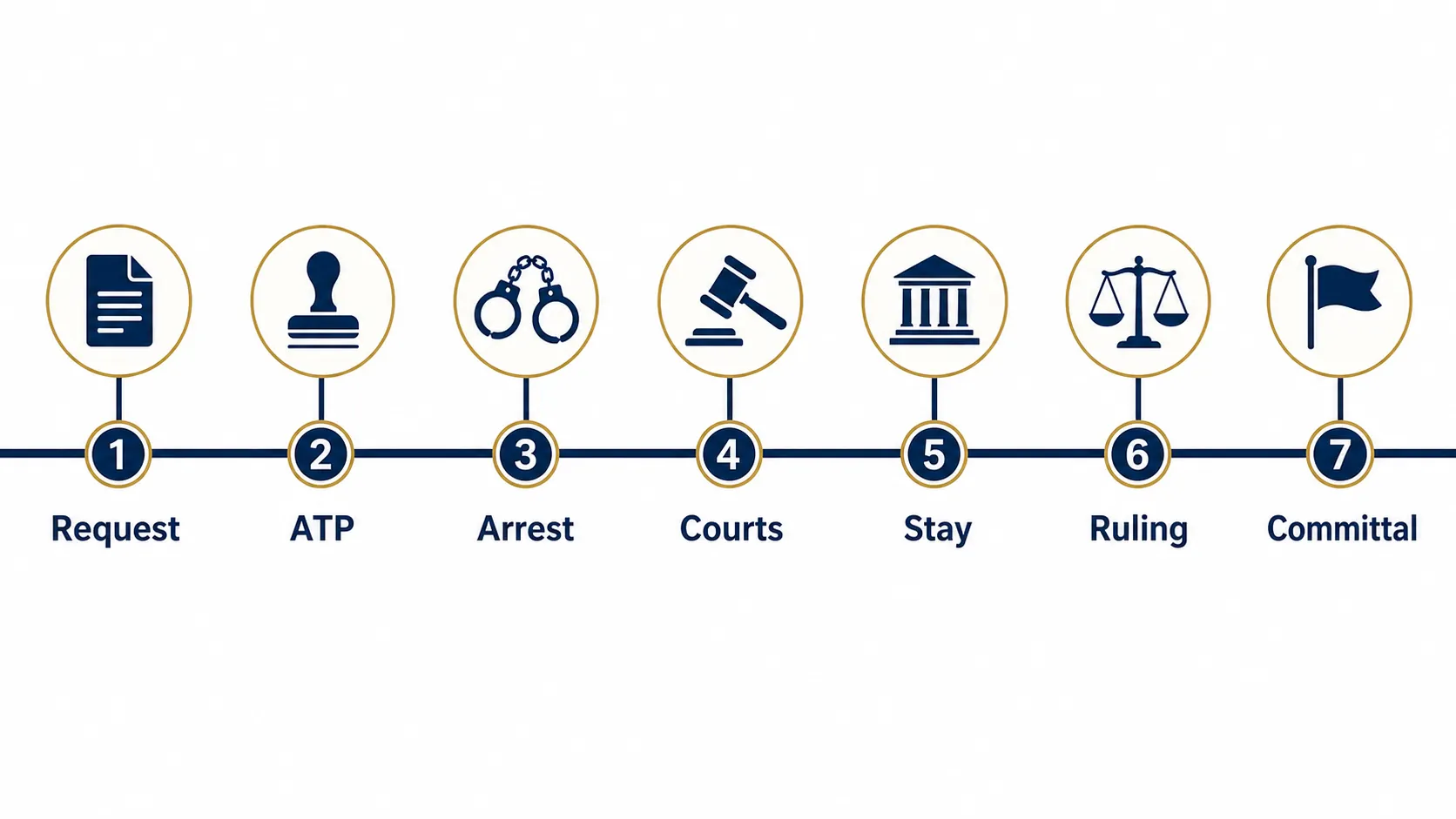
The chain matters because it shows why the case is back before the magistrate rather than finished. The Authority to Proceed is the gateway document that allows the extradition process to move into court. The committal stage is where the magistrate still has work to do. A failed judicial review of the gateway does not answer every question that can arise at committal.
The unanimous result had three routes
The full bench agreed on the result, but not on a single route to get there. That split in reasoning is part of the legal record and should not be mistaken for a split in the order. The appeal was dismissed unanimously. The disagreement was about how the Court should treat the timing and substance of an apparent-bias challenge to an Authority to Proceed. [1]

Anderson and Barrow: timing first
President Anderson and Justice Barrow would ordinarily defer challenges to the Authority to Proceed until after the committal stage, unless exceptional circumstances justify earlier intervention. On their approach, the extradition process should not usually be interrupted at the gateway stage by judicial review when the magistrate’s committal function remains to be performed. They also concluded that mere political bias did not invalidate the Authority to Proceed. [1]
Rajnauth-Lee, Jamadar, and Bulkan: early review is possible, but contamination was not shown
Justices Rajnauth-Lee, Jamadar, and Bulkan did not adopt a categorical bar against early judicial review where bias is alleged. Their route is more receptive to an early challenge in principle. But they still dismissed the appeal because the asserted apparent bias of the Attorney General did not legally contaminate the Minister of Home Affairs’ decision to issue the Authority to Proceed. [1]
Ononaiwu and Eboe-Osuji: apply the observer test
Justices Ononaiwu and Eboe-Osuji approached the issue through the fair-minded and informed observer test. On that analysis, the appellants did not establish the apparent bias needed to defeat the Authority to Proceed. [1]
For briefing purposes, the useful point is not to collapse those opinions into one broad rule. One route is restrictive about timing. One leaves more room for early review where bias is alleged but finds no operative contamination here. One applies the fair-minded observer framework and finds the case unmade. All three leave the same procedural effect: the Authority to Proceed stands.
What remains undecided before the magistrate
The resumed committal proceedings are not a formality just because the CCJ dismissed the appeal. The magistrate still has to address the committal-stage issues that were not determined by the appellate ruling. The most important unresolved point for present purposes is extraditability: whether the 11 United States counts can support committal under the applicable extradition framework.
Counsel Siand Dhurjon has previewed the defense position that the charges are not extraditable offenses, but that is counsel’s stated position as reported after the ruling, not a CCJ holding. The Court’s media release does not decide that point. [3]
That distinction is the main guardrail for anyone briefing the case. The 29 July ruling is a confirmed appellate defeat on the Authority to Proceed bias challenge. It is not a final extradition order, not a finding that every United States count is extraditable, and not a prediction of how Senior Magistrate Latchman will decide the committal issues.
Source conflicts kept in view
- Request date: the CCJ media release records the United States request as received on 28 October 2025, with the Authority to Proceed issued two days later. Some other accounts use 30 October 2025. Until the judgment text is checked against the release, this record uses the CCJ date and flags the discrepancy. [1]
- Bench: the CCJ release controls the bench composition. Any conflicting governmental or press shorthand should give way to the Court’s own release on the identity of the judges and the authorship of the reasons. [1]
- Extraditability: the “not extraditable offenses” point is treated as a defense preview reported by AP, not as something decided by the CCJ. [3]
- Sanctions and penalties: there is no AI-tool component, no counsel-sanctions ruling, and no penalty amount in this record. The only costs point recorded in the CCJ release is no order as to costs in the CCJ, with costs below reserved. [1]
The case now returns to the committal stage. No timetable is supplied here, and none should be inferred from the CCJ’s disposition. The open question is whether the United States counts satisfy the extradition requirements when the magistrate reaches them.
References
- Media Release: The Mohameds v Minister of Home Affairs, Caribbean Court of Justice, 29 July 2026
- CCJ Grants a Stay in Guyanese Extradition Matter, Caribbean Court of Justice, 25 March 2026
- Court says US extradition process against Guyana's opposition leader can resume, AP News
Related records
Tool profile
How Meta's AI Spending Reshapes Law Firm ProfitabilityGoverning regulation
Browse the obligations tracker →Preventive workflow
Browse verification workflows →
Report a correction or tip
Spotted an outdated figure, a misstated fact, or a ruling this case record should reflect? Public comments are disabled for this content given the professional cost of a misreported case outcome, penalty amount, or rule text — use the structured correction channel instead.
Report a correction or tip for this record →