
The Legal Arc of the Haiti TPS Court Ruling from July 2025
A detailed timeline and legal analysis of the Haiti TPS litigation from the July 2025 EDNY ruling through the Supreme Court's June 2026 decision, explaining how each court ruled on reviewability and equal protection, and the current compliance deadline for TPS holders.
- Jurisdiction
- United States - Eastern District of New York
- Court
- U.S. District Court for the Eastern District of New York
- Judge
- Brian Cogan
- AI tool named
- No AI tool
- Ruling date
- Jul 15, 2025
- Source document
- View primary court order ↗
- Last verified
- Jul 24, 2026
Lex Machina Review is an independent risk-tracking and reference resource. Nothing on this site is legal advice, and using it does not create an attorney-client relationship. Every record is reviewed against primary sources but may not reflect the most current status of a matter — always verify directly against the cited court order, rule text, or a licensed attorney before relying on it.
Companion explanation — secondary to the source document above
Anyone looking for a “Haiti TPS court ruling July 2025” explanation has to start with a correction: the July 15, 2025 ruling mattered, but it was not the ruling that settled Haiti TPS. It restored the February 3, 2026 expiration date after an Eastern District of New York judge held that the administration’s partial vacatur of an earlier 18-month extension exceeded statutory authority. The larger fight then moved to a formal termination notice, a District of Columbia stay, a divided D.C. Circuit posture, certiorari before judgment, and finally the Supreme Court’s June 25, 2026 decision in Mullin v. Doe.[1][2]
This is a Risk Digest companion for legal-risk orientation, not legal advice. The operational point also needs to be current-checked before use: as of reported July 2026 practitioner updates, USCIS had set employment authorization document expiration for Haiti and Syria TPS holders at July 24, 2026, but that is the kind of live compliance date that should be verified directly against USCIS before an employer, clinic, or counsel treats it as final.[3][4]
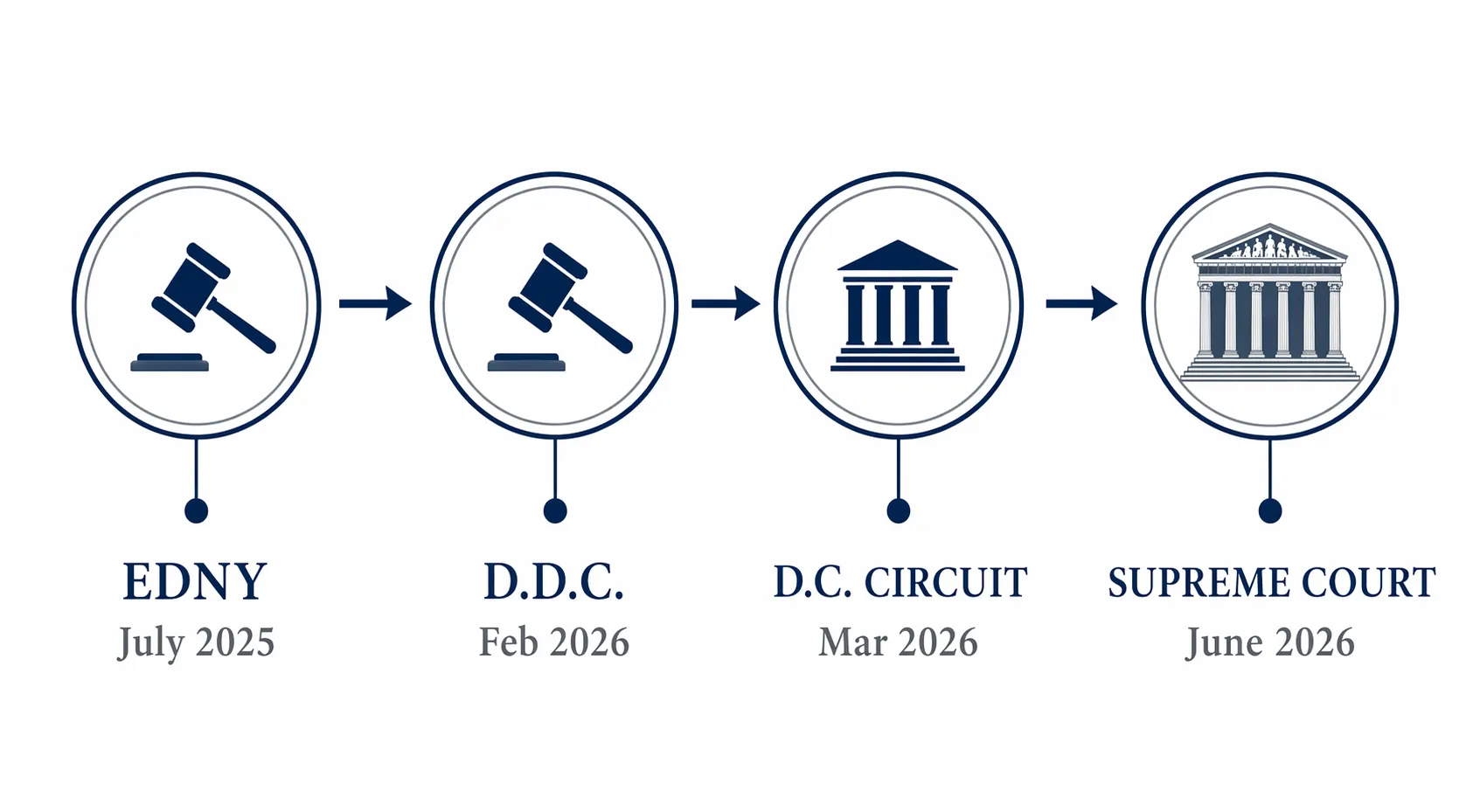
The July 2025 EDNY Ruling Fixed One Expiration Date, Not the Whole Dispute
On July 15, 2025, Judge Brian Cogan in the Eastern District of New York ruled in Haitian Evangelical Clergy Association v. Trump that Secretary Noem’s February 2025 partial vacatur of Haiti’s prior 18-month TPS extension exceeded the authority provided by 8 U.S.C. § 1254a(b)(3)(C). The remedial consequence was concrete: the court restored the February 3, 2026 expiration date.[1][2]
That is the piece of the July 2025 Haiti TPS court ruling that gets lost when the case is described too broadly. The EDNY order did not decide whether DHS could later terminate Haiti TPS through a new formal notice. It did not resolve the full reviewability question under § 1254a(b)(5)(A). It did not predict how the Supreme Court would treat equal protection allegations tied to presidential statements. It addressed a narrower administrative move: the attempted partial vacatur of a still-running extension.
The case therefore created an interim status answer, not a durable litigation endpoint. For TPS holders, employers, and counsel, that distinction was not academic. A restored February 2026 date affected work authorization planning, reverification calendars, and removal-risk counseling. But once DHS later published a formal termination notice in November 2025, the litigation entered a different channel.[5]
How the Case Moved from Partial Vacatur to Termination Review
The formal termination notice changed the object of review. The fight was no longer only whether the Secretary could partially unwind a prior extension. The new challenge, filed in D.D.C. as Miot v. Trump, attacked the termination itself and pressed both Administrative Procedure Act and constitutional theories.[5]
| Date | Forum | What changed |
|---|---|---|
| July 15, 2025 | EDNY | Partial vacatur held beyond statutory authority; February 3, 2026 expiration date restored. |
| November 2025 | DHS / D.D.C. | DHS published formal termination notice; Miot litigation followed in D.D.C. |
| February 2, 2026 | D.D.C. | Preliminary stay granted on likely APA and equal protection success. |
| March 6, 2026 | D.C. Circuit | Divided panel denied the government’s stay motion. |
| March 16, 2026 | Supreme Court | Certiorari before judgment granted. |
| June 25, 2026 | Supreme Court | Lower courts reversed; non-constitutional claims held barred from review. |
The timeline is spare because the legal weight is not evenly distributed. The EDNY order explains why February 3, 2026 remained the operative date for a time. The D.D.C. order explains why plaintiffs had a live, serious theory before the Supreme Court intervened. The Supreme Court decision explains why most future non-constitutional challenges to TPS terminations now face a jurisdictional wall.
The D.D.C. Stay Was the Plaintiffs’ Strongest Version of the Case
On February 2, 2026, Judge Ana Reyes granted a preliminary stay of the Haiti TPS termination. The court found a substantial likelihood of success on both APA claims and equal protection claims, with the constitutional analysis drawing from Village of Arlington Heights v. Metropolitan Housing Development Corp. The order catalogued Trump statements as evidence supporting an inference of racial animus.[6][7]
That posture matters because a preliminary stay is not a final merits ruling, but it tells counsel where the plaintiffs’ theory had traction. The APA theory challenged agency process and statutory compliance. The equal protection theory tried to avoid the statutory review bar by identifying unconstitutional motive, not merely flawed country-conditions reasoning. At that stage, the case was not just about TPS administration. It was about whether a termination decision could be reviewed when plaintiffs alleged that impermissible race-based considerations infected the process.
For practical purposes, the D.D.C. stay bought time and preserved the plaintiffs’ claims long enough for emergency appellate litigation. For doctrine, it created a clean contrast with the government’s position: DHS argued that Congress had stripped courts of jurisdiction over TPS determinations; plaintiffs argued that the statute could not bar review of their APA theories in that sweeping way and could not foreclose constitutional claims.
The D.C. Circuit Did Not End the Fight, But It Previewed the Winning Statutory Theory
On March 6, 2026, a divided D.C. Circuit panel denied the government’s motion for a stay. The panel posture left the lower-court relief in place, but the dissent identified the theory that would later carry the day: § 1254a(b)(5)(A), in that judge’s view, stripped jurisdiction over all non-constitutional challenges to TPS termination decisions.[5]
That was not a final court-of-appeals merits judgment. The Supreme Court granted certiorari before judgment on March 16, 2026, and heard argument on April 29, 2026.[1][5] The posture limits what one should claim about the D.C. Circuit’s precedential contribution. It was a stay-stage signal, not a circuit-level resolution of the statutory question.
Still, the signal was important. If “any determination” in § 1254a(b)(5)(A) meant only the final judgment about whether Haiti continued to satisfy TPS country conditions, then courts might still review predicate agency steps: consultation, timing, factor selection, or procedural compliance. If it meant the entire decisional chain, the APA case largely disappeared from federal court.
Mullin Converted “Any Determination” into the Main Event
On June 25, 2026, the Supreme Court reversed the lower courts in a 6-3 decision in Mullin v. Doe. Justice Alito’s majority opinion held that § 1254a(b)(5)(A) bars judicial review of all non-constitutional claims challenging TPS termination decisions. The crucial move was the Court’s reading of “determination” to include not only the ultimate country-conditions conclusion, but also predicate steps leading to that conclusion.[1][8]
That holding is the legal center of the Haiti TPS litigation arc. It means a plaintiff cannot ordinarily evade the TPS review bar by recasting a termination challenge as a complaint about consultation, sequencing, data considered, timing, or agency reasoning. If the alleged defect is part of the path to the TPS termination determination, the majority treated it as covered by the statutory bar.
The result is broader than a loss for one designation. It supplies the government with a strong jurisdictional answer in future TPS termination litigation, at least where the claim is non-constitutional. Counsel evaluating analogous cases now have to ask a threshold question before investing in administrative-law merits: is the claim truly independent of the TPS determination, or is it a predicate-step challenge wearing APA clothing?
There is a reason the July 2025 EDNY ruling should not be overread after Mullin. Judge Cogan’s ruling addressed statutory authority for a partial vacatur of an extension. The Supreme Court later addressed the reviewability of non-constitutional attacks on TPS termination determinations and their predicate steps. Those are related chapters, not interchangeable holdings.

The Equal Protection Claim Survived Jurisdiction in Theory and Lost on the Record
The constitutional claim requires a separate read. The majority did not hold that equal protection challenges to TPS terminations are categorically unreviewable. Instead, it rejected the equal protection claim under the Arlington Heights framework on the record before it.[8][9]
The majority treated the cited Trump statements as insufficient to establish unconstitutional racial animus. It also relied on a race-neutral explanation drawn from the broader pattern of terminations: the administration had terminated all 13 TPS designations, not only those involving countries with majority-Black populations.[1][8]
That reasoning narrows the practical opening left for future plaintiffs. A constitutional claim remains formally available, but a plaintiff needs more than inflammatory public rhetoric and disagreement with country-conditions judgment. The record must connect impermissible motive to the challenged government action with enough force to survive Arlington Heights scrutiny despite the government’s race-neutral account.
Justice Kagan’s dissent read the same record differently, saying that it “fairly shouts” racial animus.[1][8] That line should not be flattened into advocacy shorthand. Its importance is doctrinal as much as moral: it shows that the constitutional door is not imaginary, but the majority’s evidentiary threshold makes it punishing to walk through.
Justice Thomas wrote separately to argue that noncitizens have no equal protection rights against the federal government, but no other justice joined that concurrence.[1][10] It is therefore not the holding of Mullin. It may matter as a marker of where at least one justice would go, but it should not be cited as governing law.
What the Ruling Means for TPS Holders, Employers, and Counsel
The immediate compliance consequence is not captured by saying “the Court ended TPS.” The Court reversed lower-court relief and held that non-constitutional claims were barred from review. That ruling allowed the administration’s termination path for Haiti and Syria TPS to proceed, but the day-to-day question for employers and TPS holders turns on current agency implementation dates, notices, and document-validity rules.[1][3][4]
- For TPS holders, the key question is the current expiration of protection and work authorization, not a generic statement that litigation has ended.
- For employers, the key question is I-9 reverification timing and whether any automatic extension or agency notice applies.
- For immigration counsel, the key question is whether any remaining claim is constitutional and record-specific rather than a barred predicate-step challenge.
- For administrative-law litigators, the key question is whether a proposed theory can survive the Court’s broad reading of “any determination.”
Practitioner updates reported that USCIS set July 24, 2026 as the EAD expiration date for Haiti and Syria TPS holders after the Supreme Court ruling.[3][4] That date should be treated as an operational fact requiring last verification, not as static background. A court decision can remove an injunction; USCIS notices tell employers and workers what document rule applies on a given day.
The Current State of Law After the Haiti TPS Litigation
After Mullin, the safest doctrinal statement is narrow and severe: non-constitutional challenges to TPS terminations are now largely foreclosed when they attack the determination or its predicate steps. The July 2025 EDNY ruling remains important for what it actually did—restore the February 3, 2026 expiration date after an unlawful partial vacatur—but it does not soften the Supreme Court’s later reading of § 1254a(b)(5)(A).
Equal protection remains available in form. On this record, it failed. The majority found the cited statements and surrounding facts insufficient under Arlington Heights, while the dissent saw evidence of racial animus that should have carried legal weight. That disagreement matters, but it does not change the holding counsel must apply.
For client advisories, the final step is not rhetorical. Check the controlling agency notice, check the EAD category and expiration rule, and separate three questions that too many summaries merge: whether TPS termination is reviewable, whether a constitutional claim survives, and what document compliance requires today.
References
- Supreme Court allows Trump administration to end removal protections for Syrian and Haitian nationals, SCOTUSblog, June 2026.
- Haiti Supreme Court TPS ruling Syria, The Marshall Project, June 25, 2026.
- Supreme Court Backs Trump Administration’s Termination of TPS Protections for Haiti and Syria, Fisher Phillips LLP, July 2026.
- Supreme Court Rules Termination of TPS Probably Constitutional, SHRM.
- CRS Legal Sidebar LSB11446, Congressional Research Service.
- Late-Minute Reprieve: Court Halts Haiti TPS Termination, Seyfarth Shaw, February 2026.
- Federal Court Stay of Haiti TPS Termination Remains in Effect; Case Now Before the US Supreme Court, Morgan Lewis, March 2026.
- Mullin v. Doe slip opinion, Supreme Court of the United States, June 25, 2026.
- The Supreme Court Green Lights TPS Terminations for Haiti and Syria, The Regulatory Review, July 22, 2026.
- The Supreme Court's Badly Flawed Ruling in the Haiti TPS Case, Volokh Conspiracy / Reason, June 25, 2026.
Related records
Tool profile
How Meta's AI Spending Reshapes Law Firm ProfitabilityGoverning regulation
Browse the obligations tracker →Preventive workflow
Browse verification workflows →
Report a correction or tip
Spotted an outdated figure, a misstated fact, or a ruling this case record should reflect? Public comments are disabled for this content given the professional cost of a misreported case outcome, penalty amount, or rule text — use the structured correction channel instead.
Report a correction or tip for this record →