
How Hegseth's Testosterone Policy Weakens the Transgender Ban Case
This article analyzes how the Pentagon's new testosterone replacement policy creates a direct contradiction with the transgender military ban, a contradiction that a federal judge has now ordered the government to explain before the August 7, 2026 deadline, potentially defeating the government's rational-basis defense in Talbott v. Trump.
- Jurisdiction
- US Federal
- Court
- U.S. District Court for the District of Columbia
- Judge
- Ana Reyes
- AI tool named
- No AI tool involved
- Ruling date
- Jul 22, 2026
- Source document
- View primary court order ↗
- Last verified
- Jul 25, 2026
Lex Machina Review is an independent risk-tracking and reference resource. Nothing on this site is legal advice, and using it does not create an attorney-client relationship. Every record is reviewed against primary sources but may not reflect the most current status of a matter — always verify directly against the cited court order, rule text, or a licensed attorney before relying on it.
Companion explanation — secondary to the source document above
Judge Ana Reyes did not need to decide the merits of the transgender military ban on July 22. She did something more procedurally modest and, for the government, more uncomfortable: she ordered the parties in Talbott v. Trump to brief whether the Pentagon’s new testosterone replacement policy can be reconciled with the government’s defense of excluding transgender servicemembers who use gender-affirming care. The deadline is August 7, 2026, and the order reportedly identifies six specific areas for briefing, including medical guidelines, cost accounting, differential treatment, changed medical views, and the Department of Justice’s position on the apparent inconsistency.[1][2]
That is the legally important entry point. The analysis does not turn on whether testosterone replacement therapy is wise military medicine in the abstract. It turns on whether the government can ask one federal judge to credit testosterone-related medical care as a readiness problem when used by transgender troops, while the same Defense Department treats testosterone replacement as potentially readiness-enhancing routine care for other troops during the same litigation window.
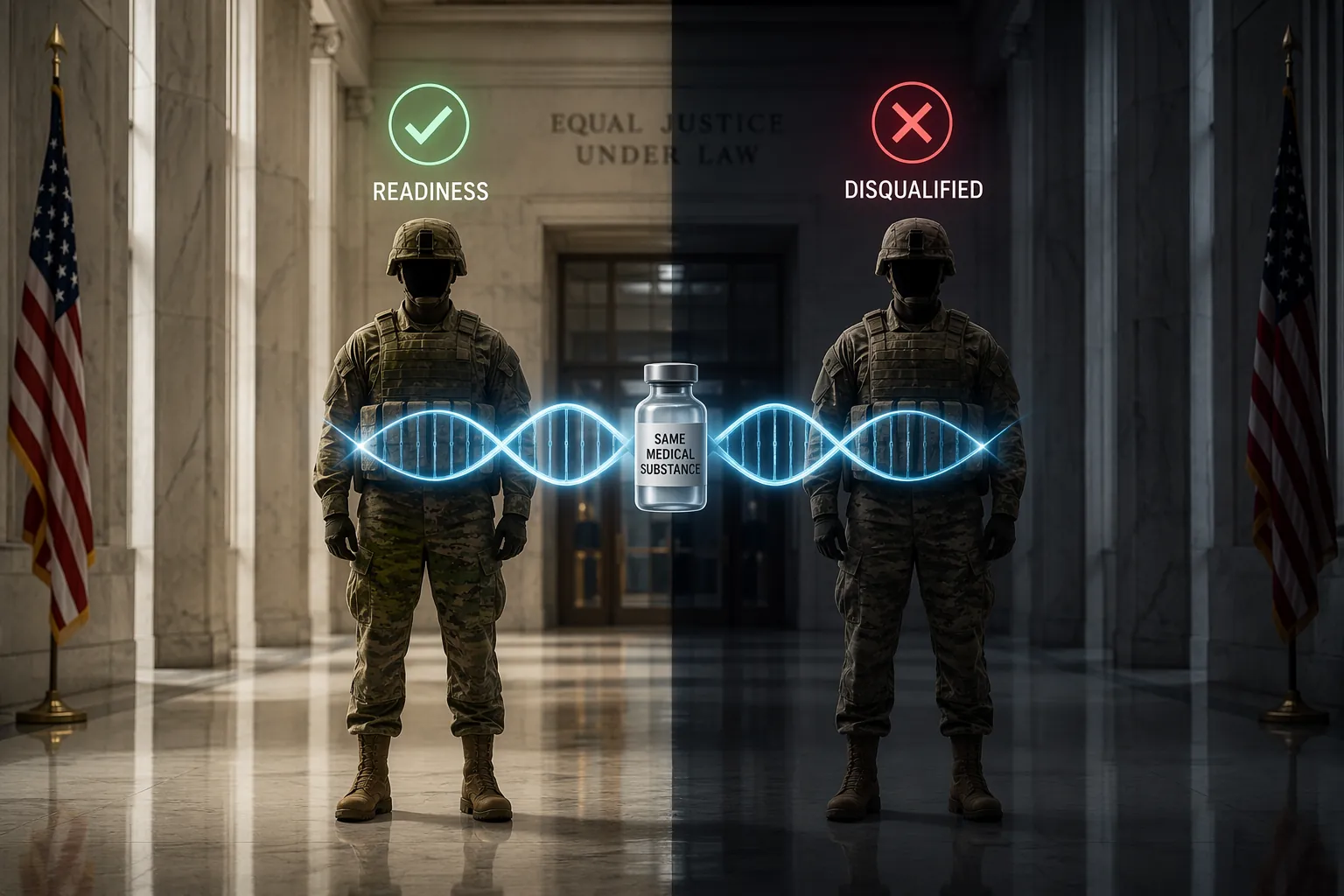
The full text of the July 22 minute order was not available in the materials reviewed here. That matters. Minute orders can be spare, and secondary descriptions can smooth out hard edges. But the reported briefing topics are specific enough to show why Reyes treated the new policy as evidence rather than noise: she is asking about the same hormone, the same institution, overlapping readiness rationales, and contemporaneous litigation positions.
The contradiction the court put on the record
The government’s defense of the transgender service restriction has rested on familiar military-law terrain: readiness, deployability, medical burden, cost, and deference to executive military judgment. The ban’s operative language, as reported in coverage of the policy, bars people who “require or have undergone” gender-affirming care and frames that care as occurring “without the benefit of routine medical treatment.”[3]
Hegseth’s July 15, 2026 testosterone policy points in the other direction. According to public reporting, the Pentagon announced a program to test troops for low testosterone and offer hormone replacement therapy. PBS described the policy as screening servicemembers for low testosterone and providing hormone replacement treatment where indicated.[3] The Center Square reported that the program could apply to roughly 2 million troops, while also noting the absence of a published cost estimate for the new screening initiative.[4]
There are uncertainties. The exact Hegseth memorandum was not available in the materials reviewed. It is also not clear from the reporting whether female servicemembers are included in the screening program. Those gaps should keep the analysis disciplined. They do not erase the litigation problem. The government now has to explain why testosterone treatment is disqualifying evidence of medical burden in one category and a potentially useful readiness intervention in another.
Reyes’ six questions are not housekeeping
The reported six briefing areas matter because they force the government to stop speaking at the level of labels. “Gender-affirming care” and “testosterone replacement therapy” can be made to sound like different legal objects. Reyes’ order appears designed to test whether they are materially different for the purposes the government has invoked: readiness, medical manageability, cost, and military fitness.
| Reported briefing area | Why it matters legally |
|---|---|
| Medical guidelines for hormone therapy for transgender troops versus TRT for cisgender troops | If the monitoring, dosage management, or clinical risks are comparable, the government’s medical-burden distinction becomes harder to defend. |
| Whether TRT administration is identical regardless of the patient’s sex or gender | This goes directly to fit: a policy cannot easily treat the same administered substance as categorically disqualifying only when the patient belongs to the disfavored class. |
| Cost accounting for both policies | The government previously invoked cost and readiness; an uncosted new screening program gives plaintiffs a clean comparison point. |
| The basis for differential treatment | This asks the government to identify something more concrete than the conclusion that one use of testosterone is acceptable and another is not. |
| Whether the new policy reflects changed medical views | If the Pentagon’s view of testosterone treatment has changed, the court can ask why that change does not also affect the ban’s premises. |
| DOJ’s position on the inconsistency | The litigation position itself becomes evidence of whether the government is explaining a real distinction or managing a contradiction. |
AP and The Advocate report that Reyes ordered briefing on these categories after the July 15 testosterone announcement, with submissions due August 7.[1][2] That timing is what gives the order its force. This is not an after-the-fact academic comparison between two administrations or two obsolete medical regimes. It is the same defendant, in the same case, under the same judge’s supervision, operating two hormone-related frameworks at once.
The administration can still attempt distinctions. It may argue that testosterone replacement for low testosterone addresses a different diagnosis, a different dosage range, a different population, or different military endpoints. It may argue that the transgender ban rests on broader concerns than testosterone alone. Rational-basis review permits conceivable justifications; plaintiffs do not win merely by identifying tension in the record.
But the reported order narrows the useful answers. If the government says testosterone administration is medically manageable for cisgender servicemembers but destabilizing for transgender servicemembers, it needs an explanation tied to medical practice rather than status. If it says cost matters for transgender care but has not costed a program reportedly reaching about 2 million troops, it has invited a comparison the court did not have to manufacture.[4]
Cost was already a weak point before July 15
The cost issue is not new in Talbott. In her March 2025 opinion, Reyes rejected the government’s cost framing in unusually sharp terms. Secondary reporting describes her opinion as finding the ban “soaked in animus and dripping with pretext,” and reports that she contrasted transgender care spending with the military’s Viagra expenditures, including a reported $41 million spent on Viagra in 2023 alone.[2][5]
The Center Square separately reported that Department of Defense spending on transgender-related care totaled $52 million over a 10-year period from 2015 through 2024.[4] Those figures do not, by themselves, answer every readiness question. A small expense can still be operationally relevant, and a large expense can still be justified. But they make the government’s cost theory vulnerable when a new hormone-screening program arrives without a public cost estimate.
That is why Reyes’ cost-accounting question is more than a budget inquiry. It asks whether cost is doing real analytical work or merely decorating a classification the government preferred for other reasons. If transgender-related hormone care is too costly or administratively burdensome to tolerate, the court can ask how the Pentagon assessed the cost and burden of broader testosterone screening before adopting it.
Rational-basis review does not require judicial blindness
The government’s best doctrinal refuge is deference. Under rational-basis review, courts generally uphold classifications if any conceivable legitimate purpose supports them. In military cases, courts are often even more cautious. A mismatch between stated reasons and current conduct is not automatically fatal.
Talbott is not in an ordinary posture, though. Reyes has already treated the ban as infected by animus and pretext, according to reporting on the March 2025 opinion.[2][5] Once a court is looking at whether stated justifications are genuine, contemporaneous inconsistency becomes probative. The question is not whether judges should run military medicine. It is whether the government’s asserted medical rationale coheres with what the military is actually doing.
That is the legal significance of the same-hormone paradox. Plaintiffs do not need to prove that every testosterone-related treatment is identical in every clinical context. They need to show that the government’s classification is poorly fitted to its stated reasons, and that the poor fit is evidence that the stated reasons are pretextual. A policy adopted one week before the court’s order gives them a fresh, clean exhibit.
Medical uncertainty does not necessarily save the government. Reuters reported that five of six doctors it consulted were puzzled by the evidence behind the Pentagon’s testosterone-screening plan.[6] That reporting is not a judicial finding, and it does not prove the program is medically invalid. It does, however, complicate any attempt to present the new policy as a settled readiness measure while portraying gender-affirming hormone care as categorically suspect.
The class posture raises the stakes of the August briefing
The July 22 order also lands after an important class-certification ruling. On June 30, 2026, the federal court certified a class in Talbott to ensure future rulings against the transgender military ban would apply to all transgender servicemembers covered by the case, according to the National Center for Lesbian Rights.[7]
That changes the practical consequence of the contradiction. This is not only about named plaintiffs seeking individual relief. If the testosterone-policy inconsistency strengthens a finding of pretext, the effect can travel through the certified class. The servicemember waiting on assignment, promotion, medical clearance, or separation processing does not experience the issue as a law-school hypothetical. The government’s explanation will help determine whether that person remains subject to a classification the court has already scrutinized with suspicion.
The appellate posture adds pressure without resolving the issue. The CourtListener docket reflects continuing proceedings in Talbott, including a June 1, 2026 D.C. Circuit decision and a July 16 DOJ motion to stay that ruling pending a Supreme Court petition, with the petition deadline reported in the research materials as August 30.[8] The trial schedule is also compressed, with discovery due October 16, 2026, and trial set for January 4, 2027, according to the docket materials summarized for this article.[8]
Those dates matter because the testosterone issue is not floating above the case. It is entering active litigation while the government is trying to preserve its appellate options and while factual development remains live. The August 7 briefing can shape discovery, expert disputes, and the record that any reviewing court sees.
What the government now has to explain
The government does not have to prove that testosterone is always good or always bad. It has to explain why the relevant differences track the legal classification it is defending. Several answers are possible in theory. The administration could distinguish testosterone replacement for low testosterone from gender-affirming hormone therapy by diagnosis, dosage, monitoring requirements, duration, side effects, deployment constraints, or the broader clinical package surrounding transition-related care.
But each answer carries a record burden. If the distinction is diagnosis, the government must explain why diagnosis changes readiness impact. If the distinction is monitoring, it must compare monitoring protocols. If the distinction is cost, it must account for both programs. If the distinction is deployability, it must identify the actual deployment limitation created by one form of hormone care and not the other. If the distinction is institutional judgment, it must explain why the institution’s current judgment about testosterone does not undermine the premise of the ban.
That is where pretext analysis becomes practical. Courts do not need to psychoanalyze officials when the record contains a contemporaneous mismatch between justification and conduct. They can ask whether the stated reason fits the policy. They can ask whether the government applies the same concern to comparable circumstances. They can ask whether new evidence reveals that the earlier rationale was overstated.
The cleanest government response would be a clinically specific, costed, administratively grounded distinction between the two uses of testosterone. A weaker response would lean on broad assertions about military judgment while leaving the same-hormone comparison mostly untouched. The July 22 order appears designed to expose the difference between those two responses.
The policy may not decide Talbott, but it gives plaintiffs new evidence
Hegseth’s testosterone policy does not automatically invalidate the transgender ban. Rational-basis review remains deferential. Military cases still give the executive room to argue institutional competence. The unavailable primary text of the July 22 minute order and the unavailable Hegseth memo counsel against overstating the record.
Even with those limits, the policy is a serious evidentiary problem for the government. It supplies a contemporaneous government act that appears to undermine the medical and readiness premises the same government has used against transgender servicemembers. That is not a communications problem. It is the kind of contradiction equal-protection litigation is built to test.
The next legal stress test is August 7, 2026. By then, DOJ must either give Reyes a principled distinction between testosterone as treatment and testosterone as disqualification, or leave the court with a record that makes pretext harder to describe as merely conceivable and easier to see as evidence.
References
- Judge questions Pentagon’s new testosterone policy impact on transgender troops ban, AP News
- Judge questions Hegseth testosterone policy in transgender troops ban case, The Advocate
- Hegseth announces new policy to test troops for low testosterone and offer them hormone replacement therapy, PBS NewsHour
- Pentagon spent $52M on transgender treatments over decade, The Center Square
- Pentagon testosterone program, Them
- Doctors question evidence behind Pentagon plan for testosterone screening, Reuters
- Federal Court Certifies Class in Talbott v. USA, Ensuring Future Rulings Against the Transgender Military Ban Will Apply to All Transgender Servicemembers, National Center for Lesbian Rights
- Talbott v. Trump, CourtListener
Related records
Tool profile
How Meta's AI Spending Reshapes Law Firm ProfitabilityGoverning regulation
Browse the obligations tracker →Preventive workflow
Browse verification workflows →
Report a correction or tip
Spotted an outdated figure, a misstated fact, or a ruling this case record should reflect? Public comments are disabled for this content given the professional cost of a misreported case outcome, penalty amount, or rule text — use the structured correction channel instead.
Report a correction or tip for this record →