
Honey Hedgehog Blue Paint Case: Current Legal Status
An update on the Honey hedgehog case: four men on bail, no charges filed, and the conditional sentencing exposure under the Animal Welfare Act 2006 if a conviction is obtained for causing unnecessary suffering.
- Jurisdiction
- United Kingdom
- Court
- Police investigation (Leeds, West Yorkshire)
- AI tool named
- No AI tool
- Ruling date
- Jul 25, 2026
- Source document
- View primary court order ↗
- Last verified
- Jul 25, 2026
Lex Machina Review is an independent risk-tracking and reference resource. Nothing on this site is legal advice, and using it does not create an attorney-client relationship. Every record is reviewed against primary sources but may not reflect the most current status of a matter — always verify directly against the cited court order, rule text, or a licensed attorney before relying on it.
Companion explanation — secondary to the source document above
As of 25 July 2026, the Honey hedgehog case remains an active police investigation, not a filed prosecution. Four males have been arrested on suspicion of causing unnecessary suffering to a protected animal and released on police bail pending further inquiries; no formal charges have been announced. Two of the suspects are under 18. That matters before any sentencing range is discussed, because arrest, bail, charge, conviction, and sentence are separate legal events, and this case has not yet crossed the charging threshold.
The likely legal frame, if prosecutors proceed on the route reported in connection with the investigation, is section 4 of the Animal Welfare Act 2006: causing unnecessary suffering to a protected animal. But that is still a conditional frame, not a confirmed indictment. The suspects are presumed innocent, and any sentencing analysis below assumes facts not yet proved in court.

What is known about Honey’s case
Honey was found in Yeadon, Leeds, on 13 July 2026, reportedly completely covered in oil-based blue and yellow paint. She was taken to Prickly Paws Hedgehog Rescue, where staff attempted intensive remedial care, including scraping paint from individual spines. Honey died on 22 July despite that care.[1][2]
West Yorkshire Police reported that four males were arrested over the weekend of 18-19 July 2026 on suspicion of causing unnecessary suffering to a protected animal. The reported ages were 24, 37, 15, and 17. All four were released on police bail while inquiries continued.[3][4]
Those facts establish why the case has drawn attention, but they do not establish criminal liability. The prosecution would still have to prove who did what, whether the statutory elements of the chosen offence are met, and, for sentencing purposes, the level of culpability attaching to each convicted person.
The procedural posture matters
A police bail update is not a charge sheet. Suspicion permits arrest where the legal threshold is met. Bail permits further investigation outside custody. A charge would mark the CPS or police decision that a prosecution should proceed. A conviction would require proof or admission of the offence. A sentence would follow only after the court determines both the offence and the offender-specific facts relevant to penalty.
That sequencing is not a technical courtesy to suspects. It changes the reliability of every risk statement. At this stage, the legally safe update is that the case may expose adult suspects to serious post-2021 animal-cruelty sentencing if a section 4 charge is brought and proved, especially if the court finds high culpability. It is not safe to say that any identified person is facing a particular sentence.
The two younger suspects make the distinction sharper. Adult custody ranges under the animal-cruelty guideline do not simply transfer onto a 15-year-old or 17-year-old. If either is charged and convicted while still sentenced as a child or young person, the court must apply the Sentencing Council’s overarching guideline for children and young people, with different custody thresholds and disposal structures.[5]
If section 4 is charged, death places harm at the top category
Section 4 of the Animal Welfare Act 2006 criminalizes causing unnecessary suffering to a protected animal, subject to the statutory elements and available defences. Since the Animal Welfare (Sentencing) Act 2021, the maximum penalty for the relevant animal-welfare offences has been five years’ imprisonment and/or an unlimited fine.[6][7]
The maximum is the ceiling, not the forecast. The working forecast comes from the Sentencing Council’s Animal Cruelty definitive guideline, effective from 1 July 2023. Under that guideline, Category 1 harm includes death, including injury necessitating euthanasia. On the reported chronology, Honey’s death is therefore the fact that would put the harm assessment in the highest category if causation and the offence are proved.[8]
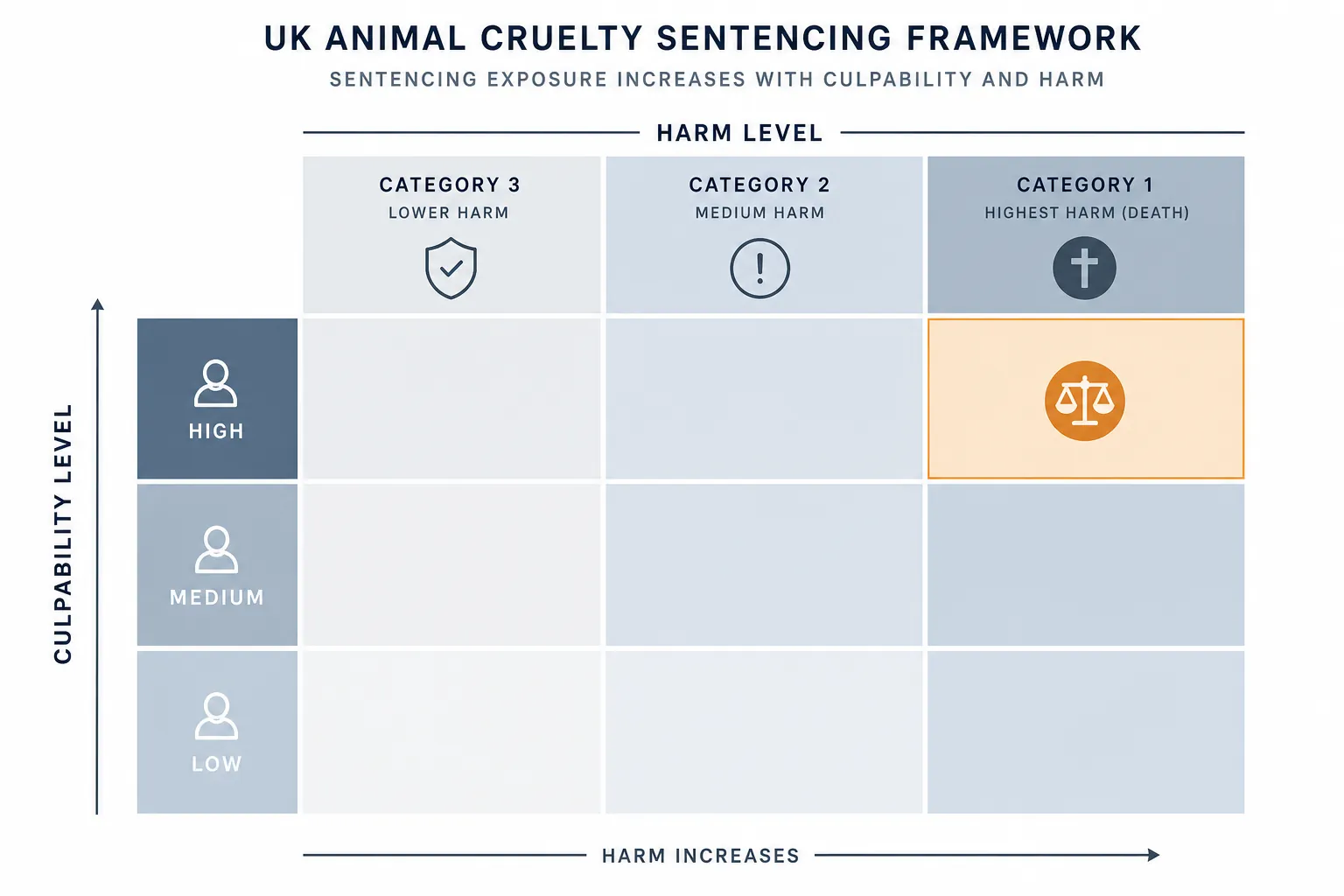
The more difficult question is culpability. Category 1 harm combined with medium culpability produces a materially different range from Category 1 harm combined with high culpability. For adult offenders, the guideline gives the following structure:[8]
| Adult guideline scenario | Starting point | Range |
|---|---|---|
| Category 1 harm plus medium culpability | 26 weeks’ custody | High-level community order to 1 year 6 months’ custody |
| Category 1 harm plus high culpability | 2 years’ custody | 1 year to 3 years 6 months’ custody |
That difference is why the paint detail matters legally only after the court has found the underlying facts. If the prosecution proved a deliberate attempt to cause suffering, medium culpability may be in view. If it proved features such as prolonged or sadistic conduct, or conduct causing public distress, high culpability may be argued. The point is not that those findings are inevitable; it is that they would move the adult sentencing exposure substantially.
Which alleged facts could affect culpability
Oil-based paint is not just a visual fact. On the reported account, Honey was covered in paint, and rescue staff had to remove it from her spines one by one.[1][2] If evidence showed that the paint restricted movement, impaired breathing, exposed her to toxicity through licking, or prevented normal defensive curling, those facts could support an argument that suffering was prolonged or severe. But the sentencing court would need evidence, not inference from public revulsion.
Public distress is another possible aggravating feature, but it should be handled carefully. Reports have linked the colors to Leeds United or to online Sonic the Hedgehog imagery, but the available material does not prove motive. If prosecutors later prove that the conduct was staged for attention, imitation, humiliation, or spectacle, the argument changes. At present, those are investigative possibilities rather than findings.
The same caution applies to causation. Honey died after intensive care, and death is central to the harm category. A sentencing court would still need to be satisfied about the link between the offending and the death, and about each offender’s role. Group arrests do not decide joint liability, individual participation, or personal culpability.
The youth issue cannot be treated as a footnote
Two of the four reported suspects are 15 and 17.[3][4] That fact should stop any clean translation of the adult table into a case-wide sentence estimate. Youth sentencing in England and Wales is governed by different principles, including welfare, age, maturity, culpability, and the aim of preventing reoffending. Custody for children and young people is approached through different thresholds and forms, including Detention and Training Orders where available and appropriate.[5]
The result is not that youth suspects face no meaningful consequences. It is that the adult post-2021 exposure map is only an adult exposure map. A practitioner briefing this case should separate the 24-year-old and 37-year-old suspects from the 15-year-old and 17-year-old suspects unless and until the charging and sentencing posture justifies treating them together.
Wildlife status may aggravate the story, but it does not settle the charge
Honey was a European hedgehog, a species listed as Vulnerable on the UK Red List, with reported population decline of 30-50% since 2000.[9] That conservation status is important context, and it explains why the case has landed beyond ordinary local crime reporting. It should not be overstated into a conclusion that the hedgehog had full legal protection for all purposes under wildlife law.
The distinction matters because European hedgehogs are listed on Schedule 6 of the Wildlife and Countryside Act 1981, which concerns certain prohibited methods of killing or taking, but they are not listed on Schedule 5 for full protection of the kind often associated with other protected species.[10] In a section 4 Animal Welfare Act case, the main questions would remain unnecessary suffering, protected-animal status, causation, and culpability.
There is also a possible charging uncertainty around the Wild Mammals (Protection) Act 1996. That route may matter because it does not require the same protected-animal analysis as section 4. The available public updates, however, have not announced a charging decision, so it is better treated as a live alternative than as a parallel conclusion.
Comparators show the ceiling problem
The closest public comparators should be used more as guardrails than predictions. In 2023, Richard Coyle received 18 months’ custody for a hedgehog cruelty case involving sadistic mutilation, on facts materially more grave than paint application.[11] That sentence is useful mainly because it prevents an easy assumption that every fatal hedgehog case must sit at the very top of the post-2021 range.
An earlier Coyle case in 2020 produced a 26-week sentence for hedgehog mutilation under the pre-2021 sentencing regime.[12] The statutory landscape has since changed, and the Sentencing Council’s current animal-cruelty guideline now supplies the adult range. The older case is therefore a lower-bound historical reference, not a current tariff.
Neither comparator decides Honey’s case. They illustrate why the maximum sentence, the adult guideline range, and the facts proved at sentencing must be kept separate. The court’s task would not be to rank public disgust; it would be to sentence the proved offence by reference to harm, culpability, aggravating and mitigating factors, offender age, and role.
What practitioners should take from the update
For risk tracking, the case is significant because the combination of death, alleged deliberate cruelty, and possible high-culpability features can move adult Animal Welfare Act exposure into serious custodial territory after the 2021 sentencing increase. The adult Category 1 pathway is the center of that analysis, not the five-year maximum by itself.
The charging decision remains the next legal event to watch. CPS guidance on animal offences will inform whether prosecutors proceed under the Animal Welfare Act, consider an alternative wildlife or wild-mammal route, or decline to charge on the available evidence.[13] Until that decision is announced, a defensible case note should state the present posture plainly: four suspects on bail, two of them minors, no filed charges, Honey dead after intensive rescue care, and adult sentencing exposure conditional on charge, proof, conviction, and offender-specific findings.
References
- Hedgehog covered in paint dies despite rescue efforts, BBC, 22 July 2026.
- Hedgehog covered in oil-based paint dies after intensive care, ITV News, 23 July 2026.
- Four arrested after hedgehog found covered in paint, BBC, 21 July 2026.
- Four males arrested after hedgehog found covered in paint in Yeadon, ITV News, 21 July 2026.
- Sentencing children and young people: overarching principles, Sentencing Council.
- Animal Welfare Act 2006, Legislation.gov.uk.
- Animal Welfare (Sentencing) Act 2021, Legislation.gov.uk.
- Animal cruelty: definitive guideline, Sentencing Council, effective 1 July 2023.
- The State of Britain’s Hedgehogs 2022, Hedgehog Street.
- Wildlife and Countryside Act 1981, Legislation.gov.uk.
- Man jailed for mutilating hedgehog, BBC, 2023.
- Man jailed for hedgehog mutilation, BBC, 2020.
- Offences involving domestic and captive animals, Crown Prosecution Service.
Related records
Tool profile
How Meta's AI Spending Reshapes Law Firm ProfitabilityGoverning regulation
Browse the obligations tracker →Preventive workflow
Browse verification workflows →
Report a correction or tip
Spotted an outdated figure, a misstated fact, or a ruling this case record should reflect? Public comments are disabled for this content given the professional cost of a misreported case outcome, penalty amount, or rule text — use the structured correction channel instead.
Report a correction or tip for this record →