
How the Moreno Voter ID Bill Tests AI Research Freshness
The six-day legislative window of H.R. 7008—from House passage to Senate failure—creates a verifiable temporal freshness test for AI legal research tools. This record documents the bill's timeline so practitioners can independently check whether their tool would produce a stale status summary.
- Jurisdiction
- US Federal
- Court
- U.S. Congress
- AI tool named
- General AI Legal Research Tool
- Ruling date
- Jul 28, 2026
- Source document
- View primary court order ↗
- Last verified
- Jul 30, 2026
Lex Machina Review is an independent risk-tracking and reference resource. Nothing on this site is legal advice, and using it does not create an attorney-client relationship. Every record is reviewed against primary sources but may not reflect the most current status of a matter — always verify directly against the cited court order, rule text, or a licensed attorney before relying on it.
Companion explanation — secondary to the source document above
Freshness signal as of July 30, 2026
Last verified: July 30, 2026, 00:00 UTC. This is a legislative-status risk record, not legal advice.
For the Moreno insider trading/voter ID bill, the date an AI legal research answer has to clear is July 28, 2026. H.R. 7008 had already passed the House 232–198 on July 22, and the Washington Times reported on July 28 that the bill “failed to pass the Senate” after the unanimous-consent effort collapsed.[1][2]
That makes the bill a clean staleness test. An answer that stops before July 22 misses House passage. An answer that stops between July 22 and July 27 may say the bill passed the House and was awaiting Senate action. An answer that stops before July 28 misses the failed Senate outcome.
- Primary House record to check: the House Rules Committee page for H.R. 7008, including the reported version and committee materials.[3]
- Senate event materials to check: Sen. Moreno’s July 27 advisory announcing the unanimous-consent request and Sen. Moody’s floor-action release.[4][5]
- Status and vote cross-checks: the House vote tracker and GovTrack bill page.[1][6]
- Important caveat: the Congressional Record PDF for the July 27 floor exchange was not directly crawled for this record. The floor sequence below is reconstructed from the Washington Times report and Sen. Moody’s press release.[2][5]
The three-phase record
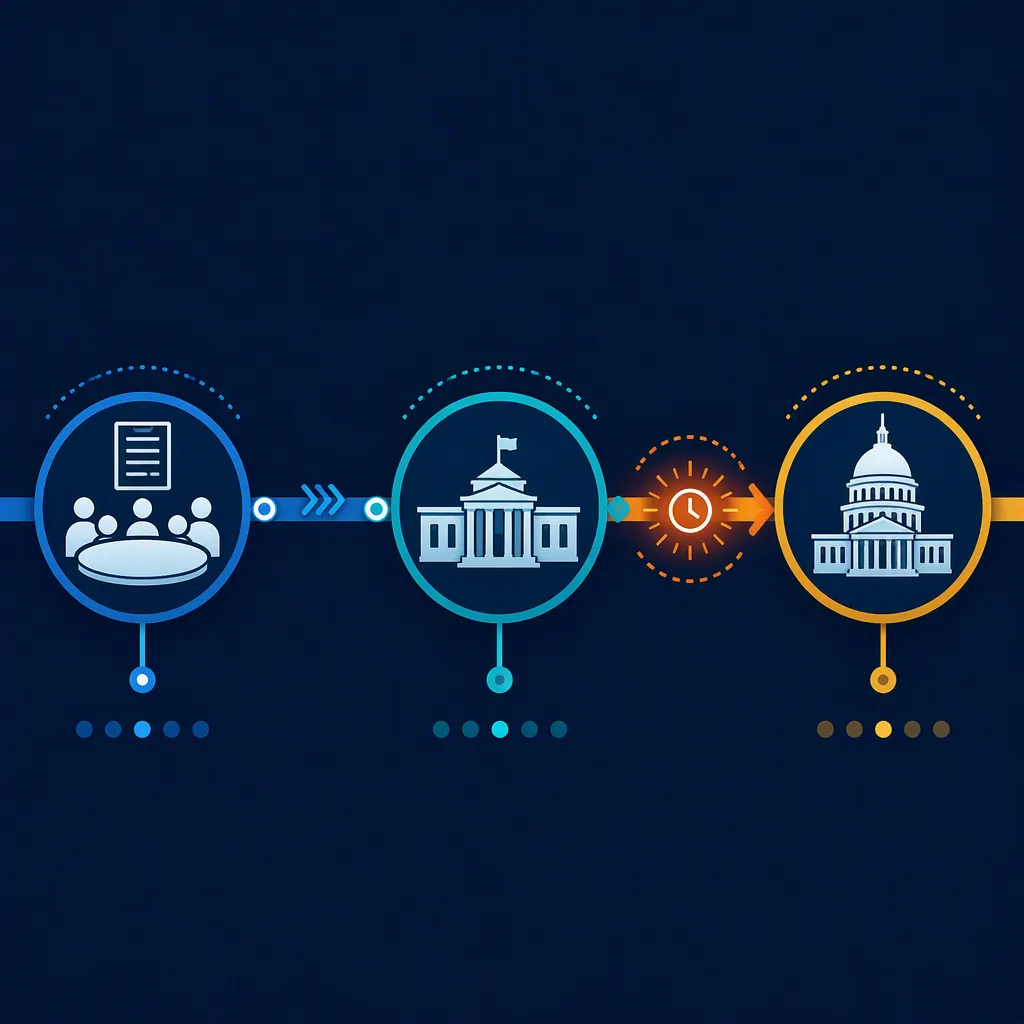
The useful feature of H.R. 7008 is not that it was obscure. It is that its public status changed in a narrow, dated sequence that can be checked against separate sources.
| Phase | Date or window | Record to verify | Why it matters for AI freshness |
|---|---|---|---|
| Introduction and committee action | January–February 2026 | H.R. 7008 was introduced on January 12, 2026, and reported by committee on February 3, 2026.[3][6] | A static answer may stop here and describe the bill as only introduced or reported. |
| House passage | July 22, 2026 | The House passed H.R. 7008 by a 232–198 vote. The package combined the Stop Insider Trading Act with the Voter ID Act, identified in the Senate materials as H.R. 9368.[1][4][7] | A tool current through July 22 but not July 28 may give a technically once-true but now incomplete answer. |
| Senate unanimous-consent failure | July 27–28, 2026 | Moreno announced a unanimous-consent request on July 27; Moody brought the motion to the floor; Padilla objected; Moreno objected to the competing HOST Act alternative; the Washington Times reported on July 28 that the bill failed to pass the Senate.[2][4][5] | This is the cutoff event. A current answer on July 30 must account for it. |
The January and February events are useful mainly as baseline identifiers. They help confirm that the tool is looking at the right H.R. 7008 in the 119th Congress, not merely inventing a plausible bill title. The House Rules page and GovTrack page are enough to anchor that early status without turning the article into a merits discussion.[3][6]
The July 22 House vote is the first serious freshness threshold. A system that still says H.R. 7008 was only in committee, only introduced, or merely “under consideration” has failed a basic legislative-status check. The House-passage number also gives a simple factual checksum: 232–198. The 5 Calls tracker further identifies 13 Democratic yes votes, which can be used as an optional accuracy check if the tool provides vote detail rather than only status language.[1]
The July 27–28 sequence is the sharper test because it converts a seemingly current House-passage answer into a stale answer in less than a week. Moreno’s July 27 advisory said he would seek unanimous consent on the House-passed bill to ban congressional insider trading and require voter ID.[4] Moody’s release records the floor effort to secure immediate passage.[5] The Washington Times then reports the objection sequence and the failed Senate outcome on July 28.[2]
Where a stale AI answer will break
The failure mode here is not limited to an AI model fabricating a nonexistent event. The more practical risk is quieter: the answer may have been true when the system last crawled its sources and stale when a lawyer relies on it.
| Tool cutoff or last successful crawl | Likely answer pattern | Reliance problem on July 30, 2026 |
|---|---|---|
| Before July 22, 2026 | H.R. 7008 is introduced, reported, or moving through House process. | Misses House passage. |
| July 22 through July 27, 2026 | H.R. 7008 passed the House and is pending or awaiting Senate action. | May have been accurate at crawl time, but misses the Senate failure reported July 28. |
| After July 28, 2026 | H.R. 7008 passed the House but failed to pass the Senate after the unanimous-consent effort. | Clears the minimum freshness threshold, assuming the answer cites verifiable sources. |
That middle category is the one most likely to be mishandled in a legal-research workflow. “Passed the House, pending in the Senate” is not nonsense. It is the kind of answer that can survive a quick read because it sounds procedurally normal and recently informed. For a July 30 status request, it is still stale.
This is why “up to date” is not a sufficient representation unless the tool exposes what it means. A live-source legal research system should be able to show the last retrieval date, the source page, and the event date it is relying on. A static model, or a product that blends static generation with intermittent retrieval, may need a separate verification step before its legislative-status answer is used in a memo, client alert, or internal risk note.
The unanimous-consent episode, without the campaign noise
For status purposes, the Senate episode can be kept narrow. Moreno announced on July 27 that he would ask for unanimous consent on the House-passed bill. Moody made the floor motion. Padilla objected. Moreno then objected to the competing HOST Act alternative associated with Sens. Hawley and Peters. The practical result, as reported July 28, was that the House-passed measure failed to pass the Senate.[2][4][5]
The competing policy claims around voter ID and congressional stock trading do not change the freshness test. A tool does not have to resolve the merits of the Voter ID Act or the design of a stock-trading ban to answer the immediate status question. It has to know that the Senate event happened, identify the date, and avoid presenting the July 22 House-passage posture as the current endpoint.
How to run the test on a legal AI tool
Use a query that forces the tool to disclose both status and time basis. For example:
As of July 30, 2026, what is the current legislative status of H.R. 7008, the Moreno bill combining the Stop Insider Trading Act and voter ID requirements? Include the date of the latest status-changing event, the source you relied on, and your last retrieval or verification date.Then score the answer against the record, not against how confident the prose sounds.
- If the answer says only that the bill was introduced or reported, it has not cleared July 22.
- If the answer says the bill passed the House and is pending in the Senate, it has not cleared July 28.
- If the answer says the bill failed to pass the Senate but gives no source, no event date, and no retrieval date, treat it as unverified.
- If the answer identifies House passage on July 22, the unanimous-consent failure reported July 28, and links to verifiable sources, it clears the minimum freshness test for this record.
The vote details can be used as a second pass. A tool that gives the 232–198 House vote and, if asked, the 13 Democratic yes votes is showing that it can retrieve a granular roll-call account rather than simply paraphrasing a headline.[1] That does not prove the tool is reliable across Congress. It does make the H.R. 7008 answer easier to audit.
What this record does not establish
This record does not compare AI vendors. It does not measure statutory interpretation, litigation reasoning, or the quality of a generated client memo. It is a narrower test: can the system answer a current federal legislative-status question when the relevant status changed six days after House passage?
Other sources may matter for different questions. The CBO estimate can help verify features of the bill’s penalty structure.[8] Campaign Legal Center’s analysis can help identify critiques of the bill’s coverage and design.[9] Those materials do not substitute for the July 28 status source. Likewise, public-opinion figures relayed through a Senate press release are not needed to decide whether a July 30 answer is current.
The key distinction is operational. A tool can be fluent about the bill and still be stale. It can summarize the insider-trading provisions and voter ID provisions and still miss the only fact that matters for a July 30 status request: the Senate failure reported on July 28.
The risk judgment
H.R. 7008 is useful as an AI freshness test because the window is short, the dates are public, and the expected answer is externally checkable. The tool does not get credit for sounding current. It has to clear July 28, 2026.
If an AI legal research tool cannot show that it reached the July 28 Senate-failure record, it should not be relied on for current legislative status without a separate live-source verification step.
References
- Voter ID + Congressional Insider Trading Ban, 5 Calls
- Voter ID provision torpedoes Senate vote on stock trading ban, Washington Times, July 28, 2026
- H.R. 7008, House Rules Committee
- Media Advisory: Moreno to Ask for Unanimous Consent on House-Passed Bill to Ban Insider Trading and Require Voter ID, Office of Sen. Bernie Moreno, July 27, 2026
- VIDEO: Senator Moody Takes to Senate Floor to Urge Immediate Unanimous Passage of Measure to Stop Congressional Insider Trading and Institute Voter ID, Office of Sen. Ashley Moody
- H.R. 7008: Stop Insider Trading Act, GovTrack
- U.S. House passes bill coupling voter ID requirement with ban on stock trading by members, Tucson Sentinel / States Newsroom, July 22, 2026
- H.R. 7008, Stop Insider Trading Act, Congressional Budget Office
- How the Stop Insider Trading Act Fails to Solve Congressional Stock Trading Problem, Campaign Legal Center
Related records
Tool profile
How Meta's AI Spending Reshapes Law Firm ProfitabilityGoverning regulation
Browse the obligations tracker →Preventive workflow
Browse verification workflows →
Report a correction or tip
Spotted an outdated figure, a misstated fact, or a ruling this case record should reflect? Public comments are disabled for this content given the professional cost of a misreported case outcome, penalty amount, or rule text — use the structured correction channel instead.
Report a correction or tip for this record →