
What the Howard Stern Severance Dispute Really Means
The phrase 'severance dispute' covers multiple distinct legal layers in the Stern–SiriusXM record — a litigated performance-bonus claim, a change-in-control payout, an executive release-conditioned package, and an unreported staff negotiation. This article distinguishes each layer, cites the primary court orders and contract language, and explains why characterization, not settlement, determined every outcome.
- Jurisdiction
- US-New York
- Court
- New York Supreme Court, Appellate Division, First Department
- Judge
- Barbara R. Kapnick
- AI tool named
- No AI tool
- Ruling date
- Apr 11, 2013
- Source document
- View primary court order ↗
- Last verified
- Aug 2, 2026
Lex Machina Review is an independent risk-tracking and reference resource. Nothing on this site is legal advice, and using it does not create an attorney-client relationship. Every record is reviewed against primary sources but may not reflect the most current status of a matter — always verify directly against the cited court order, rule text, or a licensed attorney before relying on it.
Companion explanation — secondary to the source document above
As of Aug. 2, 2026, the only Stern–SiriusXM dispute that has been fully litigated was not a severance dispute. It was One Twelve, Inc.’s performance-bonus claim against Sirius XM Radio Inc., Index No. 650762/11, dismissed in April 2012 and affirmed by the New York Appellate Division, First Department, on April 11, 2013, on contract-interpretation grounds.[1][2][3] The current phrase “Howard Stern severance dispute” therefore needs sorting before it needs outrage: it can refer to a court-decided bonus case, a merger-triggered contractual payout, an SEC-filed executive severance template, or anonymously reported 2026 staff negotiations. Those are not interchangeable legal objects.
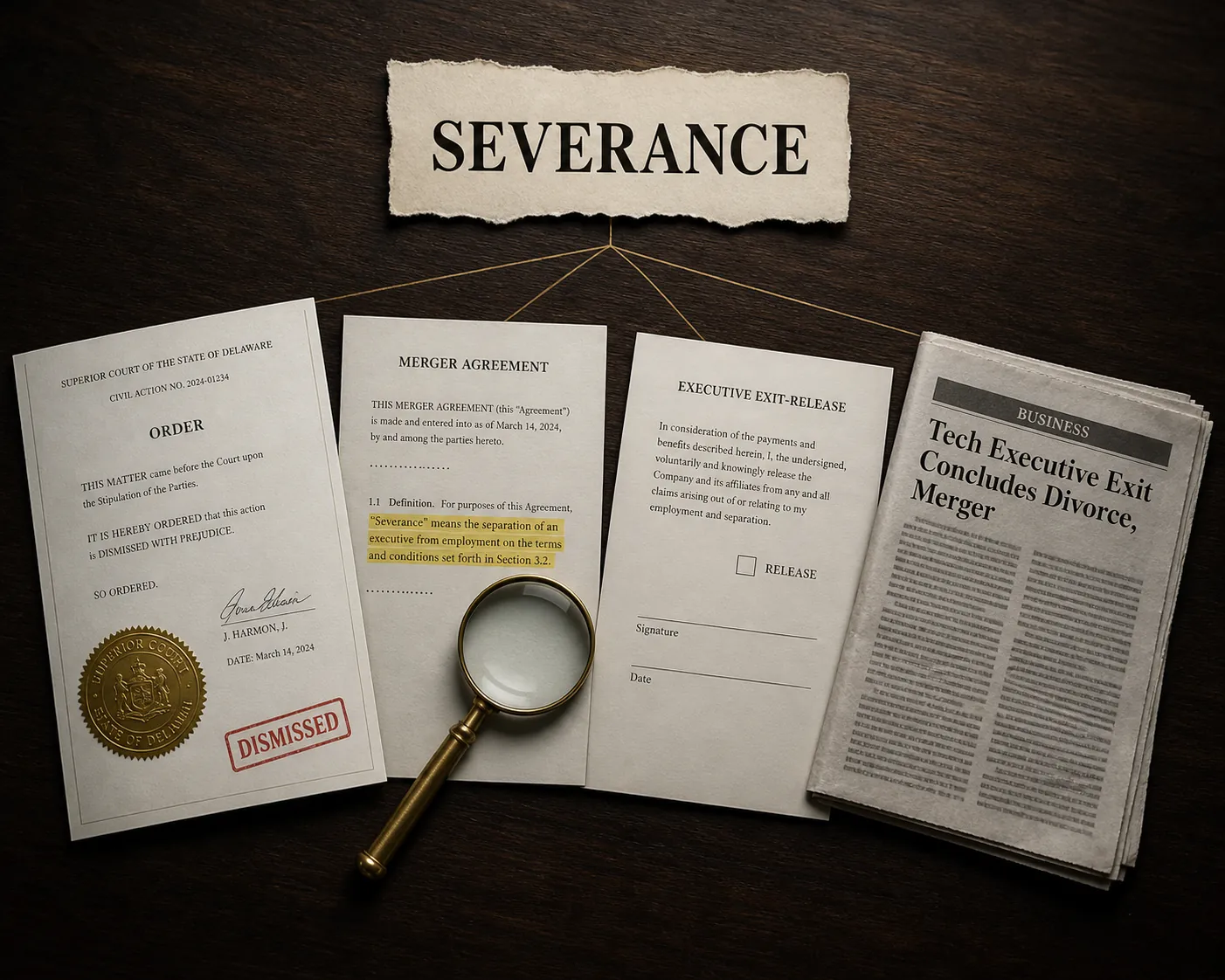
The distinction matters because each layer asks a different question. A bonus case asks whether the contract’s metric was satisfied. A change-in-control payment asks whether a specified corporate event triggered a lump sum. A severance agreement usually asks whether a termination and release condition have been met. A reported staff offer, before a filing or signed settlement is public, asks much less: what has been reported, by whom, and with what verification.
| Layer often swept into the phrase | What it legally is | Verification status as of Aug. 2, 2026 |
|---|---|---|
| 2011–2013 One Twelve litigation | Performance-bonus / stock-compensation claim based on contract language | Court-decided: dismissed and affirmed |
| Merger-related lump sum | Change-in-control payment under an express clause | Disclosed in litigation and reporting as paid |
| Executive severance comparator | Release-conditioned executive employment agreement filed with the SEC | Public contract template, not Stern’s own severance deal |
| 2026 staff reports | Reported at-will severance negotiations involving releases / NDAs | Reported by press; no located court, agency, or settlement filing |
The court case was about “Sirius subscribers,” not severance
One Twelve, the company through which Stern contracted, sued Sirius XM in 2011 after the 2008 Sirius–XM merger. The claim was not that Stern had been fired and denied exit pay. The theory was that the post-merger company owed additional stock-based compensation because XM’s subscribers should count toward the subscriber targets in Stern’s agreement.
That is why the case turns on a small phrase that did a large amount of work: “Sirius subscribers.” The First Department affirmed dismissal because the agreement did not define that term to include XM subscribers, even though the merger had been anticipated in the agreement.[1] Once that label controlled, the business story Stern’s side wanted to tell — that the combined satellite-radio company had gained the very audience value Stern helped create — could not overcome the narrower drafting.

The trial-court ruling, as reported by Courthouse News, was equally direct on the same point. Justice Barbara R. Kapnick rejected the attempt to treat XM subscribers as Sirius subscribers, with Courthouse News quoting her view that they were “not one and the same.”[2] The New York Times likewise described the case as a bonus suit, not a severance case, and reported that Sirius XM said in an April 17, 2012 SEC filing that it had “complied with all our obligations under the agreement.”[4]
Sirius XM’s FY2012 Form 10-K put the matter in the company’s Legal Proceedings section. It identified One Twelve, Inc. and Don Buchwald as plaintiffs, described the contract-compensation dispute, noted the dismissal, and stated that plaintiffs had appealed.[5] That is the right filing tray for this dispute: litigation over contingent compensation. Calling it severance blurs the fact that the court was not deciding whether Stern or his company had a right to termination pay.
The money figures also should stay attributed rather than flattened into a single neat number. Courthouse News reported that Stern and his agent sought about $330 million in stock awards and that the company had previously paid an $82.5 million bonus in January 2007.[2] A contemporaneous legal blog analysis, working from complaint-level detail, described earlier bonus mechanics in shares, including 22.1 million shares worth about $83 million for the January 2007 payment and an earlier clause involving roughly 34.4 million shares valued around $200 million.[6] Those descriptions point in the same direction — a large stock-compensation fight — but they are not identical enough to be casually merged.
The appellate result is the cleanest part of the record. On April 11, 2013, a five-judge First Department panel affirmed the dismissal.[1] Courthouse News’ appeal coverage summarized the loss as a failed bonus-denial appeal, again not as a severance ruling.[3] The courts did not decide whether Stern’s move to satellite radio was worth more in a general market sense. They decided that the contract language did not make XM subscribers count as Sirius subscribers.
The merger payout existed, which is why the failed bonus theory can sound plausible
There was a merger-related payment in the Stern–SiriusXM record. That is the piece that often makes the public shorthand feel intuitive: if the Sirius–XM combination produced one contractual payment, why would it not also expand the subscriber base for another?
The answer is that contracts can treat the same corporate event differently in different clauses. Sources identify a change-in-control payment of $25 million to One Twelve and $2.5 million to Buchwald. That payment was made under an express clause. The subscriber-bonus theory failed because a different clause used a different measuring term, and the court would not rewrite that term to capture XM subscribers after the merger.[1][6]
That is not a technicality in the pejorative sense. It is the central legal hinge. If a contract says a merger produces a lump sum, the event can trigger that lump sum. If another clause says additional compensation depends on “Sirius subscribers,” the party seeking more money still has to show that the defined or used term reaches the subscribers being counted. The merger’s existence did not do that drafting work by itself.
What an actual severance agreement looks like in the SiriusXM record
The public record does contain a useful Sirius XM severance document. It is not Stern’s agreement. It is not a ruling about laid-off show staff. It is an SEC-filed employment agreement for Jennifer Witz, dated Aug. 21, 2017, and it works as a comparator because it shows how carefully severance is usually drafted when a company wants the payment to be conditional rather than automatic.[7]
The Witz agreement ties severance mechanics to defined termination circumstances and a release process. It includes a 45-day release window, payment in a lump sum on the 60th day after termination, ADEA-related consideration and revocation language, and a Section 409A delay mechanism for certain deferred-compensation timing issues.[7] Those provisions are mundane only until there is a breakup. Then they decide when the money is payable, whether a signature is required, when the release becomes effective, and whether tax-timing rules delay the check.
That template helps explain why “severance” is not just a mood label for money paid at the end of a relationship. A severance package may be drafted as consideration for a release. It may be conditioned on not revoking an age-discrimination waiver. It may pay on a specified day rather than when the employee cleans out an office. It may be available only for certain termination categories. Those are different legal mechanics from the One Twelve subscriber-bonus claim.
The limit of the comparison is just as important as the comparison itself. The Witz agreement is an executive CMO agreement filed with the SEC. It does not disclose Stern’s severance terms, if any. It does not establish the terms offered to production staff in 2026. It simply gives a public example, within the same corporate ecosystem, of severance drafted as a release-conditioned contractual package rather than as an after-the-fact grievance.
The 2026 staff story is reported negotiation, not a court record
The staff layer is probably what many 2026 searchers mean by “Howard Stern severance dispute.” It arrived through entertainment and local press reports, not through a complaint, agency docket, court order, or publicly filed settlement located as of Aug. 2, 2026.
Page Six reported on July 31, 2026, that former Stern show staffers were in a severance battle after layoffs, describing an offer of about one week of pay per year of service and reporting that former staff were pushing back over the terms.[9] The Mirror US carried similar reporting on the staff dispute in the same July 31–Aug. 1 window.[10] Earlier in July, cleveland.com reported that Stern’s latest move had left longtime staff stunned.[11]
Those reports matter, but they belong in the attributed-reporting tray. The reported offer appears to be framed as exit pay for at-will employees in exchange for release or confidentiality commitments, not as an adjudicated entitlement. Names, numbers of affected employees, negotiation posture, and whether any individual obtained different terms remain press-reported facts unless and until a filing or attributed confirmation supplies firmer footing.
That staff-offer legality question is covered more directly in the companion analysis, Are Howard Stern’s severance terms legal?. The narrower point here is to keep the 2026 reports from being backfilled with the authority of the 2012 dismissal or the 2013 affirmance. The staff reports may describe a live severance negotiation. They do not turn the One Twelve bonus litigation into a severance case.
The contract renewal context does not change the labels
SiriusXM announced on Dec. 16, 2025, that Stern had renewed his SiriusXM contract for three more years.[8] That announcement supplies useful timing context for the 2026 staff reports, but it does not itself disclose severance terms, staff-release language, or a Stern severance claim. A renewal can sit next to layoffs in the news cycle without becoming proof of the legal terms governing either one.
The same caution applies across the whole record. The One Twelve case was resolved by the meaning of a subscriber term. The change-in-control money was paid because a clause said what happened on a qualifying corporate event. The Witz agreement shows severance as a release-conditioned executive package. The 2026 staff account remains reported severance negotiation. Put under one headline, they sound like one long fight over loyalty and money. Put in the contract file, they are four different instruments.
References
- One Twelve, Inc. v. Sirius XM Radio Inc. — NY Appellate Division First Department, Apr. 11, 2013
- Judge Tosses Suit Over Howard Stern's Bonuses — Courthouse News, Apr. 23, 2012
- Howard Stern Loses Bonus Denial Appeal — Courthouse News, Apr. 15, 2013
- Judge Dismisses Howard Stern's Suit Against Sirius — The New York Times Media Decoder, Apr. 17, 2012
- Sirius XM FY2012 Form 10-K — SEC
- Breaking Down Stern v. SiriusXM — Scary Lawyer Guy, Nov. 23, 2011
- Sirius XM employment agreement with Jennifer Witz, Exhibit 10.30 — Sirius XM, Aug. 21, 2017
- Howard Stern Renews SiriusXM Contract for 3 More Years — SiriusXM Blog, Dec. 16, 2025
- Inside Howard Stern's ex-staffers' severance battle after brutal layoffs — Page Six, Jul. 31, 2026
- Howard Stern show staff reportedly — The Mirror US, Jul. 31–Aug. 1, 2026
- Howard Stern's latest move leaves longtime staff stunned — cleveland.com, Jul. 14, 2026
Related records
Tool profile
How Meta's AI Spending Reshapes Law Firm ProfitabilityGoverning regulation
Browse the obligations tracker →Preventive workflow
Browse verification workflows →
Report a correction or tip
Spotted an outdated figure, a misstated fact, or a ruling this case record should reflect? Public comments are disabled for this content given the professional cost of a misreported case outcome, penalty amount, or rule text — use the structured correction channel instead.
Report a correction or tip for this record →