
How Howard's Pre-Move-In Unenrollment Triggers Legal Risks
This article assesses the legal claims that could arise from Howard University's July 22 unenrollment of 502 first-year students days before move-in, grounded in breach-of-contract, consumer-protection, detrimental-reliance, and disparate-impact theories. It identifies four distinct risk vectors that counsel should monitor based on the contradictory payment deadlines and Howard's prior $2 million class-action settlement.
- Jurisdiction
- US-DC
- Court
- U.S. District Court for the District of Columbia
- AI tool named
- No AI tool
- Ruling date
- Jul 22, 2026
- Source document
- View primary court order ↗
- Last verified
- Jul 24, 2026
Lex Machina Review is an independent risk-tracking and reference resource. Nothing on this site is legal advice, and using it does not create an attorney-client relationship. Every record is reviewed against primary sources but may not reflect the most current status of a matter — always verify directly against the cited court order, rule text, or a licensed attorney before relying on it.
Companion explanation — secondary to the source document above
The legal problem in Howard’s pre-move-in unenrollment begins with a date conflict. Howard’s public Bursar page lists August 3, 2026, as the Fall payment deadline, while students have reported a separate July 10 requirement that 50% of the balance be covered before enrollment would remain secure.[1][2] Howard’s July 23 statement addressed the first-time-in-college enrollment updates but did not confirm or deny that reported July 10 trigger.[3]
That mismatch matters more than the existence of a hard tuition deadline. A university can set payment terms, place holds, and manage receivables. The legal exposure starts when the condition enforced against students appears different from the condition made reasonably knowable to them before they paid deposits, arranged housing, accepted aid packages, and prepared for move-in.
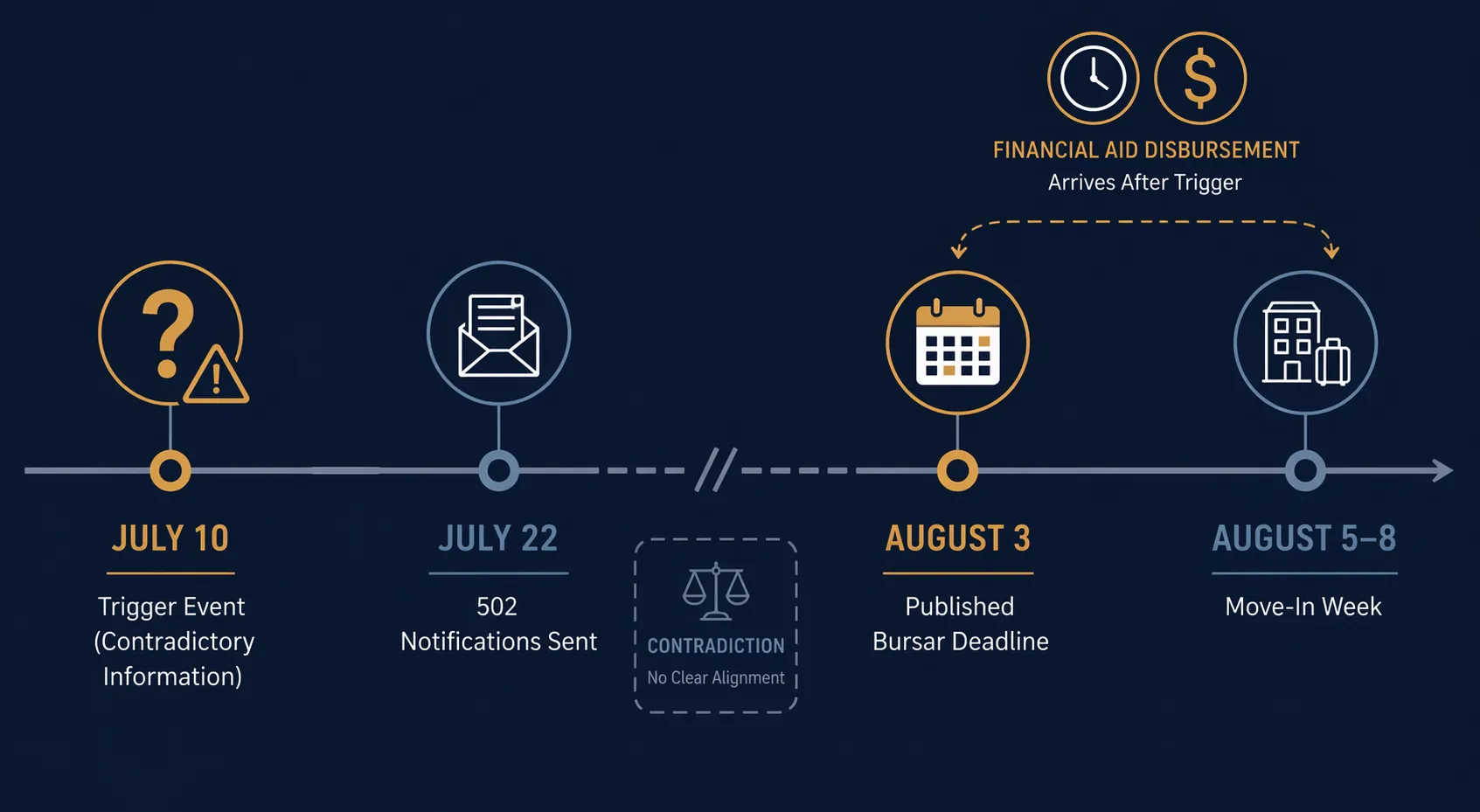
The compressed record is enough to justify close monitoring, but not enough to treat a class action as already built. Howard sent notifications to 502 first-time-in-college students on July 22, 2026.[3] Local reports described affected students losing housing assignments and nonrefundable $800 deposits, with first-year move-in scheduled for August 5–8.[4][5][6] As of July 24, 2026, no publicly filed class-action complaint has been identified in the available record.
The record that matters before any claim is filed
The most important separation is between what Howard has published, what students have reported, and what remains undisclosed. The July 10 issue should not be treated as established institutional policy unless Howard’s documents show it. It also should not be dismissed as noise, because the reported date explains why students were notified before the public August 3 payment deadline.
| Issue | Public record as of July 24, 2026 | Why it matters legally |
|---|---|---|
| Published payment deadline | Howard’s Bursar page lists August 3, 2026, as the Fall payment deadline.[1] | This is the cleanest apparent term for students comparing the bill to the academic calendar. |
| Reported earlier trigger | Students reported a July 10 requirement that 50% of the balance be covered; Kin+ corroborated the deadline questions, but Howard has not officially confirmed or denied that date.[2][3] | If enforced without clear notice, it becomes the center of contract, reliance, and consumer-protection theories. |
| Scope of action | Howard sent notifications to 502 first-time-in-college students on July 22.[3] | The number supports systemic-risk analysis, but it measures notifications, not necessarily final unenrollments. |
| Move-in consequences | Local reports described lost housing assignments, nonrefundable $800 deposits, and move-in scheduled for August 5–8.[4][5][6] | Those facts supply concrete reliance and damages allegations if students acted on the published timeline. |
| Aid timing | Howard’s financial-aid materials state that first-time undergraduate Direct Loan borrowers cannot receive the first disbursement until 30 days after the first day of classes.[7] | An account balance before move-in may not reflect approved aid that is legally unavailable for disbursement yet. |
Contract risk turns on the deadline Howard can prove
The strongest breach-of-contract theory would start with the ordinary university documents students are expected to rely on: admitted-student materials, deposit terms, billing pages, housing confirmations, and portal notices. The public Bursar deadline is useful to plaintiffs because it is not a memory, rumor, or phone call. It is a posted date: August 3, 2026.[1]
The $800 enrollment deposit also matters. Local reports describe affected freshmen losing nonrefundable $800 deposits after the unenrollment notices.[4][5] If a student paid that amount to secure a place in the incoming class, then the student has a straightforward way to plead consideration and reliance on the enrollment bargain. The cleaner factual chain is: deposit paid, enrollment accepted, public payment deadline reviewed, housing or course placement arranged, then cancellation before the published deadline.
Howard’s likely defense would not have to deny every hardship story. It would need documents showing that the July 10 50%-coverage condition was part of the enrollment contract or was otherwise clearly disclosed before the students relied on a later date. The critical evidence would be portal screenshots, timestamped emails, admitted-student checklists, financial-clearance notices, and any language tying housing or class registration to a pre-August 3 payment threshold.
That is why the July 10 date is not a peripheral detail. If Howard can show repeated, individualized notice of a July 10 threshold, the contract claim becomes harder. If the public-facing record emphasized August 3 while internal systems applied July 10, the claim becomes more serious, especially for students whose balances included aid that had been awarded but not yet posted as cash.
Consumer-protection exposure is a disclosure problem
A consumer-protection theory would not need to prove that Howard intended to mislead students. The more plausible theory is narrower: deadline disclosures may have been ambiguous or contradictory in a way that affected students’ decisions to pay deposits, rely on aid packages, and proceed toward move-in.
The public August 3 deadline supplies the visible representation.[1] The student-reported July 10 50%-coverage trigger supplies the alleged contradictory condition.[2] The July 22 notification date supplies the consequence: students were told of an enrollment problem after the reported trigger had passed but before the public Bursar deadline arrived.[3]
The missing proof is jurisdiction-specific and document-heavy. Counsel would need to identify which state or district consumer-protection statute applies, whether the transaction is covered, what exact representations were made to each student, and whether omissions were material. A generalized complaint about administrative confusion would be weak. A set of students with the same published deadline, the same undisclosed earlier trigger, and the same cancellation consequence would be much more useful.
The 502 notifications help show potential commonality, but they do not establish a class by themselves.[3] Notifications are not the same as final disenrollments, permanent loss of housing, or unreimbursed financial harm. The reinstatement record will matter: who was restored, when, on what terms, and whether classes, housing, deposits, and scholarships were restored together.
Reliance claims are strongest where aid was real but not yet spendable
The detrimental-reliance problem is sharpest for students who did not simply ignore a bill. It is strongest for students who had aid, loans, scholarships, or account credits that made attendance financially plausible, but whose account did not show the right cash position by the reported July 10 trigger.
Howard’s own financial-aid terms state that first-time undergraduate Direct Loan borrowers cannot receive the first disbursement until 30 days after the first day of classes.[7] That rule makes pre-move-in account status a poor proxy for whether an aid-dependent student can ultimately pay. A student can be financially eligible, loan-approved, and still not have disbursed loan funds available by July 10 or August 3.
The local examples are important because they show the mechanism. WJLA reported that Isabella Williams had classes restored but not her scholarship after the enrollment issue.[6] Kin+ reported that MarLae’ Coffield had a negative balance as of July 11, meaning the account appeared to show Howard owing her money, yet she was still swept into the unenrollment process.[2] Those are not classwide proof. They are factual hooks for discovery into whether the system could distinguish unpaid balances from pending aid, scholarship timing, over-aid positions, and account-update delays.
A reliance pleading would become stronger with receipts and timestamps rather than outrage. The useful evidence would include the deposit payment, housing confirmation, course schedule, aid award letter, scholarship notice, loan status, billing ledger before and after July 10, and communications from Howard about reinstatement. The harder cases are those where no aid had been accepted, no payment plan had been arranged, and no student-specific representation pointed to August 3 as the operative date.

Disparate-impact concerns are serious, but the public data stops short of liability
The disparate-impact concern comes from the collision between Howard’s student financial profile and the timing of the alleged payment trigger. Howard’s financial-aid materials state that more than 70% of students demonstrate high financial need, more than 40% are Pell-eligible, and tuition is $37,996 per year.[7] A rule that requires a large portion of the balance to be covered before aid can disburse is predictably more sensitive for students who depend on need-based aid, federal loans, outside scholarships, or delayed institutional posting.
That does not establish unlawful disparate impact on the present record. The public facts do not show the aid status, race, income profile, Pell eligibility, geography, or reinstatement outcome of the 502 students who received notifications. They also do not show whether similarly situated students with cash payments were treated differently from students with pending aid.
The monitoring question is whether the July 10 trigger, if it existed, functioned as a neutral billing rule with predictable unequal consequences for high-need students. Counsel would need student-level data: notified versus not notified, aid-dependent versus non-aid-dependent, Pell versus non-Pell, scholarship pending versus scholarship posted, reinstated versus not reinstated, and housing restored versus housing lost. Without that data, the disparate-impact theory is a warning light, not a conclusion.
Prior disputes affect risk posture, not the merits of this incident
Howard’s recent administrative and litigation history belongs in the risk file, but it should not be used as character evidence. In July 2025, Howard acknowledged that about 1,000 student account updates were delayed during the BisonWeb-to-BisonHub transition, with more than half resolved only after holds were placed.[8] That prior account-update problem does not prove the 2026 unenrollment was wrongful. It does make counsel more likely to ask whether account status, holds, aid posting, and student notice were again moving on different tracks.
The 2024 COVID tuition settlement is similar context. Howard settled a class action for $2,073,680 over COVID-era tuition refund claims.[9] That settlement does not establish liability here, but it shows that Howard has already faced classwide claims over the value students received compared with what they paid or expected to receive. A pending alumni board-of-trustees lawsuit, if verified in docket review, would belong in the same posture analysis as governance context, not as proof that any first-year student was improperly unenrolled.
The distinction matters. Litigation history can affect settlement incentives, document-preservation urgency, and plaintiffs’ counsel interest. It cannot fill the gaps on notice, causation, damages, or class membership.
What would move this from billing dispute to pleadable case
The evidence that matters now is not broad testimony that the process felt unfair. It is the document trail around the July 10 trigger and the account-by-account treatment after July 22.
- Was the July 10 50%-coverage requirement stated in an enrollment agreement, admitted-student portal, email, housing contract, or billing notice before students paid deposits or accepted housing?
- Did Howard’s public August 3 Bursar deadline include any cross-reference to an earlier first-year financial-clearance deadline?
- Were students with pending Direct Loans, outside scholarships, military benefits, institutional scholarships, or negative balances flagged differently from students with no aid path?
- How many of the 502 notifications resulted in actual unenrollment, temporary review, reinstatement, restored classes, restored scholarships, restored housing, or unrecovered deposits?
- Were reinstatement decisions consistent, timestamped, and based on documented account criteria?
If Howard can produce clear pre-July 10 notice and a consistent reinstatement process, the exposure narrows. If the operative deadline was materially different from the public Bursar deadline, inconsistently communicated, or unable to account for approved but undisbursed aid, the risk expands across contract, consumer-protection, reliance, and disparate-impact frameworks.
The Howard unenrollment impact on move-in is therefore not only a housing disruption story. It is a notice-and-reliance problem created days before students were expected to arrive. As of July 24, 2026, the matter remains pre-complaint and fact-dependent, with the most important unresolved questions still clustered around the July 10 requirement, student notice, pending-aid treatment, and what Howard restored after the July 22 notifications.
References
- Important Deadlines — Howard Office of the Bursar.
- Howard Enrollment Update: Deadline Questions — Kin+.
- First-Time-in-College Enrollment Updates — The Dig, Howard University, July 23, 2026.
- Howard University freshmen say they were mistakenly unenrolled over unpaid bills — Fox5 DC.
- Dozens of Howard University students unenrolled weeks before fall semester — NBC4 Washington.
- Howard University enrollment incoming freshman fall semester Washington DC tuition scholarship military loans administration class 2030 academic glitch funding — WJLA/7News.
- Financial Aid Terms and Conditions — Howard Financial Services.
- Howard University Works to Support Students Facing Financial Aid and Account Challenges Ahead of Fall — The Dig, Howard University, July 2025.
- Howard University Settles Class Action for $2 Million — Silverman Thompson, 2024.
Related records
Tool profile
How Meta's AI Spending Reshapes Law Firm ProfitabilityGoverning regulation
Browse the obligations tracker →Preventive workflow
Browse verification workflows →
Report a correction or tip
Spotted an outdated figure, a misstated fact, or a ruling this case record should reflect? Public comments are disabled for this content given the professional cost of a misreported case outcome, penalty amount, or rule text — use the structured correction channel instead.
Report a correction or tip for this record →