
Hunter Metcalf's Statement After Sentencing in the Austin Metcalf Case
A documented record of AI-generated misinformation during the Karmelo Anthony trial — including fake courtroom photos, an impersonated police chief account, and fabricated weapon screenshots — alongside Austin Metcalf's twin brother Hunter Metcalf's six-word victim impact statement after the 35-year sentence.
- Jurisdiction
- Texas, United States
- Court
- Collin County District Court, Texas
- AI tool named
- Unspecified AI tool
- Ruling date
- Jun 10, 2026
- Source document
- View primary court order ↗
- Last verified
- Jul 25, 2026
Lex Machina Review is an independent risk-tracking and reference resource. Nothing on this site is legal advice, and using it does not create an attorney-client relationship. Every record is reviewed against primary sources but may not reflect the most current status of a matter — always verify directly against the cited court order, rule text, or a licensed attorney before relying on it.
Companion explanation — secondary to the source document above
Hunter Metcalf’s statement after sentencing in the Austin Metcalf case was six words long: “Your name will be forgotten.” It was delivered after Karmelo Anthony was convicted of murder and sentenced to 35 years in prison for the killing of Austin Metcalf, Hunter’s twin brother, at a Frisco, Texas, track meet.[1][2]
That sentence has become search bait because it is brief, attributable, and devastating. It is also the cleanest fact in a record that became much less clean outside the courtroom. Around the trial, AI-generated and fabricated material moved through social platforms fast enough to become part of the public atmosphere around the case: fake courtroom images, an impersonated police-chief account, and fabricated weapon screenshots, all later debunked or contradicted by verification reporting or law enforcement.
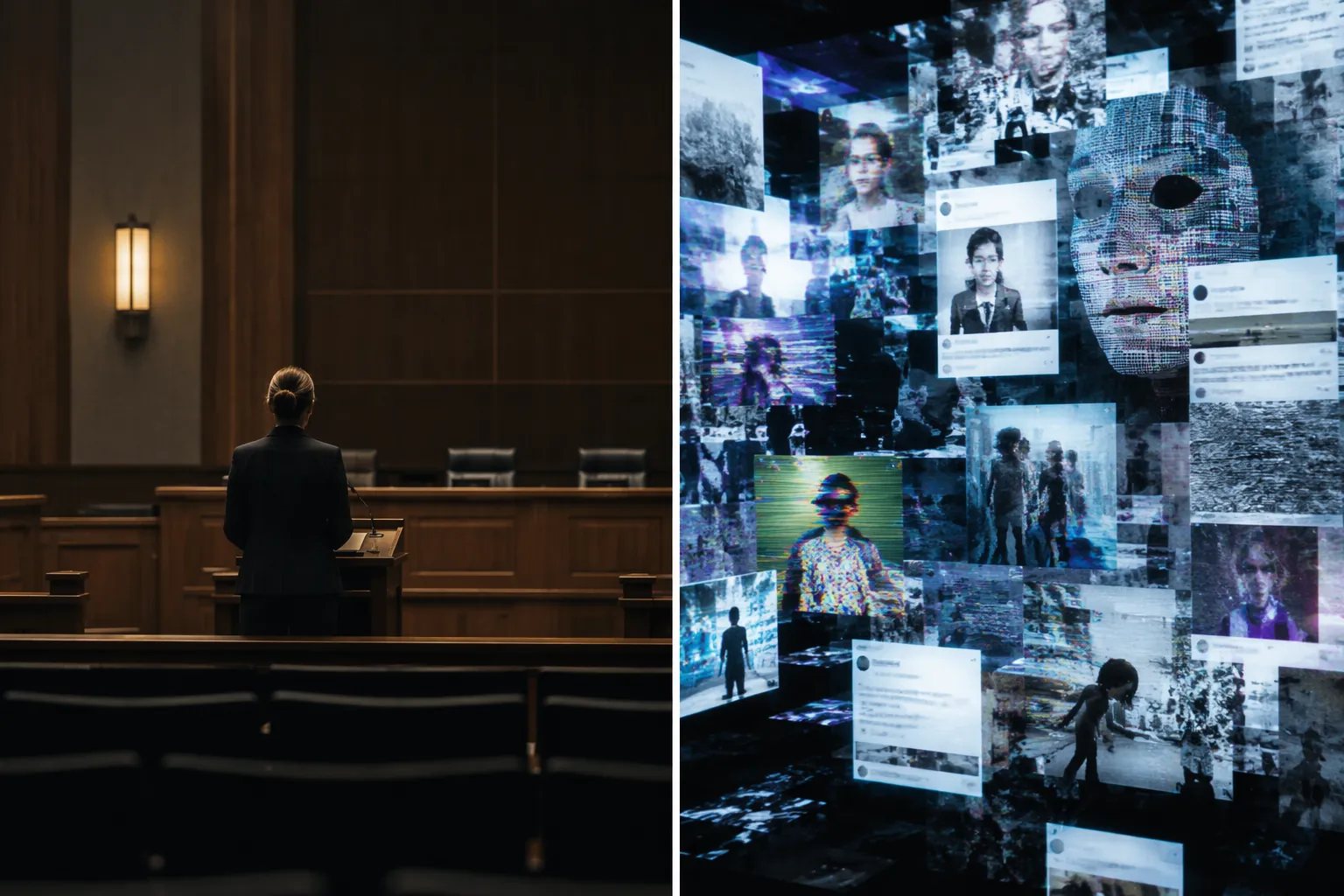
The distinction matters. A victim impact statement is part of the proceeding. A viral image pretending to be part of the proceeding is not. When the second begins to travel with more speed than the first, the public record starts carrying contaminants that lawyers, jurors, families, and judges cannot simply wish away.
The Misinformation Record
The most useful way to read this case is not as one vague warning about “AI misinformation.” The artifacts were different, and so were the risks they created.
| Artifact | Form | Verification or contradiction | Risk created |
|---|---|---|---|
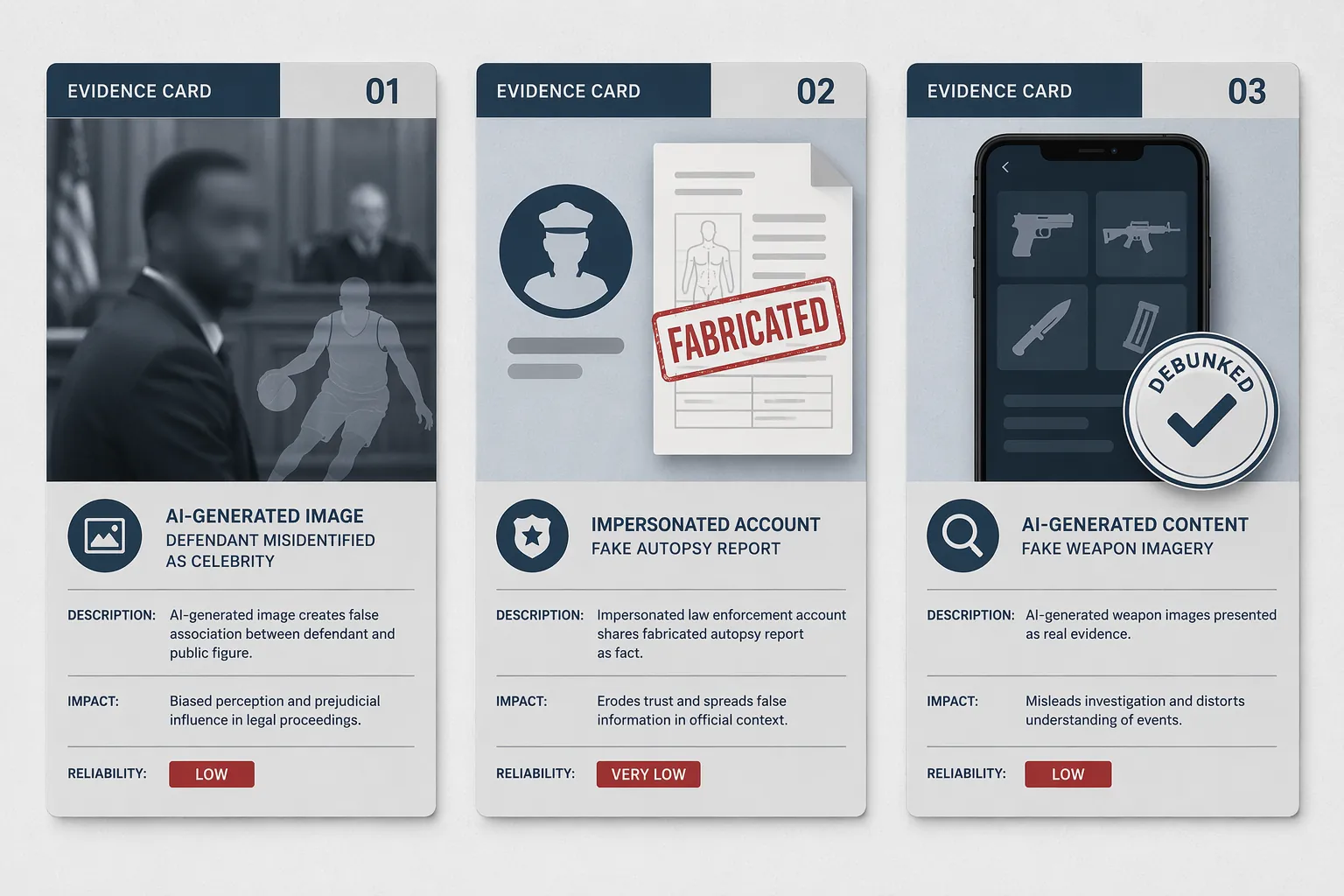
| Fake courtroom photos | AI-generated images confusing defendant Karmelo Anthony with NBA player Carmelo Anthony | Debunked by CBS News Confirm and law enforcement reporting[3] | Made the proceeding visually untrustworthy to people encountering the case through feeds rather than court records |
| Impersonated police-chief account | An X account posing as Frisco Police Chief David Shilson and posting a fabricated autopsy claim | Reported as police impersonation investigated by the FBI; contradicted by official case reporting[4] | Attached false official authority to a claim about drugs and the victim |
| Fabricated weapon screenshots | AI-generated Instagram screenshots purporting to show weapons attributed to Anthony | CBS Confirm verification cited in reporting found the screenshots were AI-generated[4] | Inserted false character and threat evidence into public discussion of the defendant |
Those three items should not be collapsed into one bucket. The fake courtroom images attacked visual identity. The impersonated police-chief account attacked institutional trust. The weapon screenshots attacked the public’s sense of what kind of person the defendant was before the jury’s work had even been reduced to a verdict.
Fake Courtroom Photos
The fake courtroom-photo thread was almost crude in concept: images circulated that confused Karmelo Anthony, the defendant, with Carmelo Anthony, the retired NBA player. CBS News Confirm and law enforcement debunked the images as AI-generated, but not before they reached a public already trying to sort a high-emotion murder trial through fragments of video, screenshots, commentary, and partisan framing.[3]
A fake image does not need to be sophisticated to do damage. In a court-adjacent setting, the viewer is not only asking whether the picture looks real. The viewer is asking whether the proceeding itself is being hidden, distorted, or staged. Once that suspicion attaches to the trial record, later corrections have to compete with a stronger story: that someone powerful must be manipulating what the public can see.
The Impersonated Police-Chief Account
The impersonation incident was more serious because it borrowed the voice of law enforcement. According to the Dallas Express, an X account impersonating Frisco Police Chief David Shilson posted a fabricated autopsy report claiming drugs were involved, and the FBI investigated the matter as police impersonation.[4]
That is a different failure mode from a bad meme or a misleading caption. It created a false official source, then used that false authority to launder a claim about the victim. In a murder case involving a dead teenager, a defendant facing decades in prison, and families already under public pressure, that kind of fabrication does not stay abstract. It gives online strangers permission to treat rumor as evidence and harassment as investigation.
Fabricated Weapon Screenshots
The third category involved fabricated Instagram screenshots of guns attributed to Anthony. The Dallas Express reported that CBS Confirm verified the weapon screenshots were AI-generated.[4]
Weapon screenshots have a particular courtroom-adjacent force. They do not merely say, “Here is another fact.” They invite a viewer to build a character profile: dangerous, prepared, violent, deserving. If the screenshots are fake, the harm is not only reputational. The fake material supplies a shortcut around the evidentiary rules that would normally decide whether such material belongs anywhere near a jury.
Where the Viral Story Met the Trial Record
The Dallas Express comparison of viral claims with official trial evidence is the hinge of the record. Its review of actual trial videos found that the evidence did not support claims of a “group jumping” or a “prolonged fight”; instead, it described a brief confrontation under a tent.[4]
That finding does not require the public to relitigate every fact of the stabbing. It shows why synthetic and fabricated material was not just tasteless noise around a tragic case. It competed with the evidentiary account. The courtroom had video exhibits, witnesses, objections, and a verdict. The online environment had a parallel evidence file made of screenshots, impersonations, and images that looked shareable before they looked provable.
This is the part lawyers often understate when they talk about “publicity.” Publicity is not only volume. It is texture. A false police source feels different from a stranger’s post. A fake weapon screenshot feels different from a vague accusation. An AI-generated courtroom image feels different from a written rumor. Each artifact gives the viewer a more concrete thing to remember, and concrete falsehoods are harder to dislodge than general impressions.
The Harms Did Not Stay Online
The public pressure around the case moved into physical and professional life. Secondary reporting collected on the case states that AI-fueled harassment contributed to swatting incidents at both the Metcalf and Anthony family homes, and that both fathers lost their jobs.[5]
Wikipedia is not the strongest source for contested criminal-case facts, and it should not be treated as a substitute for court records or law enforcement statements. Here, it is useful only in a narrower way: as a secondary aggregation of reported downstream consequences. Even with that caution, the reported pattern is familiar to anyone who has watched a criminal case become a content franchise. The people least able to step away from the case become the easiest targets for strangers who think they are participating in justice.
Swatting is not commentary. It is a safety event. Job loss is not discourse. It is an economic consequence imposed on families already attached to a murder prosecution. A courthouse can control who speaks from the witness stand. It cannot easily control who uses a fabricated screenshot to send a police response to a family home.
The Post-Trial Pressure Point
After the verdict and sentence, the misinformation environment also entered the procedural afterlife of the case. NewsNation reported in late June 2026 that Anthony’s legal team filed a motion seeking a new trial and the judge’s removal.[6]
That report should be handled carefully. The available materials do not provide a docket number, a full motion, a filing timestamp, or a ruling. They also do not establish that AI-generated misinformation changed the verdict or sentence. What they do establish is narrower and still important: the public information environment around the trial has become part of the defense’s post-trial strategy, or at least part of the reported litigation posture.
For appellate and post-conviction purposes, the hardest question is not whether false content existed. It did. The harder question is whether any legally meaningful decision-maker was exposed to it, whether the exposure can be proven, whether the exposure was prejudicial under the governing standard, and whether the trial court had a workable way to detect or cure it in real time. The public may assume a viral falsehood automatically creates reversible error. Courts usually require a much tighter chain.
What This Case Shows
The Austin Metcalf case now contains two very different kinds of public memory. One is Hunter Metcalf standing at sentencing and saying six words that can be attributed to him. The other is a cloud of trial-adjacent material that had to be chased down after it had already shaped impressions: fake courtroom photos, a false police-chief account, and AI-generated weapon screenshots.
The risk record is not that every viewer believed every fake. Nor is it that the conviction has been shown to be legally unsound because of AI content. The record is that synthetic and fabricated artifacts entered a live criminal-case ecosystem, acquired millions of views according to the reporting record, collided with official evidence, contributed to real-world harassment concerns, and then appeared in the shadow of post-trial litigation.
Courts are built to test evidence inside a bounded proceeding. This case shows how quickly a second, unbounded proceeding can form around the first, with its own exhibits, its own supposed officials, and its own punishments. The Austin Metcalf case is a risk record showing that AI-generated trial-adjacent content can contaminate public understanding and create safety and appellate pressure before courts have a clean way to measure its effect.
References
- Austin Metcalf’s twin brother delivers stinging 6-word rebuke to Karmelo Anthony, NYPost
- Closing arguments expected Tuesday in Karmelo Anthony’s murder trial, NBC DFW
- Frisco track meet killing: Austin Metcalf family victim impact statements, CBS News Texas
- Karmelo Anthony Trial Evidence Puts Viral Claims To The Test, Dallas Express
- Murder of Austin Metcalf, Wikipedia
- Karmelo Anthony legal team requests new trial, judge removal, NewsNation
Related records
Tool profile
How Meta's AI Spending Reshapes Law Firm ProfitabilityGoverning regulation
Browse the obligations tracker →Preventive workflow
Browse verification workflows →
Report a correction or tip
Spotted an outdated figure, a misstated fact, or a ruling this case record should reflect? Public comments are disabled for this content given the professional cost of a misreported case outcome, penalty amount, or rule text — use the structured correction channel instead.
Report a correction or tip for this record →