
Hyundai Tucson software recalls expose a new liability category
Using Hyundai's two 2026 software recalls as paired case studies, this article examines how automotive software defects create structurally different product liability exposure from traditional hardware recalls—and what those differences mean for in-house counsel and defense attorneys navigating recall documentation and class-action risk.
Lex Machina Review is an independent risk-tracking and reference resource. Nothing on this site is legal advice, and using it does not create an attorney-client relationship. Every record is reviewed against primary sources but may not reflect the most current status of a matter — always verify directly against the cited court order, rule text, or a licensed attorney before relying on it.
Companion explanation — secondary to the source document above
Hyundai’s 2026 software recalls are useful because they arrived close together and do not ask the same legal question. In May, Hyundai recalled 421,078 vehicles for a software condition that could trigger unintended deceleration without driver input; the affected population included Tucson HEV and PHEV vehicles along with Santa Fe, Kia Niro, and Kona Electric models.[1] In June, Hyundai recalled 96,310 Tucson SUVs because a dashboard software glitch could make the instrument cluster go blank, depriving the driver of speed, warning-light, and gauge information and increasing crash risk.[2] Taken together, the two recall populations exceed 517,000 vehicles. That is the factual core of the liability problem: one code defect allegedly acts on the vehicle, while the other allegedly withholds safety-critical information from the person controlling it.
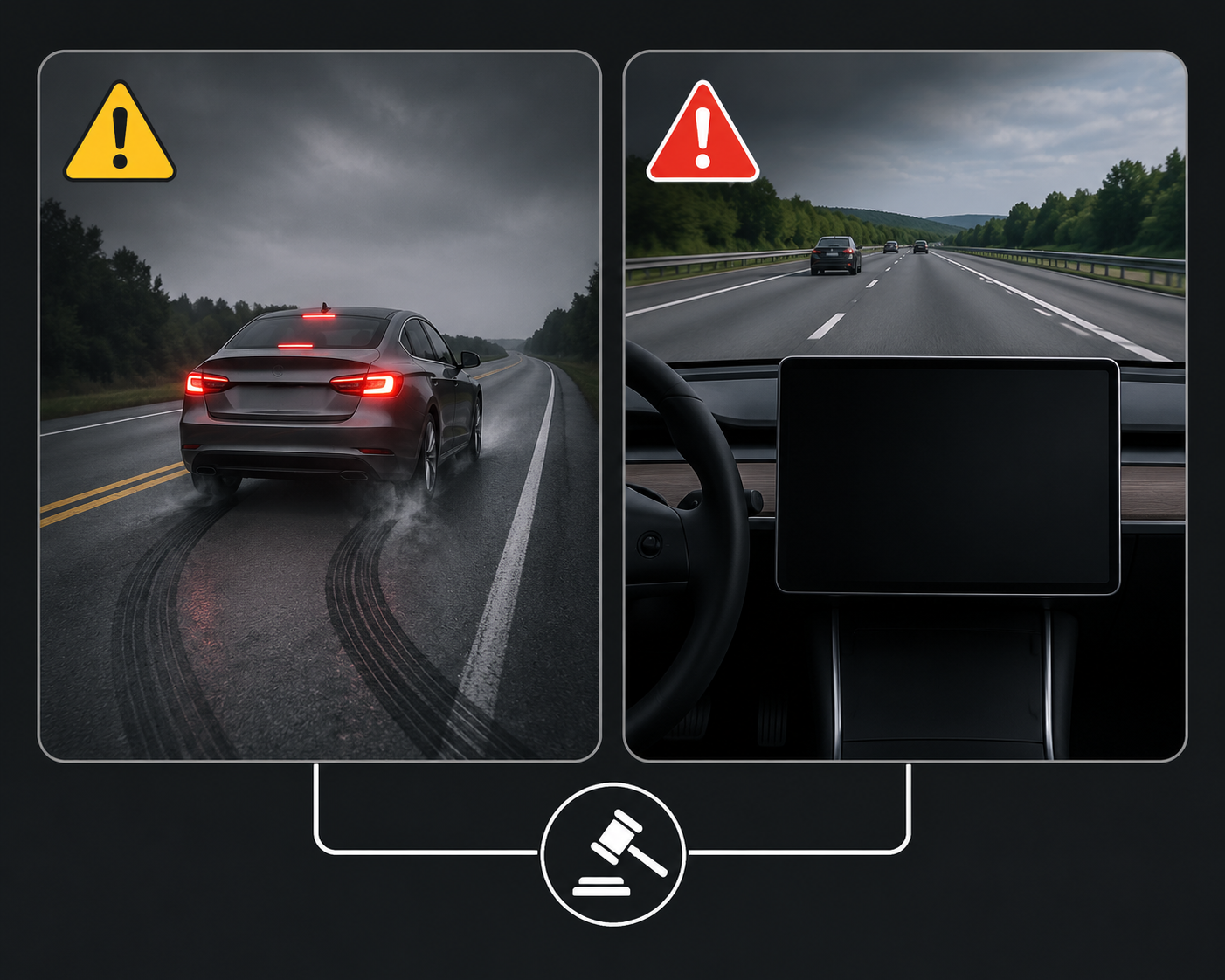
That distinction matters more than the usual shorthand of “software recall” allows. A free update may be a sensible safety remedy. It may also be the sentence plaintiffs later isolate: the manufacturer identified a defect, acknowledged a crash risk, and offered a software correction. Those statements may be accurate, responsible, and required. They are also portable.
The ordinary recall mechanics do not need much ceremony here. NHTSA recall filings exist to identify a safety-related defect, notify owners, and describe a remedy. The harder question is what happens after that public record is created. In software-defect cases, the filing can become more than a compliance document. It can become the bridge between a regulator’s safety file and a plaintiff’s defect theory.
Two defects, two safety boundaries
The May recall sits near the more familiar edge of product-liability pleading. The alleged condition is not merely that software failed in the abstract. It is that a vehicle may decelerate unexpectedly without the driver’s command. Hagerty described the issue as potential unexpected braking, while Mashable reported Hyundai’s estimate that 1% of the recalled vehicles were affected.[1][3] Even with that manifestation estimate, the language is operationally stark: unintended deceleration is a vehicle behavior, not a missing convenience feature.
That kind of recall language tends to travel easily into strict-liability allegations because it aligns with the familiar vocabulary of unreasonable danger. A plaintiff does not have to begin with a theory about elegant or inelegant code. The public record supplies a more accessible allegation: the car could slow when the driver did not ask it to slow. The engineering explanation may be complicated, but the alleged hazard is not.
The June Tucson instrument-cluster recall is different. The alleged defect does not make the vehicle brake, accelerate, steer, or stall. It makes the display go blank. Fox Business reported that the condition could cause loss of speedometer, warning-light, and gauge information, with a crash-risk consequence.[2] That moves the analysis into a related but distinct safety boundary: software can create danger not only by issuing the wrong command, but by depriving the driver of information needed to operate the vehicle safely.
That difference should not be flattened. A blank instrument cluster will not plead like a phantom-braking event. There may be no allegation that the vehicle itself took an unsafe action. The plaintiff’s theory instead must connect missing information to risk: speed cannot be monitored, warning indicators cannot be seen, and the driver is asked to operate with a compromised interface. In a traditional mechanical-defect case, the failing component often has a physical identity. Here, the relevant “part” is a display function mediated by code.
| Recall | Reported Population | Alleged Software Condition | Legal Pressure Point |
|---|---|---|---|
| May 2026 phantom-braking recall | 421,078 vehicles | Unintended deceleration without driver input | Software allegedly causing unsafe vehicle behavior |
| June 2026 Tucson instrument-cluster recall | 96,310 SUVs | Instrument cluster may go blank | Software allegedly withholding safety-critical information |
Both recalls reportedly involved free software updates, available either over the air or through a dealer-installed remedy.[1][2] That remedial similarity can obscure the legal difference between them. The remedy may be code in both cases, but the pleaded defect, causation theory, and class-certification problem will not necessarily line up.
The recall filing as litigation architecture
The most important timing fact is not just that a recall happened. It is that, according to the iHeart/KFYR report, a California class action alleging the phantom-braking issue had already been filed before Hyundai announced the May 2026 recall.[4] The available material does not independently verify a case caption or docket, so the point should be kept narrow. As reported, the sequence illustrates a familiar pattern: private litigation begins, then the recall filing supplies public, regulator-facing language plaintiffs can cite back to the manufacturer.
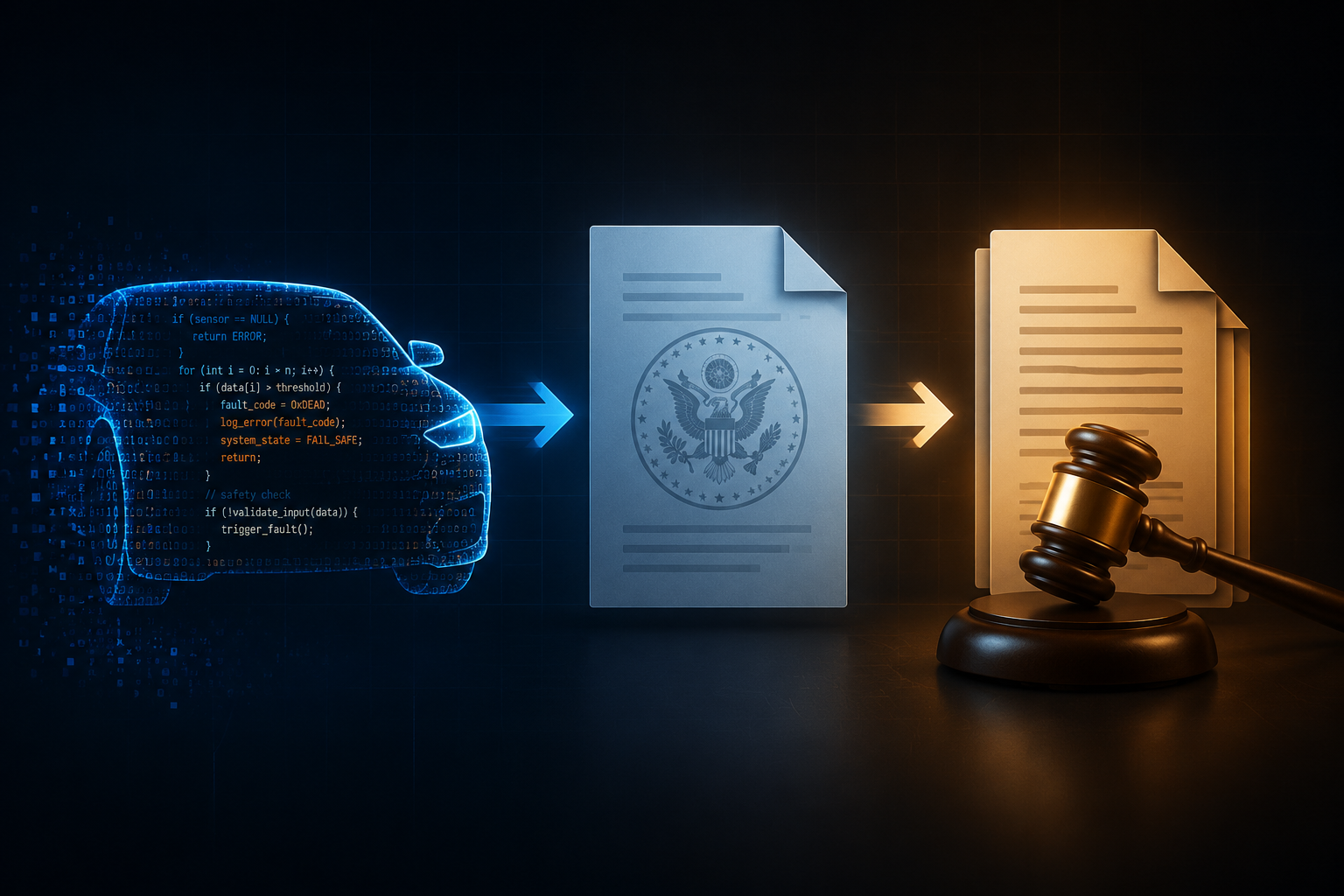
Morgan Lewis has described rising automotive litigation risk in terms that fit this sequence: recalls and regulatory filings can operate as foundations for class actions rather than as isolated compliance events.[5] That does not mean a recall is a liability admission in every jurisdiction or for every purpose. It does mean the company has created a written account of defect, population, risk, chronology, and remedy under regulatory obligations. Once published, that account becomes difficult to cabin as merely administrative.
This is where software defects create an uncomfortable drafting problem. A safety notice that minimizes the condition can look evasive to NHTSA, owners, and courts. A notice that states the condition plainly can become the cleanest exhibit in the complaint. Phrases such as “crash risk,” “unintended deceleration,” “blank display,” “estimated 1%,” and “free update” are not inflammatory by themselves. Their legal effect depends on how they are later attached to defect proof, knowledge proof, remedy adequacy, and damages.
The springboard concern is especially acute where the defect mechanism is invisible to the buyer. A cracked bracket, leaking hose, or fractured weld can sometimes be photographed, inspected, or tied to a service history. Code usually arrives as a black box to the owner. The recall filing may therefore become one of the first public documents translating an invisible condition into a legally usable narrative.
Strict liability: the defect record gets cleaner than the code
Strict-liability claims do not require the plaintiff to prove that the manufacturer acted unreasonably in the negligence sense, but they still require a defect theory and a way to show the product was unreasonably dangerous. ICLG’s 2026 U.S. product-liability overview identifies strict liability, negligence, and breach of warranty as core theories in U.S. product-liability litigation.[6] In the Hyundai recalls, the public notices give plaintiffs a starting point for the first of those theories.
For phantom braking, the strict-liability path is direct. If a vehicle may decelerate without driver input, the plaintiff can argue the product left the manufacturer with a safety-related defect that made it unreasonably dangerous. The manufacturer will still have defenses: manifestation rate, causation, remedy, owner-specific facts, software version, and whether the alleged event actually occurred. But the recall language narrows the fight. The dispute becomes less about whether there was any recognized safety condition and more about whether that condition supports the particular plaintiff’s claim.
The Tucson instrument-cluster recall is more subtle but not necessarily safer from a pleading standpoint. A blank display does not map as neatly onto a traditional mechanical-failure story. Still, the alleged loss of speed, warning lights, and gauge information gives plaintiffs a safety function to point to.[2] The defect theory becomes interface-centered: the vehicle may remain mechanically operable, but the driver’s safety-critical feedback loop is interrupted.
That matters because courts and juries do not need to read source code to understand the consequence of missing speed information. The invisible defect becomes legible through the missing display. A defense that focuses only on the elegance of the software patch may miss the simpler allegation: the product allegedly failed to provide information ordinary drivers reasonably depend on while driving.
Duke Law & Technology Review’s 2018 discussion of software defects in automated vehicles is not about these Hyundai recalls, but it remains useful for the broader legal point: software challenges product-liability analysis because defect, causation, and reasonable safety expectations may not fit cleanly into older physical-product categories.[7] The Hyundai examples do not require a fully automated-vehicle fact pattern to show the same pressure. Ordinary vehicles now carry safety-critical functions in code.
Negligence: timing becomes more than chronology
Negligence claims put more weight on what the manufacturer knew, when it knew it, and what it did next. In a software-recall record, the chronology can become unusually important because the remedy is often presented as a defined update. If the fix exists at recall time, plaintiffs may press for earlier knowledge: when was the anomaly first detected, when was the causal pathway understood, when was the update validated, and when did the risk become reportable?
The public record here does not establish Hyundai’s internal knowledge. It does not support a conclusion that Hyundai delayed improperly or knew of either condition at sale. But the public sequence still supplies plaintiffs with interrogatory targets. The May recall’s reported class-action timing gives that pressure a concrete form: if litigation was already pending, the recall can be framed as confirmation of an alleged condition rather than the beginning of public awareness.[4]
ICLG’s discussion of U.S. product-liability law also notes how negligence theories may develop around design, warning, and failure-to-act allegations.[6] For software defects, those categories translate into questions that can be awkward for a traditional recall file. Was the algorithmic behavior adequately validated before release? Were driver warnings adequate if the display could blank? Did the company’s field data, warranty data, or software logs identify a pattern before the recall? Were interim owner instructions meaningful before the update was available?
The comparison to the Fisher v. FCA US LLC pattern is not a claim that Hyundai’s facts match that case. It is a caution about how plaintiffs use chronology. In software cases, once a patch is released, plaintiffs often try to make the update itself evidence that the company could have acted sooner. That inference may be unfair in a given record; validation, root-cause analysis, and deployment all take time. Still, the recall chronology will be pleaded before those explanations are tested.
Warranty and economic loss after a free update
A free software update helps the safety file. It does not automatically end the economic-loss file. Warranty and benefit-of-the-bargain theories ask a different question: did the buyer receive the value of the vehicle promised at the time of purchase? If plaintiffs allege they paid for a vehicle free of safety-related software defects, a later no-cost patch may be characterized as repair, not full restoration.
That theory has limits. An owner who never experienced phantom braking or a blank cluster may have a harder damages story than an owner who did. A vehicle successfully updated before any incident may present no practical impairment after the remedy. State warranty law, privity rules, notice requirements, disclaimers, and economic-loss doctrines can change the analysis materially. But the recall record gives plaintiffs a common factual predicate: the vehicle population allegedly contained a safety-related software condition at the time owners possessed the product.
That is why the “free update” phrase cuts both ways. For regulators and owners, it signals access to a remedy without out-of-pocket repair cost. For plaintiffs, it may confirm that a correction was necessary and that the original software configuration was not what buyers allegedly bargained for. The defense response cannot stop at “no one paid for the patch.” The better question is whether any legally cognizable value loss remains after the patch, and for whom.
The 1% problem in class certification
Both Hyundai recall reports described an estimated 1% defect rate.[1][2] That number should be handled carefully. It is Hyundai’s estimate, not an independently audited manifestation rate in the materials available here. It is not dispositive of liability, and it does not prove that 99% of owners had no legally relevant claim. It does, however, create the procedural problem that makes software recalls structurally awkward.
At 1%, a defect can be uncommon in individual experience and still sit inside a very large recalled population. Plaintiffs can argue that every buyer received a vehicle with defective software or paid more than the vehicle was worth. Defendants can answer that most owners never experienced the alleged safety event, received a free update, and cannot show injury. Both arguments can be plausible enough to reach class-certification briefing.
ICLG’s 2026 overview identifies the unresolved significance of uninjured class members in U.S. class actions, including a circuit split: a stricter approach in the Second and Eighth Circuits, a middle approach in the First and D.C. Circuits, and a more lenient approach in the Seventh and Ninth Circuits.[6] That split matters directly for low-manifestation software recalls. The same recall filing can look overbroad in one forum and certifiable in another, depending on how much tolerance the court has for uninjured or differently injured class members.
The point is not that a nationwide class should or should not be certified from these recalls. The point is that the certification risk turns on the relationship between common defect proof and individualized injury. Software defects aggravate that relationship because the alleged defect can be common at the code level even when the alleged manifestation is rare at the driver level.
For the phantom-braking recall, individualized questions may include whether a driver actually experienced unintended deceleration, under what conditions, after which software version, and with what consequence. For the Tucson cluster recall, individualized questions may include whether the display blanked, whether the driver lost safety-critical information, whether the update was installed before any manifestation, and whether any economic loss remains. Those questions are not peripheral; they go to injury, causation, damages, and sometimes predominance.
Plaintiffs will try to move the class theory up one level of abstraction: all vehicles contained the same defective software architecture or calibration, all buyers overpaid, and the recall confirms common proof. Defendants will try to move it down one level: only an estimated small fraction manifested, owner experiences vary, updates were free, and damages cannot be presumed. Neither move is merely rhetorical. It determines whether the case is litigated as a population-wide pricing case or a set of owner-specific defect experiences.
Why OTA efficiency does not settle remedy adequacy
There is a real safety virtue in software remedies. If a dangerous condition can be corrected faster by an over-the-air update than by waiting for parts, appointments, and dealer capacity, the legal system should not pretend delay is preferable. The problem is that remedy efficiency and remedy adequacy are not the same question.
Dykema’s 2026 Automotive Trends Report states that concern over NHTSA questioning remedy adequacy rose to 41%, up 12 percentage points, and specifically notes that “software fixes for hardware problems increasingly being questioned.”[8] The Hyundai recalls at issue here are software-defect recalls rather than software fixes for a purely hardware problem, but the regulatory mood still matters. NHTSA and the industry are paying closer attention to whether a software remedy actually cures the safety condition, how it is validated, and how completion is tracked.
A free OTA or dealer-installed update may reduce owner burden. It may also raise questions a traditional parts replacement does not. Did the vehicle receive the update? Did the owner defer it? Did the update install successfully? Did it create collateral changes? Does the recall population include vehicles in configurations that behave differently? Are there vehicles outside the recall population with similar code paths? Those questions are not reasons to disfavor OTA fixes; they are reasons to document them with the expectation that someone outside engineering will later read the file.
Dykema also reported that concern over DOJ criminal enforcement risk for automakers nearly tripled to 18%.[8] That figure does not say Hyundai faces criminal exposure from these recalls. It does say the enforcement environment is less forgiving of incomplete narratives, especially where safety defects, internal knowledge, and public disclosures intersect.
Cheap fixes can still be expensive records
The economic attraction of OTA repair is obvious. Forbes, citing Harman Automotive data, reported an average cost of $500 for a traditional recall compared with $66.50 for an OTA fix.[9] That gap is too large to ignore. It helps explain why automakers have strong operational incentives to build vehicles that can be corrected through software rather than through physical replacement.
But lower remedy cost does not mean lower litigation significance. A traditional recall often has a visible part, a service procedure, and a repair event. A software recall may have a downloadable patch, an update status, and a public description of what the prior code could do wrong. The cost line may improve while the evidentiary line becomes more complicated.
That is the mistake in treating software recalls as cleaner versions of hardware recalls. They may be cleaner for logistics. They are not automatically cleaner for pleadings. The remedy can be fast, inexpensive, and appropriate while still leaving a record that frames the pre-update vehicle as defective. For class-action purposes, that record may be more important than the marginal cost of distributing the patch.
What counsel should benchmark from the Hyundai pair
The Hyundai recalls do not prove catastrophic liability. They do not prove that software defects are inherently worse than hardware defects. They do show why code-based safety issues belong in a distinct risk category. The defect may be invisible to the buyer, common at the software level, rare at the manifestation level, correctable by update, and still powerful as a public pleading exhibit.
For documentation discipline, the benchmark is not to drain recall notices of useful facts. The benchmark is to make sure the facts are accurate, bounded, and internally supportable before they are made public. If the estimated manifestation rate is 1%, the basis for that estimate should be understood and preserved. If the remedy is described as a software update, the validation record should explain what condition it corrects and how the company knows that.
For remedy framing, the important distinction is between access and cure. A free OTA update may be an accessible remedy. Whether it cures the alleged safety condition, restores any alleged economic loss, and reaches the affected population are separate questions. Those questions should be answered in the record before they are asked in discovery.
For class-action exposure, the Hyundai pair is a reminder to model both population and manifestation. A low estimated defect rate may help oppose injury and damages theories, but it will not necessarily defeat a class theory built around common software, overpayment, or recall-confirmed defect allegations. Jurisdiction matters because the treatment of uninjured class members remains uneven across circuits.[6]
This article is research-driven legal analysis, not legal advice. The application of recall language, warranty rules, economic-loss doctrines, class-certification standards, and regulatory obligations depends on jurisdiction-specific law and the underlying record; manufacturers and litigants should consult counsel for advice on particular matters.
References
- Hyundai recalls 421,000 cars for software bug: See the full list — Mashable
- Hyundai recalls 96K Tucson SUVs over dashboard software glitch — Fox Business
- Hyundai Recalls 421K Vehicles for Potential Unexpected Braking — Hagerty Media
- Hyundai Recalls Over 421,000 Vehicles To Fix Issue That Could Cause A Crash — iHeart/KFYR
- Automotive Manufacturers: Rising Litigation Risks Fuel Caution — Morgan Lewis
- USA - Product Liability Laws and Regulations 2026 — ICLG
- Crashed Software: Assessing Product Liability for Software Defects in Automated Vehicles — Duke Law & Technology Review
- 2026 Automotive Trends Report: Regulatory Compliance and Enforcement — Dykema
- Auto Software Recalls Approach Record For 6th Straight Year — Forbes
Related records
Tool profile
Browse tool evaluations →Governing regulation
Browse the obligations tracker →Preventive workflow
Browse verification workflows →
Report a correction or tip
Spotted an outdated figure, a misstated fact, or a ruling this case record should reflect? Public comments are disabled for this content given the professional cost of a misreported case outcome, penalty amount, or rule text — use the structured correction channel instead.
Report a correction or tip for this record →