
Federal judge lets ICE agents mask up, keeps NY 287(g) ban
What did the federal judge decide about ICE agents wearing masks in New York, and what survives? The August 3 ruling is a split: New York's mask and identification rules are preliminarily blocked as applied to federal officers, while the state's 287(g) local-agreement ban remains in effect and takes full effect on August 25, 2026.
- Jurisdiction
- U.S. federal
- Court
- U.S. District Court for the Northern District of New York
- Judge
- Mae D'Agostino
- AI tool named
- No AI tool implicated
- Ruling date
- Aug 3, 2026
- Source document
- View primary court order ↗
- Last verified
- Aug 4, 2026
Lex Machina Review is an independent risk-tracking and reference resource. Nothing on this site is legal advice, and using it does not create an attorney-client relationship. Every record is reviewed against primary sources but may not reflect the most current status of a matter — always verify directly against the cited court order, rule text, or a licensed attorney before relying on it.
Companion explanation — secondary to the source document above
Last verified: Aug. 4, 2026 (UTC). This is a regulation-status record, not legal advice. The federal judge ruling on ICE agents’ masks in New York is a split order: Judge Mae D’Agostino of the Northern District of New York preliminarily blocked New York’s face-covering and identification requirements as applied to federal officers, while denying the federal government’s request to block New York’s ban on local 287(g) agreements with ICE. The 287(g) ban remains in force and is set to take full effect on Aug. 25, 2026.[1][2][3]
| Provision at issue | Status after the Aug. 3 order | Immediate consequence |
|---|---|---|
| New York face-covering / mask restriction for covered officers | Preliminarily enjoined as applied to federal officers | Federal officers including ICE are not presently subject to that state mask restriction while the injunction remains in place. |
| New York identification requirement for covered officers | Preliminarily enjoined as applied to federal officers | The state cannot presently enforce those identification rules against federal officers covered by the order. |
| Local Cops, Local Crimes Act ban on 287(g) agreements | Not enjoined | State and local entities remain subject to New York’s ban; the termination deadline remains Aug. 25, 2026. |
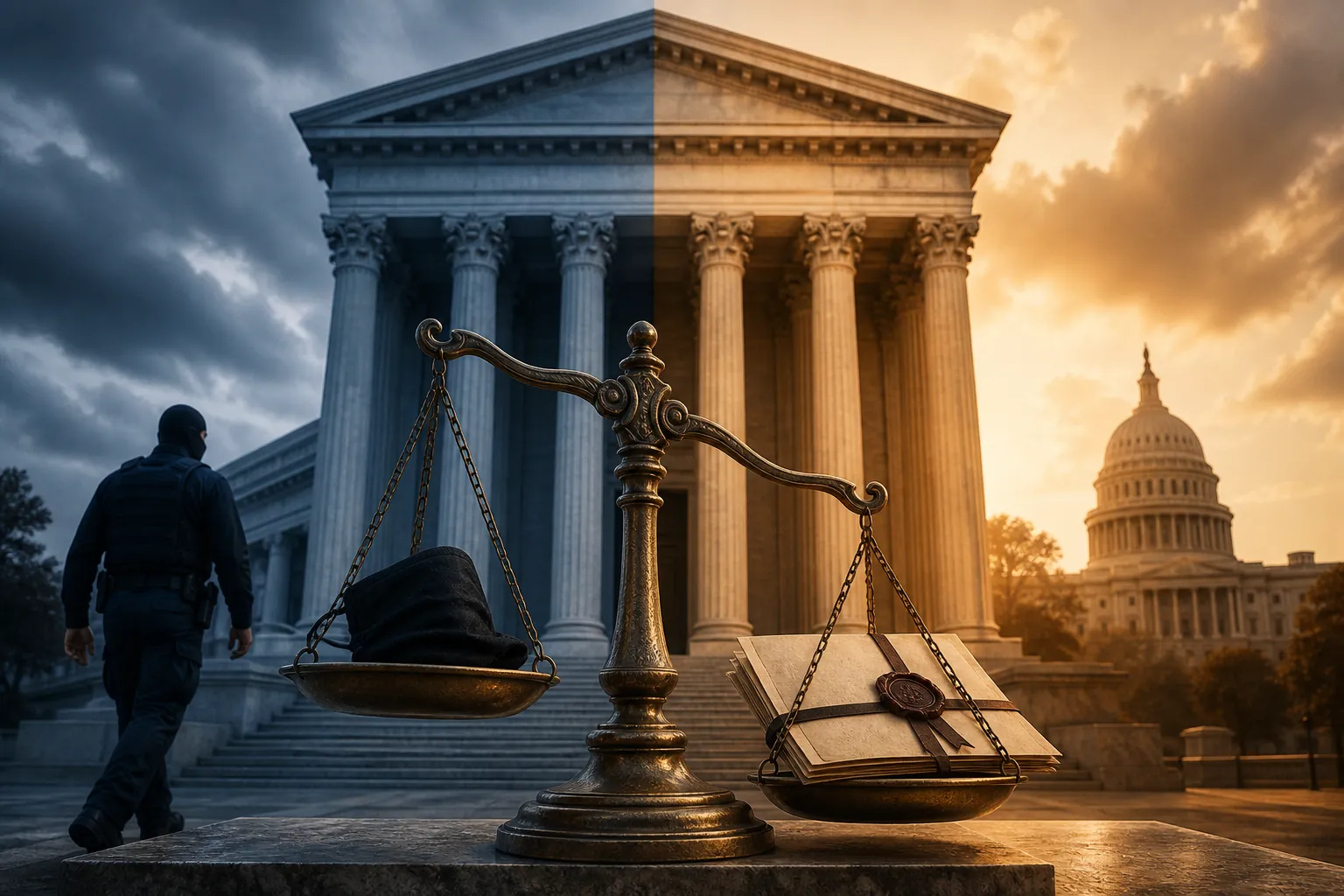
What was blocked: the mask and identification rules, as applied to federal officers
The most practical answer is the narrow one. ICE officers can still use face coverings in New York for now because the preliminary injunction runs against New York’s enforcement of the challenged mask and identification provisions as applied to federal officers. Public reports identify the covered federal personnel as including ICE, FBI, DEA, and CBP officers.[1]
That does not mean the court blessed every federal enforcement practice, and it does not mean New York lost the entire case. The order, as reported from the 51-page decision, treated the mask and identification rules as a federal-supremacy problem: New York was trying to impose its own uniform requirements on federal officers while they were carrying out federal duties. Newsday quoted Judge D’Agostino as writing that the issue “is about constitutionality — not transparency or preferable policy decisions,” and that “New York cannot impose its own uniform requirements on federal agents simply because it disagrees with how the Federal Government is exercising its authority.”[1]
For a lawyer advising a federal agency component, the current instruction is correspondingly limited: do not treat the New York mask and ID provisions as enforceable against covered federal officers while the preliminary injunction remains in place. For a state or local official, the safer reading is just as limited: the order does not erase the statutes wholesale, and it does not answer every possible application outside the federal-officer context described in the injunction.
What survived: New York’s ban on local 287(g) agreements
The part of the order most likely to be lost in a headline is the 287(g) holding. The Justice Department also asked the court to block New York’s Local Cops, Local Crimes Act provisions restricting state and local participation in 287(g) immigration-enforcement agreements. Judge D’Agostino denied that request.[2]
The reasoning is different because the actor is different. On the mask and identification provisions, New York was regulating federal officers directly. On 287(g), the court treated participation by state and local entities as voluntary under federal law, not as something Washington could require New York or its subdivisions to maintain. Fox News reported that the court described the state ban as “an appropriate means of furthering New York’s legitimate interests in protecting public welfare and choosing how state and local resources are expended.”[2]
That distinction matters before the next business day. A county sheriff’s office, police department, jail administrator, or municipal lawyer should not read the ICE-mask ruling as permission to continue a prohibited 287(g) arrangement. New York’s Office of Immigrant Trust had already sent compliance letters to all 12 New York agencies with 287(g) agreements, setting an Aug. 25, 2026 termination deadline; that deadline remains the operative date after the preliminary-injunction order.[3]
The same state release identified practical reporting channels for alleged violations: the Office of the Attorney General’s federal-action portal and the 1-800-771-7755 hotline.[3] Whether those channels become litigation exhibits later is a separate question. For compliance planning, they are the state’s announced intake routes.

How the case reached Judge D’Agostino
The procedural path is untidy, but only a few points are needed to understand the current order. The Justice Department filed a complaint challenging New York’s mask-ban and identification provisions on June 23, 2026, after New York officials and the federal government had already moved into dueling-suit posture over the same state laws.[4][5] Reports from the June filing described the state mask and identification provisions as taking effect June 26, 2026.[5]
The judge-shopping dispute then changed the venue. On July 10, U.S. District Judge Lawrence Vilardo in the Western District of New York transferred the Justice Department suit to the Northern District of New York, criticizing the department’s venue choice and calling its naming of former Buffalo Assistant Attorney General Michael Russo “highly suspect,” according to Syracuse.com’s account of the transfer order.[6]
New York’s declaratory action has been publicly identified as 1:26-cv-1281 (MAD/ML).[5] The transferred Justice Department docket number and any consolidation status should be checked on the live federal docket before anyone cites the case in a filing. That is not a formality here; the operative order is preliminary, the cases arrived through a transfer fight, and the details matter.
The legal split is the point
The order’s two outcomes are not in tension if they are kept on their own tracks. The federal government did better where New York’s laws operated directly on federal officers. New York did better where the challenged provision controlled state and local participation in a voluntary federal-local program.
| Question counsel must answer | Current answer |
|---|---|
| Can ICE agents wear masks in New York while performing federal duties? | Yes, for now, as to the state mask restriction covered by the preliminary injunction. |
| Can New York enforce the challenged identification requirement against covered federal officers? | Not while the preliminary injunction remains in place. |
| Can a New York locality assume the 287(g) ban was knocked out too? | No. The court denied the request to enjoin that ban. |
| Does the order finally resolve the merits? | No. It is a preliminary-injunction ruling. |
| Does the order validate or reject the policy arguments for masked immigration enforcement? | Not in any broad way. The reported reasoning turns on constitutional structure and state resource authority. |
That is also why the large public-safety rhetoric around masked officers should not carry more weight than the order gives it. The Justice Department complaint challenged the New York provisions and advanced federal enforcement concerns, but the operational holding described in public accounts rests on supremacy and intergovernmental-immunity reasoning for federal officers, and on voluntariness and state resource allocation for 287(g).[1][2][4]
What each office should change now
Federal litigators and agency counsel should separate two advisories. One advisory concerns field conduct by federal officers under the mask and identification provisions. The other concerns any state or local partner’s 287(g) status. Bundling them into a single “New York lost” memo would be inaccurate.
- For federal enforcement components: confirm which personnel and activities fall within the preliminary injunction before treating New York’s mask and identification rules as displaced.
- For county and municipal counsel: continue planning around the Aug. 25, 2026 287(g) termination deadline unless and until a later order changes it.
- For sheriffs and police departments with existing 287(g) agreements: preserve correspondence with the Office of Immigrant Trust and document any termination or wind-down steps.
- For immigration defense counsel: distinguish a masked federal arrest issue from a local-agreement authority issue. The preliminary injunction affects the former category more directly than the latter.
- For legal journalists and knowledge-management teams: avoid describing the order as a full block of New York’s immigration-enforcement laws.
Reactions do not change the operative status
The public statements came out in predictable directions. Fox News quoted DHS General Counsel James Percival as saying, “Blue states continue to stack losses,” after the mask portion of the order.[2] Spectrum News reported that Gov. Kathy Hochul and Attorney General Letitia James said they were reviewing legal options while also welcoming the court’s refusal to block the 287(g) ban.[7]
Those reactions are useful only after the split is clear. They do not turn the preliminary injunction into a full federal sweep or a full state win.
Verification notes before citing the order
Before relying on the decision in a brief, pull the Aug. 3, 2026 preliminary-injunction order from PACER or another live docket source and verify the exact operative language. The public reports identify the opinion as 51 pages, but the order text itself should control any filing, client alert, or compliance instruction.[1]
As of this verification pass, the safest dated status is straightforward: federal officers are preliminarily relieved from New York’s mask and identification rules for now; New York’s ban on 287(g) agreements remains in force and becomes fully effective on Aug. 25, 2026.[1][2][3]
References
- ICE agents can wear masks in New York, federal judge rules — Newsday, Aug. 3, 2026
- Federal judge blocks New York ICE mask ban law — Fox News, Aug. 3, 2026
- Attorney General James and Governor Hochul Announce First Enforcement Action Under New Law Banning Local Agreements with ICE — New York State Attorney General, July 24, 2026
- Justice Department Files Complaint Challenging New York Mask Ban and Identification Restrictions Targeting Federal Immigration Officers — U.S. Department of Justice, June 23, 2026
- New York's mask ban for ICE agents sparks dueling suits with DOJ — Courthouse News, June 23, 2026
- Judge slams Justice Dept. for judge shopping its lawsuit against NY mask ban — Syracuse.com, July 14, 2026
- Judge allows N.Y. bans of local agreements with ICE, blocks mask ban for agents — Spectrum News, Aug. 3/4, 2026
Related records
Tool profile
How Meta's AI Spending Reshapes Law Firm ProfitabilityGoverning regulation
Browse the obligations tracker →Preventive workflow
Browse verification workflows →
Report a correction or tip
Spotted an outdated figure, a misstated fact, or a ruling this case record should reflect? Public comments are disabled for this content given the professional cost of a misreported case outcome, penalty amount, or rule text — use the structured correction channel instead.
Report a correction or tip for this record →