
Why the ICE detention center sale is a legal risk transfer
Federal ownership of California's two largest ICE detention facilities, bought from CoreCivic for roughly $1.5B in July 2026, shifts the decisive oversight fight from state inspection and permitting into federal forums. The record verifies the transaction terms, breaks down the contested premium over assessed value, and maps the pending litigation that will set how much state authority survives the sale.
- Jurisdiction
- U.S. 9th Circuit
- Court
- U.S. Court of Appeals for the Ninth Circuit
- AI tool named
- No AI tool named
- Ruling date
- Sep 26, 2022
- Source document
- View primary court order ↗
- Last verified
- Jul 31, 2026
Lex Machina Review is an independent risk-tracking and reference resource. Nothing on this site is legal advice, and using it does not create an attorney-client relationship. Every record is reviewed against primary sources but may not reflect the most current status of a matter — always verify directly against the cited court order, rule text, or a licensed attorney before relying on it.
Companion explanation — secondary to the source document above
The legally important move in the July 2026 ICE detention center sale is not that CoreCivic walked away. It did not. The important move is that title to two California detention facilities shifted to the federal government while CoreCivic stayed in place as operator. For legal analysis of the sale in the Trump administration’s detention-policy context, that ownership-operation split matters more than the headline price because it changes who has the cleanest enforcement lever when inspectors, permitting officials, or local agencies demand access next week.
CoreCivic reported that, on July 2, 2026, it completed the sale of the Otay Mesa Detention Center and the California City Immigration Processing Center to the U.S. Department of Homeland Security for $739.2 million and $732.6 million, respectively, and expected about $1.1 billion in net proceeds after repayment of related debt and transaction costs.[1] CalMatters reported the bed counts as 1,994 at Otay Mesa and 2,560 at California City, making them California’s two largest ICE detention facilities.[2]
This is a record-based legal-risk analysis, not legal advice. The conclusions below depend on the transaction documents, court orders, docket records, and the distinction between what courts have already held and what litigants are still asking courts to decide.
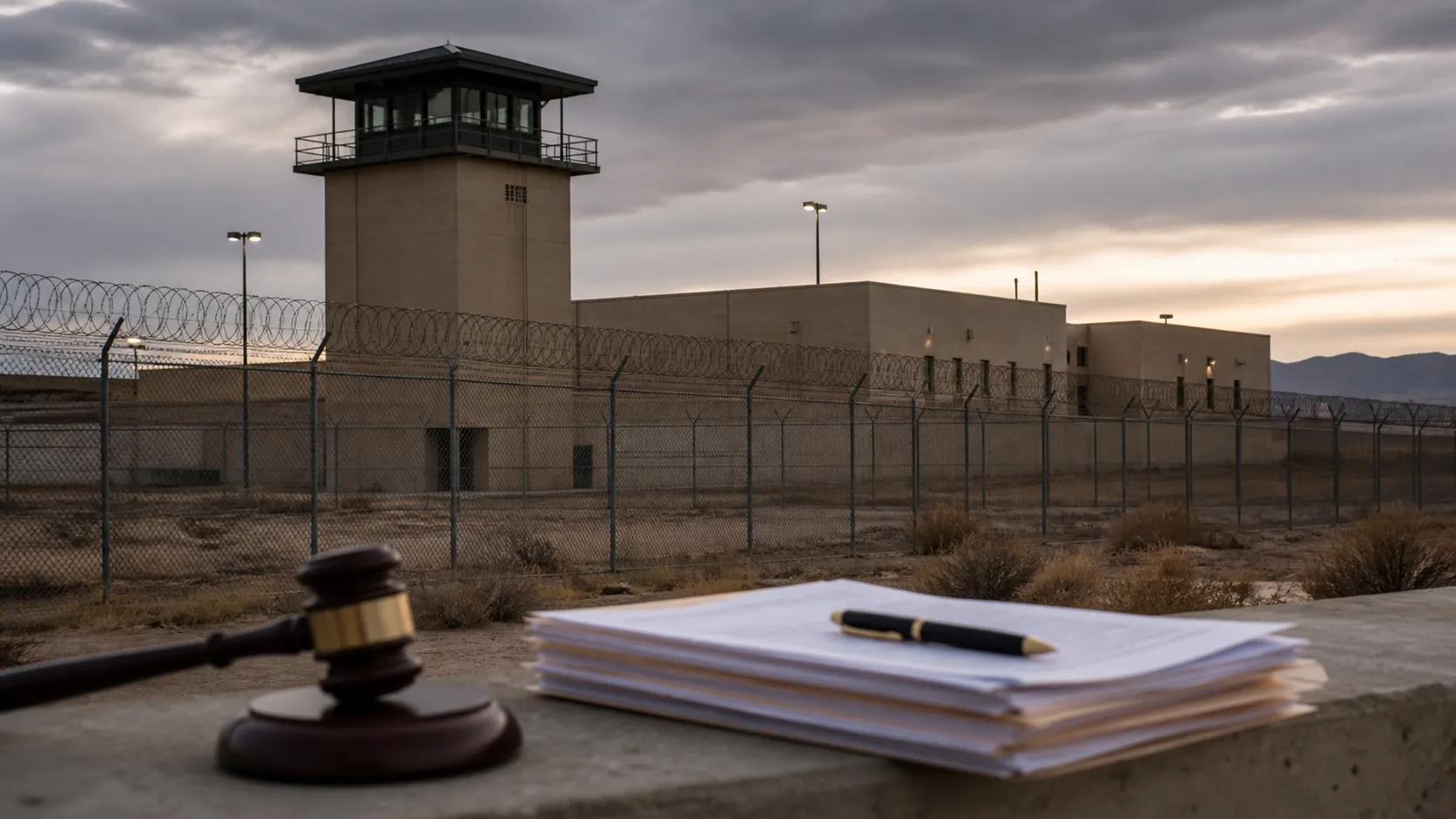
What changed hands, and what did not
The sale moved real property into federal hands. It did not, on the reported record, replace the private operator. That continuity is why the transaction should not be treated as a simple privatization-versus-nationalization story. The same company remains central to daily operation, but the facility owner now sits behind federal title.
| Facility | Reported capacity | Sale price | Post-sale operating point |
|---|---|---|---|
| Otay Mesa Detention Center | 1,994 beds | $739.2 million | CoreCivic remains operator; existing ICE contract reported through December 2029, with a five-year option exposure |
| California City Immigration Processing Center | 2,560 beds | $732.6 million | CoreCivic remains operator; existing ICE contract reported through August 2027 |
That distinction matters because ownership is often the hinge on which state and local leverage turns. A county inspection demand against a privately owned detention site presents one set of questions. A county inspection demand against federally owned property operated by a private contractor presents another. The person left with the practical problem is not the official describing the transaction at a podium; it is the lawyer deciding whether a health inspector, zoning office, permit administrator, or environmental reviewer still has a usable route to compel compliance.
CoreCivic also disclosed that it had early-stage discussions with ICE about additional potential facility sales.[1] That does not mean further transactions will close. It does mean counsel should not treat the California sale as a one-off record to be filed away without a playbook. If a private detention facility can be sold to the federal government while the operator remains under contract, the legal risk being transferred is not only real-estate risk. It is oversight risk, forum risk, and renegotiation risk.
The assessed-value premium is contested, but it is not the center of the legal case
The price is still worth getting right because it has become an easy substitute for harder legal analysis. CalMatters reported that the Otay Mesa sale price of $739.2 million was about 4.5 times its San Diego County assessed value of $164.9 million, and that the California City sale price of $732.6 million was about 4.3 times its Kern County assessed value of $171.5 million.[3]
Those comparisons may be politically potent. They are not, standing alone, proof of overpayment. California assessed values can diverge from market value under Proposition 13, and CoreCivic has argued that the federal acquisition process relied on appraisal work rather than county assessment figures.[3] The public record supports a dispute over the premium; it does not support treating the assessed-value multiple as a judicial finding about waste, fraud, or invalid acquisition authority.
The harder legal issue is not whether the facilities looked expensive on county tax rolls. It is whether the change in title reduces the force of California and local oversight tools that were already being litigated before the sale closed.
The oversight fight was already active before federal ownership
San Diego County’s inspection-access dispute shows why this is not an abstract federalism problem. In June 2026, before the sale closed, a federal judge ordered access for San Diego County health inspectors at Otay Mesa.[4] The case profile for County of San Diego v. U.S. Department of Homeland Security identifies the action as filed in March 2026 in the Southern District of California against DHS and CoreCivic.[5]
Inspection access is the legal mechanism that connects detention conditions to enforceable conduct. Without access, concerns about sanitation, medical conditions, crowding, or other health matters risk being pushed into slower, less direct channels. With access, a county can at least attempt to convert conditions evidence into official findings, corrective demands, or enforcement steps. That is why the ownership change matters: it may alter the answer to who can insist on entry, under what authority, and in which court.
The California City facility brings a different local-government lever into view. CalMatters reported pending litigation involving California City permitting issues, alongside a constitutional challenge brought by GEO Group and CoreCivic to California’s 2024 county-inspection law.[3] Those disputes are not identical to the San Diego inspection-access fight, but they sit in the same legal neighborhood: state and local officials trying to use generally available inspection, permitting, or land-use authority against immigration detention sites tied to federal detention contracts.

GEO Group v. Newsom is the doctrinal backdrop California cannot ignore
The central precedent is not a 2026 purchase case. It is GEO Group, Inc. v. Newsom, the Ninth Circuit en banc decision issued on September 26, 2022, addressing California’s AB 32, which sought to phase out private detention facilities in the state. The Ninth Circuit held that AB 32 was obstacle-preempted because it conflicted with federal immigration detention operations, and also violated intergovernmental immunity by discriminating against the federal government and those with whom it deals.[6]
That holding does not mechanically answer every post-sale question. AB 32 was a broad state prohibition on private detention contracting. A county health inspection rule, a municipal permit condition, a zoning dispute, or an environmental requirement may present different facts and a different claimed state interest. The mistake would be to read GEO Group as either irrelevant or as a blanket exemption from all nonfederal law. It is neither.
What GEO Group does provide is the analytic path DHS, ICE contractors, and facility owners are likely to invoke: obstacle preemption if the state or local rule is said to frustrate federal detention operations, and intergovernmental immunity if the rule is said to discriminate against the federal government or its contractors. Federal ownership strengthens that argument because the challenged state or local action is no longer aimed only at a privately owned facility performing federal work. It can now be characterized as interference with federal property used for federal detention.
Congressional Research Service materials describe DHS detention authority as part of the federal statutory framework for immigration custody, which is the background against which these preemption and immunity disputes arise.[7] That framework does not by itself decide whether a county inspector may enter a particular site. It does explain why courts will likely treat the federal interest as operational, not merely contractual.
“Shielding” is a litigation theory and expert inference, not yet a final boundary
The Sacramento Bee reported that the DHS purchase may limit California detention oversight, quoting former senior ICE official Claire Trickler-McNulty on the shielding effect federal ownership may create.[8] That point deserves weight because it describes the practical consequence state and local lawyers now face. But it should be framed accurately: it is expert-informed analysis and doctrine-based inference, not a final court holding that every California inspection, zoning, permitting, or environmental rule has been displaced.
The forum shift is easier to see than the final merits line. Once the property is federally owned, local enforcement efforts are more likely to trigger removal, federal defenses, emergency motions, and federal-court supervision. A county may still argue that a health-and-safety inspection is neutral, generally applicable, and compatible with federal operations. DHS or the contractor may respond that the same inspection imposes operational control over a federal detention site. The answer will depend on the rule, the remedy, and the burden the court sees.

The live map: which levers are narrowed, which remain unresolved
| Issue | Current posture on the reported record | Why the sale changes leverage |
|---|---|---|
| San Diego County inspection access at Otay Mesa | County action filed in March 2026; federal judge ordered inspection access in June 2026 | After federal acquisition, continued inspection demands may be litigated as demands affecting federal property, not only a private detention site |
| California City permitting dispute | Pending litigation reported around local permit issues | Federal ownership gives DHS and the operator a stronger argument that local permitting conditions interfere with federal detention operations |
| California’s 2024 county-inspection law | Constitutional challenge by GEO Group and CoreCivic reported | Courts must decide whether the inspection scheme is permissible health-and-safety regulation or an impermissible burden on federal detention contracting and property use |
| Statewide anti-private-detention authority | AB 32 already failed in GEO Group v. Newsom at the Ninth Circuit en banc stage | The precedent strengthens federal preemption and intergovernmental-immunity defenses, but does not automatically resolve narrower inspection or permitting rules |
For state and local counsel, the question is no longer simply, “Do we have a statute, ordinance, permit condition, or inspection authority?” The sharper question is whether the requested act can survive a federal challenge under preemption and intergovernmental-immunity principles after title has passed to DHS. A narrowly framed health inspection request may be easier to defend than a permit condition that functions like a veto over detention operations. A documentation demand may be easier to defend than an order that stops intake or changes bed use. Those distinctions are exactly where the next disputes will be fought.
For contractors, the sale does not eliminate operational risk. CoreCivic remains the operator, and existing contracts still matter. California City’s reported contract runs through August 2027; Otay Mesa’s reported contract runs through December 2029 with a five-year option exposure.[2] A federal title transfer may reduce one category of state and local leverage, but it does not erase contract compliance, conditions litigation, federal oversight, or renegotiation risk.
The federal acquisition fits a larger detention-capacity record, but it should not be blurred with federal property offloading
CalMatters reported the purchase against a broader detention-capacity backdrop, including a $45 billion detention allocation running through fiscal year 2029.[3] That context helps explain why DHS would want durable control over major detention assets. It does not change the narrower legal question posed by this sale: what happens when a privately owned detention facility becomes federally owned while private operation continues?
That question should also be kept separate from the opposite kind of “sale” story: federal disposal of warehouses or other government property. The CoreCivic-DHS transaction runs in the other direction. Private detention assets moved into federal ownership. The operator did not disappear. The legal fight therefore moves toward federal property, federal contracting, and federal detention authority rather than ordinary surplus-property disposal.
Where the boundary now sits
The sale gives DHS and CoreCivic a materially stronger position against state and local control efforts, especially where those efforts can be characterized as regulating federal detention operations through property, permits, inspections, or land use. It also makes federal court the practical center of gravity for disputes that might once have looked more local.
But the surviving scope of California and local authority has not been finally drawn. GEO Group v. Newsom supplies the federal side with powerful preemption and intergovernmental-immunity reasoning. The pending San Diego, California City, and constitutional challenges will test how far that reasoning extends when the rule at issue is not a statewide private-detention ban, but an inspection demand, a permit dispute, a zoning condition, or an environmental requirement applied to a federally owned facility operated by a private contractor.
References
- CoreCivic Form 8-K: Sale of Two Detention Facilities — SEC EDGAR
- CoreCivic sells 2 CA ICE detention centers to federal government — CalMatters, July 2026
- Why feds bought ICE detention centers in California — CalMatters, July 2026
- Judge orders ICE detention center to allow San Diego County health inspectors access — CalMatters, June 2026
- County of San Diego v. U.S. Department of Homeland Security case profile — Civil Rights Litigation Clearinghouse
- GEO Group, Inc. v. Newsom en banc opinion — U.S. Court of Appeals for the Ninth Circuit, September 26, 2022
- CRS LSB11463 on DHS detention authority — Congressional Research Service
- DHS purchase may limit California detention oversight — Sacramento Bee
Related records
Tool profile
How Meta's AI Spending Reshapes Law Firm ProfitabilityGoverning regulation
Browse the obligations tracker →Preventive workflow
Browse verification workflows →
Report a correction or tip
Spotted an outdated figure, a misstated fact, or a ruling this case record should reflect? Public comments are disabled for this content given the professional cost of a misreported case outcome, penalty amount, or rule text — use the structured correction channel instead.
Report a correction or tip for this record →