
Legal Accountability for 2026 ICE Detention Medical Failures
A source-linked record of what the 2026 ICE detention reports document about systemic medical-care failure and which legal accountability channels remain open after administrative oversight was defunded or rolled back—court orders, monitors, damages actions, FOIA, and state oversight—each tied to a primary document.
- Jurisdiction
- US federal
- Court
- U.S. District Court for the Northern District of California
- Judge
- Maxine Chesney
- AI tool named
- No AI tool named
- Ruling date
- Feb 10, 2026
- Source document
- View primary court order ↗
- Last verified
- Aug 1, 2026
Lex Machina Review is an independent risk-tracking and reference resource. Nothing on this site is legal advice, and using it does not create an attorney-client relationship. Every record is reviewed against primary sources but may not reflect the most current status of a matter — always verify directly against the cited court order, rule text, or a licensed attorney before relying on it.
Companion explanation — secondary to the source document above
Verification posture
- Last verified: August 1, 2026, 00:00 UTC.
- Placement: Regulation & Ethics. This is outside the site’s usual AI-risk lane, but it fits as an obligations tracker: which public records establish medical-care failures, and which accountability channels are producing enforceable consequences.
- Legal-background review: Marisol Keene.
- Non-advice disclaimer: this article is a source-linked public-record analysis, not legal advice, and it does not assess any individual detainee’s claim.
- Counting rule: death figures are kept separate by source and counting window. KFF’s March 2026 figure, HRW/PHR’s June 2026 figure, CNN’s mid-May investigation, and American Oversight’s 2025 figure are not added together.
The 2026 ICE detention medical-care record is now less a single “how bad is it?” story than a test of which institutions can still make facts stick. HRW and Physicians for Human Rights counted 52 deaths in ICE custody from January 20, 2025 through June 4, 2026, including 39 deaths in the first year of the second Trump administration, which the report describes as the highest annual number since ICE was established in 2003 [1]. KFF separately counted 46 deaths since January 2025 as of March 18, 2026, with 33 deaths in 2025 compared with 11 in 2024 [2]. CNN and the Project on Government Oversight, using county medical-examiner reports, identified at least a dozen deaths since January 2025 where earlier diagnosis or faster emergency response might have changed outcomes, and documented discrepancies between examiner records and ICE summaries [3].
| Record type | What it can establish | Current use in this article |
|---|---|---|
| Death and medical-care reports | Attributed counts, counting windows, recurring medical-failure patterns, and disputed agency summaries [1][2][3] | Evidence of scale and record unreliability, not a combined death total |
| Inspection and oversight reports | Conflicting inspection results across DHS oversight programs, including GAO’s FY2024 comparison of ODO, IHSC, and OIDO findings [4] | Evidence that ordinary administrative inspection channels did not describe the same facility reality |
| Agency directives and death-reporting pages | ICE’s public death-reporting posture and the June 2, 2026 removal of the 30-day post-release death-reporting requirement [5] | Evidence that the public administrative record is becoming thinner |
| Court orders and monitor filings | Preliminary injunctions, class relief, monitor appointment, site inspection, record review, and compliance findings [6] | Primary evidence of enforceable remedial mechanisms |
| FOIA litigation | Requests and lawsuits seeking death and custody records after ICE shifted from detailed reports to summaries [7] | A route to records, not yet a route to medical-care correction |
| Doctrinal authorities | Status of Bivens medical-care claims, FTCA overlap, and Public Health Service officer immunity [8][9] | Damages-path risk map, not proof of current facility compliance |
The first failure is the record itself
The reported death counts are alarming, but the legally sharper problem is that the records do not line up. HRW/PHR’s 52-death figure covers January 20, 2025 through June 4, 2026; KFF’s 46-death figure stops on March 18, 2026; CNN’s investigation was published in mid-May and focused on medical-examiner files and agency-summary conflicts; American Oversight described 33 ICE custody deaths in 2025 in its June 4, 2026 FOIA litigation announcement [1][2][3][7]. Those numbers may point in the same direction, but they are not interchangeable.
The inconsistencies matter because detention medical-care litigation often turns on the mundane: whether the blood pressure reading was charted, whether a complaint of pain appeared in the file, whether an emergency response was delayed, whether a death was categorized before the outside examiner completed review. CNN and POGO reported that ICE’s account of Maksym Chernyak’s death omitted hypertension noted by county records, that Jose Damas’s reported toothache did not appear in ICE’s initial statement, and that the El Paso County medical examiner ruled the January 2026 death of Francisco Javier Lunas Campos a homicide while ICE reported it as a suicide [3]. Those are not just narrative discrepancies. They are the places where lawyers ask whether the administrative record can be trusted at all.
GAO’s 2025 inspection report gives the same problem a bureaucratic shape. In fiscal year 2024 inspections, ICE’s Office of Detention Oversight rated 238 of 241 facilities acceptable or above, and ICE Health Service Corps found 46 of 47 facilities compliant. OIDO, by contrast, found 31 of 33 facilities non-compliant with the standard that triggered inspection [4]. An inspection apparatus can be active and still fail to produce a shared account of conditions.
The administrative record then narrowed. HRW/PHR reported that OIDO went from 86 positions to zero after the April 30, 2026 appropriations bill, while the statutory Ombudsman position at 6 U.S.C. § 205 remained without staff or budget; the same report described CRCL as cut from 135 positions to 4 [1]. ICE also ended the 30-day post-release death-reporting requirement through a June 2, 2026 directive, after a prior shift from detailed death reports to shorter summaries [5][7]. The result is not merely less oversight in the abstract. It is fewer contemporaneous records for a family, counsel, monitor, or court to test.
California City is the controlling example because it moved from allegation to enforceable order
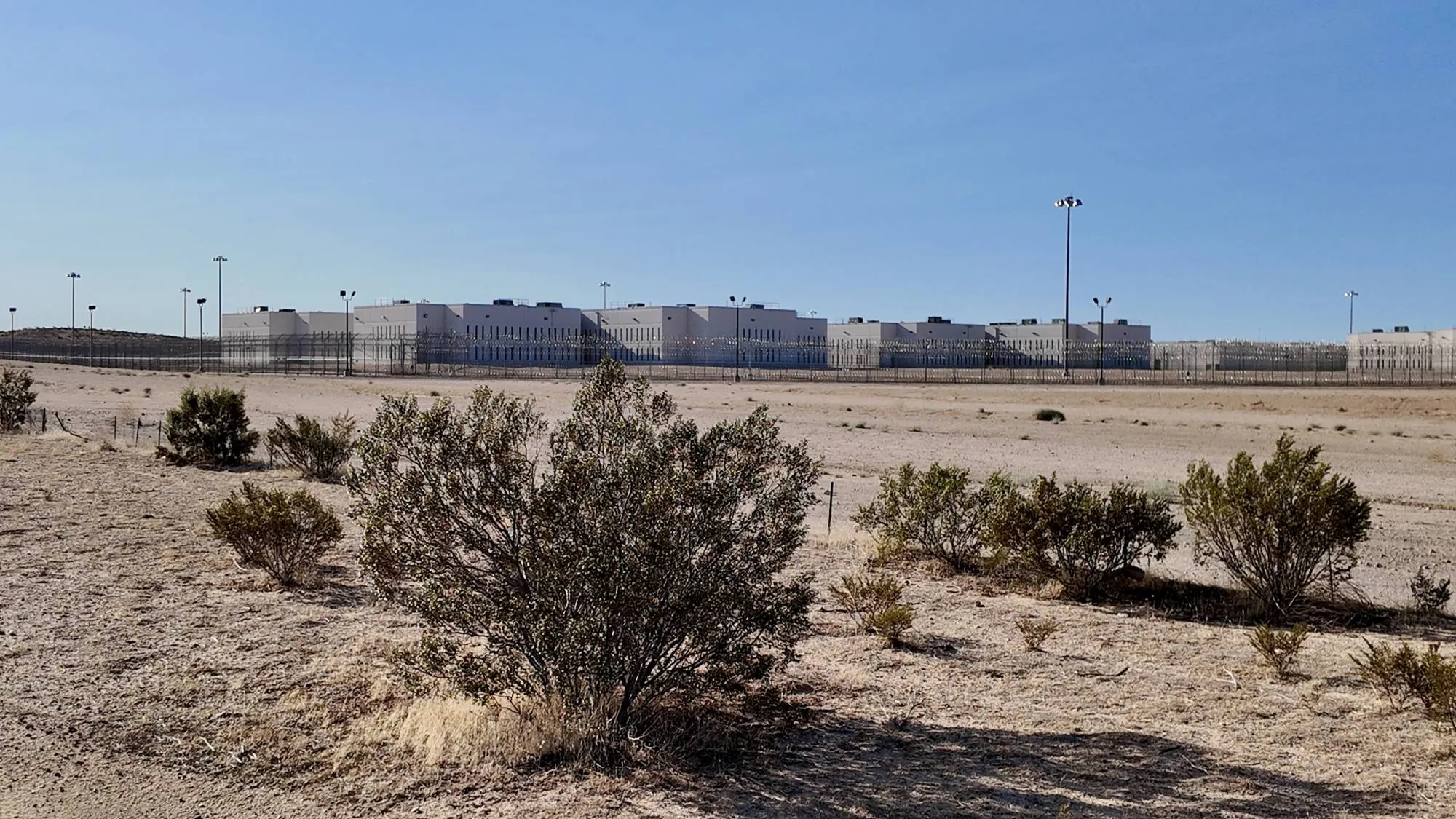
The California City record deserves the most weight because it does what reports and agency summaries cannot do by themselves. It turns alleged medical neglect into ordered obligations, then tests those obligations through a monitor with access to the site, records, patients, and staff.
In the Northern District of California case, the complaint was filed in November 2025. On February 10, 2026, Judge Maxine Chesney certified a class and issued a preliminary injunction addressing eight healthcare components at the California City ICE Processing Center. A monitor was appointed in March 2026. On July 27, 2026, the court-appointed monitor, Dr. Muthusamy Anandkumar, filed a 51-page report after a three-day May site visit, review of 141 patient medical records, interviews with 40 patients, and staff interviews [6].
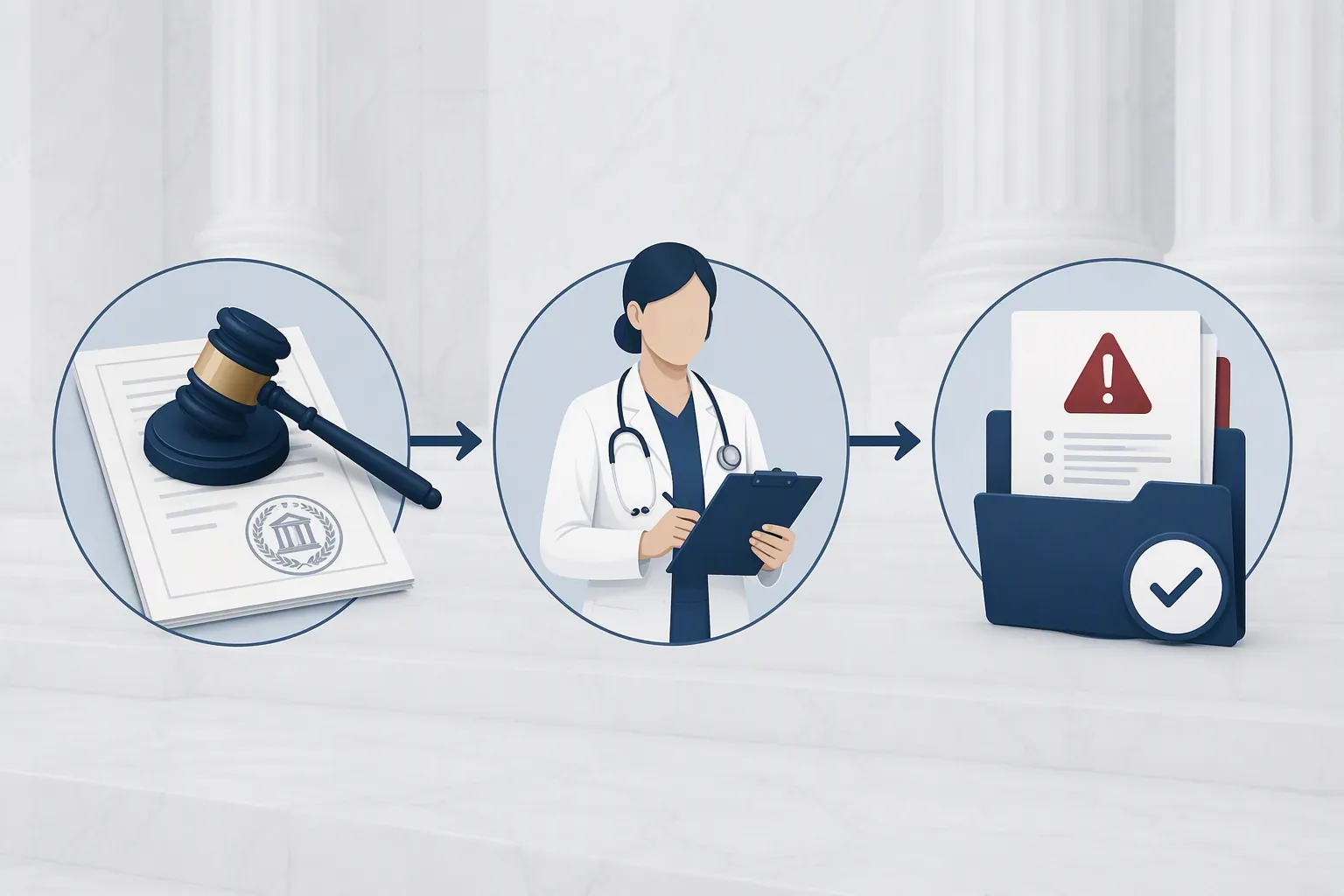
The monitor found non-compliance across all eight court-ordered healthcare components [6]. CalMatters separately described 13 areas of deficiency in its coverage of the same monitor review [10]. The counts should not be treated as competing death statistics or as two separate remedial orders. On this record, the operative legal count is the eight components ordered by the court; the 13-area description is a reporting frame for the monitor’s deficiency findings.
That distinction matters because enforcement attaches to the order. A monitor’s finding is powerful, but it becomes most useful when it can be matched back to an injunction term that a judge can enforce. The practical chain is short and consequential: plaintiffs obtain a preliminary injunction; the court appoints a monitor; the monitor reviews records and conditions; the monitor reports non-compliance; the parties and judge then have a record capable of supporting further relief, modification, contempt proceedings, or other compliance pressure. The record is not just public; it is usable.
California City also illustrates why a court record is different from an oversight press release. The monitor did not simply receive agency representations. The report was based on site inspection, patient interviews, staff interviews, and medical-record review [6]. That does not make the report beyond challenge, and it does not decide damages claims. It does make the factual record harder to dissolve into competing summaries.
Adelanto confirms the remedial pattern without replacing the California City record
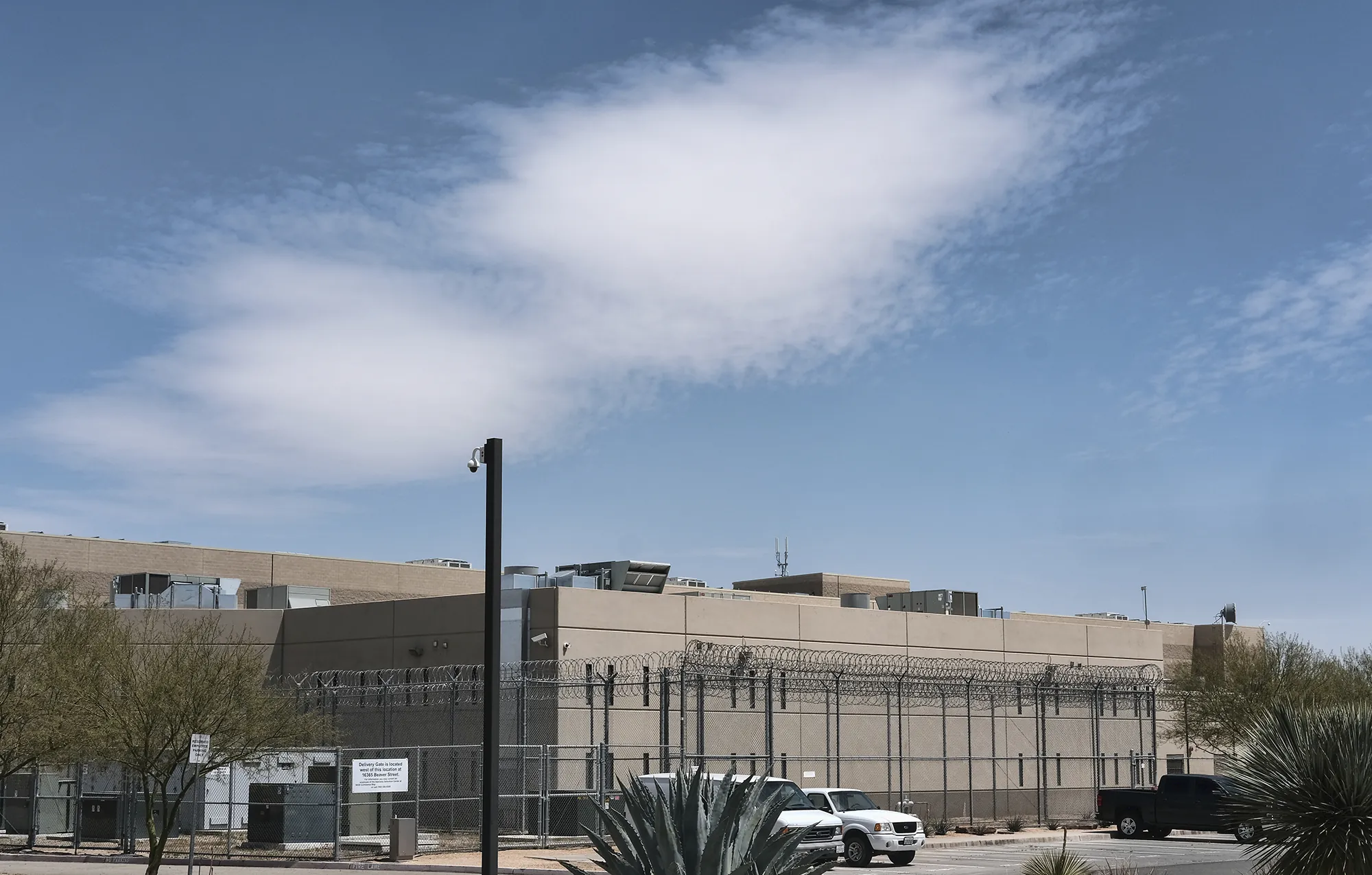
The Adelanto order points in the same direction. In July 2026, Judge Sunshine Sykes of the Central District of California issued a preliminary injunction requiring clean water and medical care at the Adelanto ICE Processing Center and ordered two independent monitors [11]. On the present record, Adelanto is a confirming comparison rather than the main evidentiary engine: it shows another court using injunctive relief and monitors to address detention conditions, but the California City monitor report is the fuller primary-source-backed medical-care compliance record available here.
What the report wave proves, and what it does not
The 2026 reports support a strong conclusion about systemic medical-care failure, but only if the sources are kept in their lanes. HRW/PHR reported a trend-level mortality rate of 8.4 per 10,000 detainees, compared with a Covid-era peak of 4.4 per 10,000, and reported seven apparent suicides in the first year of the second Trump administration compared with one in 2024 [1]. KFF reported that the detained population exceeded 68,000 on February 7, 2026, up more than 70% from 39,000 in December 2024, and that 32 of the 46 deaths it counted involved people with existing medical conditions [2]. Those figures support concern about scale, acuity, and system capacity. They do not, by themselves, prove legal causation in any individual death.
The legally usable evidence becomes stronger where records show a mismatch between known medical need and institutional response. A detained person with an existing condition is not proof of neglect; a record that shows a complaint, missed assessment, delayed response, or omitted fact can become proof. That is why the CNN/POGO medical-examiner contradictions carry unusual weight. They are not merely another count. They show the administrative summary itself becoming an object of proof [3].
The California Attorney General’s 2026 immigration-detention report is also part of the state oversight record, and it belongs in the evidence ledger [12]. But unless a state report is tied to an enforceable order, subpoena-backed follow-up, contract consequence, or filed claim, it remains an accountability input rather than a remedy. The same is true for many public reports: they can establish notice, patterns, and political pressure; they do not necessarily move a clinician, contractor, or agency official by a court-imposed deadline.
Accountability channels as of August 1, 2026
| Channel | Status label | What the current record shows |
|---|---|---|
| Preliminary injunctions and court-appointed monitors | Active and enforceable | California City has a February 10, 2026 preliminary injunction, a March 2026 monitor appointment, and a July 27, 2026 monitor report finding non-compliance across all eight ordered healthcare components [6]. Adelanto has a July 2026 preliminary injunction ordering clean water, medical care, and two independent monitors [11]. |
| Administrative inspections | Weakened and internally inconsistent | GAO reported starkly different FY2024 findings across ODO, IHSC, and OIDO inspection programs [4]. HRW/PHR reported OIDO’s staff reduction to zero after the April 30, 2026 appropriations bill and CRCL’s reduction from 135 positions to 4 [1]. |
| ICE death reporting | Narrowed | ICE’s June 2, 2026 directive removed the 30-day post-release death-reporting requirement, and public death reporting had already shifted from detailed reports to shorter summaries [5][7]. |
| FOIA | Open but slow | American Oversight filed two June 4, 2026 lawsuits seeking ICE and CBP death and custody records after ICE replaced detailed death reports with summaries [7]. FOIA may recover records, but it does not itself order medical treatment. |
| State attorney general oversight | Important evidentiary channel | California’s 2026 report contributes to the public oversight record [12]. On the record used here, it is not treated as equivalent to a court injunction or monitor order. |
| FTCA damages claims | Available but retrospective | The FTCA remains a damages route against the United States and can run alongside constitutional medical-care litigation, but it generally compensates after injury rather than forcing immediate facility-wide medical compliance [8]. |
| Bivens medical-care claims | Unsettled | Carlson v. Green remains the recognized medical-care Bivens context, but the record reviewed here establishes that Nielsen v. Watanabe and Mohan v. Watkins were being relisted as of June 17, 2026, with petitions pressing whether Carlson still supports medical-care claims in light of administrative-remedy programs and injury-severity disputes [8]. |
| Public Health Service officer individual damages | Constrained by immunity | Hui v. Castaneda held that Public Health Service officers are immune from individual damages suits under the Westfall Act for alleged failure to provide medical care to an immigration detainee [9]. |
| Congressional access and investigations | Potentially significant, not relied on here as an operative remedy | The available record for this article did not include parsed underlying congressional investigation PDFs sufficient to treat that channel as an enforceable medical-care remedy. |
Damages doctrine cannot be treated as settled medical-care relief
The damages landscape is important, but it should not be oversold as a current conditions remedy. Carlson v. Green is the recognized Bivens medical-care context, yet the Supreme Court’s relist activity in Nielsen v. Watanabe and Mohan v. Watkins left the scope of that route unsettled on the record reviewed here [8]. The narrower, safer statement is that Bivens medical-care claims remain contested, not that the Court has eliminated them or reaffirmed them in full.
Nor should Hui v. Castaneda be blurred into a general no-liability rule for every detention medical actor. Hui concerns Public Health Service officers and individual damages immunity under the Westfall Act in the medical-care context [9]. It matters acutely when the defendant is a PHS officer. It does not, by itself, answer whether injunctive relief, FTCA claims, claims against other actors, or contract-related remedies are available.
One doctrinal boundary is especially worth keeping clean: Blanche v. Lau should not be cited as a Bivens medical-care holding on this record. The materials supplied for this article identify it as a parole and lawful-permanent-resident admission case, not a detention medical-care damages ruling. It does no work in this accountability map.
The operational bottom line
As of August 1, 2026, the strongest documented legal-accountability channel for ICE detention medical-care failures is not the administrative inspection system, public death reporting, FOIA, state reporting, or damages doctrine. Those channels remain important, and several may later produce records or compensation. But in the public record reviewed here, only preliminary injunctions paired with court-appointed monitors are currently producing enforceable, primary-source-backed remedies.
California City shows why: a court order defined healthcare obligations, a monitor inspected the facility and reviewed medical records, and the monitor reported non-compliance across the ordered components [6]. Adelanto shows the same remedial form emerging in another California detention facility [11]. Everything else in the 2026 record should be read with its proper status label: report, inspection, agency summary, FOIA demand, state oversight document, damages theory, or enforceable order.
References
- Dying in Detention — Human Rights Watch / Physicians for Human Rights, June 25, 2026.
- Deaths and Health Care Issues in ICE Detention Centers Under the Second Trump Administration — KFF, March 25, 2026.
- How understaffing and DHS policy drives rising deaths in ICE detention centers — CNN, May 15, 2026.
- Immigration Detention: DHS Should Define Goals and Measures to Assess Facility Inspection Programs — U.S. Government Accountability Office.
- Detainee Death Reporting — U.S. Immigration and Customs Enforcement, updated July 22, 2026.
- Court-Appointed Monitor Finds ICE Failed to Provide Adequate Medical Care — ACLU, July 28, 2026.
- Deaths in Custody ICE CBP FOIA — American Oversight, June 4, 2026.
- Bivens at the bedside — SCOTUSblog, June 17, 2026.
- Supreme Court Rules Government Doctors Not Individually Liable For Death Of Immigration Detainee — ACLU.
- A judge sent a doctor to evaluate California’s largest ICE detention center. What he found — CalMatters, July 2026.
- Judge demands immigrants at Adelanto get clean water and medical care — CalMatters, July 2026.
- 2026 report on immigration detention — California Attorney General.
Related records
Tool profile
How Meta's AI Spending Reshapes Law Firm ProfitabilityGoverning regulation
Browse the obligations tracker →Preventive workflow
Browse verification workflows →
Report a correction or tip
Spotted an outdated figure, a misstated fact, or a ruling this case record should reflect? Public comments are disabled for this content given the professional cost of a misreported case outcome, penalty amount, or rule text — use the structured correction channel instead.
Report a correction or tip for this record →