
Five Fault Lines in the ICE Mandatory Detention Circuit Split
This analysis maps the five discrete statutory-interpretation disagreements dividing federal appeals courts over whether long-term EWI residents detained under § 1225(b)(2)(A) are entitled to individualized bond hearings, providing a jurisdiction-by-jurisdiction breakdown to inform argument strategy and risk assessment.
- Jurisdiction
- US - Second Circuit
- Court
- U.S. Court of Appeals for the Second Circuit
- AI tool named
- No AI tool discussed
- Ruling date
- Apr 28, 2026
- Source document
- View primary court order ↗
- Last verified
- Jul 31, 2026
Lex Machina Review is an independent risk-tracking and reference resource. Nothing on this site is legal advice, and using it does not create an attorney-client relationship. Every record is reviewed against primary sources but may not reflect the most current status of a matter — always verify directly against the cited court order, rule text, or a licensed attorney before relying on it.
Companion explanation — secondary to the source document above
As of July 31, 2026, the ICE mandatory detention fight is a venue-sensitive statutory split, not a single national rule. The Second, Sixth, Tenth, and Eleventh Circuits have rejected the administration’s attempt to place long-term residents who entered without inspection under mandatory detention through 8 U.S.C. § 1225(b)(2)(A). The Fifth and Eighth Circuits have upheld that approach. The Seventh Circuit has not produced binding panel precedent. The Fifth Circuit has granted en banc rehearing in Sosnava Rodriguez v. Ortega for September 2026, and cert-stage activity is already pending at the Supreme Court.[1][2][3][4][5]
That posture matters before anyone reaches equities. In one circuit, a long-term EWI resident may be entitled to an individualized bond hearing under § 1226(a). In another, the same person may be treated as mandatorily detained under § 1225(b)(2)(A). The answer turns on five interpretive questions: the relationship between “applicant for admission” and “seeking admission,” the effect of the Laken Riley Act, the actual reach of Jennings v. Rodriguez, the post-Loper Bright status of the BIA’s Yajure Hurtado reinterpretation, and the weight of decades of contrary executive practice.
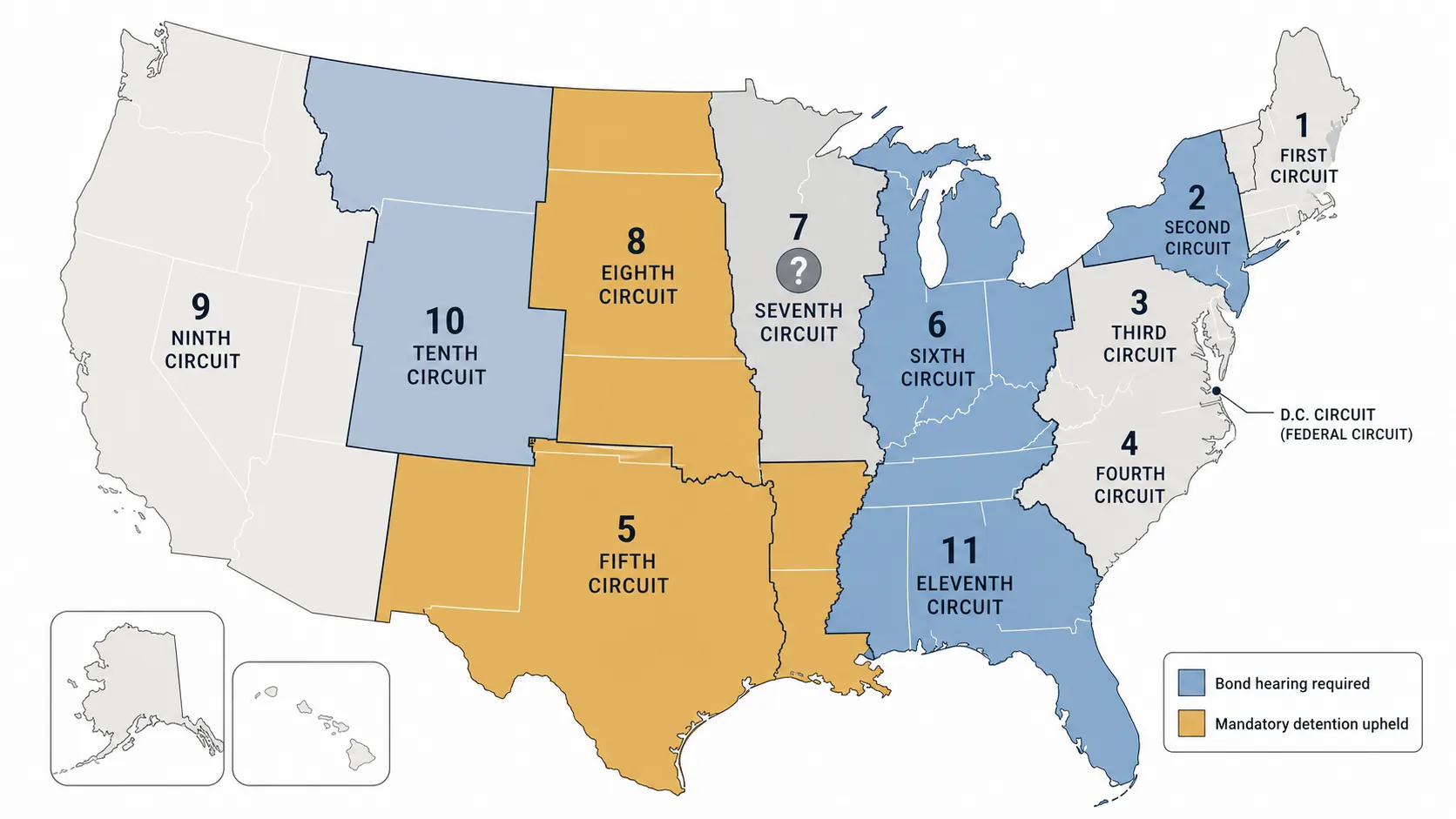
The Current Circuit Map
| Circuit | Current posture as of July 31, 2026 | Practical risk point |
|---|---|---|
| Second | Rejected the administration’s reading in Barbosa Da Cunha v. Lyons, a unanimous April 28, 2026 decision.[1] | Strongest anti-policy appellate framework; useful beyond the circuit because it addresses the main textual and structural arguments together. |
| Fifth | Upheld the policy in Buenrostro-Mendez v. Bondi, but en banc rehearing has been granted in Sosnava Rodriguez v. Ortega.[2][3] | Hostile panel law is unstable; preserve arguments for en banc and cert review. |
| Sixth | Ruled against the administration; the government filed a Supreme Court petition from that loss on June 26, 2026.[4] | Favorable circuit position, but cert risk is live. |
| Eighth | Upheld the policy in Herrera Avila v. Bondi by a 2-1 vote.[5] | Adverse law with a dissent that supplies cert-stage and preservation material. |
| Tenth | Ruled against the administration, contributing to the split identified in the cert-stage materials.[4] | Favorable posture, but not insulated from Supreme Court review. |
| Eleventh | Rejected the mandatory-detention theory in a decision discussed in May 2026 circuit commentary.[6] | Favorable law; briefing should still isolate the statutory basis rather than rely on broad detention rhetoric. |
| Seventh | No binding panel precedent; a preliminary stay posture has signaled disagreement but does not settle circuit law.[7] | Do not treat the circuit as decided. Verify the docket posture before advising on bond eligibility. |
District-court resistance has been broad. One account placed the number of district judges rejecting the administration’s interpretation at more than 450 by July 2026.[8] That is notable, but it is not the controlling unit of analysis. The question now moving the risk chart is what appellate panels—and likely the Supreme Court—do with the statutory text and structure.
Barbosa Da Cunha Supplies the Cleanest Anti-Policy Framework
The Second Circuit’s Barbosa Da Cunha opinion is the opinion to read first if the goal is argument architecture. It was unanimous, issued on April 28, 2026, and included a Trump-appointed judge, which makes it harder to file away as an ordinary partisan split.[1] More importantly for briefing, it does not rest on one loose instinct that long-term residents “should” receive bond hearings. It works through the statutory fault lines in a way that can be lifted, resisted, or distinguished.
The court treated § 1225(b)(2)(A) as a provision directed at applicants who are in the admission process, not as a dormant mandatory-detention switch that can be thrown years after an entry without inspection. On that view, the government’s reading asks too much of the phrase “applicant for admission.” It turns a definitional label into a present-tense detention command for people no longer at the threshold.
That distinction is why Barbosa Da Cunha matters outside the Second Circuit. Many detention disputes can be briefed as fact-bound custody questions. This one is not. If “applicant for admission” and “seeking admission” do the same work, the government’s position becomes easier. If they perform different statutory functions, the bond-eligibility argument has a textual foothold.
Fault Line One: “Applicant for Admission” Versus “Seeking Admission”
The first dispute is the one that carries the most weight. The administration’s reading starts from the immigration code’s definition of an “applicant for admission,” which includes a noncitizen present in the United States who has not been admitted. From there, it treats long-term EWI residents as covered by § 1225(b)(2)(A)’s mandatory-detention command once removal proceedings begin.
The contrary reading separates a definitional status from the operative trigger. “Applicant for admission” may identify a legal category, but § 1225(b) is organized around people being inspected, processed, or otherwise seeking admission. A person who entered without inspection years earlier can be an “applicant for admission” in the statutory-definition sense without presently being in the § 1225 inspection-and-admission channel. On that reading, custody belongs under § 1226, where bond hearings remain possible unless another mandatory-detention provision applies.
Barbosa Da Cunha accepted that narrower view. The Fifth and Eighth Circuit majorities did not. Buenrostro-Mendez upheld the administration’s policy in February 2026 over a dissent by Judge Douglas.[2] Herrera Avila did the same in March 2026 over a dissent by Judge Erickson.[5] The dissents matter because they do not merely announce a preference for bond hearings; they press the same structural objection that the Second Circuit later made central.
For counsel, this is the first preservation point. A brief that treats the issue as “mandatory detention versus discretion” skips the operative statutory move. The tighter question is whether the government may use a broad definitional phrase to relocate a long-resident EWI respondent from § 1226(a) into § 1225(b)(2)(A).
Fault Line Two: The Laken Riley Act Superfluity Problem
The Laken Riley Act creates the next structural problem. The argument against the administration’s reading is straightforward: if § 1225(b)(2)(A) already mandates detention for the broad class of long-term EWI residents, then later congressional expansions of mandatory detention under § 1226(c) would do little practical work for that same population. Barbosa Da Cunha found that superfluity concern persuasive, and the Fifth and Eighth Circuit dissents treated it as a serious defect in the government’s position.[1][2][5]
This is not a general appeal to legislative purpose. It is a structural argument about why Congress would expand one mandatory-detention provision if another provision already accomplished much of the same work. Courts that accept the administration’s reading must explain why the Laken Riley Act’s § 1226(c) changes are not largely redundant. Courts that reject it can use the Act as evidence that Congress understood § 1226—not § 1225(b)(2)(A)—as the custody framework for many noncitizens arrested inside the country.
The superfluity argument also changes how the case should be argued. It is tempting to present the Laken Riley Act as political context. That is weaker than using it as a statutory-structure exhibit: Congress knew how to impose mandatory detention in § 1226(c), and it chose to revise that provision rather than simply rely on § 1225(b)(2)(A).
Fault Line Three: Jennings Is Important, But It Does Not Answer This Question by Itself
Jennings v. Rodriguez is a predictable stop in the briefing, but it should not be asked to do more than it did. Jennings addressed detention under § 1225(b) and rejected a statutory construction that would have required periodic bond hearings for certain detained noncitizens. The administration can invoke Jennings for the proposition that § 1225(b) detention is mandatory when the provision applies.
The contested issue here is anterior: whether § 1225(b)(2)(A) applies to long-term EWI residents arrested inside the United States after years of presence. If the person belongs in § 1226(a), Jennings does not eliminate bond eligibility. If the person belongs in § 1225(b)(2)(A), Jennings becomes more useful to the government.
That is why Jennings can be a powerful citation and still not resolve the split. The opposing camps disagree about statutory coverage before they disagree about the consequences of coverage. In drafting terms, a bond-eligibility brief should not concede the § 1225(b) placement and then try to escape Jennings later. The coverage argument has to come first.
Fault Line Four: Yajure Hurtado After Loper Bright
The BIA’s Yajure Hurtado reinterpretation sits differently after Loper Bright. Before Loper Bright, an agency-friendly account could try to route the dispute through Chevron deference. After Loper Bright, the agency’s interpretation may still be considered for its persuasive force, consistency, and fit with the statutory scheme, but it does not receive Chevron’s mandatory deference framework.
That shift does not automatically decide the case for detained respondents. A court can still find the BIA’s reading persuasive on ordinary interpretive grounds. But the government has to win as a matter of statutory interpretation, not by asking a court to defer at step two of a doctrine that no longer governs in that form.
The practical consequence is a change in emphasis. Counsel challenging detention should attack the BIA’s reading through text, structure, prior practice, and fit with related provisions. Counsel defending detention should not overstate what agency reinterpretation supplies after Loper Bright. The court is not just reviewing whether the agency found a permissible ambiguity; it is deciding the best reading.
Fault Line Five: Thirty Years of Contrary Executive Practice
The last fault line is institutional practice. For roughly thirty years, the executive branch did not generally treat long-term EWI residents as categorically subject to § 1225(b)(2)(A) mandatory detention in the way now asserted. That history does not bind a court if the new reading is the best reading of the statute. It does, however, make the new reading harder to sell as obvious.
Past practice is most useful when paired with the other arguments. Standing alone, it can look like an appeal to administrative habit. Combined with the “seeking admission” distinction and the Laken Riley Act superfluity problem, it becomes evidence that the government’s current construction is not the natural reading Congress and the executive branch had been operating under.
For risk assessment, this point is secondary but not ornamental. A court inclined toward textual formalism may give practice little independent weight. A court concerned with statutory coherence may find it confirms that the administration is not merely enforcing a settled mandatory-detention command but advancing a late-breaking interpretation with large custody consequences.
Why the Fifth and Eighth Circuit Dissents Matter
Buenrostro-Mendez and Herrera Avila are adverse authority for detained respondents in their circuits, but the dissents are not just consolation prizes. Judge Douglas’s dissent in the Fifth Circuit and Judge Erickson’s dissent in the Eighth Circuit identify the arguments most likely to travel: the distinction between definitional status and present admission-seeking, the Laken Riley Act superfluity concern, and the danger of allowing agency reinterpretation to do the work of statutory amendment.[2][5]
That matters most in the Fifth Circuit because the en banc court has already agreed to rehear Sosnava Rodriguez v. Ortega, with argument scheduled for September 2026.[3] A panel loss is usually a poor place to pretend the law is unsettled. An en banc grant changes the advice. The panel decision remains a serious obstacle until displaced, but arguments should be preserved with the en banc court and Supreme Court in mind.
The Eighth Circuit posture is different. Herrera Avila remains adverse panel law, and the dissent supplies a roadmap rather than an active en banc event identified in the research materials. The distinction is important for client advice: a dissent can support preservation and cert framing, but it does not itself reduce the immediate custody risk in the circuit.
Population Figures Help Explain Stakes, Not Doctrine
The scale is substantial, but the available figures should be handled carefully. One account reported about 73,000 people in immigration detention in January 2026.[5] SCOTUSblog, citing ICE data, described a figure closer to 60,000 in April 2026 in a related detention-fee discussion.[9] The research materials note that the decrease may reflect stepped-up removals, but the figures do not measure exactly how many long-term EWI residents are detained under the challenged § 1225(b)(2)(A) theory.
The legal consequence is narrower and more usable: for affected respondents, the classification can determine whether an immigration judge may consider release at all. That is the operative harm in litigation. It is not necessary to inflate the numbers or treat every detention statistic as proof of the statutory claim.
Cert Risk Is No Longer Theoretical
Supreme Court review is likely, although timing and vehicle remain open. The administration filed a petition on June 26, 2026, asking the Court to endorse the policy after a Sixth Circuit loss, and the ACLU has a cross-petition arising from the Fifth Circuit side of the split.[4][9] The Fifth Circuit en banc proceeding may complicate vehicle selection because it could narrow, deepen, or reshape the split before the Supreme Court acts.[3]
Montoya Palacios should not be overstated. SCOTUSblog described it as an EAJA attorneys’ fees matter on the Supreme Court’s June 18, 2026 conference list, tied to immigration detention litigation but not presented in the research materials as the merits vehicle for resolving the § 1225(b)(2)(A) split.[9] Its status should be independently verified before publication or reliance, especially because conference listings can become stale quickly.
The same caution applies to class-action developments not fully verified in the available materials. A class posture may affect who receives relief and how quickly, but it does not replace the circuit-by-circuit merits analysis unless the docket confirms binding relief in the relevant jurisdiction.
Using the Split Without Overreading It
For a detained respondent in the Second, Sixth, Tenth, or Eleventh Circuit, current appellate law supports the argument that § 1226(a), not § 1225(b)(2)(A), governs custody for long-term EWI residents. For a respondent in the Fifth or Eighth Circuit, current panel law is adverse, with the Fifth Circuit uniquely unstable because en banc rehearing is pending. For a respondent in the Seventh Circuit, preliminary signals are not a substitute for binding precedent.
The argument should be built in the order the split actually turns: first the “applicant for admission” and “seeking admission” distinction; then the Laken Riley Act’s structural pressure; then Jennings as a coverage-dependent authority; then Yajure Hurtado after Loper Bright; then executive practice as confirmation, not a standalone trump card.
The final risk note is simple but unforgiving. Venue matters. The controlling fault line matters. Every live procedural event—the Fifth Circuit en banc rehearing, cert petitions, class-action orders, and any post-conference Supreme Court docket movement—needs last-verified treatment before the analysis is used to advise a client or frame a bond request.
References
- Appeals court rules against ICE's mandatory detention policy, Politico, Apr. 28, 2026
- Fifth Circuit upholds Trump administration's mandatory detention policy, Courthouse News Service, Feb. 6, 2026
- US appeals court to reconsider ruling faulting Trump's immigration detention policy, Reuters, July 10, 2026
- Trump administration asks US Supreme Court to endorse immigration detention policy, Reuters, June 26, 2026
- Reclassifying 'Applicants for Admission': How the Second Trump Administration is Reshaping Mandatory Detention, National Immigration Forum, May 14, 2026
- Eleventh Circuit Review—Reviewed: Mandatory Detention, Yale Journal on Regulation, May 2026
- Rapid Response Update on Bond Eligibility for Undocumented Immigrants, NILC, Apr. 8, 2026
- Trump administration's immigrant detention policy broadly rejected by federal judges, The Conversation, 2025/2026
- Supreme Court may decide important case on immigration detention regarding attorneys' fees, SCOTUSblog, June 17, 2026
Related records
Tool profile
How Meta's AI Spending Reshapes Law Firm ProfitabilityGoverning regulation
Browse the obligations tracker →Preventive workflow
Browse verification workflows →
Report a correction or tip
Spotted an outdated figure, a misstated fact, or a ruling this case record should reflect? Public comments are disabled for this content given the professional cost of a misreported case outcome, penalty amount, or rule text — use the structured correction channel instead.
Report a correction or tip for this record →