
Why Iran’s Hormuz Corridor Rejection Has Legal Grounding
Iran's rejection of Oman's 50-50 Hormuz corridor and its counter-demand for control of both shipping lanes rest on three coherent legal arguments. This analysis reviews those arguments, their limits under international law, and the practical risks for vessels transiting the strait.
- Jurisdiction
- Iran
- Court
- International Court of Justice
- AI tool named
- Legal analysis
- Ruling date
- Jul 28, 2026
- Source document
- View primary court order ↗
- Last verified
- Jul 29, 2026
Lex Machina Review is an independent risk-tracking and reference resource. Nothing on this site is legal advice, and using it does not create an attorney-client relationship. Every record is reviewed against primary sources but may not reflect the most current status of a matter — always verify directly against the cited court order, rule text, or a licensed attorney before relying on it.
Companion explanation — secondary to the source document above
Iran’s July 28 rejection of Oman’s 50-50 Strait of Hormuz corridor proposal was not just another hard-line statement in a summer of maritime brinkmanship. Oman’s proposal would have split the shipping corridor between Omani and Iranian control; Iran’s counter-demand would relocate both inbound and outbound lanes into Iranian territorial waters, a change that would give Tehran a materially different enforcement position from the current IMO traffic separation scheme established in 1968 in Omani waters.[1]
For shipowners, insurers, charterers, and energy companies reading this as of July 29, 2026, the immediate question is not whether Iran has persuaded the world. It has not. The question is whether the legal theory behind the rejection is coherent enough to affect routing decisions, war-risk premiums, charter-party clauses, sanctions review, and state-risk assumptions during the run-up to the August 21, 2026 expiration date associated with OFAC General License X and the June 17 Islamabad MOU window.[2]
This is a legal-risk analysis, not operational advice for any particular voyage. The practical boundary is narrower than much public commentary allows: Iran has arguments it can use to sustain a lane-control demand through the August negotiating window, but those arguments do not amount to a settled right to close Hormuz, charge mandatory passage fees, or displace the dominant transit-passage position accepted by the United States, the United Kingdom, most UNCLOS parties, and the Security Council.
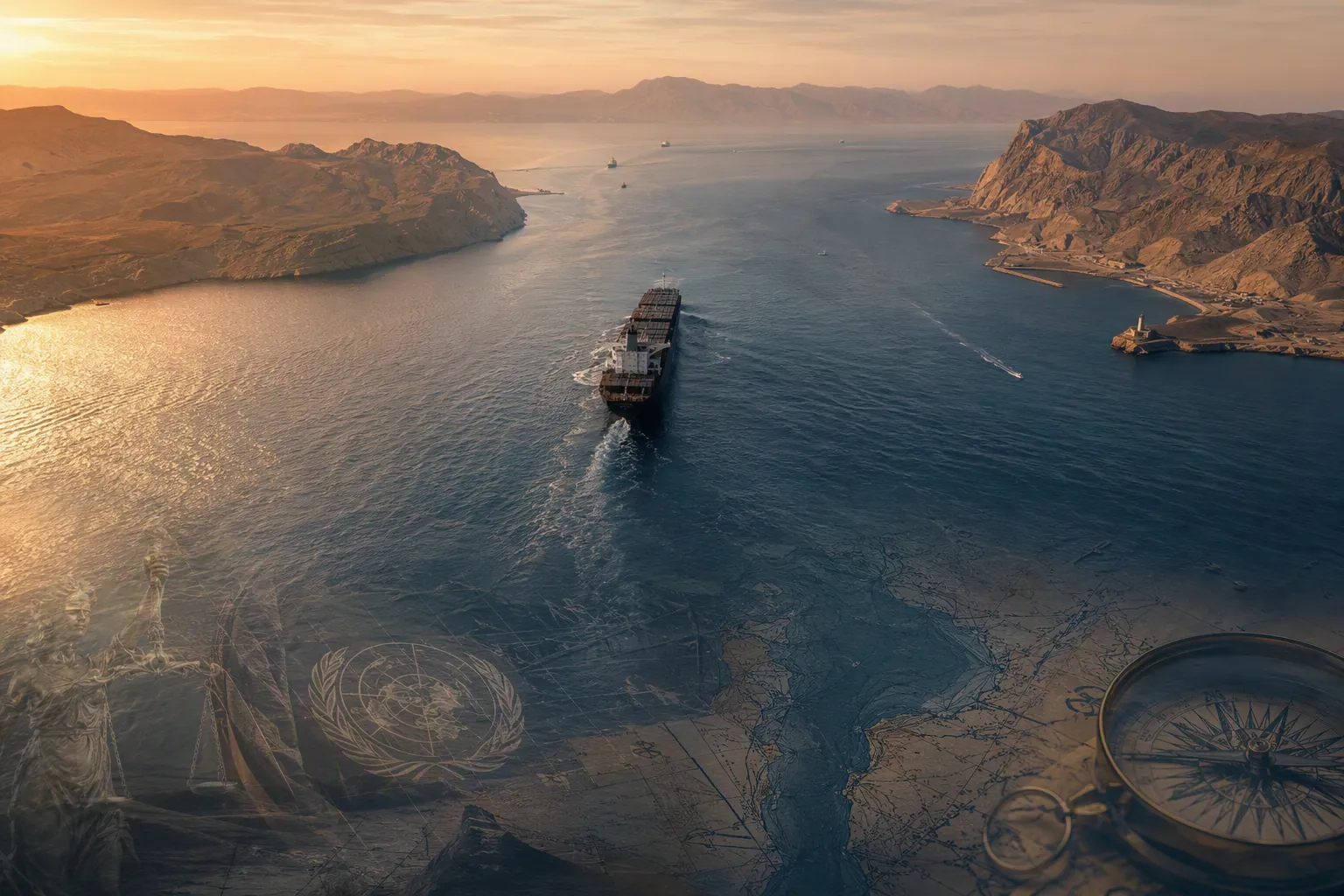
The corridor dispute is really a jurisdictional dispute
The physical move matters because maritime law often turns on where the ship is when the coastal state acts. A corridor in Omani waters leaves Iran with a different enforcement posture than a corridor drawn entirely through Iranian territorial waters. That does not automatically make Iranian control lawful. It does, however, change the risk memo from “political objection” to “coastal-state jurisdictional assertion backed by a long documentary record.”
Iran’s position has three moving parts. First, Tehran argues that Hormuz is governed by innocent passage, not the broader UNCLOS Part III regime of transit passage. Second, it argues that even if transit passage has crystallized as customary international law, Iran preserved a persistent objection to being bound by that rule. Third, it argues that the armed-conflict setting permits narrower law-of-naval-warfare restrictions against enemy vessels. Each part has a ceiling. Together, they explain why the rejection cannot be dismissed as legally content-free.

Iran’s innocent-passage claim starts before the July crisis
The strongest version of Iran’s argument does not begin with a July 2026 press line. It begins with Iran’s position at the time of UNCLOS signature in 1982, continues through its 1993 Act on Marine Areas, and reappears in later maritime-code amendments, including 2017 amendments identified in the specialist commentary.[3]
Iran signed UNCLOS but did not ratify it. At signature, it made an interpretative declaration that rejected the automatic extension of treaty-based transit-passage rights to non-parties and maintained that only states party to UNCLOS could claim the treaty’s transit-passage regime as against Iran.[3] That is not a winning argument against every state. It is, however, the kind of contemporaneous reservation that matters when a government later claims it never accepted the rule now being asserted against it.
The 1993 Act on Marine Areas then gives the argument domestic statutory continuity. The research record identifies Articles 9 and 15 through 17 as relevant to Iran’s assertion that foreign vessels, including certain warships and state vessels, are subject to an innocent-passage framework in Iranian territorial waters.[3] For a vessel operator, the point is not whether Iranian domestic law overrides international law. It does not. The point is that Iranian authorities have a domestic enforcement vocabulary ready to use if traffic is relocated into their territorial sea.
That is why the proposed lane relocation is more consequential than the phrase “50-50 corridor” suggests. If both lanes sit inside Iranian territorial waters, Tehran can characterize a boarding, exclusion order, reporting requirement, or fee demand as implementation of its existing view of innocent passage rather than as a sudden invention. Counsel advising a tanker owner may still conclude that the international-law claim is contestable or unlawful. The exposure analysis nevertheless changes when the coastal state can point to decades of consistent legal instruments.
Transit passage is the dominant answer, but not an uncontested one
The opposing position is familiar and powerful. Under UNCLOS Part III, straits used for international navigation are subject to transit passage, a regime broader than innocent passage and not suspendable in the same way. The United States, the United Kingdom, and most UNCLOS parties treat that regime as customary international law binding even on non-parties. The practical result is that ships and aircraft engaged in continuous and expeditious transit through Hormuz are not supposed to be placed at the mercy of unilateral coastal-state permission.
Corfu Channel remains the usual starting point for the older straits principle. In 1949, the International Court of Justice recognized a right of passage for warships through an international strait connecting two parts of the high seas, provided the passage was innocent.[4] Corfu Channel does not itself reproduce UNCLOS transit passage. It does, however, weaken any argument that a coastal state has unfettered discretion to stop international-strait traffic merely because the water is territorial sea.
The difficulty is that Hormuz sits at the seam between those two propositions. The transit-passage camp says UNCLOS Part III solved the seam and that the solution became custom. Iran says it never accepted that solution as binding against it, and that the older innocent-passage rule is the operative floor. Chatham House’s April 2026 treatment of the dispute framed the issue in exactly those terms: whether Hormuz remains an international strait governed by Part III transit passage, or is being pushed toward a managed-waterway model subject to Iranian sovereign discretion.[5]
A careful answer has to keep two propositions separate. Transit passage may be customary for most states and still face a documented objection from a particular coastal state. Conversely, a documented objection may make Iran’s position arguable without making it prevail against naval practice, Security Council expectations, or the risk tolerance of commercial markets.
Persistent objection is Iran’s best documentary point
Persistent-objector status is not acquired by repeating a grievance after a rule has become inconvenient. A state claiming that status must show timely, clear, and consistent objection while the alleged customary rule is forming. Iran’s record is unusually relevant because it includes a 1982 interpretative declaration, domestic legislation in 1993, and later maritime-code continuity rather than a single crisis statement.[3]
That record does useful work for Tehran. It lets Iran say its July 28 counterproposal is not a newly minted exception to transit passage but the application of a position it preserved from the beginning of the UNCLOS bargain. It also makes the corridor demand more than a cartographic preference. If the governing regime is innocent passage, the coastal state’s regulatory and security arguments become more substantial than they would be under full transit passage.
The ceiling is just as important. Persistent objection does not bind other states to agree with Iran’s characterization. It does not erase the contrary practice and legal position of states that treat transit passage as customary. It also does not give Iran a general enforcement license against neutral commercial traffic. A tanker entering Hormuz under the flag of an UNCLOS party will have its flag state, insurers, and charter counterparties looking first to the transit-passage regime, even if Iranian patrol craft are working from a different legal script.
This is where legal defensibility and legal success diverge. Iran has enough documentary continuity to complicate the assumption that it is simply lawless. It does not have enough acceptance to convert its view into a stable, generally recognized replacement for transit passage.
The naval-warfare argument is narrower and more dangerous
Iran’s third argument does not depend on ordinary peacetime law of the sea. It depends on the US-Iran armed-conflict frame and the law of naval warfare. The most rigorous synthesis in the current commentary treats the law-of-the-sea and naval-warfare arguments together because the operational question at sea will not always arrive neatly labeled.[6]
San Remo Manual Rule 10 states that belligerent rights may be exercised in international straits when the strait is used for international navigation and connects one part of the high seas or an exclusive economic zone with another, but it also protects the right of transit passage for neutral vessels and aircraft. Rule 27 separately allows belligerents, subject to the manual’s limits, to take measures against enemy merchant vessels in certain circumstances.[7]
That gives Iran a potentially serious argument against enemy vessels and vessels making an effective contribution to enemy military action. It does not give Tehran a clean right to close Hormuz to neutral commercial shipping. Nor does it transform a security restriction into a revenue measure. A belligerent-rights analysis asks who owns the vessel, what flag it flies, what cargo it carries, what destination it serves, whether it is assisting an enemy operation, and whether the measure taken is necessary and proportionate. It is not a toll schedule.
The distinction matters for operators because commercial risk does not track doctrine perfectly. A vessel that is legally neutral may still face delay, inspection, intimidation, rerouting, or insurer demands for additional documentation if Iranian authorities treat the voyage as connected to an enemy supply chain. The legal issue then becomes less abstract: who reviews the bill of lading, who verifies beneficial ownership, who confirms sanctions exposure, who contacts the flag state, and who bears the cost of waiting outside the strait.
For related background on how the armed-conflict frame complicates Hormuz operations, see How international law fails in the Strait of Hormuz tanker crisis and The Iran Strike Pause Exposes the War Powers Resolution's Blind Spot.
Institutional rejection remains broad
After the doctrinal arguments are stated at their strongest, the institutional record still runs against Iran on the core operational demand. UN Security Council Resolution 2817, adopted in April 2026, demanded restoration of freedom of navigation and rejected fee imposition in the strait.[8] The Council meeting record, SC/16349, shows the breadth of concern about allowing a single coastal state to convert a chokepoint into a discretionary managed passageway.[9]
Those materials do not magically resolve the underlying custom-versus-objection question. They do make it harder for Iran to claim that its position is moving toward broad acceptance. A state can preserve an objection and still face overwhelming nonacceptance of the remedy it wants to apply. That is the likely posture here: arguable legal predicates, contested enforcement authority, and strong institutional resistance to closure or mandatory fees.
The UKMTO and major maritime states therefore remain likely to treat Hormuz as open to transit passage, while advising operators to prepare for interference risk. That is an uncomfortable middle category. It is also the category most consistent with the documents.
The fee dispute shows what lane control is buying
The proposed fee structure is not the legal foundation of the dispute, but it explains why the legal foundation is being fought so hard. Reporting has compared Oman’s Malacca-style model of voluntary contributions, described at roughly $70 million per year, with Iran’s reported mandatory fee demand of about $1 million per vessel. Using pre-conflict traffic estimates of about 130 ships per day, that reporting chain suggested potential annual revenue above $40 billion.[10][11]
Those figures should be handled cautiously. The Malacca comparison and revenue extrapolation come through media and expert reporting rather than primary IMO or Singapore maritime authority documents in the available record. They are still useful because they identify the commercial stakes of the jurisdictional move. A voluntary cooperative-security contribution is one thing. A mandatory coastal-state fee imposed as the price of passage through an international strait is another.
If both lanes move into Iranian territorial waters, Tehran’s fee demand would be paired with its innocent-passage theory and domestic maritime statutes. If the lanes remain where the transit-passage camp says they belong, a mandatory fee looks much more like an unlawful condition on passage. That is why a routing proposal can become a legal instrument.
What counsel should treat as settled, contested, and operationally exposed
| Issue | Most defensible reading | Operational consequence |
|---|---|---|
| Transit passage | Dominant view treats it as customary law binding on all states, including non-parties | Flag states and insurers will generally resist treating Iranian permission as legally required |
| Iran’s objection | Iran has a documented record from 1982, 1993, and later maritime-code continuity | Operators should expect Iran to frame enforcement as law-based, not merely political |
| Lane relocation | Moving both lanes into Iranian territorial waters would strengthen Iran’s practical enforcement posture | Voyage planning should account for inspection, delay, exclusion, and documentation demands |
| Naval-warfare restrictions | Possible against enemy vessels or vessels sufficiently connected to enemy operations, subject to limits | Neutral commercial vessels still need ownership, cargo, destination, and sanctions review |
| Closure or mandatory fees | Not established under the law most states will recognize | Payment demands and closure threats remain legally contestable even if operationally disruptive |
The August 21 date matters because legal ambiguity has negotiating value even when it does not produce final legal victory. The June 17 Islamabad MOU and OFAC General License X created a temporary rail for state behavior; the available record does not show a replacement framework in place.[2] For background on that nonbinding framework, see Why the Iran-US ceasefire deal has no binding legal force.
Until that window closes or is replaced, the prudent operating assumption is not that Hormuz is legally closed. It is that Hormuz is legally contested in a way that can produce real delays, inconsistent boarding rationales, diverging flag-state instructions, and insurance questions that will not wait for the ICJ, the Security Council, or an arbitral tribunal to tidy up the doctrine.
For companies exposed to both sanctions and maritime-risk analysis, the same voyage may require parallel review under coastal-state passage rules, naval-warfare risk, insurance warranties, charter-party force majeure language, and Iran-related sanctions controls. A useful comparison is the broader compliance layering discussed in Iran Travel Warning's Three Overlapping Legal Regimes.
The legal-risk boundary
Iran’s rejection of Oman’s corridor proposal is legally grounded enough to matter. The grounding comes from a coherent innocent-passage theory, a documented persistent-objector record, and a narrower naval-warfare argument that may apply to enemy vessels in an armed-conflict setting. Those arguments are not theatrical simply because they are adverse to the preferred Western reading.
They are also not enough to settle the law in Iran’s favor. The dominant transit-passage view, the Corfu Channel baseline, UNCLOS-party practice, UK and US positions, and the Security Council record all cut against a unilateral right to close Hormuz or impose mandatory fees on neutral commercial traffic. For the August 2026 window, vessels should treat the strait as legally contested, not legally closed.
References
- Iran rejects Oman’s 50-50 Strait of Hormuz corridor proposal, Iran International, July 28, 2026.
- OFAC General License X and Islamabad MOU materials, U.S. Department of the Treasury / Islamabad MOU record, June 17, 2026.
- Iran’s Persistent Objection to Transit Passage in the Strait of Hormuz, Völkerrechtsblog, April 2026.
- Corfu Channel Case, International Court of Justice, 1949.
- The Strait of Hormuz and the law of international straits, Chatham House, April 2026.
- The Strait of Hormuz: Law of the Sea and Law of Naval Warfare, Opinio Juris, May 2026.
- San Remo Manual on International Law Applicable to Armed Conflicts at Sea, International Institute of Humanitarian Law, 1994.
- Resolution 2817, United Nations Security Council, April 2026.
- SC/16349 Security Council meeting record, United Nations Security Council, April 2026.
- Iran’s Hormuz fee demand and Malacca model comparison, Al Jazeera, 2026.
- Strait of Hormuz toll proposal could generate more than $40 billion annually, TechTimes, 2026.
Related records
Tool profile
Browse tool evaluations →Governing regulation
Browse the obligations tracker →Preventive workflow
Browse verification workflows →
Report a correction or tip
Spotted an outdated figure, a misstated fact, or a ruling this case record should reflect? Public comments are disabled for this content given the professional cost of a misreported case outcome, penalty amount, or rule text — use the structured correction channel instead.
Report a correction or tip for this record →