
Why 'Case 8647' in James Comey Is an AI Hallucination Trap
The string '8647' has appeared in AI-generated legal research as a docket reference, but it actually refers to a James Comey Instagram post, not a court filing. This article traces the real meaning of '8647' and explains why attorneys must verify any short numeric string before relying on it.
- Jurisdiction
- United States - Eastern District of North Carolina
- Court
- U.S. District Court for the Eastern District of North Carolina
- Judge
- Judge Louise Flanagan
- AI tool named
- General AI legal research tool
- Ruling date
- Apr 28, 2026
- Source document
- View primary court order ↗
- Last verified
- Jul 28, 2026
Lex Machina Review is an independent risk-tracking and reference resource. Nothing on this site is legal advice, and using it does not create an attorney-client relationship. Every record is reviewed against primary sources but may not reflect the most current status of a matter — always verify directly against the cited court order, rule text, or a licensed attorney before relying on it.
Companion explanation — secondary to the source document above
If you are checking “James Comey case 8647,” start with the correction: “8647” is not, on the available public record, a federal docket number for a James Comey case. It traces to the content of a May 2025 Instagram post showing seashells arranged to read “86 47.” CNBC reported that the post later became the basis for an April 2026 indictment in the Eastern District of North Carolina; as of July 2026, the docket number for that seashell-post indictment has not been publicly identified in the materials available for this record. [1]
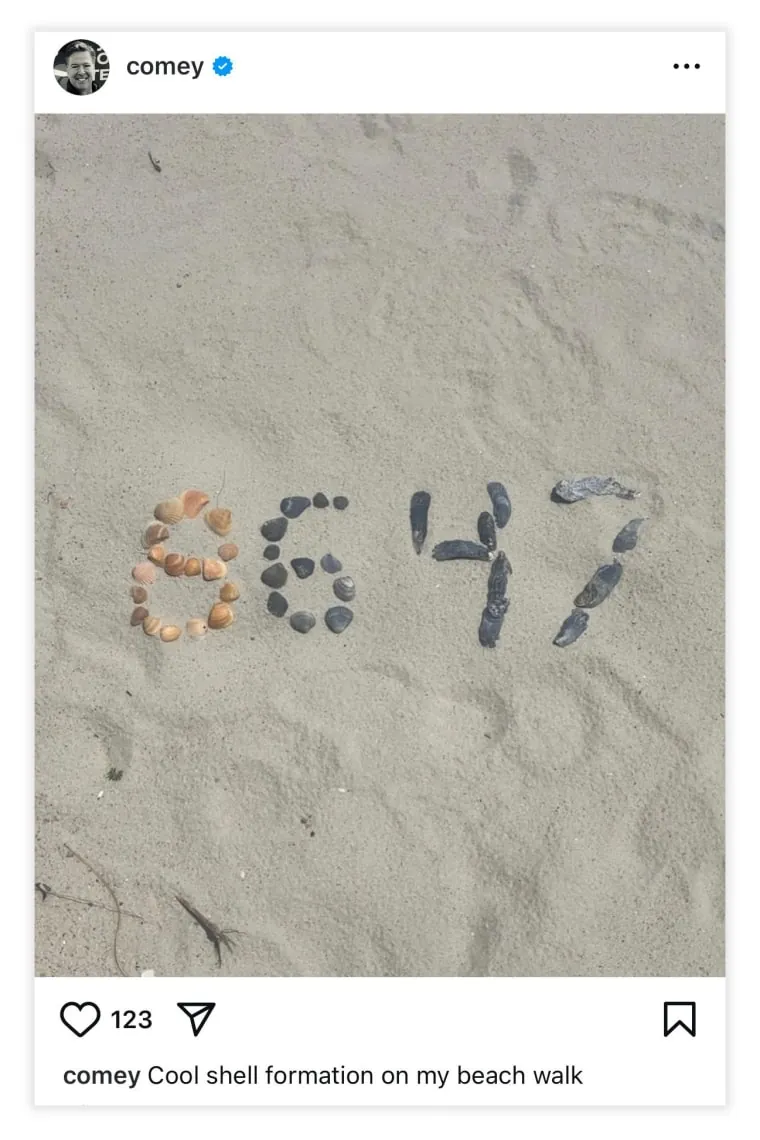
That distinction matters because “86 47” is a factual reference, not a citation. “47” refers to Donald Trump as the 47th president, and the controversy over “86” turns on whether the phrase was used as political slang, a removal reference, or a threat. BBC’s explainer gives the basic usage dispute around “86,” while SCOTUSblog places the prosecution in the true-threat line of First Amendment doctrine. Neither source turns “8647” into “Case 8647.” [2][3]
What “8647” actually identifies
The source chain is short enough that there is no excuse for skipping it. First, there was the Instagram image: seashells arranged as “86 47.” Then came public reporting and legal commentary about whether that image could be treated as a threat. Then, in April 2026, CNBC reported an Eastern District of North Carolina indictment tied to the post. The number “8647” is shorthand for the content of the image, not the caption of a court file. [1]
A proper legal reference would identify a court, case name, docket number, filing, order, or reporter citation. “8647” does none of that by itself. It does not identify a district. It does not identify a filing year. It does not identify a criminal docket sequence. It does not identify a reporter volume, reporter abbreviation, and page. It is just a compact number string that has become legally relevant because of the post it appeared in.
| Reference seen in research output | What it can safely mean | What it cannot safely mean without more |
|---|---|---|
| “86 47” | The seashell arrangement shown in the Instagram post | A docket number |
| “8647” | A compressed shorthand for the same post content | A case citation, reporter citation, or federal criminal case number |
| “Comey 8647 case” | A loose description of the EDNC seashell-post prosecution | A verified court citation |
The safest phrasing is therefore narrow: the “8647” reference belongs to the seashell-post facts. If you need to cite the prosecution, cite a verified docket entry or a reliable public report about the indictment. If no public docket number is available, say that rather than letting a tool invent one.
Do not merge the two Comey prosecutions
The confusion gets worse because there is another Comey prosecution with a real federal docket number. The public routing record distinguishes the Eastern District of Virginia case, listed as Case 1:25-cr-00272 and dismissed in November 2025, from the pending Eastern District of North Carolina seashell-post indictment before Judge Louise Flanagan. Wikipedia is useful here only as a routing aid for separating the two proceedings; the legal status of any filing still has to be checked against the court record or another primary source. [4]
Those are different cases. The EDVA matter has a docket-style identifier: 1:25-cr-00272. The EDNC seashell matter is the one associated with the “86 47” post. Substituting “8647” for a missing EDNC docket number collapses a factual allegation into a citation. That is exactly the kind of collapse that makes AI-generated legal research look more certain than it is.
Why “Case 8647” is an AI hallucination trap
Legal AI systems are especially bad company for short numeric strings. A user asks about “James Comey case 8647.” The query contains a public figure, a legal noun, and a number. The system then has strong pressure to format the number as something law-like: a docket stub, a reporter volume, a pin cite, a criminal case shorthand, or a nonexistent case title. The resulting answer may not say “I do not have a verified docket number.” It may manufacture the missing bridge.
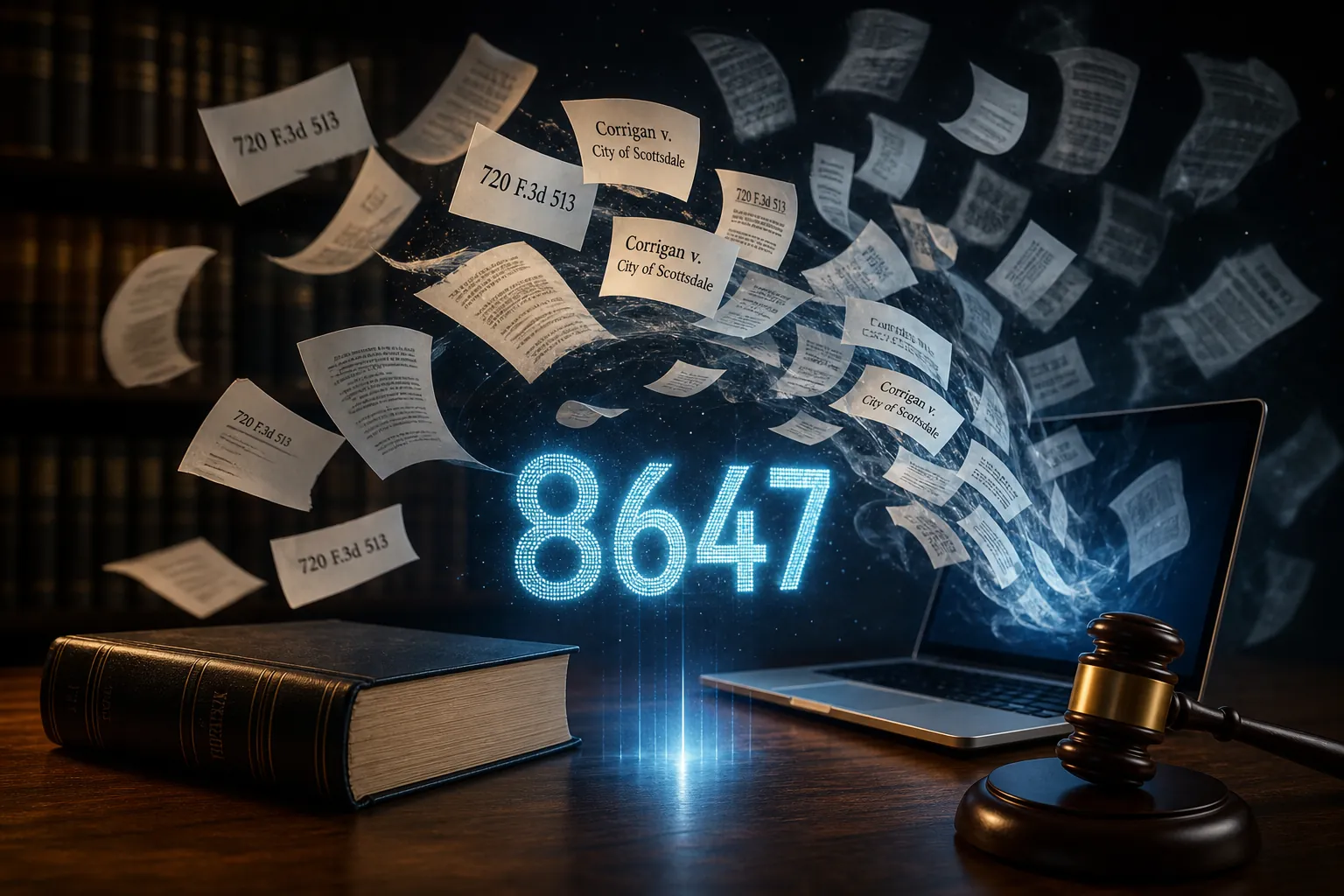
The broader pattern is not hypothetical. Damien Charlotin’s AI Hallucination Cases database listed 1,782 global cases as of July 18, 2026, including 1,228 in the United States. One fabricated example in that database is “Corrigan v. City of Scottsdale, 720 F.3d 513, 520 (9th Cir. 2013).” [5]
That “Corrigan” example should be used carefully. It is not proof that an attorney was sanctioned for citing “Case 8647,” and it is not a docket-number hallucination. The numeric pattern there sits inside a reporter-style citation: volume 720 of the Federal Reporter, Third Series, page 513, with a pin to 520. Its relevance is narrower and more useful: AI tools can turn citation-shaped numbers into confident-looking legal authorities even when the authority does not exist.
AEI’s July 2026 discussion of fake AI-generated legal content connects this kind of citation fabrication to current lawyer-risk practice, while also mentioning “8647” material as real-case content that can be mishandled in AI-assisted research. The connection is contextual, not causal: the problem is not that the Comey number itself produced the known fake “Corrigan” citation. The problem is that the same mechanism treats a short, culturally loaded number as if it must have a legal citation form. [6]
The verification rule for any short numeric string
Treat any bare number as untrusted until it survives a source-chain check. That is true whether the number appears in a chatbot answer, an associate memo, an opposing brief, a client email, or a news-derived research note.
- Identify the first real-world source of the number. For “8647,” the source is the “86 47” seashell image, not a docket sheet.
- Separate factual shorthand from legal identifiers. A number can matter to the facts without being a citation.
- Check a live court database before using a docket number. A federal criminal docket should be verified in the relevant court record, not inferred from a news phrase.
- Test every AI-supplied case citation against primary or reliable secondary sources. If the case name, reporter citation, docket, and quoted proposition do not match, the citation does not belong in a filing.
- Preserve the uncertainty in the language. If the EDNC docket number is not public in the record you have, write that it is not public rather than supplying a placeholder.
This is not an anti-AI rule. AI tools can help triage the issue, surface the CNBC report, summarize the public dispute over “86,” and point the researcher toward the true-threat frame. They cannot certify that “8647” is a docket number when the source trail does not show one.
Why the professional-duty point is not optional
The duty problem is simple: the court receives the filing from the lawyer, not from the model. The Fifth Circuit’s Fletcher v. Experian ruling in February 2026 and the Sixth Circuit’s United States v. Farris ruling in April 2026 are part of the same professional-duty line identified in current commentary on AI-generated citations: attorneys bear an independent obligation to verify authorities before filing them. [6]
For “Case 8647,” that duty translates into a very ordinary set of checks. Look for the EDNC docket. Confirm whether the indictment has a publicly available case number. Compare any AI-provided case title against the live docket. Open the cited opinion or order. Confirm that the quoted sentence appears where the tool says it appears. If the answer began with a bare “8647,” do not let it end with a polished but unverified citation.
The risk is not limited to lawyers. A pro se litigant can lose credibility by filing invented authority. A client can misread a litigation update if a research memo presents “Case 8647” as a court identifier. A knowledge-management lawyer can contaminate an internal research bank by saving an AI-generated citation that was never checked. The cleanup always takes longer than the verification would have.
The bounded answer
“8647” may matter factually in the James Comey seashell-post indictment. It is the number string generated by “86 47,” the image content that public reporting ties to the April 2026 Eastern District of North Carolina prosecution. It is not, on the current public record identified here, a docket number or a reliable case reference.
Use it as a factual clue, then verify forward: original post, public report, court, docket, filing, cited authority. If any AI tool gives you “James Comey Case 8647” as though that phrase were a formal citation, the next step is not to polish the citation. The next step is to prove that the case exists in a live court record.
References
- James Comey indicted over Trump seashell ‘8647’ post, CNBC, April 28, 2026
- BBC explainer on the meaning of “86”, BBC
- True threats, James Comey, and the Supreme Court: An explainer, SCOTUSblog
- Prosecution of James Comey, Wikipedia
- AI Hallucination Cases, Damien Charlotin
- A Ceaseless Struggle: Stopping Attorneys from Citing Fake AI-Generated Content, American Enterprise Institute, July 14, 2026
Related records
Tool profile
How Meta's AI Spending Reshapes Law Firm ProfitabilityGoverning regulation
Browse the obligations tracker →Preventive workflow
Browse verification workflows →
Report a correction or tip
Spotted an outdated figure, a misstated fact, or a ruling this case record should reflect? Public comments are disabled for this content given the professional cost of a misreported case outcome, penalty amount, or rule text — use the structured correction channel instead.
Report a correction or tip for this record →