
Will AI Create Electrician and Plumbing Jobs? Huang Says Yes
Jensen Huang's widely repeated claim that AI will create electrician and plumber jobs actually bundles three propositions with different evidentiary support. This verification ledger rates short-term trades demand verified, six-figure pay partial, and durable careers contested, so readers can tell which parts of the claim are safe to repeat or cite.
- Jurisdiction
- US
- Court
- No court proceeding
- AI tool named
- NVIDIA
- Ruling date
- Aug 2, 2026
- Source document
- View primary court order ↗
- Last verified
- Aug 2, 2026
Lex Machina Review is an independent risk-tracking and reference resource. Nothing on this site is legal advice, and using it does not create an attorney-client relationship. Every record is reviewed against primary sources but may not reflect the most current status of a matter — always verify directly against the cited court order, rule text, or a licensed attorney before relying on it.
Companion explanation — secondary to the source document above
Verification note: this is a claim audit, not a forecast of NVIDIA’s business or a recommendation to rely on any vendor’s labor-market narrative. The question is narrower: which parts of Jensen Huang’s statement about AI creating electrician, plumbing, and construction jobs are safe to repeat with sourcing, and which parts need conditions.
At Davos, Jensen Huang put the labor claim in unusually concrete language. In the World Economic Forum transcript, he described AI as driving “the largest infrastructure build-out in human history” and said, “we’re going to have plumbers and electricians and construction and steel workers” because “all of these data centers need to be built.” The NVIDIA blog version of the same Davos exchange framed the point around “six figure salaries,” quoting Huang’s broader argument that AI infrastructure would unlock skilled-trade work rather than only software jobs.[1][2]
That is a useful claim only after it is separated into its component assertions. “Someone has to build the data centers” is not the same claim as “those workers will make six figures,” and neither proves that AI has created durable, broad-based careers for electricians and plumbers.
| Proposition inside the Huang claim | Status | What the record supports |
|---|---|---|
| AI infrastructure build-outs are increasing demand for electricians, construction workers, and adjacent trades. | VERIFIED, with time limits | Large data-center capex, skilled-trade posting growth, BLS electrician demand, and county-level data-center employment effects support near-term construction demand.[3][4][5][6] |
| These jobs pay six-figure salaries. | PARTIAL | Some data-center project roles and high-end electrician examples reach six figures, but occupation-wide electrician wage data do not support a blanket six-figure claim.[5][7] |
| AI is creating durable, long-term electrician and plumbing careers. | CONTESTED | Construction work is often temporary; permanent data-center operations employ far fewer workers than construction sites; some job claims appear inflated when temporary construction labor is counted as enduring local employment.[6][9][10] |
The strongest part of the claim: someone really does have to build the AI infrastructure
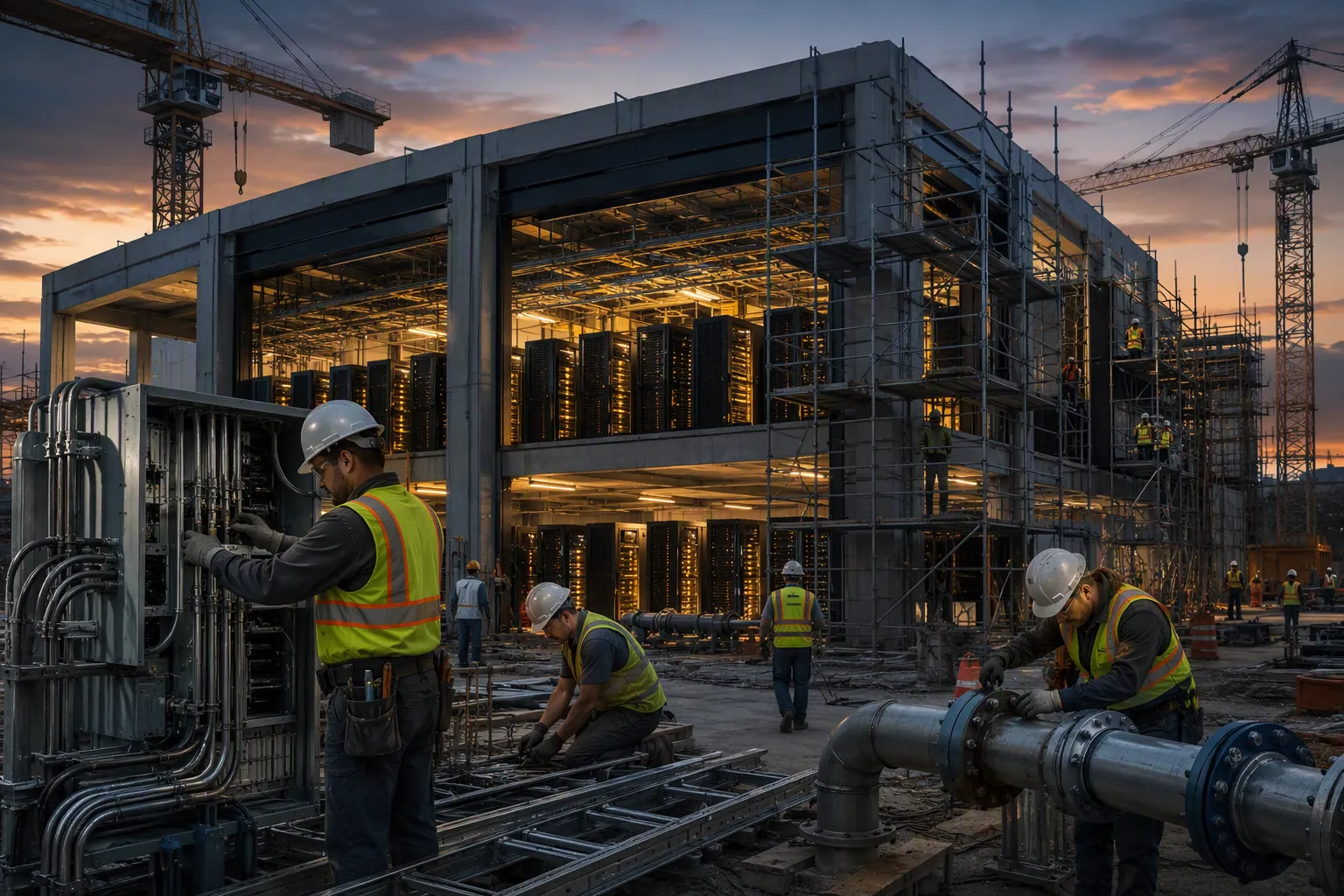
The safest version of Huang’s statement is the physical-infrastructure version. AI does not run in metaphor. It runs through land, substations, transformers, cooling systems, steel, concrete, cable trays, switchgear, backup generation, and skilled people installing and maintaining those systems. On that limited proposition, the record is substantial.
McKinsey estimates that global data-center capital expenditures required by 2030 could reach about $6.7 trillion, including about $5.2 trillion for AI workloads, with a scenario range from $3.7 trillion to $7.9 trillion. The same report flags labor shortages as one constraint on scaling that infrastructure.[3]
Hiring data point in the same direction, though they measure demand signals rather than completed jobs. Randstad’s global analysis of 50 million postings from 2022 to 2026 reported skilled-trade demand up 27%, with construction postings up 30%, welders up 25%, electricians up 18%, HVAC engineers up 67%, robotics technicians up 107%, and industrial automation roles up 51%. It also reported a 56-day time-to-hire for trades roles, slightly longer than the 54 days for desk-based professionals.[4]
The electrician baseline is not a niche anecdote either. The Bureau of Labor Statistics projects electrician employment to grow 9% from 2024 to 2034, from a 2024 base of 818,700 jobs, with about 81,000 openings each year. BLS also makes an important distinction: many of those openings are expected to come from replacement needs, including workers transferring occupations or leaving the labor force, not simply from new growth.[5]
Brookings gives the cleanest bridge from “data centers are being built” to “local employment changes are observable.” In a synthetic-control study covering 93 treated counties and roughly 3,000 control counties, Brookings found that data-center openings were associated with a 4% to 5% increase in total private employment, an 11% increase in construction employment over five to six years, and wage gains of 3% to 4%.[6]
That does not prove that every AI data-center announcement will generate the same local labor effect, or that every electrician or plumber will see a long run of high-paid work. It does support the narrower proposition that data-center construction increases near-term demand for electricians and adjacent trades. For responsible citation, that is the part of the Huang claim with the firmest footing.
The six-figure claim is real at the edges, not proven across the occupation
The wage part of the claim needs much tighter handling. Fortune reported Skillit data showing construction workers on data-center projects averaging about $81,800 per year, or $39.33 per hour, roughly 32% more than non-data-center construction workers. The same Fortune article also reported Mike Rowe’s example of three electricians under 30 earning between $240,000 and $280,000 at a Plano, Texas data-center site.[7]
Those figures matter because they show why the claim travels. A data-center project can pay unusually well, especially where schedules are compressed, specialized electrical work is scarce, overtime is available, or local labor markets are tight. The Plano electricians are not imaginary just because they are unrepresentative.
But the occupation-wide baseline is lower. BLS reports a median electrician wage of $62,350, with the top decile above $106,030. That makes “some data-center electricians can make six figures” a supportable statement. It does not make “AI-created electrician jobs are six-figure jobs” a safe occupation-wide claim.[5]
The record is thinner for plumbers in this audit. Huang named plumbers, and data-center construction can involve substantial piping, cooling, and mechanical systems. But the strongest quantified wage evidence in the supplied record concerns construction workers generally and electricians specifically. The electrician evidence should not be silently transferred to plumbers as if the two occupations had identical wage distributions or demand dynamics.
A separate Fortune report, citing figures attributed to the International Brotherhood of Electrical Workers, stated that electrical work can represent about 45% to 70% of data-center construction cost and that the United States will need about 300,000 new electricians over the next decade plus about 200,000 retirements. Those are relevant signals, but in this record they are second-hand figures reported through Fortune, not independently verified IBEW primary data.[8]
The disputed part is durability: construction jobs are not the same as operating jobs
The most important ambiguity in the public version of the claim is the word “jobs.” A construction job on a data-center site, a permanent facilities job after commissioning, a replacement opening caused by retirement, and an incentive-agreement “job created” figure can all be counted as jobs. They do not mean the same thing for the worker, the county, or the person citing the claim.
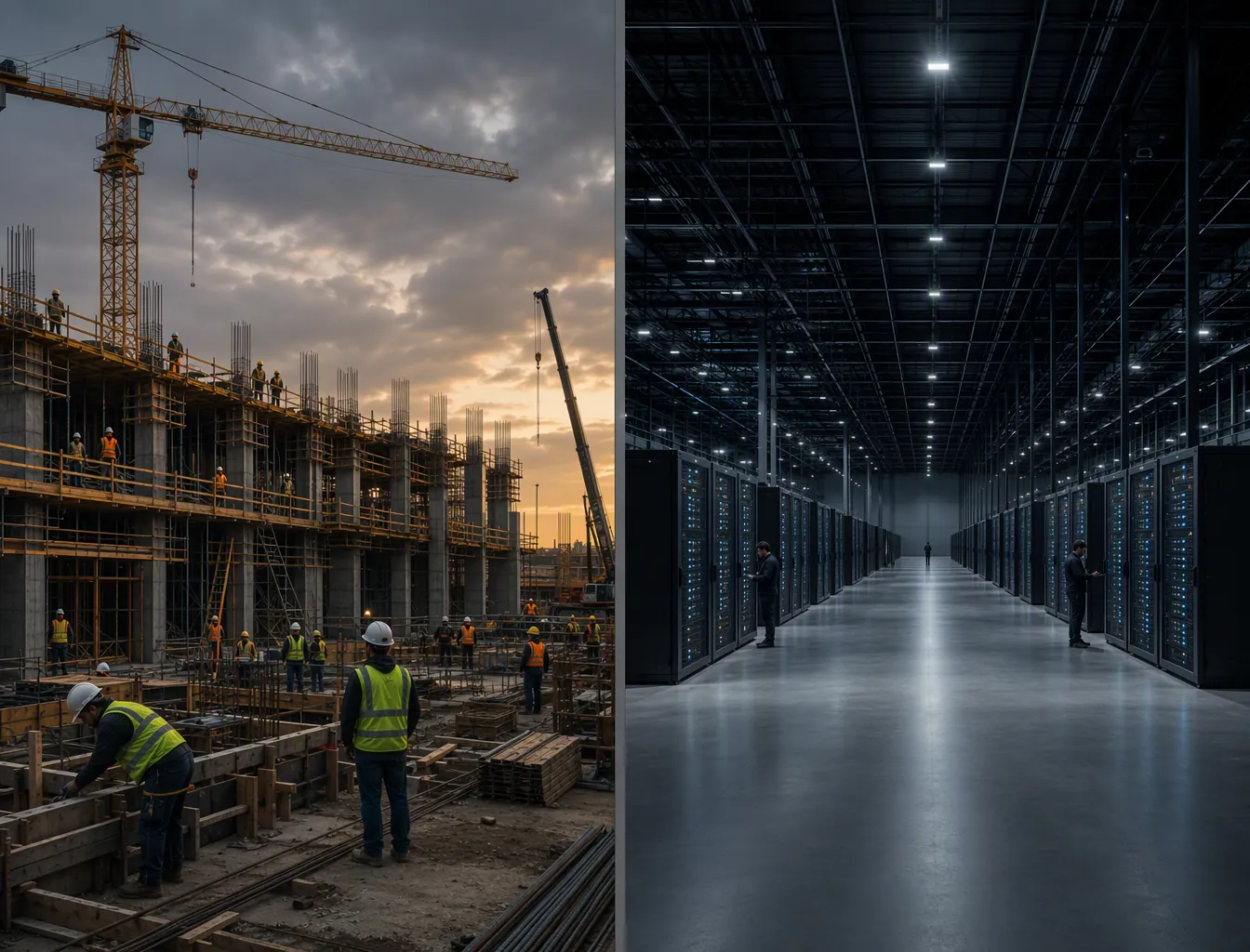
Brookings is especially useful because it cautions against a common accounting error. Its study found measurable employment effects, including construction gains, but also concluded that naive estimates overstate job effects by about three times. In other words, data centers do affect local labor markets, but the headline number can be badly inflated if it does not control for what would have happened in comparable counties without the facility.[6]
Good Jobs First supplies concrete examples of how this inflation can enter public debate. It described a Cologix project in Columbus where about 146 construction workers averaged roughly 6.5-week stints. It also cited a New York case involving 125 promised jobs tied to $1.4 billion in incentives, or about $11 million per job, and found that 16 of 36 state data-center subsidy programs had no job-creation requirement.[9]
Those examples do not prove that all data-center job claims are abusive. They do show the specific risk in using construction labor as a durable-employment credential. A site can be crowded with electricians, plumbers, welders, and steel workers during construction and still operate later with a much smaller permanent staff.
Food & Water Watch, an advocacy organization that has argued for a national moratorium on new data centers, estimated about 23,000 permanent U.S. data-center jobs, or about 0.01% of national employment. That figure should be treated as advocacy research rather than neutral statistical ground truth, but it is directionally relevant to the construction-versus-operations distinction: the permanent operating workforce is not the same thing as the temporary build-out workforce.[10]
This distinction matters most for the worker whose labor is being used in the argument. The electrician who earns a premium on a fast-moving data-center project may have a very good year. The plumber pulled into a regional construction surge may see real demand. The construction worker on a six-week stint has still done real work. But none of that, by itself, establishes a durable AI-created career path in the same locality once the facility is built.
How to cite the claim without importing the hype
For legal, policy, or procurement writing, the safest approach is to cite the proposition actually supported by the evidence. The claim should not be shortened into “AI will create six-figure electrician and plumbing jobs” unless the sentence itself preserves the conditions.
- Safe: AI data-center build-outs are increasing short-term demand for electricians, construction workers, and other skilled trades involved in infrastructure construction.
- Conditional: some data-center trade roles, especially specialized or overtime-heavy electrical work, can reach six-figure pay.
- Not yet safe: AI is creating durable, broad-based electrician and plumbing careers.
The same discipline applies to infrastructure-risk analysis more generally. A data-center boom can create real trade demand while still raising unresolved questions about incentives, energy, permitting, and state regulation. For that adjacent issue, see Why State Regulation Is GEV's Biggest AI Infrastructure Risk. The method is the same one used in docket-level verification work such as Relying on 'DOJ Drops Charges'? Verify the Hearn Docket: split the attractive public sentence into claims that can actually be checked.
Huang’s infrastructure claim is repeatable if its boundaries stay attached. AI data-center construction is creating near-term work for electricians and other trades. Some of that work pays very well. The broader claim—that AI has solved the future of electrician and plumbing employment—is not established by this record.
References
- Conversation with Jensen Huang, President and CEO of NVIDIA — World Economic Forum — https://www.weforum.org/podcasts/meet-the-leader/episodes/conversation-with-jensen-huang-president-and-ceo-of-nvidia-5dd06ee82e/
- Davos WEF: BlackRock CEO Larry Fink, Jensen Huang — NVIDIA Blog — https://blogs.nvidia.com/blog/davos-wef-blackrock-ceo-larry-fink-jensen-huang/
- The cost of compute: A $7 trillion race to scale data centers — McKinsey — https://www.mckinsey.com/industries/technology-media-and-telecommunications/our-insights/the-cost-of-compute-a-7-trillion-dollar-race-to-scale-data-centers
- AI can’t build data centers: global demand for skilled trades soars in the AI era — Randstad — 2026 — https://www.randstad.com/press/2026/ai-cant-build-data-centers-global-demand-for-skilled-trades-soars-in-the-ai-era/
- Electricians — Occupational Outlook Handbook — U.S. Bureau of Labor Statistics — https://www.bls.gov/ooh/construction-and-extraction/electricians.htm
- New evidence on data center employment effects — Brookings — https://www.brookings.edu/articles/new-evidence-on-data-center-employment-effects/
- Jensen Huang says a lot of six-figure jobs in plumbing and construction will soon be unlocked because someone needs to build new AI centers — Fortune — https://fortune.com/article/jensen-huang-says-a-lot-of-six-figure-jobs-in-plumbing-and-construction-will-soon-be-unlocked-because-someone-needs-to-build-new-ai-centers/
- Skilled trade demand, Randstad report, electricians, technicians, construction workers, six-figure salaries, data center boom — Fortune — 2026-03-20 — https://fortune.com/2026/03/20/skilled-trade-demand-randstand-report-electricans-technicans-construction-workers-six-figure-salaries-data-center-boom/
- Will Data Center Job Creation Live Up to Hype? I Have Some Concerns — Good Jobs First — https://goodjobsfirst.org/will-data-center-job-creation-live-up-to-hype-i-have-some-concerns/
- New Research Debunks Data Center Industry Job Claims — Food & Water Watch — 2026-01-07 — https://www.foodandwaterwatch.org/2026/01/07/new-research-debunks-data-center-industry-job-claims/
Related records
Tool profile
What Nvidia's 2026 Earnings Say About AI Legal RiskGoverning regulation
Browse the obligations tracker →Preventive workflow
Browse verification workflows →
Report a correction or tip
Spotted an outdated figure, a misstated fact, or a ruling this case record should reflect? Public comments are disabled for this content given the professional cost of a misreported case outcome, penalty amount, or rule text — use the structured correction channel instead.
Report a correction or tip for this record →