
Relying on 'DOJ Drops Charges'? Verify the Hearn Docket
When 'DOJ drops charges' appears in a headline, the docket — not the press release — determines what actually happened. This verification workflow uses the David Hearn case to show what legal teams must check before citing a case as dismissed.
- Jurisdiction
- US federal
- Court
- U.S. District Court for the District of Columbia
- Judge
- Carmen McLean
- AI tool named
- AI-generated legal summaries
- Ruling date
- Aug 2, 2026
- Source document
- View primary court order ↗
- Last verified
- Aug 2, 2026
Lex Machina Review is an independent risk-tracking and reference resource. Nothing on this site is legal advice, and using it does not create an attorney-client relationship. Every record is reviewed against primary sources but may not reflect the most current status of a matter — always verify directly against the cited court order, rule text, or a licensed attorney before relying on it.
Companion explanation — secondary to the source document above
When a headline, AI answer, docket-alert summary, or opposing brief says DOJ drops charges in the David Hearn case, the useful response is not to copy the phrase. It is to ask which procedural state the phrase is trying to describe.
In the Hearn matter, the same public arc can be compressed into one convenient sentence: the government charged him, then the case was dismissed. That sentence is not wrong enough to be useless, but it is too blunt to cite. For a brief, client update, risk memo, or legal-tech record, “indicted,” “motion to dismiss filed,” and “dismissed” are separate entries, supported by different documents and carrying different consequences.
This workflow uses Hearn as a verification example and relies on the existing Risk Digest anchor record for the case narrative. The point here is narrower: before anyone relies on “DOJ drops charges,” the docket has to show what actually happened.
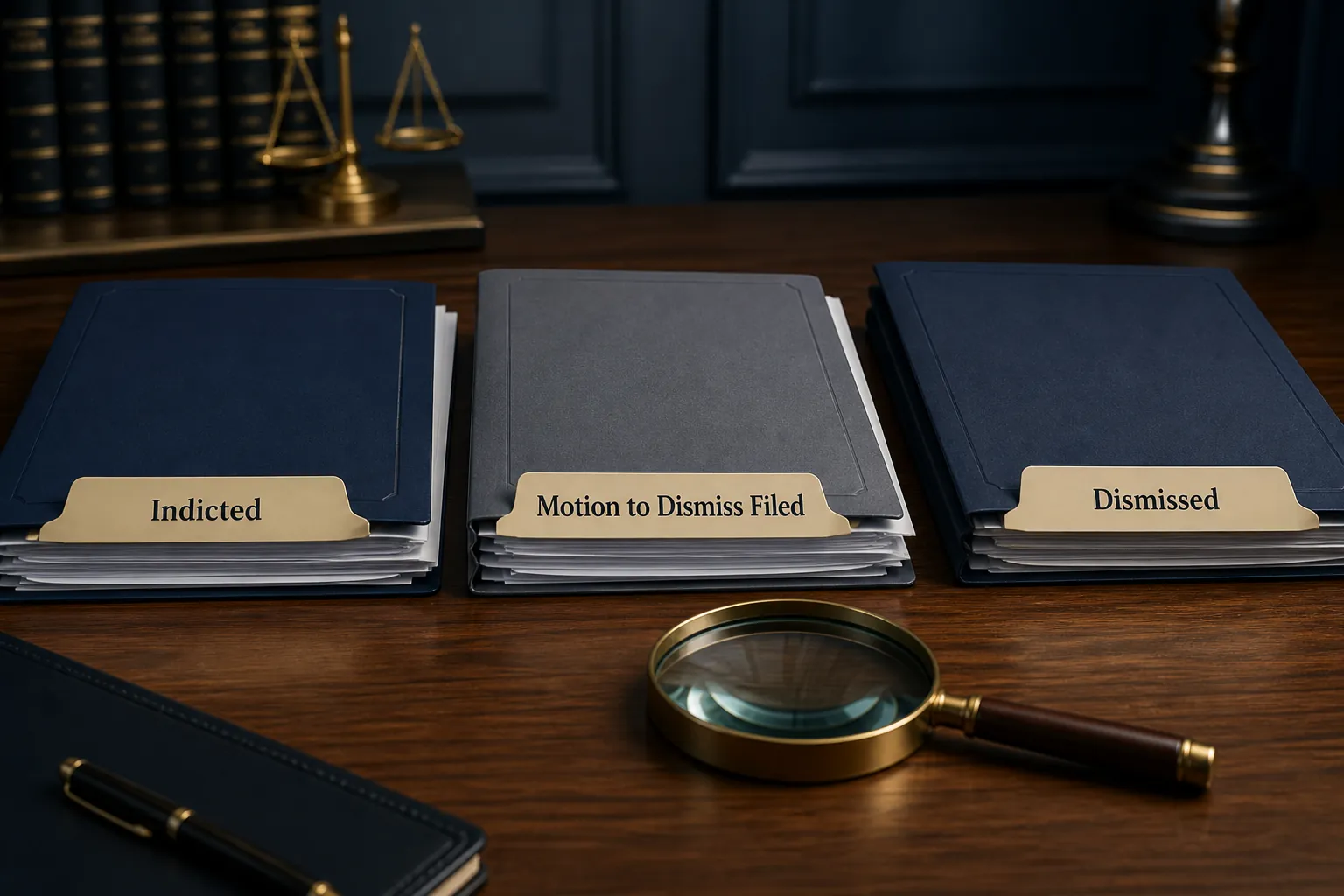
Start with the disposition ladder, not the headline
A workable disposition check begins as a ladder. Each rung needs its own source. The Hearn docket sequence, as used for this verification exercise, looks like this:
| Date | Procedural state | What that state does and does not prove | Artifact to check |
|---|---|---|---|
| June 19, 2026 | Arrest | Shows a law-enforcement event occurred; it does not by itself establish indictment, plea, dismissal, or final disposition. | Arrest-related docket entry or charging materials |
| July 2, 2026 | Indictment announced | Shows the government publicly treated the case as charged; a press announcement is not the charging instrument. | Indictment or other filed charging document |
| July 9, 2026 | Not-guilty plea before Judge Carmen McLean | Shows the case was active and contested at that point; it is incompatible with describing the matter as already dismissed. | Minute entry, plea entry, or hearing record |
| July 31, 2026 | Government motion to dismiss | Shows the government asked the court to end the case; the motion itself is not the dismissal. | Filed motion to dismiss |
| After the motion | Dismissal without prejudice | Shows the court acted; “without prejudice” matters because it does not carry the same consequences as dismissal with prejudice. | Court order granting dismissal and specifying prejudice |
Those dates are not interchangeable labels for the same event. They mark changes in legal posture. The case was announced on July 2, Hearn entered a not-guilty plea on July 9 before Judge Carmen McLean, the government moved to dismiss on July 31, and the court granted dismissal without prejudice.[1]
“Indicted” means a charging instrument exists
The July 2 public announcement is the sort of source that gets quoted because it is vivid. U.S. Attorney Jeanine Pirro described the case in confident terms, referring to “tremendous evidence” and saying Hearn “violently” ripped up the liner at the Lincoln Memorial Reflecting Pool.[1] That language may be newsworthy. It is not the source that proves the docket status.
For verification purposes, an indictment announcement is a pointer. It tells the researcher where to look next. The charging instrument is the operative document: indictment, information, complaint, superseding instrument if any, and the docket entry that records its filing. If the only available item is a press release, the correct database note is not “indicted confirmed.” It is “government announced indictment; charging document not yet checked.”
That distinction matters because a public statement often carries factual narrative along with procedural status. In Hearn, the government’s early account relied on the Interior Department’s secondhand vandalism narrative, and the later reversal came only after primary documents surfaced.[1] A verification note should not promote the narrative because the prosecutor spoke confidently. It should separate the fact of a filed charge from the government’s description of the underlying conduct.
A motion to dismiss is not a dismissal
The phrase “DOJ drops charges” often appears when the government files a motion to dismiss. That is understandable shorthand outside the courthouse. Inside a citation workflow, it is premature.
A motion to dismiss tells you what the government asked the court to do. It does not tell you that the court has done it. Until the judge grants the motion, the reliable status is “government motion to dismiss pending,” not “case dismissed.” If an automated summary skips that step, the summary has flattened the docket.
The Hearn sequence makes the problem easy to see. The July 31 filing changed the government’s position. The later court order changed the case disposition. A legal team citing the case between those two events would need to say that the government had moved to dismiss, not that dismissal had already occurred.[1]
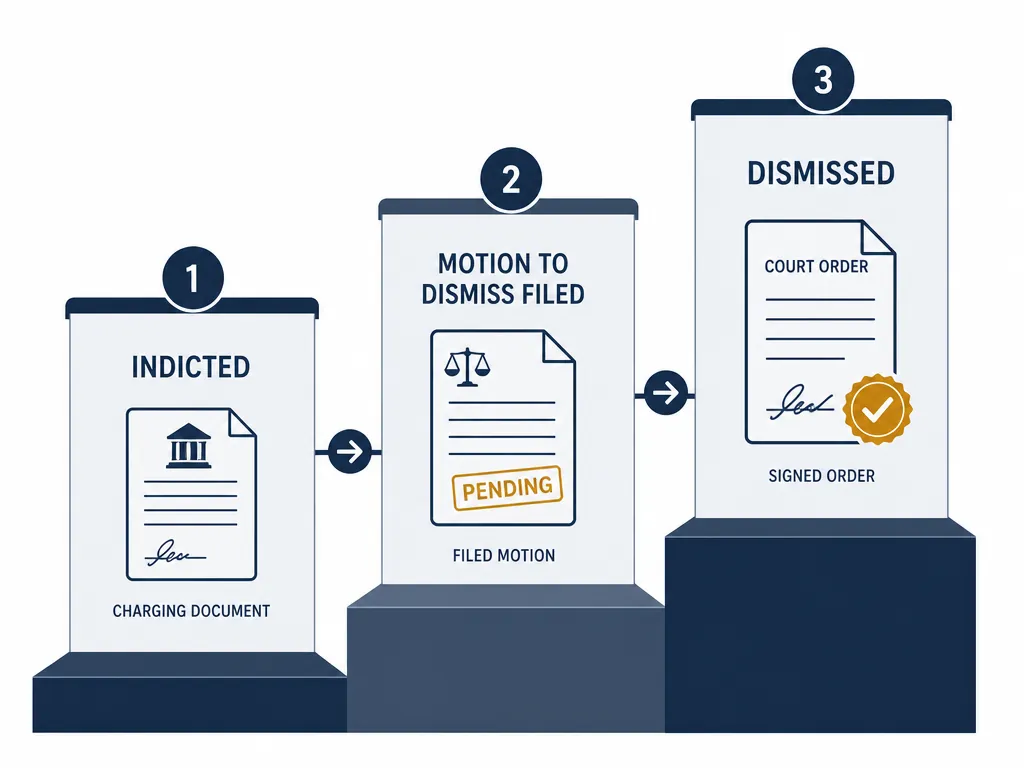
The order supplies the disposition, including prejudice
Once the court acts, the verification target shifts again. The question is no longer whether the government wanted out. The question is what the judge ordered.
The order should be checked for at least three things: whether dismissal was granted, whether the order addresses all charges and defendants at issue, and whether the dismissal was with or without prejudice. In Hearn, the court granted dismissal without prejudice.[1] That last phrase should not be trimmed away. A dismissal without prejudice is a confirmed dismissal, but it does not carry the same finality signal as a dismissal with prejudice.
A clean database entry would therefore not stop at “dismissed.” It would read closer to: “Government moved to dismiss on July 31, 2026; court granted dismissal without prejudice; order checked.” The exact wording can vary by system, but the three components should survive: motion, order, and prejudice.
The source-checking workflow
For risk, KM, litigation-support, and legal-tech teams, the Hearn file is useful because it converts a familiar problem into a repeatable check. The work is not complicated. It is easy to skip.
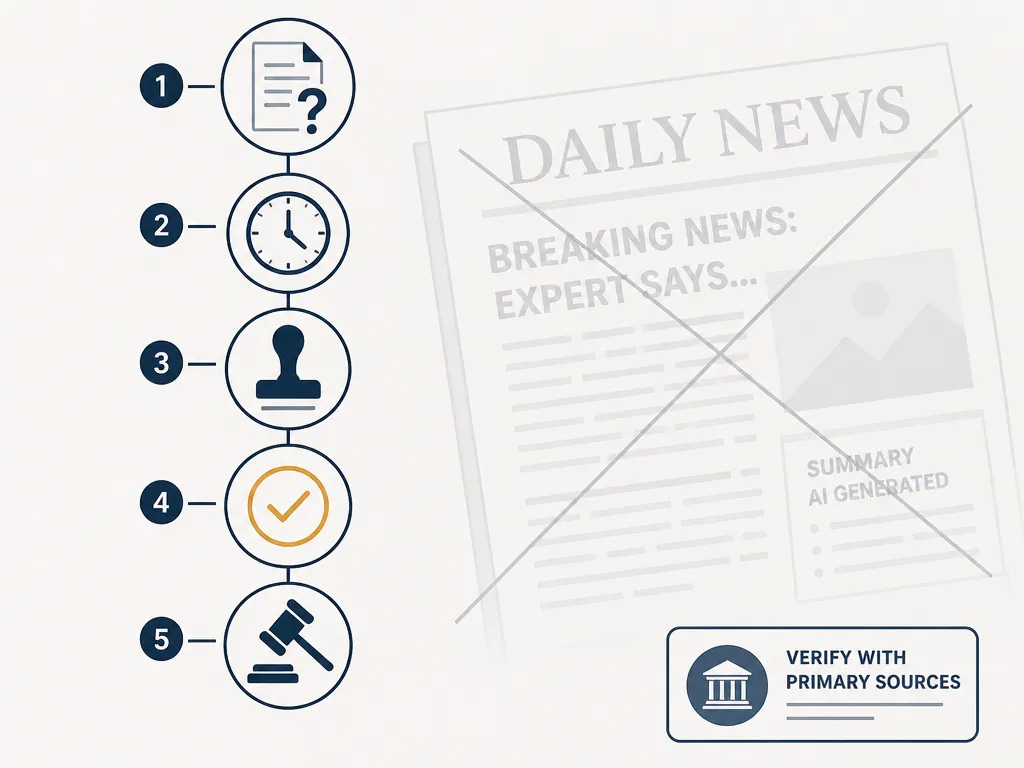
- Identify the claim being made. If the source says “DOJ drops charges,” translate that into a checkable proposition: indictment filed, motion to dismiss filed, court dismissed, or something else.
- Find the charging instrument. Do not treat a press release or article as proof that a charge exists in the form described.
- Check for intervening docket activity. A plea entry, hearing minute, reassignment, superseding filing, or pending motion can change how the case should be described.
- If a dismissal motion appears, keep it pending until the court acts. The motion changes the government’s position; the order changes the disposition.
- Read the dismissal order. Capture whether dismissal is with or without prejudice, whether it covers the entire matter, and whether any related counts, defendants, or proceedings remain.
- Timestamp the verification. A case described accurately at noon can be stale by the time a court posts the next entry.
This is also the point where AI-generated legal summaries need a stricter editor than a fluency check. A model may produce a perfectly readable sentence saying the charges were dropped. The question is whether the model can point to the filed motion, the signed or entered order, and the docket entry showing the order’s effect. If it cannot, the sentence is not ready for use as a disposition.
What to record when citing Hearn
A citation note for this case should avoid the loose verb set: dropped, cleared, collapsed, abandoned. Some of those words may be defensible in commentary. They are poor disposition fields because they hide the source of authority.
| If you see this wording | Use this verification question | Safer disposition language after confirmation |
|---|---|---|
| “Hearn was indicted” | Is the charging instrument on the docket, and what exactly does it charge? | “Indictment filed,” with the docket date and document checked |
| “DOJ dropped the charges” | Did the government file only a motion, or did the judge grant it? | “Government moved to dismiss,” if no order has been checked |
| “The case was dismissed” | Where is the court order, and does it specify prejudice? | “Court granted dismissal without prejudice,” if the Hearn order has been verified |
| “The case collapsed” | Is this a procedural statement or commentary on the factual narrative? | Keep commentary separate from the disposition field |
For Hearn, the verified procedural wording is that the government moved on July 31, 2026 to dismiss and the court granted dismissal without prejudice.[1] If the surrounding discussion needs to explain why the government reversed course, send readers to the case record rather than trying to rebuild the Reflecting Pool factual dispute inside a disposition note.
The practical rule
Before relying on any formulation of “DOJ drops charges,” cite the docket and the court order, state whether dismissal was with or without prejudice, and record when the check was performed. A headline, press statement, AI summary, or adversary’s characterization can start the search. It cannot convert a pending motion into a confirmed disposition.
References
- Why Did the Reflecting Pool Vandalism Case Collapse? — Lex Machina Review
Related records
Tool profile
How Meta's AI Spending Reshapes Law Firm ProfitabilityGoverning regulation
Browse the obligations tracker →Preventive workflow
Browse verification workflows →
Report a correction or tip
Spotted an outdated figure, a misstated fact, or a ruling this case record should reflect? Public comments are disabled for this content given the professional cost of a misreported case outcome, penalty amount, or rule text — use the structured correction channel instead.
Report a correction or tip for this record →