
Jessica Treviño's DACA lawsuit tests the deportation shield
A sourced Risk Digest record of Treviño Villegas v. Mullin: the verified detention-to-removal timeline, the DACA termination notice, and the relief sought, with the disputed voluntary-departure question flagged rather than adjudicated.
- Jurisdiction
- US Federal
- Court
- U.S. District Court for the Southern District of Texas, Brownsville Division
- AI tool named
- No AI tool named
- Ruling date
- Jul 29, 2026
- Source document
- View primary court order ↗
- Last verified
- Aug 1, 2026
Lex Machina Review is an independent risk-tracking and reference resource. Nothing on this site is legal advice, and using it does not create an attorney-client relationship. Every record is reviewed against primary sources but may not reflect the most current status of a matter — always verify directly against the cited court order, rule text, or a licensed attorney before relying on it.
Companion explanation — secondary to the source document above
Risk Digest record — category: risk-digest. The Jessica Treviño Villegas case is docketed as Treviño Villegas v. Mullin et al., No. 1:26-cv-00832, in the U.S. District Court for the Southern District of Texas, Brownsville Division. The public docket summary shows a July 29, 2026 filing date and mandamus jurisdiction under 28 U.S.C. § 1361; last verification of the docket metadata for this entry: August 1, 2026, UTC, against the public source links listed below.[1]
| Record point | Current status for this entry |
|---|---|
| Case name and number | Treviño Villegas v. Mullin et al., No. 1:26-cv-00832.[1] |
| Court | Southern District of Texas, Brownsville Division.[1] |
| Filing date | July 29, 2026.[1] |
| Jurisdictional basis shown in public docket summary | 28 U.S.C. § 1361 mandamus.[1] |
| Judge assignment | Not treated as confirmed from the public summary reviewed for this entry. |
| Exact petition text, named defendants, and counsel of record | Require direct docket verification before being treated as confirmed beyond the public case-page metadata. |
| Posture | Live, disputed removal-and-DACA-termination record; not legal advice. |
The public case page is enough to anchor the docket and filing metadata. It is not enough to settle the pleading details. AP and FWD.us report the timeline, the relief sought, and the competing accounts; those points are used here as reported facts unless the public docket metadata independently confirms them.[2][3]
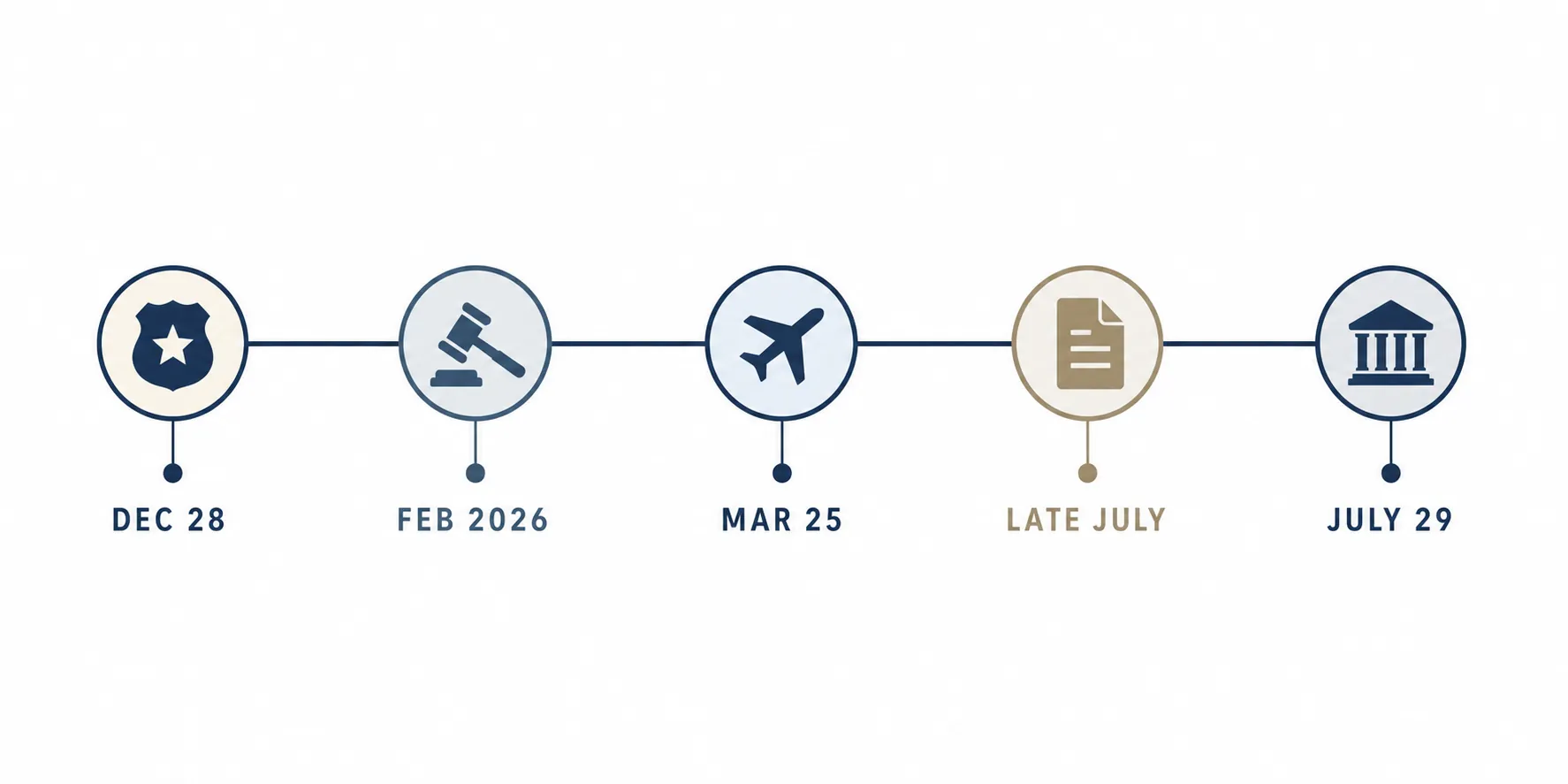
The detention-to-removal-to-mandamus sequence
For removal-defense screening, the useful part of this record is not the broad label “Dreamer deported.” It is the sequence: custody, order, physical removal, DACA notice, then district-court filing. The voluntary-departure point remains the factual hinge, because the government and Treviño give sharply different accounts of whether she knowingly accepted departure and gave up appeal.
| Date or window | Event | How it should be read |
|---|---|---|
| December 28, 2025 | Treviño was detained in a Home Depot parking lot in Alamo, Texas.[2][3] | Reported custody start. This date matters because her DACA status was later described as active during the events that followed. |
| February 2026 | An immigration judge entered a voluntary-departure order. DHS says Treviño “knowingly accepted voluntary departure and waived appeal”; Treviño told AP she signed no forms and did not want to leave.[2] | Disputed core fact. Do not treat consent, waiver, or voluntariness as established on the current public source set. |
| March 25, 2026 | Treviño was removed to Matamoros, Mexico.[2][3] | Reported physical consequence. This is also the same date later cited by USCIS as the travel event underlying the DACA termination notice. |
| Late July 2026 | USCIS issued a Notice of Intent to Terminate DACA citing “unauthorized travel on or about March 25, 2026.”[2][3] | Reported agency notice language. The circularity is apparent on the face of the reported sequence: the date of government removal becomes the date of alleged unauthorized travel. |
| July 29, 2026 | Treviño filed the mandamus action in S.D. Texas.[1][2][3] | Verified filing date from the public docket summary; exact pleading language still requires direct docket review. |
The February order cannot be treated as a minor procedural detail. If DHS’s account is right, the government will frame the March 25 event as the execution of an accepted voluntary-departure path, with appeal waived. If Treviño’s account is right, the premise of knowing acceptance is missing: she told AP she signed no forms and did not want to leave.[2]
That dispute carries forward into the DACA notice. AP reports that DHS said Treviño “will NOT return” to the United States, while Treviño’s side seeks return and preservation of her DACA status.[2] The difference is not rhetorical. It determines whether the court is being asked to correct an unlawful removal from an active-DACA posture or to interfere with an agency action the government says followed from a waived-appeal departure order.
The March 25 loop: removal becomes the alleged unauthorized travel
Treviño’s mandamus filing matters because it asks the district court to address an administrative loop that looks dry on paper but is severe in operation. AP and FWD.us report that she seeks to have the removal declared unlawful, to compel DHS to facilitate her return to the United States, and to preserve her DACA through its April 2027 expiration.[2][3]
The unresolved legal question is narrower than the national DACA fight and more useful to practitioners: can DHS carry out the March 25 removal and then can USCIS cite that same March 25 event as “unauthorized travel” to terminate DACA? The current public source set supports that this is the alleged sequence. It does not establish how the district court will characterize the removal, the voluntary-departure order, or the DACA notice.
| Account | What is being asserted | Risk significance |
|---|---|---|
| Government position, as reported by AP | Treviño knowingly accepted voluntary departure, waived appeal, and will not be returned.[2] | If credited, the government will argue that the March 25 event followed from an accepted process rather than an unlawful removal of a protected DACA recipient. |
| Treviño’s account, as reported by AP | She signed no forms and did not want to leave.[2] | If credited, the asserted waiver and voluntary-departure premise are undermined, making the later DACA termination notice harder to separate from the disputed removal. |
| USCIS notice language, as reported by AP and FWD.us | The Notice of Intent to Terminate cited “unauthorized travel on or about March 25, 2026.”[2][3] | This is the operational circularity: the date of government-executed removal is also the date used to threaten DACA termination. |
Mandamus is not a general invitation for the district court to supervise every immigration decision. The public docket summary identifies 28 U.S.C. § 1361, which points to a request to compel federal officers to perform a duty allegedly owed to the plaintiff.[1] On the reported relief, Treviño is asking for more than a status correction in a database: she is asking for facilitated return after physical removal and preservation of DACA until its stated April 2027 expiration.[2][3]
What this record can support now
The nearby administrative backdrop is the April 24, 2026 BIA decision treating DACA alone as insufficient to stop removal proceedings.[4] That point should not be overread. It helps explain why an active-DACA recipient’s removal exposure is being litigated in 2026; it does not answer whether the government may use its own March 25 removal action as the “unauthorized travel” basis for terminating Treviño’s DACA.
Two comparator matters are useful only at the edge of the frame. In Estrada Juárez, Politico reported that Judge Coggins in the Eastern District of California ordered the government on March 24, 2026, to bring back a DACA recipient deported to Mexico and described the removal as a “flagrant violation” of DACA.[5] In Contreras Díaz, the Texas Tribune reported that a deported Texas DACA recipient was returned to the United States, detained, and later released in May 2026.[6] Those matters show that return-after-removal relief has appeared in nearby DACA enforcement disputes. They do not resolve Treviño’s voluntary-departure conflict or her DACA-notice circularity.
The enforcement numbers are also context, not the center of this case. AP reported a DHS letter to Sen. Dick Durbin saying 86 DACA recipients had been deported and 241 arrested.[2] CBS News reported on a DHS letter covering January 1 through November 19, 2025, stating that ICE arrested 261 DACA recipients, deported 86, and that 92% of those arrested had “criminal histories.”[7] The Texas Tribune noted inconsistency in DHS figures, including 86 versus 174 deportations in different letters to Democratic members of Congress.[6] Those figures should be carried with their source and window attached; they should not be converted into a clean trend line for Treviño’s docket.
This record also has no AI-filing nexus on the reviewed materials. It belongs in a litigation-risk digest, if published here, because it is an enforcement-risk record for DACA and removal-defense work, not because it involves an AI-generated citation, hallucinated authority, or automated filing error.
For now, Treviño Villegas v. Mullin leaves open the question that matters most for screening active-DACA clients with removal exposure: whether the March 25 removal can lawfully be used as the basis for DACA termination. Until the docket supplies the next verified event, the case should be treated as live, disputed, and source-dependent.
References
- Trevino Villegas v. MULLIN et al (1:26-cv-00832) — PACER Monitor
- US cites “unauthorized travel” to end DACA status for a mom of 3 deported to Mexico — AP
- THE GOVERNMENT DEPORTED JESSICA TREVIÑO VILLEGAS DESPITE HAVING A VALID DACA — FWD.us
- BIA decision April 24, 2026 — DOJ EOIR — April 24, 2026
- Judge orders Trump administration to bring back DACA recipient deported to Mexico — Politico — March 24, 2026
- Deported Texas DACA recipient returned to U.S. freed after detainment — Texas Tribune — May 7, 2026
- ICE arrested 261 DACA recipients over 10 months last year — CBS News
Related records
Tool profile
How Meta's AI Spending Reshapes Law Firm ProfitabilityGoverning regulation
Browse the obligations tracker →Preventive workflow
Browse verification workflows →
Report a correction or tip
Spotted an outdated figure, a misstated fact, or a ruling this case record should reflect? Public comments are disabled for this content given the professional cost of a misreported case outcome, penalty amount, or rule text — use the structured correction channel instead.
Report a correction or tip for this record →