
Jessica Treviño's DACA Suit Tests Unauthorized Travel Rule
Case-status record on Treviño Villegas v. MULLIN, the S.D. Tex. mandamus petition challenging USCIS's termination of Jessica Treviño's DACA after her March 25, 2026 removal to Mexico was labeled 'unauthorized travel.' As of August 1, 2026, the petition is pending without a ruling; the record documents the disputed NOIT facts, the governing 8 CFR rules, and the relief sought, each tied to primary sources.
- Jurisdiction
- U.S. federal (S.D. Tex.)
- Court
- U.S. District Court for the Southern District of Texas
- AI tool named
- No AI tool named
- Source document
- View primary court order ↗
- Last verified
- Aug 1, 2026
Lex Machina Review is an independent risk-tracking and reference resource. Nothing on this site is legal advice, and using it does not create an attorney-client relationship. Every record is reviewed against primary sources but may not reflect the most current status of a matter — always verify directly against the cited court order, rule text, or a licensed attorney before relying on it.
Companion explanation — secondary to the source document above
Case posture as of August 1, 2026
Treviño Villegas v. MULLIN et al., No. 1:26-cv-00832, is a Southern District of Texas case assigned to the Brownsville Division and filed on July 29, 2026. The public case page identifies the action as a mandamus filing under 28 U.S.C. § 1361, nature of suit 540. As of this case-status record, no ruling is identified in the available public docket materials reviewed for August 1, 2026. The visible docket information is header-level metadata, not a substitute for the complaint, exhibits, or the Notice of Intent to Terminate itself. [1]
The load-bearing issue in the Jessica Treviño DACA lawsuit unauthorized travel rule dispute is narrow: whether USCIS may treat a DHS-ordered removal to Mexico as “unauthorized travel outside of the United States” sufficient to terminate active DACA. AP and the Texas Tribune report that USCIS’s July 2026 notice cited “unauthorized travel outside of the United States on or about March 25, 2026” — the same date DHS removed Treviño Villegas to Matamoros, Mexico. [2][3]
That sentence should not be inflated into a holding. There is no court decision yet saying the agency may use the rule that way, and no court decision yet saying it may not. The useful work, at this stage, is to separate the reported agency characterization from the reported challenge to it.

The reported sequence matters more than the label
The exposure in this case sits in the order of events. A DACA recipient is detained, receives a voluntary-departure order while in custody, is removed to Mexico, and later receives a notice that reportedly treats the removal date as unauthorized travel. Each step has a different legal consequence, and the present record does not allow those consequences to be merged.
| Date or period | Event | Status of support in the present record |
|---|---|---|
| Dec. 28, 2025 | Treviño Villegas was reportedly detained in a Home Depot parking lot. | Reported by AP and the Texas Tribune; not independently verified here from the complaint or detention records. [2][3] |
| February 2026 | An immigration judge reportedly issued a voluntary-departure order while Treviño Villegas was in ICE custody. | AP reports DHS’s position that voluntary departure was accepted and appeal was waived; the petition side disputes the lawfulness of the removal sequence. [2] |
| March 25, 2026 | DHS removed Treviño Villegas to Matamoros, Mexico. | Reported by AP and the Texas Tribune. This is also the date AP and the Texas Tribune report USCIS later identified as “unauthorized travel.” [2][3] |
| July 2026 | USCIS reportedly issued a Notice of Intent to Terminate DACA citing unauthorized travel outside the United States. | The quoted NOIT language is from AP and Texas Tribune reporting; no primary copy of the NOIT was available in the materials reviewed. [2][3] |
| July 29, 2026 | Treviño Villegas filed the federal mandamus petition in the Southern District of Texas. | Supported by the public case page and AP reporting. [1][2] |
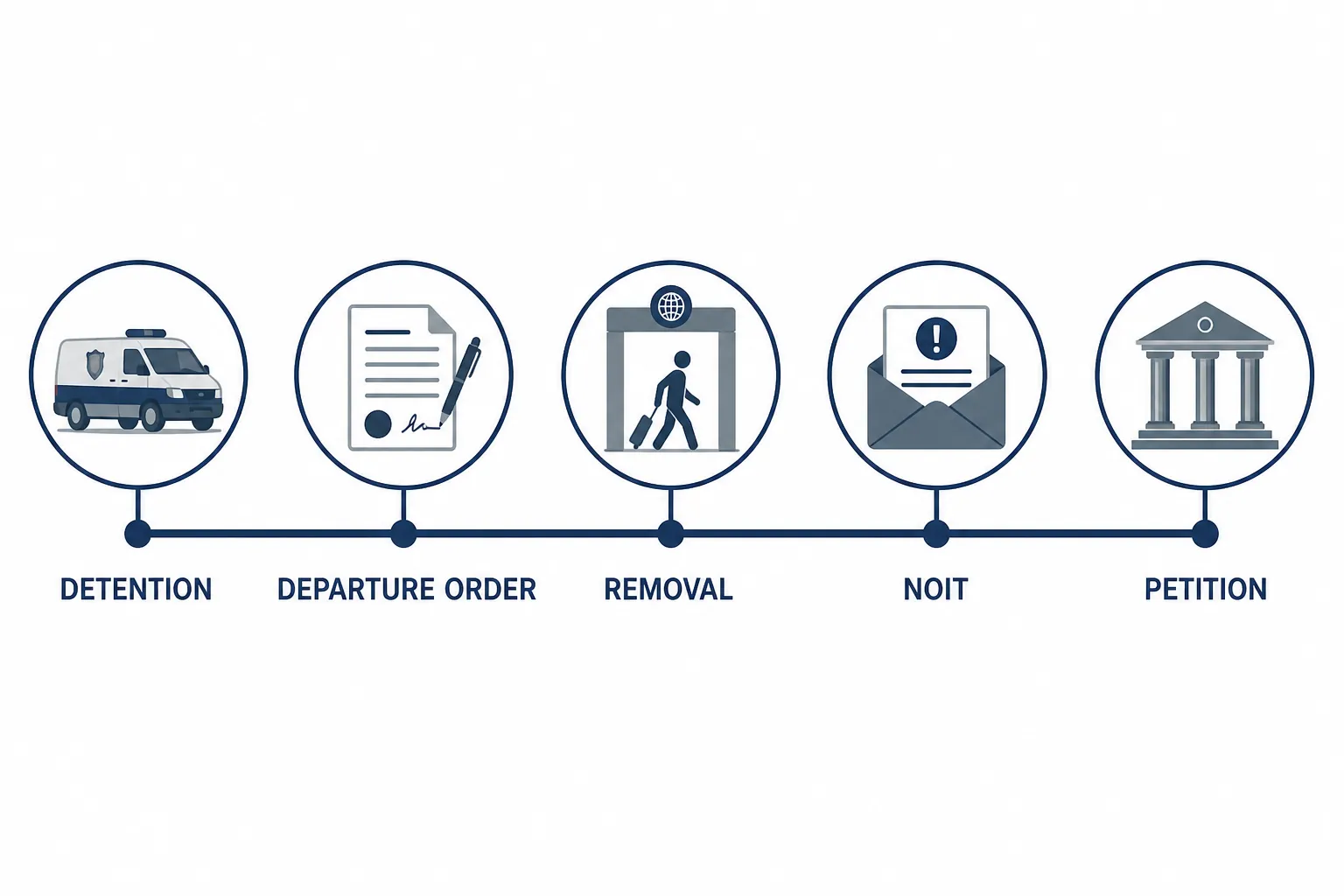
The March 25 date is the oddity that makes this filing more than an ordinary DACA-termination notice. If the reported notice language is accurate, the government action that physically put Treviño Villegas outside the United States is also being used as the event that may strip the deferred-action protection she says remained valid when she was removed.
What the DACA travel regulations actually do
The regulatory hinge is not simply the phrase “unauthorized travel.” The DACA regulation at 8 CFR 236.23(d)(2) addresses termination after a Notice of Intent to Terminate where a DACA recipient departed the United States without advance parole on or after August 15, 2012, and then entered the United States without inspection. Separately, 8 CFR 236.22(b)(2) treats unauthorized travel outside the United States as interrupting continuous residence for DACA purposes. [4]
That wording is why the Treviño Villegas facts have to be handled carefully. A removal is a departure in the physical sense, but the case turns on whether it can be treated as the kind of unauthorized travel contemplated by the DACA rules. The materials available so far do not include the primary NOIT, so the exact regulatory subsection USCIS relied on should be checked against the notice before anyone cites this case for a more precise proposition.
USCIS’s public DACA FAQ also matters because it recognizes that some border-crossing events are not treated the same way as ordinary travel choices. The FAQ refers to “exigent circumstances, such as accidental or involuntary border crossings,” language that counsel may point to when arguing that a government-ordered removal cannot fairly be converted into unauthorized travel by the person removed. [5]
That FAQ language does not itself decide Treviño Villegas’s petition. It does, however, show why the government’s reported shorthand is incomplete. The legal question is not whether she was outside the United States on March 25. The harder question is what legal meaning USCIS may assign to the reason she was outside the United States.
The two competing characterizations
On the agency side, the reported NOIT treats March 25 as unauthorized travel outside the United States. AP also reported DHS’s position that Treviño Villegas had accepted voluntary departure and waived appeal. That position matters because, if credited, it frames the departure as the consequence of an immigration proceeding rather than an unexplained government expulsion. [2]
On Treviño Villegas’s side, counsel and advocates say she had active DACA, reportedly valid through April 2027, and that the government unlawfully removed her despite that status. FWD.us describes the government as having deported a person with valid DACA and then attempting to strip that status after the fact. [6]
Both characterizations cannot be treated as established facts at this stage. The petition has been filed; it has not been adjudicated. The agency’s reported NOIT language is important because it identifies the theory of termination. The counsel and advocacy account is important because it identifies the theory of unlawfulness. Neither is a judicial finding.
Relief sought
The requested relief, as reported, is practical rather than abstract. Treviño Villegas seeks a declaration that the expulsion was unlawful, an order requiring the government to facilitate her return to the United States, and protection of the continuing validity of her DACA. AP and FWD.us both describe return and preservation of DACA status as central requested remedies. [2][6]
A separate FWD.us release, issued with LUPE, frames the requested return around Treviño Villegas’s separation from her three U.S.-citizen children. That family-separation fact is relevant to the requested emergency posture and public advocacy around the case, but it does not replace the legal question presented by the NOIT language. [7]
What still needs verification before citation
The public case page is enough to identify the federal filing, court, case number, filing date, cause-of-action category, and nature-of-suit code. It is not enough to quote the complaint, confirm all defendants, or resolve the factual disputes described in secondary reporting. The visible caption uses the shorthand “MULLIN et al.”; caption details and co-defendants should be confirmed against the district court docket before publication or filing use. [1]
The NOIT is the most important missing primary document. AP and the Texas Tribune both report the key phrase, but the notice itself was not available in the materials reviewed for this record. Until it is in hand, the safer formulation is that USCIS reportedly cited “unauthorized travel outside of the United States on or about March 25, 2026,” not that the notice has been independently reviewed here. [2][3]
Counsel identification also should be checked against filings. The FWD.us materials name different attorneys in different releases, which may simply reflect co-counsel or separate advocacy communications, but the docket and signature block are the documents that should control.
Status flag
Pending, unruled mandamus petition. The present record supports saying that Treviño Villegas has filed a federal challenge after USCIS reportedly moved to terminate her DACA based on “unauthorized travel” dated to the same day DHS removed her to Mexico. It does not support saying that a court has held the removal unlawful, that DACA categorically barred removal in these circumstances, or that USCIS has been found to have violated the DACA rule.
Before citing this case for any proposition beyond posture, check the docket and primary filings. As of August 1, 2026, the key NOIT text and complaint allegations remain partly dependent on AP, Texas Tribune, and FWD.us reporting rather than independently reviewed court-filed exhibits.
References
- Trevino Villegas v MULLIN et al, PacerMonitor.
- DACA immigration Texas USCIS, Associated Press, July 30, 2026.
- Texas mother DACA recipient deportation lawsuit, The Texas Tribune, July 30, 2026.
- 8 CFR Part 236 Subpart C, Electronic Code of Federal Regulations.
- Frequently Asked Questions, U.S. Citizenship and Immigration Services.
- The Government Deported Jessica Treviño Villegas Despite Having a Valid DACA. Now It Is Trying to Strip Her Status, FWD.us.
- FWD.us and LUPE Condemn Unlawful Deportation of Active DACA Recipient Jessica Treviño and Demand Immediate Return to Her Three U.S. Citizen Children, FWD.us.
Related records
Tool profile
How Meta's AI Spending Reshapes Law Firm ProfitabilityGoverning regulation
Browse the obligations tracker →Preventive workflow
Browse verification workflows →
Report a correction or tip
Spotted an outdated figure, a misstated fact, or a ruling this case record should reflect? Public comments are disabled for this content given the professional cost of a misreported case outcome, penalty amount, or rule text — use the structured correction channel instead.
Report a correction or tip for this record →