
How Josh Turek's Campaign Affects Section 504 Compliance for AI Tools
The HHS Section 504 final rule requiring WCAG 2.1 AA conformance applies to law firms receiving federal funds, but the compliance deadline extension and the Texas v. Kennedy lawsuit create regulatory uncertainty. Josh Turek's Senate campaign could shift enforcement, making proactive accessibility audits essential for firms using AI-powered tools.
- Jurisdiction
- US-Federal
- Court
- U.S. District Court
- AI tool named
- AI-assisted legal tools
- Ruling date
- Jan 23, 2026
- Source document
- View primary court order ↗
- Last verified
- Jul 29, 2026
Lex Machina Review is an independent risk-tracking and reference resource. Nothing on this site is legal advice, and using it does not create an attorney-client relationship. Every record is reviewed against primary sources but may not reflect the most current status of a matter — always verify directly against the cited court order, rule text, or a licensed attorney before relying on it.
Companion explanation — secondary to the source document above
For lawyers tracking Josh Turek’s 2026 Senate campaign and disability-rights law, the practical question is not whether one Iowa candidate can rewrite federal accessibility law. He cannot. The immediate problem is narrower and more useful: HHS has moved the Section 504 digital-accessibility compliance dates to May 11, 2027 for large covered entities and May 10, 2028 for small covered entities, while leaving the WCAG 2.1 AA standard in place.[1] At the same time, Texas v. Kennedy continues to challenge the rule, and ADA website cases are moving on a separate track.
That combination creates a familiar compliance trap. A deadline extension looks like breathing room. In a procurement file, it can become a reason to defer the accessibility audit, accept a vendor’s one-paragraph representation, or let an AI intake system go live before anyone tests whether a screen-reader user can complete the workflow. The legal standard did not become softer just because the calendar moved.
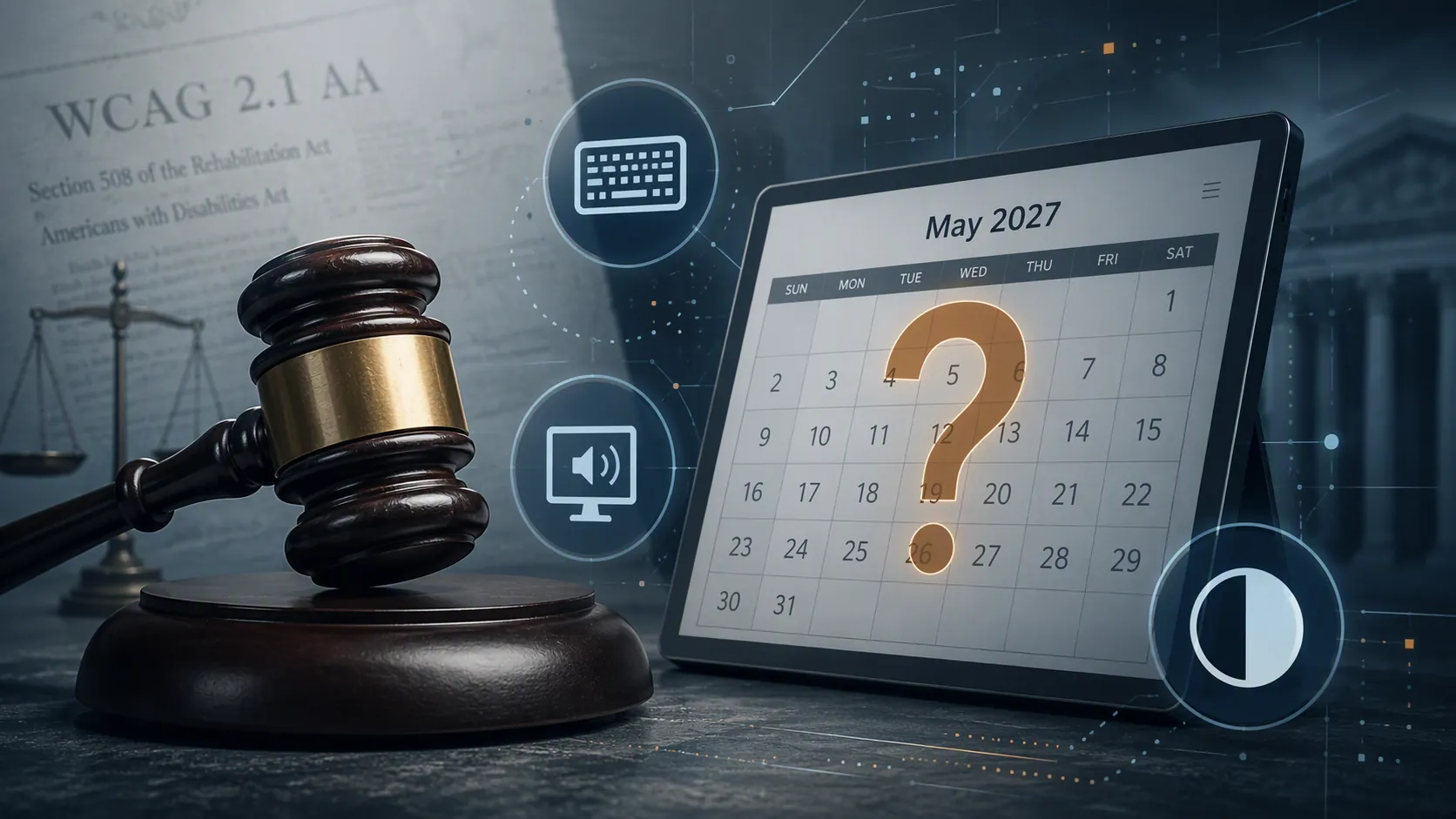
The Compliance Calendar Is Moving, Not the Standard
HHS issued its Section 504 digital-accessibility final rule in May 2024. The rule requires covered recipients of federal financial assistance to make web content, mobile apps, and certain digital tools conform to WCAG 2.1 AA.[1] In May 2026, HHS extended the compliance deadline through an interim final rule: entities with 15 or more employees now have until May 11, 2027, and smaller entities have until May 10, 2028.[1]
The detail worth underlining is the one that tends to disappear in management summaries: WCAG 2.1 AA remained the benchmark.[1] The extension changed time, not the expected accessibility outcome. A covered legal-aid organization, law school clinic, public defender office, court system, or federally funded legal-services program that uses a client portal still has to ask whether the portal can actually be used by disabled people. The answer cannot be supplied by an innovation slide.
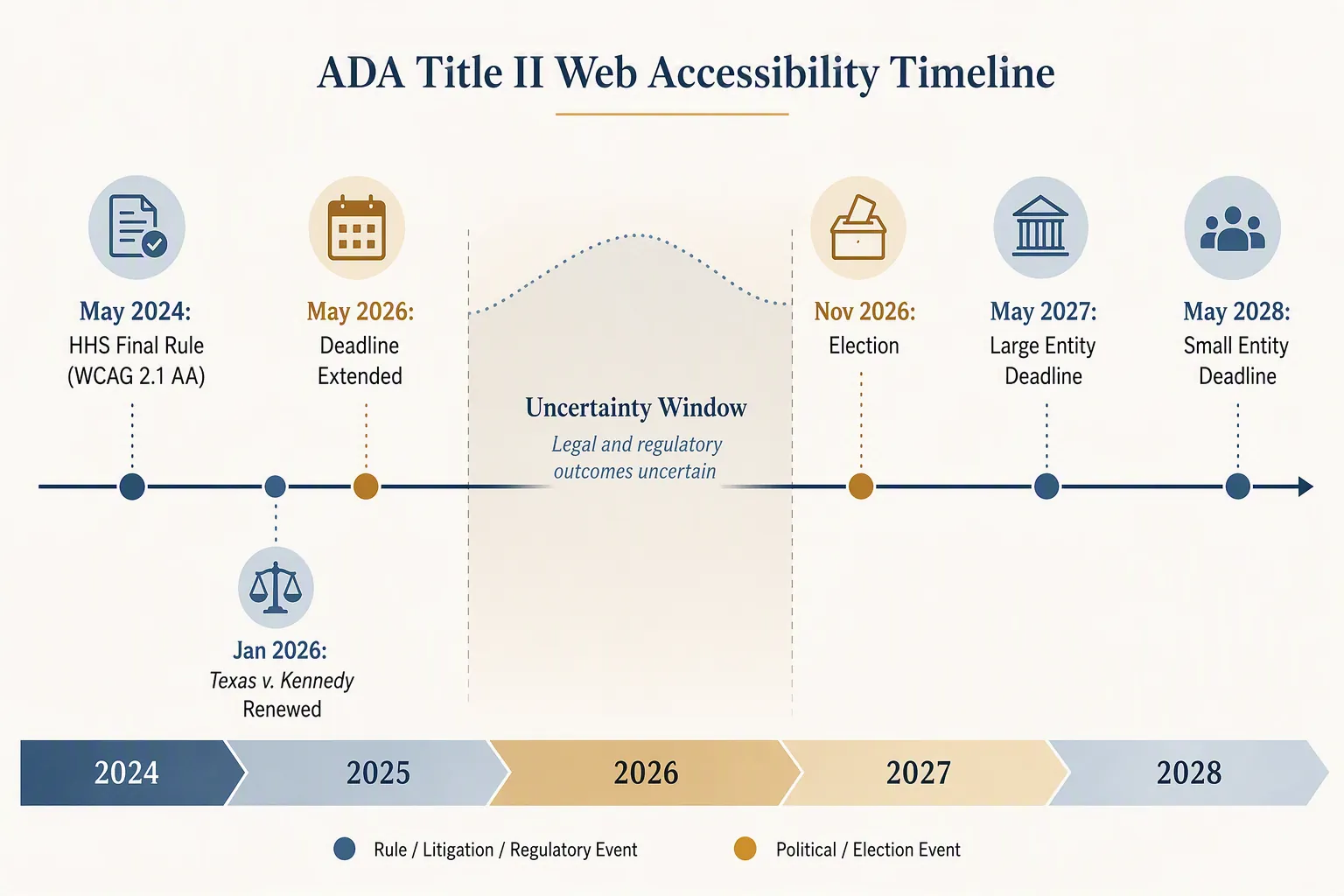
| Date | Event | Why it matters for legal AI and digital tools |
|---|---|---|
| May 2024 | HHS Section 504 final rule | Sets WCAG 2.1 AA as the accessibility target for covered web content, mobile apps, and digital tools. |
| January 23, 2026 | Texas v. Kennedy renewed challenge | Nine states continued a challenge to the HHS integration mandate and digital-accessibility requirements. |
| May 2026 | HHS deadline extension | Moves compliance dates to 2027 and 2028 without relaxing the WCAG 2.1 AA standard. |
| November 2026 | Senate election | May affect oversight, appropriations, nominations, and political pressure around disability enforcement. |
| May 11, 2027 | Large-entity deadline | Covered entities with 15 or more employees reach the extended compliance date. |
| May 10, 2028 | Small-entity deadline | Smaller covered entities reach the extended compliance date. |
Texas v. Kennedy Keeps the Rule Politically and Legally Unsettled
Texas v. Kennedy is not a footnote for legal entities that receive federal funds. On January 23, 2026, nine states — Texas, Alaska, Florida, Indiana, Kansas, Louisiana, Missouri, Montana, and South Dakota — renewed their challenge to HHS’s Section 504 rule, arguing that the integration mandate and digital-accessibility requirements exceed federal authority.[2] The suit creates genuine uncertainty about the rule’s final shape and enforcement path.
It does not create a clean operational answer of “wait.” A lawsuit can narrow a rule, delay enforcement, or change settlement leverage. It does not repair an inaccessible intake form, regenerate a tagged PDF, add labels to empty buttons, or make a chatbot’s output usable with assistive technology. Those failures remain visible to clients, opposing counsel, advocacy groups, and private plaintiffs under other disability-law theories.
For risk managers, the better reading is that 2026 and early 2027 are an uncertainty window. It is the right time to inventory systems, test workflows, and negotiate vendor remediation while there is still room to prioritize. It is a poor time to discover, after a demand letter, that the firm’s AI document generator produces court forms that a blind user cannot review or correct.
Which Legal Entities Should Be Reading Section 504 Closely
Section 504 exposure turns on federal financial assistance. That means the rule lands most directly on legal-aid organizations, federally funded public-defense or access-to-justice programs, law schools and clinics, court systems, Medicaid-reimbursed practices, and any legal entity whose programs or activities fit the funding condition. It is not precise to say that every law firm is covered by the HHS Section 504 rule merely because it has a website or buys AI tools.
That distinction matters in both directions. A private firm with no relevant federal financial assistance should not be analyzed as if HHS funding jurisdiction automatically applies. A legal-services organization that does receive federal support should not hide behind the word “firm” and treat digital accessibility as a general brand-risk issue. For covered entities, the obligation is tied to how disabled people access programs and services through digital systems.
The hardest files are often mixed. A large organization may run federally supported clinics, grant-funded intake projects, public-facing referral tools, and separately funded legal practices on shared technology. Procurement teams then need a system map, not a slogan. Which portal serves which program? Which vendor hosts the form? Which PDF generator creates the client-facing output? Which chatbot or triage tool changes the user’s route through services? Those questions decide where the audit starts.
What WCAG 2.1 AA Means When the Tool Is AI-Assisted
“AI tool” is too vague to be useful in a compliance file. The surfaces that matter are concrete: a website intake form, a mobile app, a guided interview, a filing portal, a chatbot, a document-assembly workflow, a PDF output, a client dashboard, a scheduling tool, or an automated eligibility screener. If a disabled user has to pass through it to receive legal help, file something, review advice, or correct information, the accessibility of that surface is not secondary.
WCAG 2.1 AA is not an AI ethics label. It is a testable web-accessibility standard. In legal workflows, the failures usually appear in ordinary places: fields without programmatic labels, buttons that cannot be reached by keyboard, error messages that are conveyed only by color, uploaded documents with no usable text layer, modal windows that trap focus, generated PDFs without tags, visual-only progress indicators, and chat interfaces that announce new content poorly or not at all.
AI can make the remediation burden worse because it expands volume. A human staff member may have once prepared ten letters and corrected accessibility problems by hand when asked. An automated system may generate hundreds of notices, pleadings, summaries, or eligibility letters before anyone checks whether the outputs are navigable. Throughput is not a defense if the throughput produces inaccessible services faster.
A useful audit follows the user’s path rather than the vendor’s feature list. Start where a disabled client or pro se user starts: Can the person reach the tool by keyboard? Can a screen reader identify the form fields? Does the chatbot disclose choices in a usable order? Can the user review and edit generated answers? Does the final document preserve headings, reading order, alt text where needed, and fillable-field labels? If an error occurs, does the system tell the user how to fix it without relying on sight, hearing, or precise mouse control?
Vendor paperwork should be evidence, not decoration
The procurement file should contain more than an accessibility promise in a sales deck. Ask for a current VPAT or equivalent accessibility conformance report, the testing date, the tested version, known exceptions, remediation timelines, and whether testing included assistive technology and keyboard-only use. If the vendor’s AI module creates documents, require the same level of evidence for the generated output, not just the web interface that launches it.
Legacy systems make this harder. Some court integrations, payment processors, case-management tools, and PDF engines were never designed around modern accessibility testing. That friction is real. It is also exactly why the deadline extension should be used to rank systems by user impact and funding exposure, rather than waiting until every vendor contract is convenient to reopen.
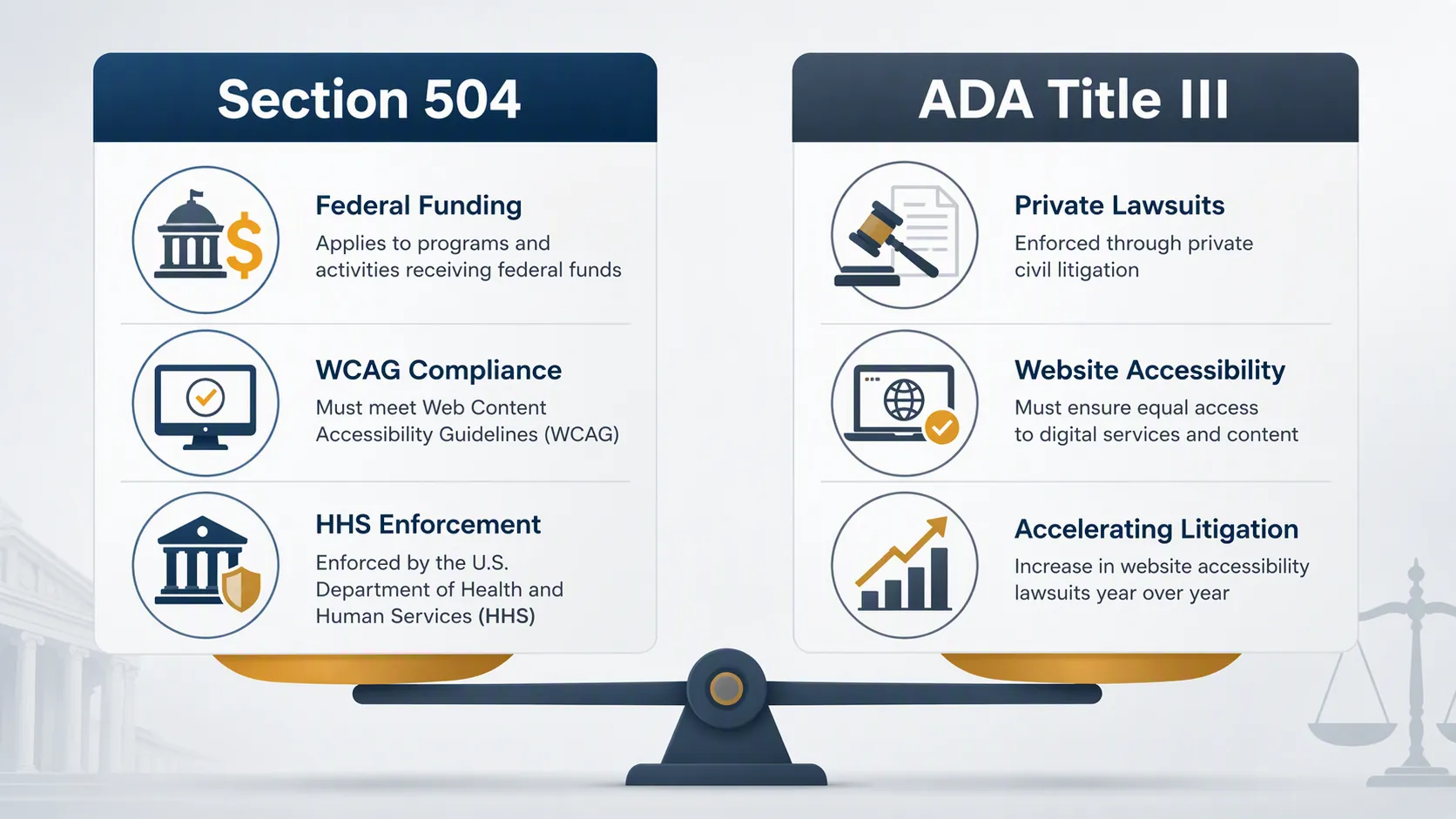
Section 504 and ADA Title III Create Different Pressure Systems
Section 504 and ADA Title III should not be collapsed into one generic “ADA website compliance” bucket. Section 504, in this context, is tied to federal financial assistance and HHS enforcement authority. ADA Title III private litigation moves through a different channel and can affect businesses and public accommodations regardless of HHS’s Section 504 deadline.
Industry trackers reported 8,667 federal ADA Title III lawsuits in 2025, with more than 5,000 targeting digital properties and a 37% year-over-year increase in web-accessibility filings; the same reporting put the average settlement around $30,000.[3] Those are not official court-administration counts, and different tracking methods can produce different totals. They are still useful pressure indicators for anyone hoping that digital-accessibility disputes are too rare to budget for.
The pattern of technical failures is also stubbornly mundane. The 2025 WebAIM Million findings, as summarized in the same industry reporting, found that 94.8% of websites failed basic WCAG checks and that six categories — low-contrast text, missing alt text, missing form labels, empty links, empty buttons, and missing document language — accounted for 96% of detected failures.[3] These are not exotic machine-learning edge cases. They are the kinds of defects that block people at the first screen.
Repeat-defendant risk makes the economics worse. Industry reporting attributed 45% to 46% of 2025 federal digital-accessibility lawsuits to repeat defendants that had been sued before and had not fixed their code.[3] That is a blunt lesson for legal organizations: resolving one complaint without remediating the underlying system can leave the next plaintiff a cleaner story.
AI is also changing plaintiff-side capacity. Accessible.org reported that 40% of federal ADA Title III filings in 2025 came from pro se plaintiffs, citing the use of AI tools that scan websites for WCAG violations.[4] That figure should not be read as proof that every scan produces a meritorious case. It does suggest that obvious defects are becoming cheaper to find, package, and file.
Where Josh Turek’s Senate Campaign Fits
Josh Turek’s campaign matters here as an enforcement variable, not as the source of the rule. His platform says he would “stop the federal lawsuit to gut Section 504” and “protect and defend the Americans with Disabilities Act.”[5] For disability-rights advocates and regulated entities watching Section 504, that is a clear campaign position against the litigation posture represented by Texas v. Kennedy.
The race is live enough to belong in a risk note, but it should not swallow the legal analysis. The Hill reported that a Fox News poll conducted June 23-27, 2026 showed Turek leading Ashley Hinson 50% to 46%, while the Cook Political Report had shifted the Iowa Senate race from “Likely Republican” to “Lean Republican” on June 3, 2026.[6] Turek had won the Democratic primary on June 2, 2026, defeating state Sen. Zach Wahls.[7]
Even if Turek wins in November 2026, he would not personally decide Texas v. Kennedy or direct HHS enforcement. The effect would be mediated through Senate control, committee oversight, appropriations, nominations, confirmation leverage, and the political cost of retreating from disability enforcement. If he loses, that also would not automatically erase the HHS rule or terminate ADA Title III private litigation.
That is the right scale for the campaign’s significance. It can affect the environment in which Section 504 is defended, funded, criticized, narrowed, or enforced. It cannot turn an inaccessible client workflow into a compliant one.
How to Use the Uncertainty Window
The organizations with the most reason to move now are not necessarily the ones with the largest websites. They are the ones where disabled users must rely on digital systems to obtain legal help, file documents, communicate with counsel, or receive generated legal materials. A beautiful public homepage is less important than the eligibility screener that rejects keyboard navigation or the AI-assisted form that produces an unreadable PDF.
- Inventory AI-assisted and digital systems: websites, intake portals, chatbots, filing tools, document generators, client dashboards, mobile apps, scheduling tools, payment flows, and PDF outputs.
- Map funding exposure: identify which programs, clinics, offices, or workflows are tied to federal financial assistance and therefore need Section 504 analysis.
- Test against WCAG 2.1 AA: include keyboard-only navigation, screen-reader use, color contrast, form labels, error handling, focus order, document structure, and generated-output accessibility.
- Document vendor representations: keep current accessibility conformance reports, known defects, remediation commitments, indemnity language, and escalation contacts.
- Prioritize user-blocking defects: fix barriers that prevent intake, filing, review, correction, signature, payment, or receipt of legal documents before lower-impact presentation issues.
- Preserve remediation records: track what was tested, what failed, who accepted the risk, what was fixed, and what remains scheduled.
A covered entity does not need to solve every procurement problem at once to improve its posture. It does need to know which systems disabled users depend on and which defects block access. The worst record is not usually “we found problems and are fixing them.” It is “we bought the tool, never tested the workflow, and left the disabled user or front-line staff to discover the barrier after launch.”
The HHS deadline extension may eventually look prudent, unnecessary, or overtaken by litigation. The Senate race may increase pressure to defend Section 504, or the broader political environment may move toward regulatory retreat. None of those possibilities makes the current risk low. They make the paper trail more important.
References
- HHS Office for Civil Rights extends compliance deadline for digital accessibility final rule to May 2027, ADA News, May 2026.
- Texas and Eight Other States Renew Attack on Section 504 and the Right of Disabled People to Live in Their Communities, DREDF.
- ADA Lawsuit Statistics, WCAGsafe.
- 2026 ADA Website Compliance Lawsuits & AI, Accessible.org.
- Platform, Turek for Iowa.
- Fox News poll shows Democrat Josh Turek with narrow lead over Republican Ashley Hinson in Iowa Senate race, The Hill.
- Josh Turek, Wikipedia.
Related records
Tool profile
How Meta's AI Spending Reshapes Law Firm ProfitabilityGoverning regulation
Browse the obligations tracker →Preventive workflow
Browse verification workflows →
Report a correction or tip
Spotted an outdated figure, a misstated fact, or a ruling this case record should reflect? Public comments are disabled for this content given the professional cost of a misreported case outcome, penalty amount, or rule text — use the structured correction channel instead.
Report a correction or tip for this record →