
How the Hernández pardon nullified a 45-year drug conviction
A documented record of the Trump pardon of former Honduran President Juan Orlando Hernández, who was convicted in SDNY of drug trafficking conspiracy involving 400+ tons of cocaine. The entry covers the conviction, pardon timeline, investigation origin, appellate disposition, and congressional response, sourced to primary court orders and official statements.
- Jurisdiction
- US Federal - SDNY
- Court
- U.S. District Court for the Southern District of New York
- Judge
- P. Kevin Castel
- AI tool named
- No AI tool implicated
- Ruling date
- Dec 1, 2025
- Source document
- View primary court order ↗
- Last verified
- Jul 27, 2026
Lex Machina Review is an independent risk-tracking and reference resource. Nothing on this site is legal advice, and using it does not create an attorney-client relationship. Every record is reviewed against primary sources but may not reflect the most current status of a matter — always verify directly against the cited court order, rule text, or a licensed attorney before relying on it.
Companion explanation — secondary to the source document above
The appeal disappeared before the merits did
The cleanest docket entry in the Juan Orlando Hernández case record is not the pardon announcement. It is the April 2026 appellate end point: the Second Circuit dismissed Hernández’s pending appeal as moot after President Donald Trump granted him a full pardon. Reuters has reported the dismissal as a mootness disposition, not as an appellate ruling that the government’s proof was insufficient or that the trial was legally defective. On the materials reviewed here, no appellate court reached the merits of the conviction before the pardon took operative effect. [1]
That distinction is the reason this case matters beyond one former head of state. The pardon did not expose a weak conviction after appellate testing. It cut off the process before that testing occurred. What remained in the public record was a federal jury verdict, a 45-year sentence, a full presidential pardon, immediate release, and a dismissed appeal.
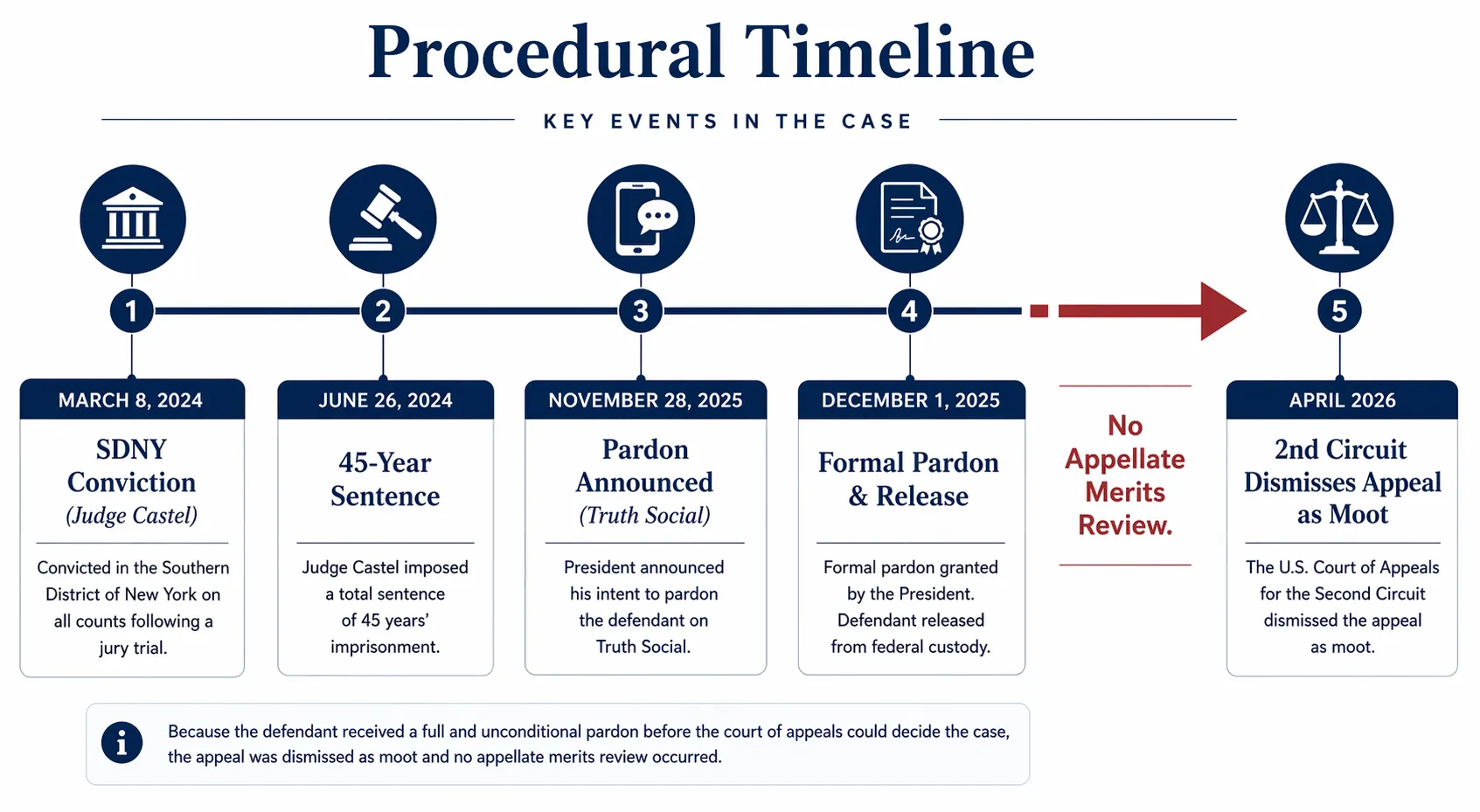
| Date | Procedural event | Legal significance |
|---|---|---|
| March 8, 2024 | Federal jury in SDNY convicted Juan Orlando Hernández before Judge P. Kevin Castel. [2] | The conviction rested on a trial record, not a plea or unresolved indictment. |
| June 26, 2024 | Judge Castel sentenced Hernández to 45 years in prison. [2] | The sentence made the federal conviction operational while appeal remained available. |
| November 28, 2025 | Trump announced on Truth Social that he would pardon Hernández. [3] | The political decision preceded the formal clemency instrument. |
| December 1, 2025 | The pardon was formalized and Hernández was released from USP Hazelton the same day. [3][4] | The conviction’s operative federal consequences were displaced before appellate merits review. |
| April 2026 | The Second Circuit dismissed the pending appeal as moot. [1] | The appellate court did not decide whether the trial evidence was sufficient. |
What the pardon displaced
Hernández was not pardoned out of an untested allegation. On March 8, 2024, a federal jury in the Southern District of New York convicted the former Honduran president after a trial before U.S. District Judge P. Kevin Castel. On June 26, 2024, Castel sentenced him to 45 years in prison. The charges and proof described a drug-trafficking conspiracy involving more than 400 tons of cocaine headed toward the United States, along with machine-gun counts tied to the trafficking operation. [2]
The government’s theory was not merely that traffickers operated during Hernández’s presidency. Prosecutors alleged that Hernández accepted bribes and used political power, law enforcement, and military protection to shield trafficking routes. The trial record included evidence of a $1 million bribe allegation tied to Joaquín “El Chapo” Guzmán and the Sinaloa Cartel, testimony from multiple cooperating witnesses, and ledger evidence used to corroborate parts of the government’s case. [2][3]
The family context also mattered at trial. Hernández’s brother, Tony Hernández, had already been sentenced to life in prison in the United States for drug trafficking. That prior conviction did not prove Juan Orlando Hernández’s guilt by itself, but it supplied co-conspirator context for the government’s account of how Honduran political protection and narcotics trafficking overlapped. [2][3]
A pardon can eliminate the federal consequences of a conviction without declaring the conviction factually wrong. That is the cold procedural point. The evidentiary density of the Hernández verdict and the legal fragility of its post-pardon status now sit in the same record.
The record was built through witnesses, ledgers, and prior prosecutions
The available reports do not support treating the prosecution as a bare accusation later rescued from scrutiny. The case involved a federal jury, a three-week trial, cooperating witnesses, documentary corroboration, and a sentencing judge who imposed a decades-long prison term. The more than 400-ton cocaine figure is not a rhetorical flourish in the post-pardon debate; it was part of the conviction record as reported from the SDNY proceeding. [2][3]
None of that makes a pardon legally unavailable. It does make the public justification for the pardon more important. If the executive branch chooses to override a conviction of this scale, the question is not whether the Constitution permits clemency in general. The narrower question is what factual basis the executive offers for treating this particular verdict as unjust.
The pardon sequence and the White House defense
Trump announced on November 28, 2025, through Truth Social, that he would pardon Hernández. The formal pardon followed on December 1, 2025, and Hernández was released from USP Hazelton that same day. [3][4]
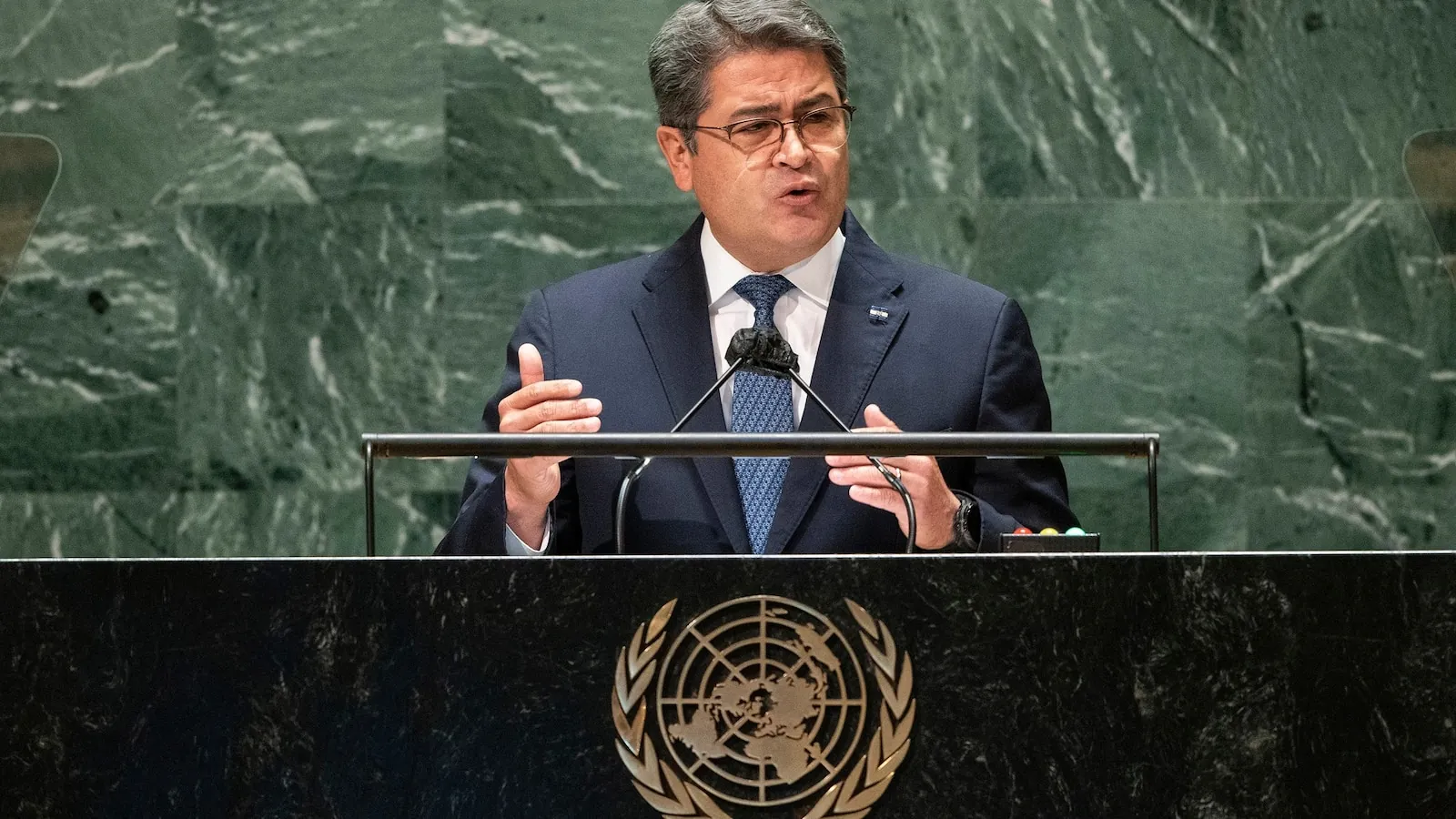
At a December 1, 2025 press briefing, White House press secretary Karoline Leavitt defended the pardon by describing Hernández as a victim of “Biden administration over-prosecution.” Politico reported that the White House did not provide factual evidence supporting that characterization. [5]
The investigation-origin point requires care because it is easy to overstate. The reviewed materials trace the investigation back to 2015, which is before the Biden administration. That timing does not answer every question about later charging decisions, trial strategy, or sentencing advocacy. It does, however, make the White House’s Biden-era framing unsupported as an explanation for the case’s origin. [3][5]
A public defense of clemency does not need to mimic an appellate brief. But when it contradicts or ignores the procedural history of the case, the gap is not cosmetic. It becomes part of the institutional record that prosecutors, judges, foreign partners, and future defendants will read back into the pardon.
What no appellate court reviewed
The Second Circuit’s April 2026 disposition is the hinge. Hernández had a pending appeal. After the full pardon, that appeal was dismissed as moot. The appellate docket therefore did not produce a merits ruling on whether the evidence was sufficient, whether the jury instructions were proper, whether evidentiary rulings were reversible, or whether any sentencing error required correction. [1]
That is not the same as saying the conviction was immune from appellate challenge. It is also not the same as saying the pardon was legally invalid. It means the public record now contains a federal trial verdict and sentence on one side, and a full executive pardon on the other, with no appellate merits bridge between them.
The full Second Circuit order was not among the primary materials reviewed for this record. The characterization used here therefore stays within the available reporting: dismissal as moot after pardon, with no identified appellate decision on evidentiary sufficiency. If the order contains reasoning not reflected in the reviewed reporting, that would matter to any later case note.
Congressional reaction was a risk signal, not just a partisan footnote
The congressional response is relevant because it treated the pardon as an institutional problem, not merely a campaign talking point. Senator Peter Welch announced S.Res. 530 condemning the pardon, with 12 Democratic co-sponsors. The available materials also identify H.Res. 929, sponsored by Representative Joaquin Castro with 12 original co-sponsors, as the House-side condemnation vehicle. The record reviewed here supports introduction and condemnation; it does not support stating that either resolution was finally adopted. [6][3]
The criticism was not confined to Democrats. Senators Bill Cassidy, Thom Tillis, and Maria Elvira Salazar, all Republicans, publicly criticized the pardon. Their objections do not change the legal effect of the clemency grant, but they do show that the concern crossed ordinary party lines in at least some corners of Congress. [3][5]
For lawyers tracking the durability of international narcotics convictions, that is the useful point. Congressional condemnation cannot revive a mooted appeal. It can, however, mark the pardon as a precedent risk: a documented instance in which a major cross-border drug conviction was politically nullified after sentencing and before appellate review.
Post-pardon administration belongs in the record, but not at its center
ProPublica later reported that Hernández received special treatment after the pardon, including details involving conditions and handling at USP Hazelton, transport logistics connected to the Waldorf Astoria, and removal of an ICE detainer at 11 p.m. on December 1. ProPublica attributed parts of its account to government records and anonymous sources. [7]
Those details are relevant to how the pardon was administered. They are not the legal mechanism that erased the federal conviction’s operative consequences. The mechanism was the pardon itself, followed by release and the mootness dismissal of the pending appeal.
Honduras remains outside the U.S. pardon
The U.S. pardon does not dispose of Honduran legal exposure. Reuters reported on July 22, 2026, that Hernández was returning to Honduras to seek dismissal of local charges. Those Honduran proceedings are separate from the federal conviction pardoned by Trump. [1]
That dual-sovereignty point prevents the pardon from being overstated. Trump’s clemency could nullify the federal consequences of the SDNY conviction. It could not, by itself, terminate Honduran proceedings, dismiss Honduran charges, or bind Honduran courts.
The risk signal in the docket sequence
The Hernández sequence is unusually stark: a federal jury conviction in SDNY; a 45-year sentence; evidence involving more than 400 tons of cocaine, machine guns, alleged bribes, cooperators, ledgers, and co-conspirator context; a presidential announcement; a formal full pardon; same-day release; a mooted appeal; congressional condemnation; and unresolved foreign exposure. [1][2][3][4][6]
The case does not prove that future presidents will pardon similarly situated defendants. It proves something narrower and already complete: in this instance, executive clemency overrode a major international narcotics conviction before appellate merits review, leaving a concrete example of how even a heavily documented federal conviction can be politically nullified.
References
- “Pardoned by Trump, Hernandez to return to Honduras and seek dismissal of local charges,” Reuters, July 22, 2026
- “Former Honduras President Juan Orlando Hernández sentenced to 45 years,” AP News
- “Examining Trump’s Pardon of Former Honduran President Convicted of Trafficking Drugs to U.S.,” FactCheck.org
- “Former Honduras President Juan Orlando Hernández freed after Trump pardon,” AP News
- “White House defends pardon of ex-Honduran president convicted of drug trafficking,” Politico
- “Welch Leads Resolution Condemning Trump’s Pardon of Ex-Honduran President and Drug Kingpin Juan Orlando Hernández,” Senator Peter Welch
- “Ex-Honduran President Hernández Given Special Treatment After Trump Pardon,” ProPublica
Related records
Tool profile
How Meta's AI Spending Reshapes Law Firm ProfitabilityGoverning regulation
Browse the obligations tracker →Preventive workflow
Browse verification workflows →
Report a correction or tip
Spotted an outdated figure, a misstated fact, or a ruling this case record should reflect? Public comments are disabled for this content given the professional cost of a misreported case outcome, penalty amount, or rule text — use the structured correction channel instead.
Report a correction or tip for this record →